Last October, a nurse practitioner named Brian in Fort Worth told me something that stuck. He'd been prescribing sermorelin for three years, liked it fine, and then switched a handful of patients over to CJC-1295 (no-DAC) paired with ipamorelin. "Within six weeks," he said, "two guys who'd plateaued on sermorelin were sleeping deeper and dropping belt notches again. One came back with an IGF-1 that finally crept into the upper quartile for the first time in 14 months." His takeaway: same pathway, better staying power per pulse. "I still start conservative patients on sermorelin," Brian added, "but the CJC combo is my go-to now."
That anecdote captures where compounding-pharmacy GH-axis therapy sits in 2026. CJC-1295 is a synthetic 30-amino-acid analog of growth-hormone-releasing hormone (GHRH), and it comes in two forms that behave so differently they're practically separate drugs. The no-DAC version (also called mod-GRF 1-29) has a half-life around 30 minutes and preserves pulsatile GH release. The DAC version, which includes a Drug Affinity Complex that covalently binds circulating albumin, stretches that half-life to roughly 8 days. Neither is FDA-approved. Both are prepared by licensed 503A compounding pharmacies as prescriptions for individual patients.
The no-DAC form combined with ipamorelin is the standard GH-axis stack in modern compounding practice. Typical dosing: 100 to 300 micrograms of no-DAC, one to three times daily. For the DAC version, 1 to 2 milligrams once weekly.
This guide covers what CJC-1295 actually is at the molecular level, why the DAC distinction matters more than most people realize, dosing protocols, side effects, lab monitoring, how it compares to sermorelin and tesamorelin, and cost.
The Molecule, Briefly
CJC-1295 starts with the same active 29-amino-acid fragment as sermorelin: GHRH(1-29). Four amino acid substitutions (D-Ala2, Gln8, Ala15, Leu27) protect the peptide from the enzymes that chew up native GHRH in seconds. That modified backbone is the no-DAC form. It lasts longer than sermorelin in circulation (about 30 minutes versus sermorelin's 10 to 20 minutes) but still clears fast enough to produce a discrete pulse.
The DAC version takes that same backbone and tacks on a maleimidopropionic acid linker. Once injected, the linker grabs onto albumin in the bloodstream. Albumin has a half-life of roughly three weeks, and the peptide essentially hitchhikes. Result: the same base GHRH analog now sticks around for about 8 days instead of 30 minutes.
This is the point that gets lost in 90% of online discussions. People say "CJC-1295" without specifying which version, and they might as well be comparing a cup of espresso to a caffeine IV drip. Same active ingredient, wildly different kinetics.
Why the DAC vs No-DAC Distinction Actually Matters
Here's the thing: these two forms aren't interchangeable protocol tweaks. They produce fundamentally different hormonal patterns.
No-DAC (mod-GRF 1-29) fires a short GHRH pulse, triggers a GH spike, and clears. Your pituitary still experiences the normal peaks and troughs that healthy GH physiology depends on. This is why it pairs so well with ipamorelin (which also has a short half-life, about 2 hours). You inject both together, get a coordinated burst, and your body returns to baseline. Dose: 100 to 200 mcg of CJC plus 200 to 300 mcg of ipamorelin, typically twice daily (morning and bedtime).
DAC produces sustained GHRH receptor activation for days. GH release becomes more continuous, less pulsatile. IGF-1 climbs higher on average. Once-weekly dosing is convenient. But the tradeoff is real: more fluid retention, more joint stiffness, and a higher likelihood of pushing IGF-1 above the reference range. For patients who haven't responded to the no-DAC stack, or who genuinely can't manage daily injections, DAC has a place. Standard dosing: 1 to 2 mg subcutaneous once weekly.
The clinical reality in 2026: most prescribers reach for no-DAC plus ipamorelin first. DAC is the second-line option or the convenience play for patients who need simplicity.
Read the full CJC-1295 DAC vs no-DAC explained guide.
One more thing. When you see "CJC-1295" on a forum or supplement site without specifying DAC or no-DAC, the writer often doesn't know which form they're talking about. Always verify before you assume anything about dosing, frequency, or expected effects.
How It Works at the Pituitary
Both forms bind the GHRH receptor on anterior pituitary somatotroph cells, triggering cAMP-mediated signaling and GH release. Same mechanism as sermorelin. Same mechanism as tesamorelin. The only variable is how long the receptor stays activated, which is entirely a function of how long the peptide circulates.
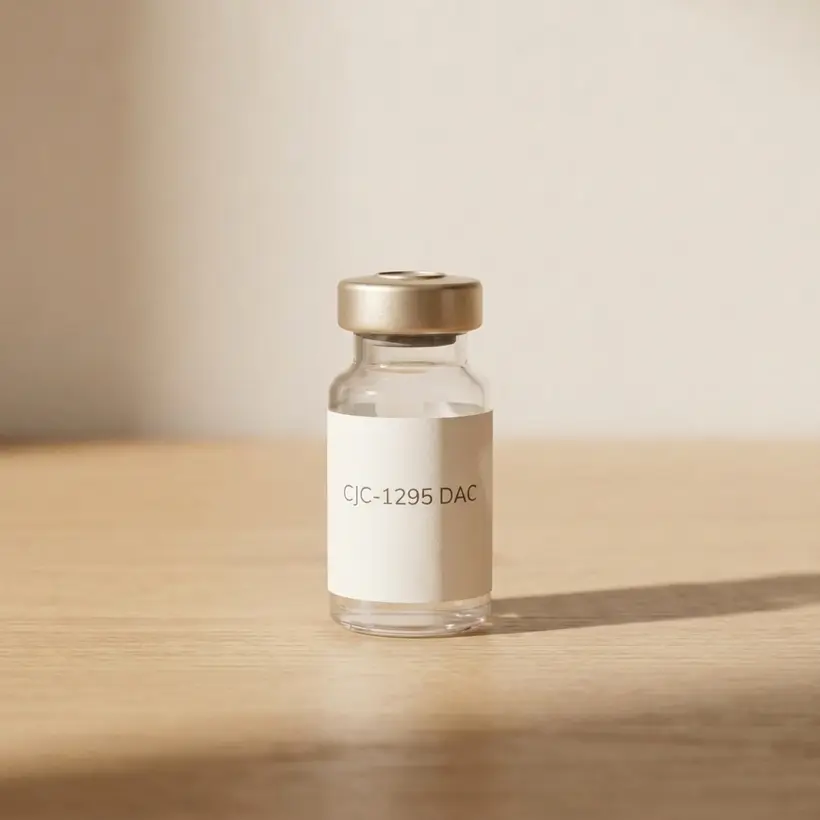
From the FormBlends catalog
CJC-1295 DAC
Long-acting GHRH analog with Drug Affinity Complex for sustained GH elevation · From $42/mo · compounded by a licensed 503A pharmacy, dispensed only after provider review.
Learn about CJC-1295 DAC →The Teichman SL et al. 2006 phase 1 study, published in the Journal of Clinical Endocrinology and Metabolism, characterized the pharmacokinetics of the DAC form and demonstrated sustained IGF-1 elevation following weekly dosing. It remains the most-cited human study of CJC-1295 in the published literature. The data confirmed what the chemistry predicted: albumin-bound CJC-1295 produces a smooth, prolonged IGF-1 curve rather than discrete spikes.
Think of it like watering a garden. No-DAC is a sprinkler that runs twice a day. DAC is a slow-drip irrigation line that never really shuts off. Both get water to the plants. The pattern of delivery changes what happens to the soil.
The CJC-1295 / Ipamorelin Stack (and Why It Became Standard)
The no-DAC plus ipamorelin combination didn't become the default GH-axis stack by accident. The logic is pharmacologically clean.
Two parallel signaling routes. GH release from the pituitary depends on two inputs: GHRH (the primary "go" signal) and the ghrelin/GHRP pathway (which amplifies the response and suppresses somatostatin, the "stop" signal). Hit both at once and you get a GH pulse substantially larger than either peptide produces alone.
Matched kinetics. Both peptides clear quickly. You get a coordinated burst, not a mismatched signal where one pathway is still firing while the other has already shut down.
Ipamorelin's selectivity. Older growth-hormone-releasing peptides like GHRP-6 and GHRP-2 elevated cortisol, prolactin, and ACTH. Ipamorelin doesn't, at least not meaningfully. The combined stack avoids off-target hormonal noise.
One injection. Both peptides can be co-compounded in a single vial. No mixing two syringes.
The standard protocol that most prescribers have settled on:
- CJC-1295 (no-DAC): 100 to 200 mcg per dose
- Ipamorelin: 200 to 300 mcg per dose
- Combined in one subcutaneous injection
- Once to three times daily; most commonly twice (morning or pre-workout, plus bedtime)
Read the full CJC-1295 / ipamorelin stack protocol guide.
Dosing Protocols in Detail
No-DAC standalone (less common): 100 to 300 mcg subcutaneous per dose, one to three times daily. Bedtime dose is the minimum; a morning or post-workout dose is often added.
No-DAC plus ipamorelin (the workhorse protocol): CJC-1295 100 to 200 mcg plus ipamorelin 200 to 300 mcg per combined injection. One to three times daily. Bedtime is non-negotiable for most prescribers; the morning or post-workout dose is the variable.
DAC standalone: 1 to 2 mg subcutaneous once weekly. Some protocols call for 2 mg twice weekly when a more aggressive sustained effect is the goal. Most prescribers start at 1 mg weekly and titrate up after confirming tolerability.
Injection sites. Subcutaneous in abdominal fat, anterior thigh, or upper outer arm. Rotate.
Cycling. The no-DAC plus ipamorelin stack is typically run continuously for 12 to 24 weeks before reassessment, though some prescribers prefer a 5-days-on, 2-days-off rhythm. DAC is usually continuous weekly for 12 to 24 weeks.
Lab monitoring. Baseline IGF-1, fasting glucose, lipid panel. Repeat IGF-1 at 8 to 12 weeks. The target is IGF-1 in the upper half of the age-adjusted reference range, not above the upper limit. This matters more with the DAC form, which has a higher tendency to overshoot.
Your prescriber determines your specific protocol. These are the common clinical patterns.
Side Effects and What to Watch For
Common (most patients experience at least one):
- Injection-site redness, warmth, mild itching
- Headache, especially during the first week or two
- Brief flushing immediately after injection
- Vivid dreams (many patients actually like this one)
- Water retention, more pronounced with the DAC form
Less common:
- Joint stiffness or aching (again, more frequent with DAC)
- Persistent edema that doesn't resolve between doses
- IGF-1 above reference range on follow-up labs (dose reduction required; DAC is the usual culprit)
- Mild dizziness
- Numbness or tingling in the hands, carpal-tunnel-style, from fluid retention
Rare:
- Significant allergic reaction
- Worsening insulin sensitivity (primarily a DAC concern with sustained GH elevation)
The boring truth about DAC side effects is that they're mostly consequences of the sustained pharmacokinetic profile. Higher average GH means more fluid retention, more IGF-1 overshoot risk, more joint complaints. This is exactly why the no-DAC form dominates in everyday practice.
What to Expect and When
For the no-DAC plus ipamorelin stack:
Weeks 1 to 2. Sleep gets noticeably deeper. Dreams become cinematic. Some patients report mild headache or flushing that fades.
Weeks 3 to 6. Recovery improvement consolidates. Active patients (especially those training hard) may notice early body composition shifts.
Weeks 8 to 12. This is the assessment window. Repeat IGF-1 labs. Measurable body comp changes for responders. Sleep and recovery benefits are well established by now.
Weeks 12 to 26. Sustained benefit plateau. Most prescribers reassess at 12 weeks.
For DAC standalone, the timeline compresses slightly at the front end (IGF-1 rises faster with continuous activation) but fluid retention and joint stiffness can appear early too. Full assessment at 12 weeks.
How CJC-1295 Stacks Up Against Sermorelin and Tesamorelin
All three are GHRH analogs. They hit the same receptor. The differences are potency, duration, clinical evidence, and price.
Sermorelin. The original. GHRH(1-29), unmodified. Half-life 10 to 20 minutes. Most "natural" pulsatile pattern. FDA-approved as Geref in 1990, discontinued in the U.S. in 2008. Lowest cost. Lowest potency per dose. Still a solid conservative option.
CJC-1295 (no-DAC). Modified GHRH(1-29) with stability substitutions but no albumin binding. Half-life around 30 minutes. Preserves pulsatility. Higher potency than sermorelin per dose. The standard ipamorelin partner.
CJC-1295 (DAC). Everything above, plus albumin binding. Half-life roughly 8 days. Loses pulsatility. Once-weekly dosing. Higher cumulative IGF-1 elevation. More side effects.
Tesamorelin. Stabilized full-length GHRH (44 amino acids) with an N-terminal hexenoic acid modification. Most potent of the group at typical doses. FDA-approved as Egrifta for HIV-associated lipodystrophy. Published RCT evidence for visceral fat reduction (Falutz 2007, 2008). Off-label compounded use for visceral fat. Highest cost.
My honest read on how to think about it:
- Starting cautious or on a budget? Sermorelin.
- Want the standard 2026 GH-axis protocol? CJC-1295 (no-DAC) plus ipamorelin.
- Need once-weekly simplicity or didn't respond to the no-DAC stack? CJC-1295 (DAC).
- Visceral fat is the specific, primary target? Tesamorelin has the RCT data that CJC-1295 doesn't.
Read the full sermorelin vs CJC-1295 comparison.
Cost
Typical FormBlends cash pricing:
- CJC-1295 (no-DAC) 5 mg vial: $80 to $120
- CJC-1295 (no-DAC) plus ipamorelin combination vial, monthly supply: $140 to $220
- CJC-1295 (DAC) 2 mg vial (4 to 8 weekly doses): $120 to $180
- CJC-1295 (DAC) monthly supply: $160 to $260
Insurance does not typically cover compounded CJC-1295. HSA and FSA card payment is generally accepted.
Frequently Asked Questions
What is the difference between CJC-1295 and CJC-1295 DAC? The DAC version includes a Drug Affinity Complex that binds to albumin, extending the half-life to approximately 8 days. The no-DAC version has stability modifications but no albumin binding, with a half-life of about 30 minutes. They are dosed completely differently and produce different hormonal patterns.
Is CJC-1295 the same as mod-GRF 1-29? Yes. Mod-GRF 1-29 is another name for CJC-1295 without DAC. The terms are interchangeable.
Why do I usually see CJC-1295 paired with ipamorelin? The GHRH pathway (CJC-1295) and the ghrelin/GHRP pathway (ipamorelin) are synergistic. Combining a GHRH analog with a GHRP produces a larger GH release than either alone. The no-DAC form's short half-life coordinates with ipamorelin's short half-life to produce discrete, coordinated pulses.
Can I take CJC-1295 (DAC) with ipamorelin? Some prescribers use this combination, but it's less common. The DAC form's sustained activation doesn't coordinate with ipamorelin's short pulse in the same synergistic way. Most practitioners either use no-DAC plus ipamorelin or DAC alone.
How long until I see effects? Sleep changes typically within 1 to 2 weeks. Body composition changes measurable at 8 to 12 weeks. Full effects at 4 to 6 months.
Will CJC-1295 show up on a drug test? Yes. CJC-1295 and other GHRH analogs are on the WADA Prohibited List under category S2. If you compete in any sport subject to anti-doping testing, do not use CJC-1295.
Is CJC-1295 the same as growth hormone? No. CJC-1295 is the upstream signal that stimulates your pituitary to release your own growth hormone. Recombinant GH is exogenous hormone administered directly. Different mechanism, different regulatory status, different safety profile.
Can women take CJC-1295? Yes. The no-DAC plus ipamorelin stack is widely used in female patients. Pregnancy and breastfeeding are contraindications.
Do I need lab work? Yes. Baseline IGF-1 and fasting metabolic panel at minimum. Repeat IGF-1 at 8 to 12 weeks. More frequent monitoring with the DAC form because of the higher risk of IGF-1 over-elevation.
How does CJC-1295 compare to tesamorelin for visceral fat? Tesamorelin has published RCT evidence for visceral fat reduction (Falutz 2007, 2008). CJC-1295 has more limited published evidence on visceral fat specifically. If elevated visceral adiposity is your primary clinical target, tesamorelin is the better-supported choice. For general GH-axis support, CJC-1295 plus ipamorelin is more common and less expensive.
How to Get CJC-1295 Through FormBlends
- Complete the digital intake form
- Submit existing labs or have the prescriber order baseline IGF-1 and metabolic panel
- Book the telehealth consult
- Discuss whether no-DAC plus ipamorelin, DAC standalone, or another GH-axis protocol fits your goals
- If clinically appropriate, the prescription is written
- The compounded preparation ships from a licensed 503A/503B compounding pharmacy
- Follow-up at 4 and 8 weeks, repeat IGF-1 at 8 to 12 weeks
See the CJC-1295 / ipamorelin combination preparation.
See the CJC-1295 (DAC) standalone preparation.
Back to peptide therapy overview.
---
Disclaimer: Compounded CJC-1295 (both DAC and no-DAC forms) is not an FDA-approved drug. It is a prescription medication prepared by a licensed 503A compounding pharmacy for an individual patient based on a prescriber's clinical judgment. Research suggests potential benefits for GH-axis support in adults with age-related decline; individual results vary. CJC-1295 is contraindicated in pregnancy, breastfeeding, active malignancy, and severe untreated metabolic disease. Side effects can occur, including fluid retention and elevated IGF-1. Lab monitoring is required. Information on this page is for educational purposes and is not medical advice. Do not self-administer peptides obtained from unregulated sources.
---
Not FDA-approved. Compounded peptides are prepared by licensed 503A pharmacies for individual patients based on a prescriber's clinical judgment. FormBlends is not a medical practice. Individual results vary. Consult a licensed clinician before starting any peptide therapy.
Ready when you are
CJC-1295 DAC
Long-acting GHRH analog with Drug Affinity Complex for sustained GH elevation · From $42/mo · compounded by a licensed 503A pharmacy, dispensed only after provider review.
Learn about CJC-1295 DAC →