
Trust Signals
Key Takeaways
- CJC-1295 with DAC has a plasma half-life of approximately 6 to 8 days due to covalent albumin binding; the non-DAC form has a half-life of roughly 30 minutes, these are pharmacologically distinct compounds, not just name variants.
- The only published human RCT (Teichman 2006, n=64) showed a 200 to 300% IGF-1 increase at the 2 mg dose lasting up to 6 days; no long-term safety trial exists.
- HPLC purity should be 98% or higher on a lot-specific, third-party COA; mass spec must confirm correct MW (3367 Da without DAC, 3647 Da with DAC).
- CJC-1295 is prohibited by WADA under S2 and was restricted from compounding pharmacies by FDA in 2024, the legal landscape changed materially in the last two years.
- Research-grade pricing below roughly $25 per 2 mg vial for the DAC form is a reliable signal of underdosing or substituted peptide; use it as a quality filter before the COA.
What Is CJC-1295 and What Does It Actually Do?
CJC-1295 for sale exists in two chemically distinct versions and confusing them is the most common buyer mistake. CJC-1295 without DAC is a modified GHRH(1-29) analogue with four amino-acid substitutions that increase receptor binding affinity roughly 30-fold over native GHRH and extend plasma half-life from under 5 minutes (native) to approximately 30 minutes. CJC-1295 with DAC adds a Drug Affinity Complex, a maleimidopropionic acid linker on a modified lysine residue, that covalently bonds to serum albumin in vivo, extending half-life to approximately 6 to 8 days.
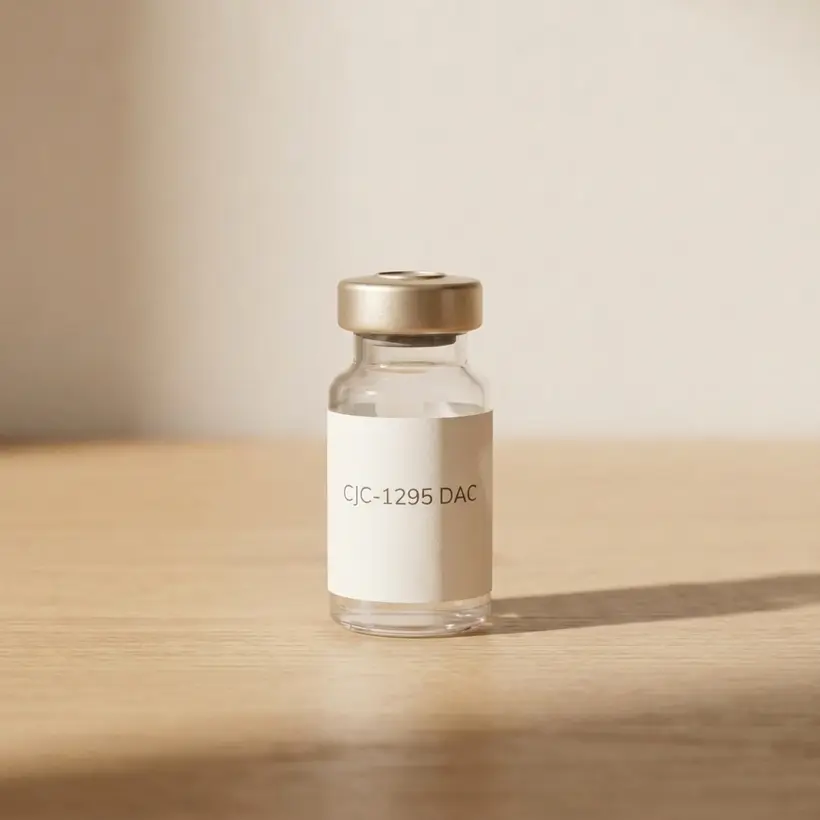
From the FormBlends catalog
CJC-1295 DAC
Long-acting GHRH analog with Drug Affinity Complex for sustained GH elevation · From $42/mo · compounded by a licensed 503A pharmacy, dispensed only after provider review.
Learn about CJC-1295 DAC →Both forms act on the GHRH receptor (GHRHR) expressed on pituitary somatotroph cells. Receptor activation triggers intracellular cAMP signaling, stimulating growth hormone (GH) synthesis and pulsatile release. Elevated GH in turn drives hepatic and peripheral IGF-1 production.
Table of Contents
- What Is CJC-1295 and What Does It Actually Do?
- Evidence Ledger: What the Research Actually Shows
- CJC-1295 With DAC vs Without DAC: Which Should You Buy?
- What Most Pages Get Wrong About CJC-1295
- Honest Head-to-Head: CJC-1295 vs Sermorelin vs Tesamorelin
- CJC-1295 Price Guide and What Prices Signal About Quality
- How to Read a CJC-1295 COA: Operational Label Literacy
- Dosing Tables and Reconstitution Math
- Storage, Stability, and the Chemistry Behind the Rules
- Legal Status, WADA, and the 2024 FDA Compounding Restriction
- Known Side Effects and Safety Evidence Gaps
- FAQ
Evidence Ledger: What the Research Actually Shows
| Claim | Best Evidence Type | Key Source | Effect Direction | Confidence |
|---|---|---|---|---|
| CJC-1295 with DAC raises IGF-1 200 to 300% above baseline at 2 mg dose | Human RCT (n=64, single-dose) | Teichman et al., J Clin Endocrinol Metab 2006 | Strong increase, sustained ~6 days | Moderate |
| DAC modification extends half-life to ~6 to 8 days via albumin binding | Human PK data (same RCT) | Teichman et al. 2006 | Confirmed | High (pharmacokinetic) |
| GHRH receptor agonism drives pulsatile GH release | Established mechanism, multiple human studies | Multiple; Frohman et al. foundational work | Confirmed | High (mechanistic) |
| CJC-1295 improves body composition (fat loss / muscle gain) | No published RCT; extrapolation from GH biology | Mechanism only | Plausible, unproven | Very Low |
| CJC-1295 improves sleep quality | Anecdotal / mechanism (GH pulses nocturnal) | No controlled data | Unproven | Very Low |
| CJC-1295 + ipamorelin synergy on GH pulse | Mechanistic (separate receptor pathways) + small clinical observation | Mechanistic; Walker et al. ghrelin receptor biology | Synergy plausible, magnitude unquantified in RCT | Low |
| Long-term safety in humans | No data | Absent | Unknown | Very Low (evidence gap) |
CJC-1295 With DAC vs Without DAC: Which Should You Buy?
| Feature | CJC-1295 Without DAC (Mod GRF 1-29) | CJC-1295 With DAC |
|---|---|---|
| Plasma half-life | ~30 minutes | ~6 to 8 days |
| Dosing frequency (research) | Multiple times per day or timed with GHRP | Once or twice weekly |
| GH pulse pattern | Mimics physiologic pulsatile release | Sustained, less pulsatile (blunted trough) |
| Synthesis complexity | Lower | Higher (DAC linker chemistry) |
| Typical research price per 2 mg | $30, $70 | $60, $120 |
| Human PK/PD data | Extrapolated from DAC study and native GHRH data | Teichman 2006 RCT |
| Preferred for pairing with GHRP/ipamorelin | Yes (timing overlap) | Less common (DAC's tonic level does not sync with acute GHRP pulse) |
For researchers studying pulsatile GH physiology, the non-DAC form is the closer model. For protocols requiring infrequent injection and sustained IGF-1 elevation, the DAC form has the pharmacokinetic rationale and the only human RCT data.
What Most Pages Get Wrong About CJC-1295
1. They treat the two compounds as dose-equivalent. Vendors and blogs routinely list "CJC-1295" without specifying DAC status, then cite Teichman 2006 data that applies only to the DAC form. The non-DAC form has never been studied in a published human RCT of comparable size.
2. They ignore the DAC linker purity problem. The maleimidopropionic acid-lysine conjugation step introduces an additional failure point in synthesis. A low-cost supplier may ship a product with the peptide sequence intact (passing basic amino-acid analysis) but with incomplete or degraded DAC conjugation. This product will fail to bind albumin at the expected rate and will behave pharmacokinetically like the short-acting non-DAC form, at the full DAC price. The only reliable check is mass spec confirmation of the correct 3647 Da molecular weight AND an albumin-binding functional assay, which few third-party labs offer commercially. In practice, mass spec at minimum is non-negotiable when buying the DAC form.
3. They claim it is bioavailable orally or intranasally. CJC-1295 is a 30-residue peptide with a molecular weight above 3300 Da. Oral bioavailability is negligible due to gastrointestinal proteolysis. Intranasal absorption of peptides above roughly 1000 Da is poor without specialized absorption enhancers. Any product sold as oral CJC-1295 is either misdescribed or nonfunctional for the stated purpose.
4. They ignore the 2024 FDA compounding restriction. In 2024 the FDA issued guidance prohibiting CJC-1295 from being compounded by 503A and 503B pharmacies in the United States, removing the previously common route of physician-prescribed compounded CJC-1295 injections. This is a material change that most existing articles have not updated for.
Honest Head-to-Head: CJC-1295 vs Sermorelin vs Tesamorelin
| Factor | CJC-1295 with DAC | Sermorelin | Tesamorelin |
|---|---|---|---|
| FDA approval status | None | Historically approved (pediatric GHD); approval lapsed, compounding restricted | Approved (HIV-associated lipodystrophy, Egrifta) |
| Mechanism | GHRH receptor agonist (modified 1-29 + DAC) | GHRH receptor agonist (native 1-29) | GHRH receptor agonist (stabilized full-length analogue) |
| Human RCT data | One (Teichman 2006, n=64, single-dose PK/PD) | Several small trials (pediatric GHD focus) | Multiple Phase 3 trials, 800+ subjects |
| IGF-1 elevation evidence | 200 to 300% above baseline (Teichman 2006) | Modest; smaller effect size than CJC-1295 | Significant; established in Phase 3 program |
| Long-term safety data | Absent | Limited (pediatric, short-term) | Extensive (HIV population, 2-year trials) |
| Dosing convenience | Once, twice weekly (DAC) | Daily injection | Daily injection |
| Legal access (US, 2026) | Research chemical only | Research chemical; compounding restricted | Prescription only (approved indication) |
| Where CJC-1295 loses | Loses on safety data volume, regulatory clarity, and long-term outcomes evidence | , | , |
Tesamorelin is the honest benchmark. It acts on the same receptor, has the most robust human trial data of any GHRH analogue, and has an FDA-approved indication. CJC-1295 with DAC offers greater dosing convenience and a stronger single-dose IGF-1 signal in the available data, but it cannot match tesamorelin on the evidence hierarchy. Any researcher or clinician choosing CJC-1295 over tesamorelin is trading safety evidence for convenience.
CJC-1295 Price Guide and What Prices Signal About Quality
| Product Type | Typical Price Range (2 mg vial) | What a Below-Floor Price Signals |
|---|---|---|
| CJC-1295 without DAC, single vial | $30, $70 | Under $20: likely underdosed or low-purity peptide |
| CJC-1295 without DAC, bulk (5+ vials) | $22, $50 per vial | Under $15: synthesis shortcuts likely |
| CJC-1295 with DAC, single vial | $60, $120 | Under $25: DAC conjugation almost certainly incomplete or absent |
| CJC-1295 with DAC, bulk (5+ vials) | $45, $90 per vial | Under $35: treat as non-DAC until mass spec confirms otherwise |
Price floors exist because raw material and synthesis costs are real. SPPS (solid-phase peptide synthesis) for a 30-residue peptide, HPLC purification to 98%, lyophilization, vial filling, and third-party testing each carry irreducible costs. The DAC conjugation step adds reagent cost, reaction time, and purification complexity. A vendor clearing all those steps and selling the DAC form at non-DAC prices is absorbing losses (unsustainable and suspicious) or cutting one of those steps.
How to Read a CJC-1295 COA: Operational Label Literacy
A certificate of analysis is the primary trust document. Here is what to require and what to reject:
| COA Element | What to Require | Red Flag |
|---|---|---|
| Issuing laboratory | Named, accredited third party (not vendor's internal lab) | "Internal testing," anonymous, or no lab name |
| Lot number | Matches vial label; traceable | Generic lot number used across multiple products |
| HPLC purity | Stated percentage with actual chromatogram attached | Purity stated without chromatogram; "greater than 95%" without decimal |
| Target purity | 98.0% or higher | Below 98%; unacceptable impurity peaks not identified |
| Mass spectrometry | Confirmed MW: ~3367 Da (no DAC) or ~3647 Da (with DAC) | MW missing; MW matches no-DAC form on a DAC-labeled product |
| Moisture / water content | Karl Fischer titration result provided | Absent; affects accurate dosing by weight |
| Endotoxin | LAL (limulus amebocyte lysate) test result | Not tested; especially important for injectable research use |
Dosing Tables and Reconstitution Math
The Teichman 2006 trial used doses of 0.03, 0.1, and 0.3 mg/kg of CJC-1295 with DAC administered as single IV or SC injections. For a 75 kg subject those doses correspond to 2.25 mg, 7.5 mg, and 22.5 mg respectively. The 2 mg dose (approximately 0.03 mg/kg for an average adult) produced the 200 to 300% IGF-1 elevation cited most often.
Reconstitution example (2 mg vial, target 500 mcg/mL):
- Add 4 mL bacteriostatic water to 2 mg lyophilized CJC-1295 with DAC.
- Result: 500 mcg per mL (0.5 mg/mL).
- A 200 mcg research dose = 0.4 mL drawn into a U-100 insulin syringe = 40 units on the syringe scale.
- A 1 mg research dose = 2 mL = 200 units.
Storage, Stability, and the Chemistry Behind the Rules
Lyophilized (dry powder): store at -20°C, protected from light. Why: peptide bonds are susceptible to oxidation, deamidation (asparagine and glutamine residues converting to aspartate and glutamate), and hydrolysis. In the dry lyophilized state and at sub-zero temperatures these reaction rates slow to negligible. Light-driven photolysis can attack aromatic residues (phenylalanine, tyrosine, tryptophan). CJC-1295's sequence includes tyrosine at position 1; keep it dark.
Reconstituted in bacteriostatic water: store at 2 to 8°C, use within 28 days. Why: bacteriostatic water (0.9% benzyl alcohol) inhibits microbial growth but does not prevent peptide degradation. In aqueous solution, the deamidation and oxidation reactions resume. Temperature is the key rate control variable; above 25°C degradation accelerates meaningfully. Do not use sterile water without benzyl alcohol if storing beyond 24 hours, it lacks antimicrobial protection and peptide stability is similar or worse.
Do not freeze reconstituted peptide repeatedly. Why: freeze-thaw cycling causes ice crystal formation that mechanically disrupts peptide conformation and promotes aggregation. Each cycle can reduce functional activity even if HPLC purity appears unchanged.
The DAC linker has its own stability consideration. The maleimide-thiol bond (DAC to albumin, in vivo) is stable under physiologic conditions, but in vitro the maleimide ring can undergo hydrolysis to a non-reactive open-ring form, particularly at pH above 7.4 or elevated temperature. This is a storage stability concern unique to the DAC form and is one reason why the COA must confirm the intact DAC conjugate, not just the peptide backbone.
Legal Status, WADA, and the 2024 FDA Compounding Restriction
CJC-1295 is not FDA-approved for any indication. In the United States it may be sold as a research chemical for laboratory or in-vitro use. In 2024, FDA issued guidance categorically restricting CJC-1295 (along with several other GHRH analogues) from compounding under both 503A (traditional compounding pharmacies) and 503B (outsourcing facilities). This effectively ended the path by which some US physicians were prescribing compounded CJC-1295 injections. Clinics that continue to offer this route are operating outside current FDA guidance.
WADA lists CJC-1295 under the S2 category (Peptide Hormones, Growth Factors, Related Substances and Mimetics) on its Prohibited List. It is prohibited both in-competition and out-of-competition. Athletes subject to WADA-compliant drug testing face potential sanctions regardless of the purpose or source of the compound.
Regulations differ by country. Some jurisdictions permit prescription or research use under conditions that differ from US law. Verify local rules before purchasing or possessing this compound.
Known Side Effects and Safety Evidence Gaps
The Teichman 2006 trial (the primary and essentially only controlled human data) reported that the most common adverse events were transient injection-site reactions, flushing, and headache, occurring in a minority of subjects. No serious adverse events were attributed to CJC-1295 in that single-dose study.
Theoretical concerns based on GH biology (not confirmed in CJC-1295-specific trials):
- Fluid retention and edema from supraphysiologic IGF-1 levels
- Carpal tunnel syndrome (documented with exogenous GH therapy)
- Insulin resistance and glucose dysregulation at high doses
- Theoretical concern for promoting growth of pre-existing neoplasms (GH/IGF-1 axis and cancer risk is a recognized area of study; no causal data specific to CJC-1295)
The most important safety statement on this page: There is no long-term controlled safety trial for CJC-1295 in humans. The absence of documented harm in a single-dose PK study of 64 subjects is not safety clearance. Anyone using this compound is accepting a meaningful unknown-risk burden.
FAQ
What is the difference between CJC-1295 with DAC and CJC-1295 without DAC?
CJC-1295 without DAC is chemically identical to modified GRF(1-29) and has a plasma half-life of roughly 30 minutes. CJC-1295 with DAC has a Drug Affinity Complex lysine-maleimidopropionic acid modification that covalently binds serum albumin, extending half-life to approximately 6 to 8 days. They differ in dosing frequency, peak-to-trough profile, and price.
What does CJC-1295 do in the body?
CJC-1295 is a GHRH analogue that binds and activates the GHRH receptor on pituitary somatotroph cells, stimulating release of endogenous growth hormone. In the Teichman 2006 human RCT, a single injection increased IGF-1 levels by 200 to 300% above baseline and kept them elevated for 6 days at the 2 mg dose.
Is CJC-1295 legal to buy?
In the United States, CJC-1295 is not FDA-approved for any indication. It is sold legally as a research chemical for in-vitro or laboratory use. In 2024 the FDA prohibited certain peptides including CJC-1295 from compounding under 503A and 503B pharmacies, narrowing the path to clinical use. Rules differ by jurisdiction; verify local regulations before purchasing.
How much does CJC-1295 cost?
Research-grade CJC-1295 without DAC typically runs $30, $70 per 2 mg vial depending on quantity and vendor. CJC-1295 with DAC costs more per vial, roughly $60, $120 per 2 mg, reflecting the more complex synthesis. Prices below $25 per vial for DAC-conjugated peptide are a strong signal of underdosing or poor purity.
What purity level should I look for when buying CJC-1295?
Look for HPLC purity of 98% or higher confirmed by a certificate of analysis (COA) from an independent third-party lab, not the vendor's internal lab. Mass spectrometry (MS) confirmation of the correct molecular weight is a second essential check. CJC-1295 without DAC: MW approximately 3367 Da. CJC-1295 with DAC: MW approximately 3647 Da.
What is the standard research dosing protocol for CJC-1295 with DAC?
The Teichman 2006 trial used single intravenous or subcutaneous doses of 0.03 to 0.1 mg/kg, which for a 75 kg subject equals roughly 2.25 to 7.5 mg. Observed repeat-dosing in research settings commonly uses 1 to 2 mg subcutaneous once or twice weekly due to the 6 to 8 day half-life. This is not a clinical recommendation.
How should CJC-1295 be stored after reconstitution?
Lyophilized (dry) CJC-1295 should be stored at -20°C or below and kept away from light. After reconstitution with bacteriostatic water, store at 2 to 8°C (standard refrigerator) and use within 28 days. The DAC-conjugated form is somewhat more stable in solution than the non-DAC form, but both degrade meaningfully above 25°C.
How does CJC-1295 compare to sermorelin?
Sermorelin is FDA-approved (historically, for pediatric GHD) and is the shortest active GHRH fragment (1-29). CJC-1295 without DAC is a tetra-substituted analogue of the same 1-29 fragment with roughly 30x greater receptor affinity and longer half-life. Sermorelin has a larger clinical safety dataset; CJC-1295 has stronger GH/IGF-1 elevations in the available human data.
What are the known side effects of CJC-1295?
In the Teichman 2006 trial the most common adverse events were transient injection-site reactions, flushing, and headache. GH-related effects including fluid retention, carpal tunnel symptoms, and glucose dysregulation are theoretical concerns at higher doses based on GH biology. Long-term safety data in humans is absent; this is a major evidence gap.
Can CJC-1295 be combined with ipamorelin?
CJC-1295 (GHRH pathway) and ipamorelin (ghrelin-receptor pathway) act on different receptors and have a well-documented synergistic GH pulse when combined. This combination is commonly used in research and was observed in compounding pharmacy protocols before 2024 FDA restrictions. No large RCT exists for the combination; evidence is mechanistic plus small clinical observations.
Is CJC-1295 on the WADA prohibited list?
Yes. WADA classifies CJC-1295 under S2 Peptide Hormones, Growth Factors, Related Substances and Mimetics. It is prohibited in-competition and out-of-competition for all sports under the World Anti-Doping Code. Athletes subject to WADA-compliant testing must not use it.
What does a legitimate CJC-1295 COA look like?
A legitimate COA includes: issuing lab name and accreditation number, lot-specific HPLC chromatogram showing peak purity above 98%, mass spec result confirming molecular weight (3367 Da without DAC or 3647 Da with DAC), moisture/water content by Karl Fischer, and endotoxin testing (LAL). Reject any COA without a traceable lot number or that lists purity only as "greater than 95%" without the chromatogram.
Sources
- Teichman SL, et al. "Prolonged stimulation of growth hormone (GH) and insulin-like growth factor I secretion by CJC-1295, a long-acting analog of GH-releasing hormone, in healthy adults." Journal of Clinical Endocrinology and Metabolism. 2006;91(3):799 to 805. PMID: 16352683.
- Frohman LA, Jansson JO. "Growth hormone-releasing hormone." Endocrine Reviews. 1986;7(3):223 to 253. PMID: 2874976.
- Ionescu M, Frohman LA. "Pulsatile secretion of growth hormone (GH) persists during continuous stimulation by CJC-1295, a long-acting GH-releasing hormone analog." Journal of Clinical Endocrinology and Metabolism. 2006;91(12):4792 to 4797. PMID: 16984982.
- WADA Prohibited List 2024. World Anti-Doping Agency. Section S2: Peptide Hormones, Growth Factors, Related Substances and Mimetics. Available at: wada-ama.org.
- FDA. "Memorandum: Bulk Drug Substances That May Not Be Used in Compounding Under Section 503A of the Federal Food, Drug, and Cosmetic Act." 2024. Includes CJC-1295 on restricted substance list. FDA.gov.
- Clemmons DR. "Consensus statement on the standardization and evaluation of growth hormone and insulin-like growth factor assays." Clinical ChemistryRelated peptide guides
Browse the full catalog →
Ready when you are
CJC-1295 DAC
Long-acting GHRH analog with Drug Affinity Complex for sustained GH elevation · From $42/mo · compounded by a licensed 503A pharmacy, dispensed only after provider review.
Learn about CJC-1295 DAC →