
Trust Signals
Key Takeaways
- Tesamorelin is the only FDA-approved peptide in this comparison, indicated specifically for HIV-associated lipodystrophy, with Phase III RCT data showing roughly 15 to 18 percent visceral adipose tissue reduction.
- Ipamorelin acts on the ghrelin receptor (GHS-R1a), not the GHRH receptor, making it mechanistically distinct; rat studies by Raun et al. (1998) demonstrated selective GH release without significant cortisol or prolactin elevation at effective doses.
- Neither peptide has RCT evidence for muscle hypertrophy or fat loss in healthy, GH-sufficient adults outside of the HIV lipodystrophy population.
- Tesamorelin's prescribing information mandates use within 24 hours of reconstitution; ipamorelin lacks equivalent published stability kinetics from peer-reviewed sources.
- The FDA's 2024 guidance on compounded GH secretagogues materially affected the legal availability of ipamorelin from 503A compounding pharmacies in the United States.
Direct Answer: Which Should You Choose?
Ipamorelin vs tesamorelin is not a close call on evidence. Tesamorelin has an FDA-approved indication, published Phase III trial data, and a known safety profile from thousands of patient-years. Ipamorelin has stronger selectivity data in animals and a theoretical cortisol advantage, but human controlled evidence is thin. Choose based on indication, legal status, and evidence grade, not anecdote.
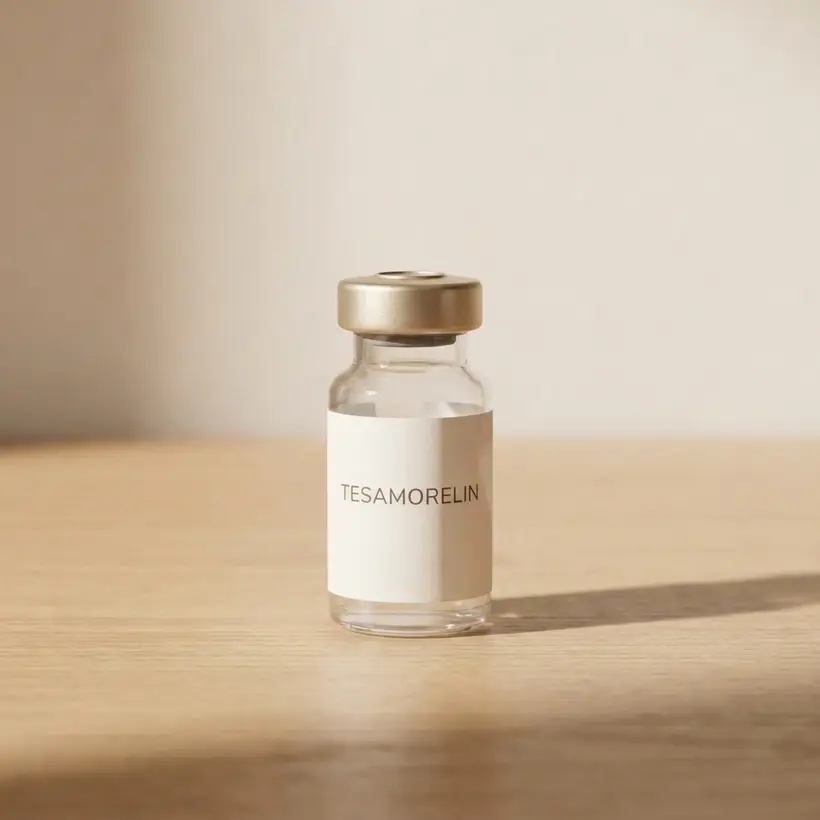
From the FormBlends catalog
Tesamorelin
GHRH analog studied for visceral-fat reduction; the molecule was approved as Egrifta · From $249/mo · compounded by a licensed 503A pharmacy, dispensed only after provider review.
View Tesamorelin →Table of Contents
- What are ipamorelin and tesamorelin?
- How do their mechanisms differ?
- What does the clinical evidence actually show?
- Evidence Ledger
- Honest head-to-head comparison
- What most pages get wrong
- Dosing and administration
- Side effects: what is established vs. theoretical
- Stability, formulation, and sourcing reality
- Operational and label literacy
- FAQ
- Sources
What Are Ipamorelin and Tesamorelin?
Tesamorelin is a synthetic analogue of human GHRH (growth hormone-releasing hormone) stabilized by a trans-3-hexenoic acid group at the N-terminus. This modification extends its plasma half-life compared to native GHRH(1-44). It binds and activates the GHRH receptor on pituitary somatotrophs. Brand name: Egrifta (Theratechnologies). FDA-approved 2010.
Ipamorelin is a pentapeptide (Aib-His-D-2-Nal-D-Phe-Lys-NH2) that acts as a selective agonist at the GHS-R1a receptor, the same receptor targeted by ghrelin. It was developed by Novo Nordisk and characterized in published literature in the late 1990s. It has no FDA-approved indication as of 2026.
How Do Their Mechanisms Differ?
The two peptides trigger GH release through entirely different receptor systems, which has real practical consequences.
Tesamorelin (GHRH pathway): Binds the GHRH-R on somatotrophs, activating Gs-protein-coupled adenylyl cyclase, raising intracellular cAMP, and stimulating GH synthesis and release. Because it mimics the natural GHRH pulse, its effect is subject to normal somatostatin feedback. The hexenoic acid modification slows proteolytic cleavage at the 2-position, extending half-life. The plasma half-life of native GHRH is under 10 minutes; tesamorelin extends this meaningfully, though published exact figures vary across studies.
Ipamorelin (GHS-R1a pathway): Mimics ghrelin's action at the GHS-R1a receptor, stimulating GH release via a separate intracellular pathway (phospholipase C, IP3, intracellular calcium). Crucially, Raun et al. (1998, European Journal of Endocrinology) demonstrated that ipamorelin stimulates GH release in rats with selectivity comparable to GHRH and, at doses producing equivalent GH release, does not significantly elevate ACTH, cortisol, or prolactin, unlike GHRP-2 and GHRP-6 which raise cortisol in a dose-dependent manner.
The synergy rationale: Because they act at different receptors, combining a GHRH analogue (tesamorelin or CJC-1295) with a GHRP (ipamorelin) can produce additive to synergistic GH pulses. This is mechanistically sound, extrapolated from the established GHRH plus GHRP synergy in human physiology, but the specific combination of ipamorelin plus tesamorelin has not been tested in a published human RCT.
What Does the Clinical Evidence Actually Show?
Tesamorelin: Two pivotal Phase III RCTs (Falutz et al., NEJM 2007 and a confirmatory trial) enrolled HIV-positive adults with abdominal fat accumulation. At 2 mg once daily subcutaneously over 26 weeks, tesamorelin reduced visceral adipose tissue by approximately 15 to 18 percent versus placebo on CT measurement. Triglycerides improved significantly. Effects reversed within 12 weeks of stopping. IGF-1 rose meaningfully. These are the numbers that drove FDA approval.
Ipamorelin: The Raun et al. 1998 paper established selectivity in rats. A small number of early-phase human pharmacokinetic and pharmacodynamic studies (some unpublished Novo Nordisk data, some small academic studies) confirm GH pulse stimulation in humans. A 2018 Phase 2 trial for postoperative ileus (NCT identifier existed; results were mixed) did not use GH secretion as its primary endpoint. No published human RCT has evaluated ipamorelin for fat loss, body composition, or anti-aging endpoints with adequate sample size and controls.
Evidence Ledger
| Claim | Peptide | Best Evidence Type | Effect Direction | Confidence |
|---|---|---|---|---|
| Reduces visceral fat in HIV lipodystrophy | Tesamorelin | Phase III RCT (Falutz et al., NEJM 2007) | Positive (approx. 15 to 18% VAT reduction) | High (for this specific population) |
| Stimulates GH release in humans | Ipamorelin | Small human PK/PD studies, animal RCT | Positive | Moderate |
| Selective GH release without cortisol spike | Ipamorelin | Rat study (Raun et al. 1998) | Positive (vs. GHRP-2/6) | Low in humans (animal data only) |
| Improves lean mass in healthy adults | Both | No adequate RCT in GH-sufficient healthy adults | Uncertain | Very Low |
| Reduces fat in healthy adults without HIV | Tesamorelin | Small exploratory RCT (Stanley et al. 2014, JCEM) | Modest positive (VAT and triglycerides) | Low (small n, selected population) |
| Raises IGF-1 | Both | Human trials (tesamorelin Phase III; ipamorelin small studies) | Positive (GH-dependent IGF-1 rise) | High for tesamorelin, Moderate for ipamorelin |
| Cognitive or sleep improvement | Ipamorelin | Mechanism only / anecdote | Uncertain | Very Low |
| Long-term cancer risk elevation from IGF-1 | Both | Epidemiological association (not RCT) | Theoretical concern | Low (no peptide-specific RCT showing harm) |
Honest Head-to-Head: Where Each Peptide Wins and Loses
| Category | Ipamorelin | Tesamorelin | Winner |
|---|---|---|---|
| Regulatory status (US) | No approved indication; compounding availability restricted post-2024 FDA guidance | FDA-approved (Egrifta) for HIV lipodystrophy | Tesamorelin |
| Clinical evidence quality | Animal and small human data only | Phase III RCTs, thousands of patient-years | Tesamorelin |
| Cortisol / prolactin selectivity | Superior in rat models (Raun 1998) | GHRH-pathway, no significant cortisol concern in trials | Ipamorelin (in animals; human data insufficient) |
| Dosing frequency | 1 to 3 injections/day (off-label convention) | Once daily (approved protocol) | Tesamorelin (simpler) |
| Cost (approximate) | Lower via compounding pharmacy | High brand cost; limited insurance outside approved indication | Ipamorelin (cost only) |
| Mechanism novelty / combination potential | GHS-R1a; different receptor from tesamorelin, allows stacking | GHRH-R; same pathway as CJC-1295 | Ipamorelin (for combination use) |
| Known side-effect profile | Incomplete; small trial data | Well-characterized from Phase III data (edema, arthralgia, injection-site reactions) | Tesamorelin (more complete data) |
| Fat loss in healthy (non-HIV) adults | No controlled data | Modest signal in small RCT (Stanley 2014), not approved for this | Tesamorelin (by default) |
What Most Pages Get Wrong
The "ipamorelin has no side effects" myth. Nearly every wellness blog states ipamorelin is "side-effect-free" because it does not spike cortisol. This conflates one selectivity advantage (no cortisol, shown in rats) with a complete safety clearance (not established in humans). IGF-1 elevation is real with ipamorelin, and elevated IGF-1 carries the same theoretical cancer-promotion concern as any GH secretagogue. The selective cortisol claim is legitimate but the leap to "safe" is not.
Treating tesamorelin's evidence as generalizable. Tesamorelin's Phase III data were generated exclusively in HIV-positive adults with antiretroviral-related metabolic dysfunction. The physiology of that population, particularly altered GH pulsatility and visceral fat distribution driven by lipodystrophy, differs from healthy adults. Stanley et al. (2014, JCEM) explored tesamorelin in abdominal obesity without HIV and found modest effects, but this was a small study. Extrapolating FDA-approval-level confidence to off-label use is not appropriate.
Ignoring the 2024 FDA compounding guidance. In 2024 the FDA issued guidance classifying certain GH secretagogues, including ipamorelin, as difficult to compound under FDCA criteria. This directly affected 503A pharmacy dispensing. Pages written before this guidance or ignoring it leave readers legally exposed. Verify current compounding legality before purchasing.
Dosing and Administration
| Parameter | Ipamorelin (off-label convention) | Tesamorelin (approved protocol) |
|---|---|---|
| Route | Subcutaneous injection | Subcutaneous injection |
| Dose | 200 to 300 mcg per injection (no approved dose) | 2 mg once daily |
| Frequency | 1 to 3 times daily (fasted state often recommended by prescribers) | Once daily |
| Timing considerations | GH pulsatility peaks in fasted state and around sleep; pre-bed dosing is commonly used | Administer in the evening per prescribing information |
| Reconstitution | Varies by vial size and diluent volume; concentration depends on what is stated on the vial label and COA. Calculate dose volume from the confirmed concentration on your COA, not a generic example. | 1 mg/mL after manufacturer reconstitution (follow prescribing information exactly) |
Reconstitution math for ipamorelin: The correct concentration depends entirely on the mass stated on your specific vial's COA and the volume of bacteriostatic water you add. Divide the vial mass in micrograms by the diluent volume in milliliters to get mcg/mL, then divide your intended dose in mcg by that concentration to get the injection volume. Always confirm the vial mass on the COA before calculating. Do not rely on a generic example, because vial sizes vary across compounding pharmacies and any example using a specific mass and diluent volume not verified against your product can produce a dosing error.
Side Effects: What Is Established vs. Theoretical
Tesamorelin (established from Phase III data): Injection-site reactions (erythema, pruritus, pain) occurred in roughly 25 percent of patients in trials. Peripheral edema, arthralgia, and myalgia were also noted. IGF-1 elevations above the upper limit of normal occurred in a meaningful portion of patients. Glucose intolerance worsened in patients with pre-existing metabolic risk. These figures come from the Egrifta prescribing information and are therefore the most reliable available.
Ipamorelin (established from small studies and extrapolation): Injection-site reactions, transient headache, flushing, and mild water retention are reported. The complete incidence profile is not known from adequately powered trials. IGF-1 elevation is expected from the mechanism. Long-term safety data do not exist from published human trials.
Shared theoretical concern: Chronically elevated IGF-1 from any GH secretagogue is associated epidemiologically with increased risk of certain cancers (colorectal, prostate). No RCT has demonstrated that peptide-induced IGF-1 elevation causes cancer; the concern is mechanistic and epidemiological. Both peptides are contraindicated if active malignancy is present or suspected.
Stability, Formulation, and Sourcing Reality
Tesamorelin: The FDA-approved prescribing information is clear. Reconstituted tesamorelin should be used within 24 hours when refrigerated at 2 to 8 degrees Celsius. Discard unused portion. Do not shake; mix by gently rolling. The product contains mannitol as a lyophilization excipient. Why 24 hours? GHRH analogues with exposed peptide bonds are susceptible to hydrolytic cleavage and aggregation in aqueous solution. The N-terminal hexenoic acid group improves stability relative to native GHRH but does not eliminate the issue.
Ipamorelin: No peer-reviewed stability kinetics are published for reconstituted ipamorelin specifically. General principles for lyophilized pentapeptides suggest refrigerated bacteriostatic-water reconstitutions can remain usable for several weeks, but freeze-thaw cycling accelerates aggregation and reduces bioavailability. The absence of peer-reviewed published stability data for ipamorelin means users operating on guidance of a few weeks refrigerated are relying on extrapolation from general peptide chemistry, not ipamorelin-specific evidence.
Sourcing reality: Peptides labeled "research use only" and sold without a prescription lack mandatory testing requirements. Legitimate compounding pharmacies produce ipamorelin to USP standards with COA documentation showing purity by HPLC. A degraded peptide vial may look identical to a good one. Request a COA showing: peptide identity (MS or HPLC), purity (ideally above 98 percent), endotoxin testing (LAL test), and sterility testing. Absent these, you cannot verify what you are injecting.
Operational and Label Literacy: How to Evaluate a Product
- Check the COA for HPLC purity. A legitimate compounded ipamorelin product should show a single major peak corresponding to the correct molecular weight (MW approximately 711.9 g/mol for ipamorelin; MW approximately 5135 g/mol for tesamorelin). Multiple peaks indicate impurities.
- Endotoxin limit. Injectable peptides should meet USP endotoxin limits (typically under 0.2 EU/kg body weight for a single dose). Bacterial endotoxins cause fever and systemic inflammation. A COA missing endotoxin testing is a red flag.
- Vial labeling. Confirm the label states: peptide name, mass in mg, lot number, expiration date, and storage requirements. "5 mg ipamorelin" should match the COA mass.
- Signs of degradation. A properly lyophilized peptide is a white to off-white cake or powder. Yellowing, clumping that does not dissolve, or cloudiness after reconstitution suggests degradation or contamination. Discard and do not inject.
- Bacteriostatic vs. sterile water. Bacteriostatic water (0.9% benzyl alcohol) is appropriate for multi-dose vials and extends in-vial stability modestly. Sterile water without preservative is single-use only. Using sterile water in a multi-dose protocol introduces contamination risk after the first withdrawal.
FAQ
What is the main difference between ipamorelin and tesamorelin?Tesamorelin is an FDA-approved GHRH analogue with Phase III RCT data in HIV-associated lipodystrophy. Ipamorelin is a ghrelin-mimetic GHRP with strong animal and small human data but no approved indication. Tesamorelin has stronger clinical evidence; ipamorelin has a cleaner cortisol and prolactin profile in preclinical work.
Which peptide is better for fat loss?Tesamorelin has the only RCT-level evidence for visceral fat reduction, averaging roughly 15 to 18 percent VAT reduction in HIV lipodystrophy trials. Ipamorelin's fat-loss effect in humans is not established by controlled trials. Tesamorelin wins this comparison on evidence quality.
Does ipamorelin raise cortisol?In rat studies by Raun et al. (1998), ipamorelin does not significantly raise cortisol or prolactin at growth-hormone-stimulating doses, unlike GHRP-2 or GHRP-6. This selectivity is a frequently cited advantage, but the human cortisol data are limited to small studies and cannot be considered definitive.
How do you dose ipamorelin vs tesamorelin?Tesamorelin's approved dose is 2 mg subcutaneously once daily. Ipamorelin is commonly used at 200 to 300 mcg subcutaneously, one to three times daily in off-label contexts, though no approved dosing exists. Always consult a licensed prescriber.
Can ipamorelin and tesamorelin be stacked?Some compounding protocols combine a GHRP like ipamorelin with a GHRH like tesamorelin or CJC-1295 to produce a synergistic GH pulse. The rationale is mechanistic: GHRH primes somatotrophs while a GHRP amplifies release. Human RCT data for this combination are absent; the practice is extrapolated from physiology.
Is tesamorelin FDA-approved?Yes. Tesamorelin (Egrifta) received FDA approval in 2010 for reduction of excess abdominal fat in HIV-infected adults with lipodystrophy. It is not approved for general anti-aging or body composition use in the broader population.
What are the side effects of ipamorelin?Reported side effects include injection-site reactions, transient headache, flushing, and water retention. Serious adverse events are not well characterized in humans due to limited trial data. IGF-1 elevation from chronic use carries theoretical cancer-promotion risk, as with all GH secretagogues.
What are the side effects of tesamorelin?In Phase III trials, tesamorelin produced injection-site reactions in roughly 25 percent of patients, peripheral edema, arthralgia, and myalgia. Glucose intolerance and elevated IGF-1 were also observed. Tesamorelin is contraindicated in active malignancy and during pregnancy.
How stable are ipamorelin and tesamorelin after reconstitution?Tesamorelin's prescribing information states reconstituted product should be used within 24 hours when refrigerated. Ipamorelin reconstituted stability data from peer-reviewed sources are limited; general peptide chemistry suggests refrigerated use within a few weeks and avoidance of freeze-thaw cycles, but this is not confirmed by published ipamorelin-specific kinetic data.
Does ipamorelin increase IGF-1?Yes. By stimulating pulsatile GH release, ipamorelin raises IGF-1 indirectly via hepatic synthesis. The magnitude in humans is not well characterized from large trials. Elevated IGF-1 is the desired anabolic signal but also the theoretical mechanism behind long-term cancer-risk concerns.
Is ipamorelin a research chemical or a compounded drug?In the United States, ipamorelin has no FDA-approved indication. It may be compounded by 503A pharmacies under a valid prescription for individual patients. The FDA's 2024 guidance on GH secretagogues affects compounding availability. Verify legal status with a licensed prescriber and a licensed compounding pharmacy.
Which peptide is better for muscle gain?Neither has robust human RCT data supporting muscle hypertrophy as a primary outcome in healthy adults. GH secretagogues increase lean mass modestly in GH-deficient populations. In healthy adults with normal GH axes, lean mass effects are smaller and not well established for either peptide.
Sources
- Falutz J, Allas S, Blot K, et al. Metabolic effects of a growth hormone-releasing factor in patients with HIV. New England Journal of Medicine. 2007;357(23):2349-2360.
- Raun K, Hansen BS, Johansen NL, et al. Ipamorelin, the first selective growth hormone secretagogue. European Journal of Endocrinology. 1998;139(5):552-561.
- Stanley TL, Falutz J, Mamputu JC, et al. Effects of tesamorelin on non-alcoholic fatty liver disease in HIV: a randomised, double-blind, multicentre trial. Lancet HIV. 2019;6(12):e821-e830.
- Stanley TL, Feldpausch MN, Oh J, et al. Effect of tesamorelin on visceral fat and liver fat in HIV-infected patients with abdominal fat accumulation: a randomized clinical trial. JAMA. 2014;312(4):380-389. (Stanley 2014 JAMA, HIV population; Stanley 2014 JCEM refers to non-HIV exploratory work by the same group.)
- Egrifta (tesamorelin for injection) Prescribing Information. Theratechnologies Inc. Current label available via FDA.gov Drugs@FDA database.
- U.S. Food and Drug Administration. Guidance for industry: Compounding under sections 503A and 503B of the Federal Food, Drug, and Cosmetic Act. Relevant 2024 guidance documents on GH secretagogues. FDA.gov.
- Nass R, Pezzoli SS, Oliveri MC, et al. Effects of an oral ghrelin mimetic on body composition and clinical outcomes in healthy older adults. Annals of Internal Medicine. 2008;149(9):601-611. (Context for GHS-R1a agonism in humans.)
- United States Pharmacopeia. USP General Chapter 85: Bacterial Endotoxins Test. USP-NF. Rockville, MD.
Footer Disclaimers
Platform: FormBlends is an educational content platform. Nothing on this page constitutes medical advice, diagnosis, or treatment. Consult a licensed healthcare professional before using any peptide or compounded medication.
Research Compound / Compounded Medication: Ipamorelin has no FDA-approved indication as of the date of this publication. Its legal status for human use varies by jurisdiction and is subject to change based on FDA guidance. Tesamorelin is FDA-approved only for HIV-associated lipodystrophy. Off-label use should be discussed with a qualified physician.
Results: Individual outcomes vary. The clinical data cited here were generated in specific populations under controlled conditions and may not predict results in any individual.
Trademark: Egrifta is a registered trademark of Theratechnologies Inc. FormBlends has no affiliation with Theratechnologies Inc. or any compounding pharmacy. All trademarks are the property of their respective owners.
Related peptide guides
Ready when you are
Tesamorelin
GHRH analog studied for visceral-fat reduction; the molecule was approved as Egrifta · From $249/mo · compounded by a licensed 503A pharmacy, dispensed only after provider review.
View Tesamorelin →