
Trust Signals
Every claim is tagged by evidence type in the ledger table below. No sponsored claims. Conflicts are disclosed where relevant.
Key Takeaways
- Tesamorelin (Egrifta SV) is FDA-approved at a 2 mg daily dose with large RCT evidence showing roughly 15 to 18 percent visceral fat reduction in HIV lipodystrophy patients.
- CJC 1295 plus ipamorelin is a compounded, unapproved combination; no published human RCTs on fat loss, body composition, or safety exist for the pair used together.
- Ipamorelin acts on the ghrelin receptor (GHSR-1a) while CJC 1295 acts on GHRHR; combining them targets two distinct GH-release pathways, a rationale supported by animal data only.
- CJC 1295 with the DAC modification has a half-life of approximately 6 to 8 days versus roughly 26 minutes for tesamorelin, creating fundamentally different dosing and pulsatility profiles.
- WADA prohibits all three compounds for competitive athletes under the peptide hormone category.
What Is the Bottom Line on CJC 1295 Ipamorelin vs Tesamorelin?
Tesamorelin wins on evidence quality by a wide margin. It has FDA approval, multiple large randomized controlled trials, and a defined prescribing label. CJC 1295 plus ipamorelin has mechanistic plausibility and favorable animal data, but no human RCT confirms its fat-loss efficacy or long-term safety. Choose based on how much evidentiary certainty your decision requires.
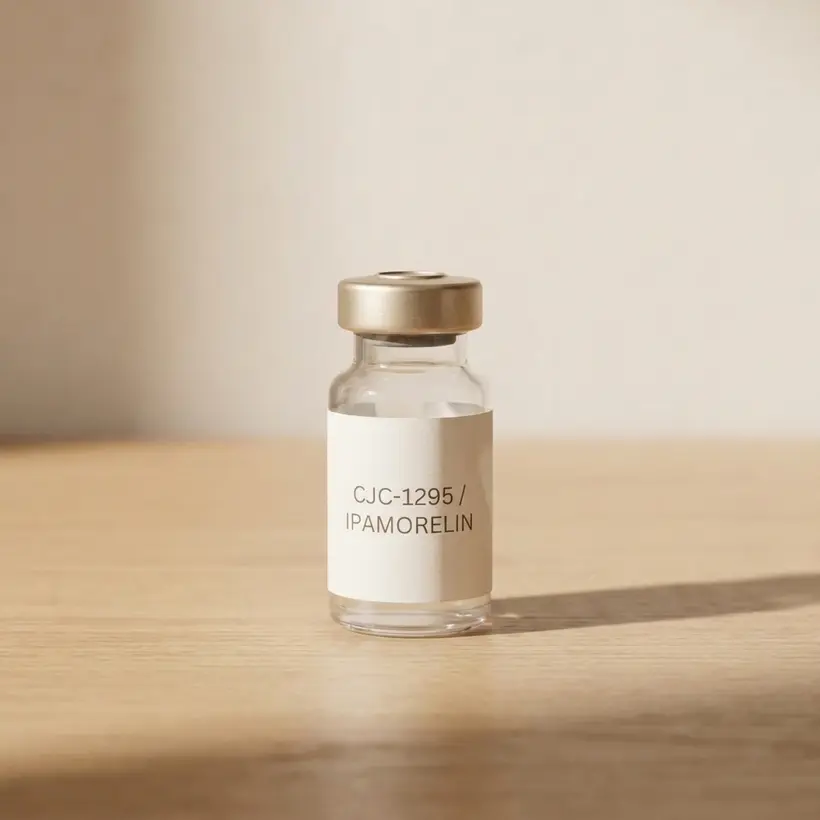
From the FormBlends catalog
CJC-1295 / Ipamorelin Blend
The gold standard growth hormone secretagogue stack · From $69/mo · compounded by a licensed 503A pharmacy, dispensed only after provider review.
Learn about CJC-1295 / Ipamorelin Blend →Table of Contents
- What Are These Peptides and How Do They Work?
- Evidence Ledger: What Does the Data Actually Show?
- Mechanism With Numbers: GH Pulse Physiology
- What Most Pages Get Wrong About This Comparison
- Honest Head-to-Head Comparison Table
- Dosing, Stability, and Formulation Facts
- Operational and Label Literacy: Reading a COA
- Side Effects and Contraindications
- FAQ
- Sources
- Footer Disclaimers
What Are These Peptides and How Do They Work?
All three compounds stimulate growth hormone (GH) release, but they do so via different molecular strategies.
Tesamorelin is a synthetic 44-amino-acid analog of endogenous growth hormone releasing hormone (GHRH), with a trans-3-hexenoic acid group added to the N-terminus to improve stability. It binds the pituitary GHRH receptor (GHRHR), triggering pulsatile GH secretion. Endogenous GHRH is rapidly cleaved by dipeptidyl peptidase IV (DPP-IV); the trans-3-hexenoic acid modification provides partial resistance to this cleavage, explaining tesamorelin's modestly extended but still short plasma half-life of roughly 26 minutes after subcutaneous injection.
CJC 1295 is also a GHRH analog, typically derived from the first 29 amino acids of GHRH. Two versions exist. CJC 1295 without DAC (also called Modified GRF 1-29) carries amino acid substitutions at positions 2, 8, 15, and 27 that resist DPP-IV cleavage, giving a half-life of roughly 30 minutes. CJC 1295 with DAC (Drug Affinity Complex) adds a lysine-linked maleimide group that covalently binds circulating albumin, extending the half-life to approximately 6 to 8 days and creating a non-pulsatile, sustained GH elevation that is physiologically quite different from normal secretion patterns.
Ipamorelin is a pentapeptide ghrelin mimetic (Aib-His-D-2-Nal-D-Phe-Lys-NH2) that activates the growth hormone secretagogue receptor type 1a (GHSR-1a) in the pituitary and hypothalamus. This is a completely different receptor from GHRHR. By activating GHSR-1a, ipamorelin triggers GH release independently of the GHRH pathway, and the two mechanisms together are believed to produce additive or synergistic GH pulses. Ipamorelin is considered more GH-selective than older GHSRPs like GHRP-2 or GHRP-6 because it produces less cortisol and prolactin co-secretion at standard doses, though systematic human comparative data are sparse.
Evidence Ledger: What Does the Data Actually Show?
| Claim | Best Evidence Type | Sample/Source Quality | Effect Direction | Confidence |
|---|---|---|---|---|
| Tesamorelin reduces visceral fat in HIV lipodystrophy | Human RCT (Falutz et al., 2010; multiple trials) | N=800+ across trials, placebo-controlled | Roughly 15 to 18% VAT reduction vs placebo | High |
| Tesamorelin raises IGF-1 | Human RCT | Same trials above | Significant IGF-1 increase vs baseline | High |
| CJC 1295 (without DAC) raises GH and IGF-1 in healthy adults | Small human trial (Ionescu and Frohman, 2006) | N=21, dose-escalation, no placebo group | Dose-dependent GH and IGF-1 increase | Moderate (single small trial) |
| Ipamorelin stimulates GH release | Animal studies, small human PK data | Rat and pig studies; limited human PK | GH increase, relatively selective | Moderate (animal) / Low (human) |
| CJC 1295 plus ipamorelin combination improves body composition | No published human RCT | Absent | Unknown in humans | Very Low |
| Tesamorelin improves body composition in non-HIV adults | Small exploratory human trials | N under 100, short duration | Modest IGF-1 increase, some VAT reduction | Low |
| CJC 1295 with DAC produces sustained GH elevation | Small human PK trial (Ionescu and Frohman, 2006) | N=32, dose-ranging | GH elevated for days after single dose | Moderate |
| Ipamorelin does not significantly raise cortisol at standard doses | Animal (rat) comparative studies | Rat pituitary cell and in vivo data | Cortisol/ACTH sparing vs GHRP-2 | Low (no human confirmation) |
Mechanism With Numbers: GH Pulse Physiology
Normal pituitary GH secretion occurs in pulses, with the largest pulse during the first hours of deep sleep. Peak GH concentrations during a healthy nocturnal pulse can reach 10 to 30 ng/mL in young adults, while daytime trough levels are often below 0.5 ng/mL. This pulsatility matters because sustained GH elevation, rather than pulsatile release, is associated with greater receptor desensitization and a less favorable metabolic profile.
Tesamorelin, with its 26-minute half-life, mimics endogenous GHRH in that it amplifies existing pulsatile GH secretion without obliterating the trough. In the Falutz 2010 trials, once-daily dosing at 2 mg produced mean IGF-1 increases that normalized toward baseline over the 26-week trial, suggesting some receptor adaptation without complete desensitization.
CJC 1295 without DAC at doses around 100 mcg in the Ionescu and Frohman 2006 study produced a GH spike followed by return to baseline within hours, resembling pulsatile behavior. CJC 1295 with DAC at 2 mg in the same study produced sustained GH elevation lasting multiple days from a single injection. That DAC-extended profile is the critical mechanistic difference that is almost never explained on competitor pages.
Ipamorelin's GHSR-1a mechanism is additive to GHRH-pathway stimulation because the two receptor systems converge on different intracellular signaling pathways (Gs-cAMP for GHRHR, Gq-PKC and MAPK for GHSR-1a) and can both stimulate somatotroph GH release simultaneously. The synergy hypothesis is supported by preclinical co-administration data, but what this does NOT prove is that the combination produces better body composition outcomes than either agent alone in humans.
What Most Pages Get Wrong About This Comparison
Bioavailability and penetration limits are ignored. All three compounds are peptides that must be injected subcutaneously. Oral, intranasal, and transdermal formulations marketed for these molecules face severe bioavailability challenges. Peptides above roughly 500 daltons (CJC 1295 is approximately 3367 daltons, ipamorelin approximately 711 daltons, tesamorelin approximately 5136 daltons) are poorly absorbed through gut or skin epithelium without advanced delivery technology. Claims for non-injectable versions should be viewed with skepticism unless supported by human bioavailability data.
The "no cortisol spike" claim for ipamorelin is often overstated. The selectivity data come primarily from rat pituitary cell studies and a small number of animal in vivo experiments. A direct human comparison of ipamorelin versus GHRP-6 on cortisol output in a blinded, controlled design has not been published to this author's knowledge. The claim is plausible and mechanistically supported, but should not be stated as confirmed human fact.
Purity and sourcing reality. Tesamorelin is manufactured under FDA-regulated cGMP conditions. CJC 1295 and ipamorelin, when obtained from compounding pharmacies, should come with a COA from an accredited analytical lab. Research-grade peptides purchased outside a licensed compounding pharmacy may not meet sterility or endotoxin standards required for injection. Endotoxin contamination (bacterial lipopolysaccharide) causes fever, local inflammation, and systemic reactions independent of the peptide's pharmacology. This is a real, non-trivial risk that commodity pages omit entirely.
Honest Head-to-Head Comparison Table
| Parameter | CJC 1295 (no DAC) plus Ipamorelin | CJC 1295 (with DAC) | Tesamorelin |
|---|---|---|---|
| FDA Approval | None | None | Yes (HIV lipodystrophy only) |
| Human RCT fat-loss data | None | None | Multiple; 15 to 18% VAT reduction |
| Half-life | CJC: ~30 min; Ipamorelin: ~2 hrs | ~6 to 8 days | ~26 minutes |
| GH release pattern | Pulsatile (amplifies natural pulse) | Sustained, non-pulsatile | Pulsatile (amplifies natural pulse) |
| Receptor target | GHRHR plus GHSR-1a (dual) | GHRHR (sustained) | GHRHR |
| Dosing frequency | Once to twice daily injection | Once weekly or less | Once daily injection |
| Standard dose | 200 to 300 mcg each compound (compounded) | 1 to 2 mg per week (compounded) | 2 mg/day (FDA label) |
| Injection site reactions | Reported; no systematic incidence data | Reported; no systematic incidence data | Documented in FDA label (common) |
| Regulatory sourcing | Compounding pharmacy or research supply | Compounding pharmacy or research supply | Licensed pharmacy, prescription required |
| WADA status | Prohibited | Prohibited | Prohibited |
| Cost (approximate monthly) | Lower (compounded) | Lower (compounded) | Higher (brand-name Rx) |
| Where peptide LOSES | No approved indication, no human RCT | Non-pulsatile profile may drive desensitization | Narrow approved indication, high cost |
Dosing, Stability, and Formulation Facts
Tesamorelin dosing per the Egrifta SV FDA label is 2 mg subcutaneously once daily, injected into the abdomen. The labeling specifies rotation of injection sites. Lab monitoring of IGF-1 at baseline and periodically during treatment is recommended.
CJC 1295 without DAC plus ipamorelin is most commonly compounded at 200 to 300 mcg of each peptide per injection, given once daily before sleep to align with the natural nocturnal GH pulse. Some protocols use twice-daily dosing. These doses are not derived from an approved label; they originate from clinical convention and extrapolation from small studies.
Stability. Lyophilized peptides are relatively stable when stored at 2 to 8 degrees Celsius and protected from light. Why cold storage matters: peptide bonds in solution are susceptible to hydrolysis, and aggregation (where peptide chains clump together, losing receptor-binding activity) accelerates at room temperature. After reconstitution with bacteriostatic water (water for injection with 0.9% benzyl alcohol, which inhibits microbial growth), use within the window stated by your compounder, typically 14 to 28 days refrigerated. Do not freeze reconstituted peptide. Ice crystal formation during freezing disrupts the three-dimensional confirmation of the peptide chain, degrading bioactivity. This is not a rule of thumb; it reflects the physics of peptide aggregation under freeze-thaw mechanical stress.
Bacteriostatic water vs sterile water. Bacteriostatic water is preferred for multi-dose vials because benzyl alcohol inhibits contamination between draws. Sterile water without a preservative should be used for single-dose reconstitution only, or when a product label specifies it.
Operational and Label Literacy: Reading a COA
A legitimate certificate of analysis for an injectable peptide should include all of the following. If any element is missing, the product's safety for injection cannot be confirmed.
| Parameter | What to Look For | Why It Matters |
|---|---|---|
| HPLC purity | Above 98% for injectable grade | Impurities can be biologically active or immunogenic |
| Mass spectrometry (MS or MS/MS) | Measured molecular weight matches theoretical | Confirms identity; HPLC alone cannot distinguish isomers |
| Endotoxin (LAL test) | Below 1 EU per mg (USP guideline for parenteral drugs) | LPS contamination causes fever and systemic inflammation |
| Sterility | Sterility test passed (USP Method) | Required for safe injection |
| Water content (Karl Fischer) | Below about 6% for lyophilized peptide | Excess moisture accelerates degradation in storage |
| Sequence confirmation | MS/MS fragmentation confirming amino acid sequence | Gold standard for detecting substitutions or truncations |
A red flag: a COA from a third-party lab you cannot independently verify via the lab's own website or accreditation database. NELAP or ISO 17025 accreditation is the minimum acceptable standard for analytical testing labs.
What a degraded peptide looks like. Reconstituted peptide solution should be clear and colorless. Yellow or cloudy solution, visible particulate matter, or unusual odor suggests degradation, contamination, or incorrect reconstitution. Do not inject degraded product.
Side Effects and Contraindications
Tesamorelin (from FDA label): injection site reactions including erythema, pruritus, and pain are the most common adverse events. Fluid retention and peripheral edema have been reported. Arthralgias and myalgias occur in a minority of patients. IGF-1 elevation above the upper limit of normal occurred in a proportion of trial participants; this is relevant because sustained supraphysiologic IGF-1 carries theoretical proliferative risk. Tesamorelin is contraindicated in active malignancy, pregnancy, and hypersensitivity to GHRH or mannitol (an excipient in Egrifta SV).
CJC 1295 plus ipamorelin: Reported adverse effects in clinical use include transient flushing shortly after injection (particularly with GHRP-class compounds), mild water retention, injection site reactions, and occasional headache. Systematic incidence rates from controlled human trials do not exist for this combination. The same theoretical IGF-1 proliferative concern applies.
Both compound classes are contraindicated in active malignancy by clinical convention, given IGF-1's mitogenic properties. Neither has been studied in pregnant or breastfeeding women.
FAQ
What is the main difference between CJC 1295 ipamorelin and tesamorelin?
Tesamorelin is an FDA-approved synthetic analog of GHRH with human RCT data demonstrating roughly 15 to 18 percent reductions in visceral adipose tissue in HIV-associated lipodystrophy. CJC 1295 plus ipamorelin is a compounded, unapproved combination with no published human RCTs; its use rests on animal data and mechanistic reasoning.
Does CJC 1295 ipamorelin burn fat as well as tesamorelin?
There is no head-to-head human trial. Tesamorelin's visceral fat reduction is documented in large RCTs. CJC 1295 plus ipamorelin has no comparable human fat-loss trial, so a direct efficacy comparison cannot be made honestly.
Is tesamorelin FDA approved?
Yes. Tesamorelin (brand name Egrifta SV) received FDA approval in 2010 for reduction of excess abdominal fat in HIV-infected adults with lipodystrophy. It is not approved for general fat loss or body composition improvement in otherwise healthy adults.
What does ipamorelin add to CJC 1295?
Ipamorelin is a ghrelin mimetic that acts on the GHSR-1a receptor to trigger GH release via a different pathway than GHRH analogs. The combination theoretically creates a synergistic GH pulse. This synergy is supported by animal studies but not confirmed in published human trials.
What are the half-lives of CJC 1295, ipamorelin, and tesamorelin?
CJC 1295 without DAC has a half-life of roughly 30 minutes, similar to native GHRH. CJC 1295 with DAC extends half-life to approximately 6 to 8 days by covalent albumin binding. Ipamorelin has a short half-life of roughly 2 hours. Tesamorelin's half-life is approximately 26 minutes after subcutaneous injection.
How are CJC 1295 ipamorelin and tesamorelin dosed?
Tesamorelin is dosed at 2 mg subcutaneously once daily per its FDA label. CJC 1295 (without DAC) is commonly compounded at 200 to 300 mcg per injection combined with ipamorelin at 200 to 300 mcg, typically once daily at night. These compounded doses are not derived from approved labeling.
What are the main side effects of each?
Tesamorelin's FDA label documents injection site reactions, fluid retention, arthralgias, and a small increase in IGF-1. CJC 1295 plus ipamorelin side effects reported clinically include transient flushing, water retention, and injection site reactions, but systematic incidence data from controlled trials do not exist for the combination.
Can you use CJC 1295 ipamorelin and tesamorelin together?
Both act on overlapping GH axis pathways. Stacking them could amplify GH and IGF-1 elevation beyond intended levels, increasing the risk of side effects including fluid retention and potential IGF-1-driven proliferative effects. No safety data exist for this combination.
How do I read a COA for these peptides?
Look for HPLC purity above 98 percent, mass spectrometry confirmation of the correct molecular weight, endotoxin testing below 1 EU per mg, and sterility testing if the product is injectable. Sequence verification by MS/MS is the gold standard for confirming identity.
Does tesamorelin work for body composition in people without HIV lipodystrophy?
Small trials in non-HIV adults have shown modest IGF-1 increases and some visceral fat reduction, but the FDA approval does not extend to general obesity or athletic body composition. Evidence quality in the general population is low.
How should these peptides be stored?
Lyophilized forms should be stored at 2 to 8 degrees Celsius before reconstitution. After reconstitution with bacteriostatic water, use within the window specified by the compounder, typically 14 to 28 days refrigerated. Do not freeze reconstituted solution; freeze-thaw cycles degrade peptide structure.
Are CJC 1295 and ipamorelin on the WADA prohibited list?
Yes. GHRH analogs including CJC 1295 and growth hormone releasing peptides including ipamorelin are listed under WADA's Prohibited List in the peptide hormone category. Tesamorelin is also prohibited in competitive sport under the same category.
Sources
- Falutz J, et al. "Effects of tesamorelin (TH9507), a growth hormone-releasing factor analog, in HIV-infected patients with excess abdominal fat: a pooled analysis of two multicenter, double-blind placebo-controlled phase 3 trials with safety extension data." Journal of Acquired Immune Deficiency Syndromes, 2010. (Falutz 2010)
- Ionescu M, Frohman LA. "Pulsatile secretion of growth hormone (GH) persists during continuous stimulation by CJC-1295, a long-acting GH-releasing hormone analog." Journal of Clinical Endocrinology and Metabolism, 2006.
- FDA. Egrifta SV (tesamorelin for injection) Prescribing Information. U.S. Food and Drug Administration. Accessed 2026.
- Raun K, et al. "Ipamorelin, the first selective growth hormone secretagogue." European Journal of Endocrinology, 1998.
- Popovic V, Leal A, Micic D, et al. "GH-releasing hormone and GH-releasing peptide-6 for diagnostic testing in GH-deficient adults." Lancet, 2000.
- World Anti-Doping Agency. "The Prohibited List." WADA, current version. https://www.wada-ama.org/en/prohibited-list
- United States Pharmacopeia. "General Chapter 85: Bacterial Endotoxins Test." USP-NF.
- Sigalos JT, Pastuszak AW. "The Safety and Efficacy of Growth Hormone Secretagogues." Sexual Medicine Reviews, 2018.
Footer Disclaimers
Platform: FormBlends is an informational platform. Content on this page is for educational purposes only and does not constitute medical advice. Consult a licensed healthcare provider before initiating any peptide therapy.
Research Compound or Compounded Medication: CJC 1295 and ipamorelin are not FDA-approved drugs. Where available through licensed compounding pharmacies, they are compounded medications subject to state pharmacy board regulation and federal compounding rules. They are not approved for any indication. Tesamorelin is FDA-approved only for HIV-associated lipodystrophy in adults.
Results: Individual responses to peptide therapy vary. The fat-loss and body composition outcomes described in clinical trials may not reflect results achievable in general populations or outside trial conditions.
Trademark: Egrifta and Egrifta SV are trademarks of their respective owners. FormBlends has no affiliation with any peptide manufacturer or compounding pharmacy mentioned in this content.
Related peptide guides
Ready when you are
CJC-1295 / Ipamorelin Blend
The gold standard growth hormone secretagogue stack · From $69/mo · compounded by a licensed 503A pharmacy, dispensed only after provider review.
Learn about CJC-1295 / Ipamorelin Blend →