
Trust Signals
Key Takeaways
- Tesamorelin is the only GHRH analogue with an FDA approval (HIV-associated lipodystrophy, 2 mg/day subcutaneous) and multiple positive human RCTs, giving it the strongest evidence base in this stack category.
- Ipamorelin acts on GHS-R1a, a different receptor than the GHRH-R tesamorelin targets; dual-receptor engagement is the mechanistic rationale for stacking, but no published human RCT has tested the combination directly.
- CJC-1295 without DAC has a half-life of roughly 30 minutes, preserving pulsatility; CJC-1295 with DAC has a half-life of roughly 8 days and produces continuous GH elevation, a pharmacologically different effect.
- IGF-1 LR3 addition amplifies the IGF-1 signal downstream but carries distinct mitogenic risk and has zero published human RCT data for body composition.
- Pre-mixing peptides into a single vial before injection introduces instability risk; reconstitute separately and combine only in the syringe immediately before use.
What Is the Tesamorelin and Ipamorelin Stack and Does It Work?
The tesamorelin and ipamorelin stack combines a GHRH-receptor agonist (tesamorelin) with a ghrelin-receptor agonist (ipamorelin) to stimulate pituitary GH release through two distinct receptor pathways simultaneously. Tesamorelin has robust human RCT evidence for GH and IGF-1 elevation in FDA-approved dosing. Ipamorelin's synergy with GHRH analogues is supported by animal and mechanistic data but has not been confirmed in a published human RCT as a combination. Confidence that the stack stimulates GH more than either alone is moderate; confidence that this produces specific body composition outcomes in healthy adults is low.
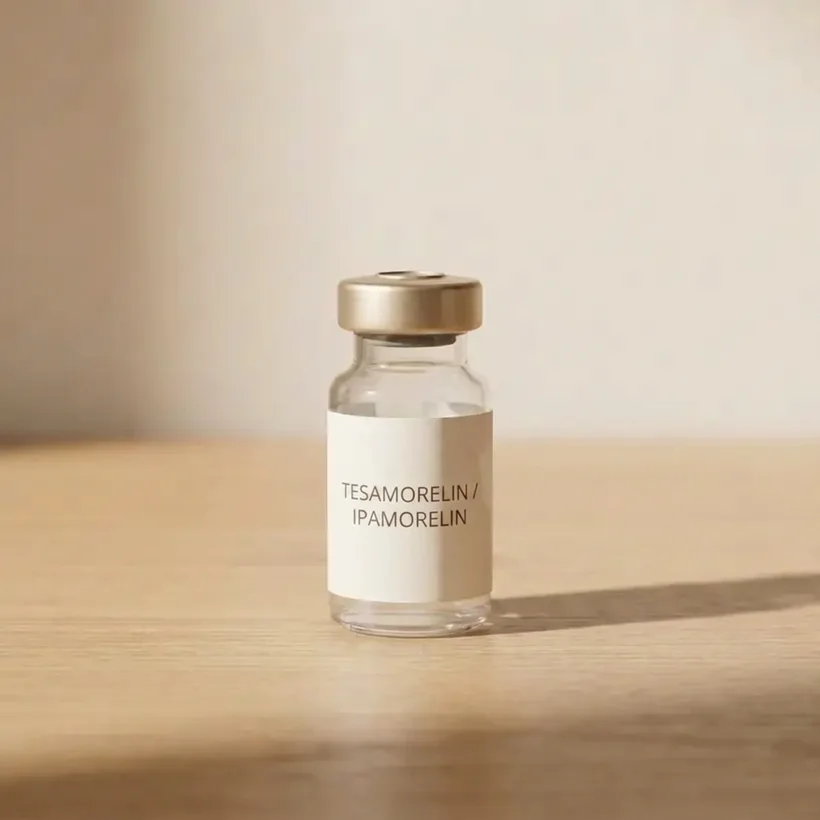
From the FormBlends catalog
Tesamorelin / Ipamorelin Blend
Growth-hormone pathway support in one blend · From $299/mo · compounded by a licensed 503A pharmacy, dispensed only after provider review.
View Tesamorelin / Ipamorelin Blend →Table of Contents
- Evidence Ledger: Every Major Claim Graded
- Mechanism With Numbers: How Each Peptide Works
- CJC-1295 No DAC vs CJC-1295 With DAC: Which Belongs in a Stack?
- What Does Adding IGF-1 LR3 Actually Change?
- What Most Pages Get Wrong (The Omissions That Matter)
- Why You Cannot Pre-Mix These Peptides: The Chemistry
- Honest Head-to-Head: This Stack vs Real Alternatives
- Dosing and Operational Protocol Table
- Label and COA Literacy: How to Judge Your Source
- Safety Signals and Contraindications
- FAQ
- Sources
Evidence Ledger: Every Major Claim Graded
| Claim | Best Evidence Type | Effect Direction | Confidence |
|---|---|---|---|
| Tesamorelin 2 mg/day reduces visceral fat in HIV-associated lipodystrophy | Human RCT (Falutz et al., 2007 NEJM; Phase 3 trials supporting FDA approval) | Positive, statistically significant | High (within approved indication) |
| Tesamorelin elevates IGF-1 in humans | Human RCT (multiple Phase 2 and Phase 3 trials) | Positive | High |
| Ipamorelin selectively stimulates GH with minimal cortisol or prolactin elevation vs GHRP-6 | Animal study (Raun et al., 1998, European Journal of Endocrinology) | Positive for selectivity | Moderate (animal, not confirmed in large human RCT) |
| GHRH plus ghrelin agonist combination produces greater GH pulse than either alone | Human pharmacodynamic studies (small n, e.g., Bowers et al. and related work) | Positive, synergistic | Moderate |
| Tesamorelin plus ipamorelin stack improves body composition in healthy adults | Mechanism extrapolation; no direct RCT for this combination | Speculative | Very low |
| CJC-1295 with DAC produces sustained GH and IGF-1 elevation | Small human pharmacokinetic study (Teichman et al., 2006, JCEM) | Positive | Low (single small study, no replication) |
| IGF-1 LR3 improves body composition in healthy adults | Animal and in vitro; no published human RCT | Unknown in humans | Very low |
Mechanism With Numbers: How Each Peptide Works
Tesamorelin is a synthetic analogue of human GHRH(1-44) with a trans-3-hexenoic acid modification at the N-terminus that increases plasma stability. It binds the GHRH receptor (GHRH-R) on somatotroph cells in the anterior pituitary, activating adenylyl cyclase via Gs protein and raising intracellular cAMP. In the Phase 3 trials supporting FDA approval, tesamorelin 2 mg/day produced mean IGF-1 increases of roughly 70 to 100 mcg/L above baseline in treated subjects (Egrifta prescribing information; Falutz et al., 2007). Plasma half-life is reported as approximately 26 minutes in pharmacokinetic data cited in the FDA label.
Ipamorelin (Aib-His-D-2Nal-D-Phe-Lys-NH2) is a pentapeptide ghrelin receptor agonist (GHS-R1a). In the Raun et al. 1998 rat study, ipamorelin was the first GH secretagogue shown to release GH with minimal co-release of ACTH and cortisol at doses that maximally stimulate GH, which distinguishes it from GHRP-2 and GHRP-6. Ghrelin-receptor activation suppresses somatostatin release from hypothalamic neurons, removing the brake on pituitary GH secretion and thus amplifying the GHRH signal. That is the pharmacological rationale for combining the two classes: GHRH turns on the accelerator, a ghrelin agonist releases the brake.
What this mechanism does NOT prove: That elevating GH and IGF-1 in eugonadal, non-GH-deficient adults produces the same magnitude of fat loss or muscle gain seen in trials of GH therapy for diagnosed GHD. GH response to secretagogues depends heavily on somatostatin tone, age, sex, body composition, and sleep quality. The ceiling effect in normal somatotroph function means healthy young adults may see smaller absolute GH increases than GHD patients.
CJC-1295 No DAC vs CJC-1295 With DAC: Which Belongs in a Stack?
This is one of the most confused topics in the peptide space. The two compounds have different pharmacology and are not interchangeable.
| Property | CJC-1295 No DAC (Mod GRF 1-29) | CJC-1295 With DAC |
|---|---|---|
| Chemical basis | Modified GHRH(1-29) with 4 amino acid substitutions for stability | Same peptide plus lysine-linked maleimido-propionic acid group that binds albumin |
| Half-life | Approximately 30 minutes | Approximately 8 days (Teichman et al., 2006, JCEM) |
| GH release pattern | Pulsatile, mimics physiological GHRH | Prolonged, non-pulsatile "GH bleed" |
| Stacking with ipamorelin | Standard approach; pulses align | Mismatched kinetics; ipamorelin pulse sits atop persistent GH elevation |
| Somatostatin feedback risk | Lower; follows endogenous rhythm | Higher; sustained GH may upregulate somatostatin |
| Human RCT data | Very limited | One small PK study (Teichman et al., n = approximately 21) |
For pulse-based stacking with ipamorelin, the no-DAC version is the mechanistically coherent choice. CJC-1295 with DAC produces a pharmacological profile more similar to continuous low-dose GH infusion, which is a different experiment with different feedback implications.
What Does Adding IGF-1 LR3 Actually Change?
IGF-1 LR3 substitutes arginine for glutamate at position 3, reducing binding affinity for IGF-binding proteins (IGFBPs) by roughly 1000-fold compared to native IGF-1 (Francis et al., 1992, Journal of Molecular Endocrinology). This leaves more free IGF-1 LR3 in circulation. Combined with a longer half-life (roughly 20 to 30 hours versus approximately 15 minutes for native IGF-1), the result is prolonged, amplified IGF-1 receptor signalling.
Added to a GH-stimulating stack, IGF-1 LR3 bypasses the pituitary-liver axis entirely and acts directly at peripheral IGF-1 receptors. This can theoretically amplify muscle protein synthesis signalling (PI3K/Akt/mTOR pathway) beyond what endogenous GH-stimulated IGF-1 achieves alone.
What Most Pages Get Wrong (The Omissions That Matter)
1. Tesamorelin and CJC-1295 are not the same thing and are not interchangeable. Commodity pages treat any GHRH analogue as equivalent. Tesamorelin is a full-length stabilised GHRH(1-44) analogue with an FDA approval and multiple Phase 3 trials. CJC-1295 (no DAC) is a shorter modified fragment with one small pharmacokinetic study. They share a receptor but differ in half-life, stability, and depth of human evidence.
2. The synergy claim lacks a head-to-head human RCT. The mechanistic logic (dual receptor classes, additive GH pulse) is sound. But no published randomised controlled trial has enrolled healthy adults, given them the combined stack, and measured body composition against monotherapy controls. Synergy at the level of GH secretion does not automatically translate to synergy at the level of fat loss or lean mass.
3. Dosing numbers on most sites are not evidence-based. The widely cited "100-300 mcg ipamorelin plus 100-300 mcg CJC" figure is not derived from a clinical trial. It is a community convention that has been republished until it looks authoritative. The only real dosing anchor in this space is the tesamorelin 2 mg FDA-approved dose for lipodystrophy.
4. Somatostatin rebound is rarely discussed. Repeated stimulation of GH secretion, especially with long-acting variants, can trigger compensatory somatostatin upregulation that blunts GH response over time. This is why cycle breaks are commonly recommended, but that recommendation is itself not RCT-validated for this specific use case.
Why You Cannot Pre-Mix These Peptides: The Chemistry
Peptide degradation in solution proceeds primarily through hydrolysis of peptide bonds, which accelerates with pH deviation from optimal, elevated temperature, and the presence of reactive neighbouring residues. Tesamorelin (44 amino acids) and ipamorelin (5 amino acids) have different isoelectric points and different optimal pH ranges for stability. When co-formulated in a shared vial and stored over days, the more labile compound degrades faster than it would in isolation.
Bacteriostatic water (0.9% benzyl alcohol) is the standard diluent because benzyl alcohol inhibits microbial growth. It does not prevent chemical hydrolysis. In simple terms: bacteriostatic water keeps your peptide sterile but does not stop it from falling apart at the peptide bonds if conditions are wrong or the solution is stored too long after reconstitution.
The rule and why it exists: Reconstitute each peptide in its own vial. Store reconstituted vials at 2 to 8 degrees Celsius. Draw ipamorelin into the syringe, then draw tesamorelin into the same syringe, inject immediately. Do not store the mixture. This limits co-formulation time to seconds rather than days, which is long enough to be practically zero degradation risk from co-exposure.
Lyophilised (freeze-dried) powder is stable at room temperature for the manufacturer's stated period because removal of water halts aqueous hydrolysis. Once reconstituted, the clock starts. Most reconstituted peptides in bacteriostatic water are considered usable for roughly 2 to 4 weeks under refrigeration, but this window varies by compound and is not always validated by independent published stability kinetics for research-grade sources.
Honest Head-to-Head: This Stack vs Real Alternatives
| Option | Mechanism | Human RCT evidence | Regulatory status | Where this option wins | Where this option loses |
|---|---|---|---|---|---|
| Tesamorelin plus ipamorelin stack | Dual GHRH-R and GHS-R1a stimulation | Indirect; tesamorelin RCTs exist for mono use | Off-label; tesamorelin is FDA-approved for a different indication | Pulsatile GH physiology, ipamorelin selectivity, strongest GHRH evidence base | No RCT for the combination; cost; compounding access |
| Sermorelin plus ipamorelin | GHRH-R (1-29 fragment) plus GHS-R1a | Limited human data for sermorelin alone | Sermorelin is FDA-approved for pediatric GHD; off-label in adults | Widely available as compounded; lower cost | Weaker GHRH-R binding than tesamorelin; less clinical evidence |
| CJC-1295 no DAC plus ipamorelin | Modified GHRH fragment plus GHS-R1a | Very limited; one small CJC-1295 PK study | Not approved; research compound | Lower cost than tesamorelin; widely discussed protocol | Much weaker evidence base than tesamorelin; community dosing only |
| Recombinant human GH (rhGH) | Direct GH receptor agonist | Extensive RCT data for approved indications | FDA-approved for GHD, HIV wasting, others | Proven, predictable effect; well-characterised safety profile at approved doses | Suppresses endogenous GH axis; controlled substance; prescription-only; higher side-effect burden at supraphysiological doses |
| Resistance training plus adequate sleep and protein | Physiological GH pulse, IGF-1 elevation, mTOR | Extensive human RCT evidence | No regulatory issue | Safe, legal, proven, free | Slower; requires effort; ceiling limited by genetics |
Dosing and Operational Protocol Table
| Compound | Common research dose range | Timing anchor | Route | Evidence basis for dose |
|---|---|---|---|---|
| Tesamorelin | 1 to 2 mg per injection | Before sleep (aligns with nocturnal GH peak) | Subcutaneous | 2 mg/day FDA-approved for lipodystrophy; lower end extrapolated |
| Ipamorelin | 100 to 300 mcg per injection | Same injection as GHRH analogue to use synergy | Subcutaneous | Community convention; no published human dose-finding study |
| CJC-1295 no DAC (if substituting for tesamorelin) | 100 to 200 mcg per injection | Same as above | Subcutaneous | Community convention only |
| CJC-1295 with DAC (if used) | 1 to 2 mg once or twice weekly | Fixed day weekly | Subcutaneous | Extrapolated from Teichman et al. PK study only |
| IGF-1 LR3 (if added) | 20 to 50 mcg per day, short cycles | Post-exercise or morning | Subcutaneous or intramuscular | Animal studies; no human RCT basis |
Reconstitution math example for tesamorelin 2 mg vial: Add 2 mL of bacteriostatic water to yield 1 mg/mL. A 100-unit insulin syringe draws 10 units = 0.1 mL = 0.1 mg. For a 2 mg dose you draw 200 units (2 full 100-unit syringes) or use a 1 mL syringe and draw to the 1 mL line twice. Always confirm your concentration before drawing: concentration (mg/mL) equals mass added (mg) divided by volume of diluent added (mL).
Label and COA Literacy: How to Judge Your Source
For any peptide purchased outside a licensed pharmacy, the COA is your only independent quality signal. Here is what to require:
- HPLC purity percentage: Look for 98% or above. Anything below 95% is substandard for subcutaneous use. The COA should show the chromatogram or at minimum the peak area calculation method.
- Mass spectrometry (MS) confirmation: The reported molecular weight should match the theoretical MW of the sequence. For tesamorelin the theoretical MW is approximately 5135 Da. For ipamorelin it is approximately 711 Da. A mismatch indicates wrong sequence, oxidation damage, or adulteration.
- Endotoxin testing (LAL assay): For subcutaneously injected peptides, endotoxin burden matters. A result below 1 EU/mg is a commonly cited target. Endotoxin causes pyrogenic reactions; this is not hypothetical risk.
- Named third-party laboratory: The COA must come from a lab that is not the vendor. A vendor self-certifying purity is not verification. Look for a named CLIA-certified or ISO 17025-accredited lab.
- Batch number traceability: The batch number on the COA must match the number printed on your vial. A generic COA posted on a website that does not reference your specific batch is not meaningful for your product.
- What degraded product looks like: Properly lyophilised peptide is a white to off-white powder that dissolves cleanly in bacteriostatic water. Yellowing, clumping that does not dissolve, or cloudiness after reconstitution in clear diluent are failure signs. Discard and do not inject.
What Are the Safety Signals for GH-Stimulating Peptide Stacks?
The adverse effect profile of GH-stimulating agents is a class effect driven by elevated GH and IGF-1. From tesamorelin's FDA prescribing information and the broader GH therapy literature:
- Fluid retention and peripheral oedema (common at therapeutic doses of rhGH; less well characterised for secretagogues at typical research doses)
- Insulin resistance and elevated fasting glucose; tesamorelin's label notes increased HbA1c in some subjects in Phase 3 trials
- Arthralgia and myalgia (joint and muscle pain; dose-dependent)
- Carpal tunnel syndrome (class effect of GH excess)
- Injection site reactions
Contraindications from tesamorelin's label that apply by extension to any GH-stimulating agent: active malignancy, proliferative or severe non-proliferative diabetic retinopathy, disruption of the hypothalamic-pituitary axis (tumour, surgery, radiation), and pregnancy. These are not soft cautions; they are hard stops.
What is not known: Long-term safety data for repeated peptide secretagogue use in healthy adults does not exist in the published literature. The absence of evidence is not evidence of safety; it is a genuine gap.
FAQ
What does a tesamorelin and ipamorelin stack actually do?
Tesamorelin is a GHRH analogue that drives pulsatile GH release from the pituitary. Ipamorelin is a selective ghrelin receptor agonist (GHS-R1a) that amplifies that pulse and also suppresses somatostatin. Used together they act on two different receptor classes and produce a larger, still-pulsatile GH response than either alone. Human RCT data for tesamorelin alone exists; the combined stack has not been directly studied in a published randomised trial.
What is the difference between CJC-1295 no DAC and CJC-1295 with DAC?
CJC-1295 without DAC has a half-life of roughly 30 minutes and mimics a natural GH pulse. CJC-1295 with DAC uses a drug affinity complex to bind albumin, extending half-life to roughly 8 days and producing a prolonged GH bleed rather than a pulse. The no-DAC version is considered more physiological for pulse-based stacking with ipamorelin.
Is tesamorelin FDA-approved and does that matter for a stack?
Tesamorelin (Egrifta) is FDA-approved specifically for HIV-associated lipodystrophy at 2 mg subcutaneous daily. That approval is the strongest human RCT evidence base among GHRH analogues. Using it in a stack with ipamorelin goes beyond any approved indication; the combination has no RCT data and is considered off-label or investigational use.
How should a tesamorelin and ipamorelin stack be dosed?
No peer-reviewed dosing protocol exists for the combined stack. Clinically discussed ranges are tesamorelin 1 to 2 mg plus ipamorelin 100 to 300 mcg per injection, given subcutaneously, typically before sleep when endogenous GH pulsatility is highest. Dosing more than once daily has not been validated in any published human study for this combination.
What does IGF-1 LR3 add to a CJC-1295 ipamorelin stack?
IGF-1 LR3 has a modified arginine-3 substitution that reduces IGF-binding protein affinity and extends half-life to roughly 20 to 30 hours versus about 15 minutes for native IGF-1. Adding it downstream amplifies the IGF-1 signal directly. However IGF-1 LR3 has no approved human indication, no published human RCT for body composition, and carries additional mitogenic risk that GHRH-based peptides do not.
What is the stability risk most people miss when stacking these peptides?
Pre-mixing multiple peptides into one vial is a common error. Ipamorelin is a cyclic pentapeptide and tesamorelin is a 44-amino-acid chain. They have different pH optima and different degradation kinetics. Co-formulation without validated stability data risks faster hydrolysis of one or both compounds. Reconstitute separately in bacteriostatic water and draw into the same syringe only immediately before injection.
How does the tesamorelin ipamorelin stack compare to sermorelin ipamorelin?
Sermorelin is a shorter GHRH fragment (1-29) with a half-life under 15 minutes and less receptor binding stability than tesamorelin. Tesamorelin showed statistically significant IGF-1 elevation in multiple human RCTs; sermorelin's human data is thinner. For evidence strength tesamorelin wins, though it is more expensive and harder to source compounded.
Can CJC-1295 with DAC be stacked with ipamorelin?
CJC-1295 with DAC can be combined with ipamorelin but the prolonged GH elevation it produces is not pulsatile, raising the question of whether chronic GH elevation causes somatostatin feedback and reduced receptor sensitivity over time. No human RCT has directly compared pulse-based versus continuous GH stimulation for body composition in healthy adults. Most clinicians discussing this stack prefer the no-DAC version for that reason.
What are the main safety signals for GH-stimulating peptide stacks?
Known class effects from elevated GH and IGF-1 include fluid retention, insulin resistance, joint discomfort, and carpal tunnel syndrome. These are dose and duration dependent. GH-stimulating agents are contraindicated in active malignancy, proliferative or severe non-proliferative diabetic retinopathy, and pituitary tumours. Long-term safety of stacked peptide use in healthy adults has not been established in any published trial.
How do I read a COA for these peptides to judge purity?
A credible COA should report HPLC purity as a percentage (look for 98% or above for research grade), mass spectrometry confirmation of the correct molecular weight, and endotoxin testing (LAL assay, target below 1 EU/mg for subcutaneous peptides). The COA should name the testing lab, include a batch number traceable to your vial, and show a date. A COA without a named third-party lab is not independent verification.
Is this stack detectable on anti-doping tests?
WADA prohibits all GH-releasing peptides and GHRH analogues including tesamorelin, CJC-1295, and ipamorelin under the Peptide
Related peptide guides
Ready when you are
Tesamorelin / Ipamorelin Blend
Growth-hormone pathway support in one blend · From $299/mo · compounded by a licensed 503A pharmacy, dispensed only after provider review.
View Tesamorelin / Ipamorelin Blend →