
Trust Signals
Evidence claims are graded by study type. No financial relationship with any peptide pharmacy or Novo Nordisk. Compounded sermorelin and FDA-approved semaglutide are categorically different regulatory products; that distinction is stated plainly throughout.
Key Takeaways
- Semaglutide (Ozempic/Wegovy) produces roughly 5 to 15% body weight loss in large RCTs; sermorelin has no comparable large-scale weight-loss trial data.
- Sermorelin's plasma half-life is roughly 10 to 20 minutes, requiring daily injections; semaglutide's half-life is approximately 1 week, supporting once-weekly dosing.
- Sermorelin is not an FDA-approved commercial product as of 2026; it is available only through compounding pharmacies, introducing purity and potency variability absent from branded Ozempic.
- The two drugs work through entirely different axes: sermorelin stimulates pituitary GH release via GHRH-R; semaglutide activates GLP-1 receptors in the gut, pancreas, and brain.
- Ozempic carries a black-box warning for thyroid C-cell tumors (based on rodent data) and documented gastrointestinal side effects in 15 to 44% of SUSTAIN trial participants depending on dose; sermorelin's dominant risk is injection-site reaction and, at high doses, fluid retention.
What is the core difference between sermorelin and Ozempic?
Sermorelin stimulates your pituitary to release growth hormone, modestly improving body composition over months in GH-deficient adults. Ozempic (semaglutide) activates GLP-1 receptors to suppress appetite and slow gastric emptying, producing clinically meaningful weight loss supported by large RCTs. They are not interchangeable. Ozempic wins on weight loss evidence; sermorelin has a milder GI side-effect profile and lacks Ozempic's black-box warning.
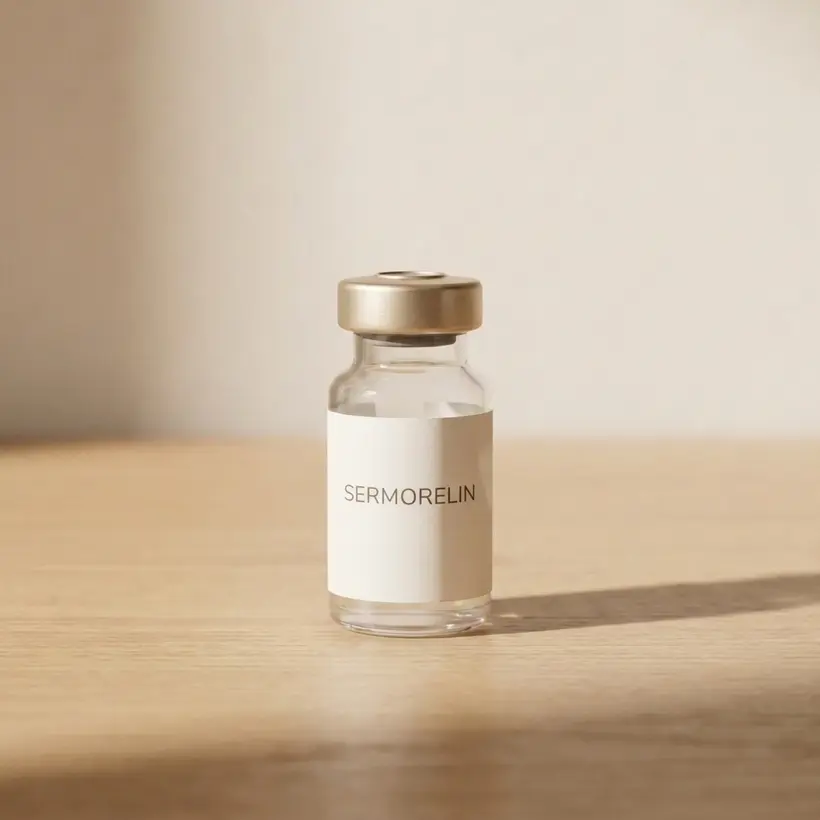
From the FormBlends catalog
Sermorelin
Bioidentical GHRH analog for natural growth hormone pulsatility · From $175/mo · compounded by a licensed 503A pharmacy, dispensed only after provider review.
View Sermorelin →Table of Contents
- How each drug works: mechanism with numbers
- Evidence ledger: what the data actually shows
- Which produces more weight loss?
- Side effects compared honestly
- Head-to-head table: sermorelin vs Ozempic
- What most pages get wrong about this comparison
- How to evaluate a sermorelin product or Ozempic prescription
- Who is actually a candidate for each?
- Can they be used together?
- FAQ
- Sources
How does each drug actually work, at the receptor level?
Sermorelin is a 29-amino-acid synthetic analog of endogenous growth hormone-releasing hormone (GHRH). It binds the GHRH receptor (GHRH-R), a G-protein-coupled receptor on somatotroph cells in the anterior pituitary. Receptor activation raises intracellular cAMP, triggering pulsatile release of endogenous GH. GH then stimulates hepatic and peripheral production of IGF-1. Sermorelin preserves the pituitary's own feedback loop: rising GH and IGF-1 still engage somatostatin brake signaling, which limits the degree of GH excess compared with injecting exogenous GH directly.
Plasma half-life of sermorelin is roughly 10 to 20 minutes (noted in FDA pharmacokinetic reviews of the original Geref product), which is why protocols almost always call for nightly subcutaneous injection timed to the natural GH pulse around sleep onset. It does not stay active long enough for once-weekly dosing.
Semaglutide (Ozempic, Wegovy) is a GLP-1 receptor agonist. GLP-1 receptors are expressed in pancreatic beta cells, the nodose ganglion of the vagus nerve, the hypothalamus, and the brainstem nucleus tractus solitarius. Semaglutide's primary weight-related mechanisms are: slowing gastric emptying (reducing postprandial glucose excursions and increasing satiety signals), activating hypothalamic neurons that reduce appetite, and augmenting glucose-dependent insulin secretion. Its half-life is approximately 1 week because of a C-18 fatty diacid linker that enables albumin binding and protects against DPP-4 degradation. This is a fundamentally different axis from GH, with no meaningful mechanistic overlap.
Evidence ledger: what quality of data supports each claim?
| Claim | Drug | Best Evidence Type | Sample Size Range | Effect Direction | Confidence |
|---|---|---|---|---|---|
| Significant body weight reduction in obesity | Semaglutide | Phase 3 RCTs (STEP program, SUSTAIN program) | Hundreds to 2,000+ per trial | Strong reduction (roughly 5 to 15% body weight) | High |
| Glycemic control in type 2 diabetes | Semaglutide | Multiple large RCTs, meta-analyses | Hundreds to 3,000+ per trial | Meaningful HbA1c reduction | High |
| Cardiovascular mortality reduction | Semaglutide | SUSTAIN-6 RCT (3,297 patients) | 3,297 | Reduction in MACE | Moderate to High |
| Raises IGF-1 in GH-deficient adults | Sermorelin | Small RCTs and open-label trials | 20 to 120 | IGF-1 increase | Moderate |
| Improves body composition (lean/fat ratio) | Sermorelin | Small trials in older/GH-deficient adults | 20 to 80 | Modest improvement | Low |
| Clinically meaningful weight loss in adults without GH deficiency | Sermorelin | No published RCT | N/A | No demonstrated effect | Very Low |
| Sleep quality improvement | Sermorelin | Anecdotal, mechanism-based speculation | N/A | Uncertain | Very Low |
Which produces more weight loss, and by how much?
Ozempic (semaglutide 1 mg weekly for diabetes) produced mean body weight reductions of roughly 4 to 6 kg across the SUSTAIN trial program in type 2 diabetes patients. At the 2.4 mg weekly Wegovy dose in the STEP 1 trial (Wilding et al., NEJM 2021, n=1,961 adults with obesity), mean weight loss was approximately 14.9% of body weight versus 2.4% with placebo over 68 weeks. These are large effect sizes by obesity pharmacotherapy standards.
Sermorelin has no published RCT showing comparable weight reduction. Small studies in growth hormone-deficient adults (a narrower population) show reductions in fat mass, primarily visceral, with modest lean-mass preservation. Translating those findings to otherwise healthy adults seeking weight loss is not scientifically supported.
The honest summary: if the primary goal is weight reduction in obesity, semaglutide is in a different league on evidence. Sermorelin is not a weight-loss drug under current data.
What are the real side effects of each?
Sermorelin: Injection-site erythema and pain are the most commonly reported reactions in clinical documentation of the original Geref product. Flushing, headache, and transient dizziness have been reported. At doses sufficient to meaningfully elevate GH, fluid retention and arthralgias can occur, mirroring exogenous GH side effects but typically at lower severity because the pituitary feedback axis is intact. Antibody formation to the peptide was documented in a minority of patients in original trials but did not appear to cause hypersensitivity reactions clinically. There is no black-box warning for sermorelin.
Semaglutide: Nausea is the most frequently reported adverse event, occurring in roughly 20% or more of participants in SUSTAIN and STEP trials at therapeutic doses (exact percentages vary by trial, dose, and timepoint). Vomiting and diarrhea are also common. The FDA label carries a black-box warning for thyroid C-cell tumors based on rodent carcinogenicity data; the relevance to humans is uncertain and no causal human signal has been established, but the warning requires counseling. Pancreatitis is a rare serious adverse event. Semaglutide is contraindicated in patients with a personal or family history of medullary thyroid carcinoma or MEN2.
Head-to-head: sermorelin vs Ozempic
| Feature | Sermorelin | Ozempic (Semaglutide) | Winner / Caveat |
|---|---|---|---|
| Weight loss evidence | Very limited, small studies | High-quality RCTs, 5 to 15% body weight | Ozempic clearly |
| Mechanism | GHRH-R agonist, pituitary GH release | GLP-1R agonist, appetite and glucose | Different axes; not comparable |
| Half-life | Roughly 10 to 20 minutes (daily injection) | Roughly 1 week (weekly injection) | Ozempic wins on convenience |
| Regulatory status (US, 2026) | Compounded only; no approved commercial product | FDA-approved; commercial product | Ozempic wins on regulatory assurance |
| GI side effects | Minimal | Common (nausea, vomiting, diarrhea) | Sermorelin wins on GI tolerability |
| Black-box warning | None | Thyroid C-cell tumors (rodent data) | Sermorelin wins on label risk profile |
| Lean mass support | Plausible (IGF-1 pathway); low-quality evidence | Some lean mass loss with caloric restriction | Sermorelin plausible advantage; evidence weak |
| Diabetes management | Not indicated or evidenced | FDA-approved; strong RCT evidence | Ozempic clearly |
| Cardiovascular outcome data | None | SUSTAIN-6 showed MACE reduction | Ozempic clearly |
| Cost (approximate, out-of-pocket) | Roughly $100 to $300/month compounded | Roughly $800 to $1,000+/month without insurance | Sermorelin wins on cash price |
| Insurance coverage | Almost never covered | Covered for T2D; variable for obesity | Depends on indication |
| Sourcing and purity assurance | Variable; compounding pharmacy dependent | Pharmaceutical-grade, standardized | Ozempic wins on product consistency |
What most comparison pages get wrong about sermorelin vs Ozempic
Treating them as competing weight-loss drugs. The majority of comparison content online frames this as "natural weight loss (sermorelin) vs drug weight loss (Ozempic)." That framing is inaccurate. Sermorelin is not approved or well-evidenced for weight loss in the general population. Comparing them as if both are equivalent options for someone with obesity misrepresents the evidence hierarchy.
Ignoring compounding pharmacy risk. Every page that recommends sermorelin as "safer" omits the critical variable: compounded sermorelin has no FDA lot release testing, no standardized impurity limits, and no required bioequivalence data. A compounding pharmacy operating under 503A must comply with USP Chapter 797, but analytical testing depth varies substantially. Purchasing from an unverified peptide vendor outside the pharmacy system introduces additional contamination risk. Pharmaceutical-grade Ozempic from a licensed dispensary does not carry this uncertainty.
Misrepresenting the feedback loop as purely protective. It is accurate that sermorelin preserves somatostatin feedback better than exogenous GH. But that feedback loop does not cap GH at a perfectly safe level at all doses. Patients with pre-existing conditions such as active malignancy, in which IGF-1 signaling may promote tumor growth, should not be using GHRH agonists. Most peptide-adjacent content never raises this contraindication.
Overstating lean mass data for sermorelin. Studies showing lean mass changes with sermorelin or GHRH analogs are primarily in adults with documented GH deficiency or older adults with age-related GH decline. These populations have more room for GH-axis restoration. Extrapolating those results to eugonadal adults in their 30s with normal IGF-1 is not supported by direct evidence.
How to evaluate what you are actually getting
For compounded sermorelin: Ask the pharmacy for a certificate of analysis (COA) from a third-party analytical laboratory. The COA should report identity confirmation (typically HPLC or LC-MS), purity as a percentage (USP peptide standards generally require 95% or greater), residual solvent levels, and sterility/endotoxin results for injectable products. A COA that only lists the peptide name and a pass/fail sterility result without purity data is insufficient. The product should be a lyophilized powder for reconstitution or a pre-mixed solution with documented preservative and pH data. Reconstituted sermorelin in bacteriostatic water is typically stable for a limited period under refrigeration; specific stability data should come from the pharmacy, not from forum posts.
Reconstitution math: A common supplied quantity is 3 mg (3,000 mcg) of lyophilized sermorelin. To prepare a solution of 100 mcg per 0.1 mL, add 3 mL of bacteriostatic water. Draw 0.1 mL per injection for a 100 mcg dose. Confirm the pharmacy's labeled concentration before calculating.
For Ozempic: Confirm the product is dispensed by a state-licensed pharmacy, carries an NDC number matching Novo Nordisk's registered products, and that the pen device has intact tamper-evident packaging. Counterfeit semaglutide has been reported by the FDA; purchasing from sources outside the licensed pharmacy supply chain is a documented risk. Store between 36 and 46 degrees Fahrenheit before first use; after first use, the pen can be kept at room temperature (up to 77 F) for up to 56 days per FDA-approved labeling.
Degraded product signs: Sermorelin solution that is cloudy, colored, or has visible particulates should not be used. Ozempic solution that is anything other than clear and colorless should not be used.
Who is actually a candidate for each?
Sermorelin is most defensible for: Adults with a documented low IGF-1 level or a formal GH deficiency diagnosis who do not want exogenous GH, and who are working with a physician who can monitor IGF-1 levels. It is sometimes used off-label for age-related GH decline. It is not a first-line or evidence-supported option for weight loss in people with obesity.
Ozempic is most defensible for: Adults with type 2 diabetes for glycemic control (its FDA-approved indication). Wegovy (semaglutide 2.4 mg) is FDA-approved for chronic weight management in adults with BMI 30 or greater, or BMI 27 or greater with at least one weight-related comorbidity. It has the strongest evidence base of any currently available weight-management drug short of surgery.
A person who has obesity, wants weight loss, and is looking for "something more natural" is not well served by choosing sermorelin over semaglutide on the basis of marketing language. A person with age-related GH decline or documented IGF-1 insufficiency who has already achieved a healthy weight may get value from sermorelin that semaglutide cannot offer.
Can sermorelin and Ozempic be used together?
There is no published clinical trial examining this combination. Mechanistically the two axes (GH/IGF-1 and GLP-1) do not share a direct pharmacodynamic interaction, so additive toxicity is not an obvious concern. Some clinicians prescribe them together targeting appetite reduction via GLP-1 and lean-mass/recovery support via GH axis. Sermorelin does not lower blood glucose directly, so hypoglycemia risk from the combination is not meaningfully elevated beyond semaglutide's own profile. Any combination protocol requires physician supervision and periodic IGF-1 monitoring to avoid supraphysiologic GH exposure. This is an off-label combination with no RCT evidence behind it.
FAQ
Can sermorelin and Ozempic be used together?
Some clinicians combine them targeting both GLP-1-driven appetite reduction and GH-axis body composition effects simultaneously. There are no published RCTs on the combination. Risk of compounding hypoglycemia is low because sermorelin does not directly lower blood glucose, but oversight by a prescribing physician is required for any combined protocol.
Which causes more weight loss, sermorelin or Ozempic?
Ozempic (semaglutide) causes substantially more documented weight loss. Phase 3 SUSTAIN trials showed roughly 4 to 6 kg mean body weight reduction at 1 mg dosing in type 2 diabetes patients, and the STEP trials showed roughly 15% body weight reduction at the 2.4 mg Wegovy dose. Sermorelin has no comparable large RCT weight-loss data; the modest lean-mass and fat-mass changes seen in small trials do not approach those magnitudes.
Does sermorelin build muscle while Ozempic causes muscle loss?
Sermorelin raises IGF-1 and may support lean mass retention, but the evidence in healthy adults is from small trials only. Ozempic's weight loss is predominantly fat loss, though some lean mass loss occurs with any significant caloric deficit. The degree of lean mass loss with semaglutide depends heavily on protein intake and resistance training. Neither drug is a proven standalone muscle-builder in healthy adults.
Is sermorelin FDA-approved?
Sermorelin acetate (Geref) held FDA approval for pediatric growth hormone deficiency diagnosis and treatment. That branded product was discontinued. Sermorelin is currently available only through compounding pharmacies under Section 503A or 503B, not as an FDA-approved commercial drug product, which means each compounded batch carries different purity and potency guarantees than an approved product.
What are the main side effects of sermorelin versus Ozempic?
Sermorelin's most common side effects are injection-site reactions, flushing, and transient headache. At supraphysiologic GH levels, fluid retention and joint discomfort can occur. Ozempic's dominant side effects are nausea, vomiting, diarrhea, and constipation, reported in roughly 15 to 44% of participants in SUSTAIN trials depending on dose and endpoint. Rare but serious Ozempic risks include pancreatitis and a thyroid C-cell tumor signal seen in rodents.
How long does it take for sermorelin to work?
IGF-1 levels begin rising within the first few weeks of nightly sermorelin dosing, but subjective changes in body composition typically require 3 to 6 months of consistent use in adult clinical reports. Ozempic's appetite suppression is noticeable within the first week of initiation for many patients, with measurable weight loss appearing within 4 to 8 weeks.
Who is the right candidate for sermorelin vs Ozempic?
Ozempic and Wegovy (semaglutide) have strong evidence bases for type 2 diabetes management and obesity (BMI 30 or greater, or 27 with a weight-related comorbidity). Sermorelin is more commonly prescribed off-label for adults with documented low IGF-1 or GH deficiency who want body composition support without exogenous GH. It is not a weight-loss drug under current evidence.
Does insurance cover sermorelin?
Sermorelin is almost universally not covered by insurance for anti-aging or body composition indications because those uses are off-label and lack the evidence threshold insurers require. Ozempic is covered for type 2 diabetes by most insurance plans; Wegovy (semaglutide 2.4 mg) coverage for obesity is more variable and often requires prior authorization.
What is the half-life of sermorelin versus semaglutide?
Sermorelin has a plasma half-life of roughly 10 to 20 minutes, requiring daily or twice-daily subcutaneous injection to maintain pulsatile GH release. Semaglutide has a half-life of approximately 1 week, enabling once-weekly dosing. This pharmacokinetic difference is clinically important for adherence and for the consequences of a missed dose.
Can sermorelin help with weight loss at all?
Small studies show sermorelin can modestly reduce visceral fat and improve lean-to-fat ratio in GH-deficient or older adults, but there are no large RCTs demonstrating clinically meaningful weight loss in people with obesity. Any weight changes seen in case series likely reflect improved body composition rather than the scale-moving effect of a GLP-1 agonist.
Is sermorelin safer than Ozempic?
Neither drug is categorically safer. Sermorelin's risk profile is milder in terms of gastrointestinal side effects, but compounded sermorelin carries sourcing and purity risks absent from pharmaceutical-grade Ozempic. Ozempic has rare but serious risks including pancreatitis and a rodent thyroid tumor signal. Safety comparisons depend heavily on the individual patient's health status and the quality of the product dispensed.
Sources
- Wilding JPH, et al. "Once-Weekly Semaglutide in Adults with Overweight or Obesity." New England Journal of Medicine. 2021;384(11):989-1002. (STEP 1 trial, n=1,961)
- Marso SP, et al. "Semaglutide and Cardiovascular Outcomes in Patients with Type 2 Diabetes." New England Journal of Medicine. 2016;375(19):1834-1844. (SUSTAIN-6 trial, n=3,297)
- Ozempic (semaglutide) US Prescribing Information. Novo Nordisk. Current label available via FDA.gov Drugs@FDA.
- Wegovy (semaglutide 2.4 mg) US Prescribing Information. Novo Nordisk. FDA-approved June 2021.
- FDA Drug Database, Geref (sermorelin acetate) NDA history. FDA.gov.
- Alba M, et al. "Once-daily administration of CJC-1295, a long-acting growth hormone-releasing hormone analog, normalizes growth hormone secretion in adults with severe growth hormone deficiency." Journal of Clinical Endocrinology and Metabolism. 2006;91(6):2195-2203. (Context for GHRH analog pharmacology)
- Khorram O, et al. "Effects of growth hormone-releasing hormone on the circadian rhythm of plasma growth hormone secretion in healthy elderly men." Journal of Clinical Endocrinology and Metabolism. 1993;77(2):526-530.
- USP Chapter 797: Pharmaceutical Compounding, Sterile Preparations. United States Pharmacopeia.
- FDA Safety Alert: Counterfeit semaglutide products identified in US drug supply. FDA.gov. 2024.
- Svensson J, et al. "Growth hormone replacement therapy and the insulin-like growth factor axis." Clinical Endocrinology. 2001. (General GH/IGF-1 axis pharmacology review)
Related peptide guides
Ready when you are
Sermorelin
Bioidentical GHRH analog for natural growth hormone pulsatility · From $175/mo · compounded by a licensed 503A pharmacy, dispensed only after provider review.
View Sermorelin →