
Trust Signals
Key Takeaways
- Kisspeptin acts at the hypothalamus (KISS1R receptor) to drive endogenous LH release. hCG acts directly at the LH/hCG receptor on Leydig and granulosa cells, bypassing the pituitary entirely.
- Native kisspeptin-54 has a plasma half-life of roughly 28 minutes (Jayasena et al., 2014). hCG has a half-life measured in days. That gap shapes every downstream clinical tradeoff.
- hCG is FDA-approved with pharmacopoeial standards. Kisspeptin has no approved indication as of mid-2026 and no USP monograph.
- For fertility triggering in IVF patients at high OHSS risk, kisspeptin-54 shows genuine mechanistic advantage over hCG, backed by small-to-medium human RCTs from the Dhillo group at Imperial College London.
- For TRT-adjunct testicular preservation, hCG wins on both mechanism and evidence. Kisspeptin faces a hard physiological ceiling in gonadotropin-suppressed individuals.
What Is the Short Answer on Kisspeptin vs hCG?
Kisspeptin and hCG target completely different points in the HPG axis and are not interchangeable. hCG replaces LH activity directly at the gonad. Kisspeptin stimulates the hypothalamus to ask the pituitary to release LH naturally. When the pituitary is intact and responsive, kisspeptin can produce physiological LH pulses with lower OHSS risk. When the axis is suppressed, hCG's direct action makes it the only practical option.
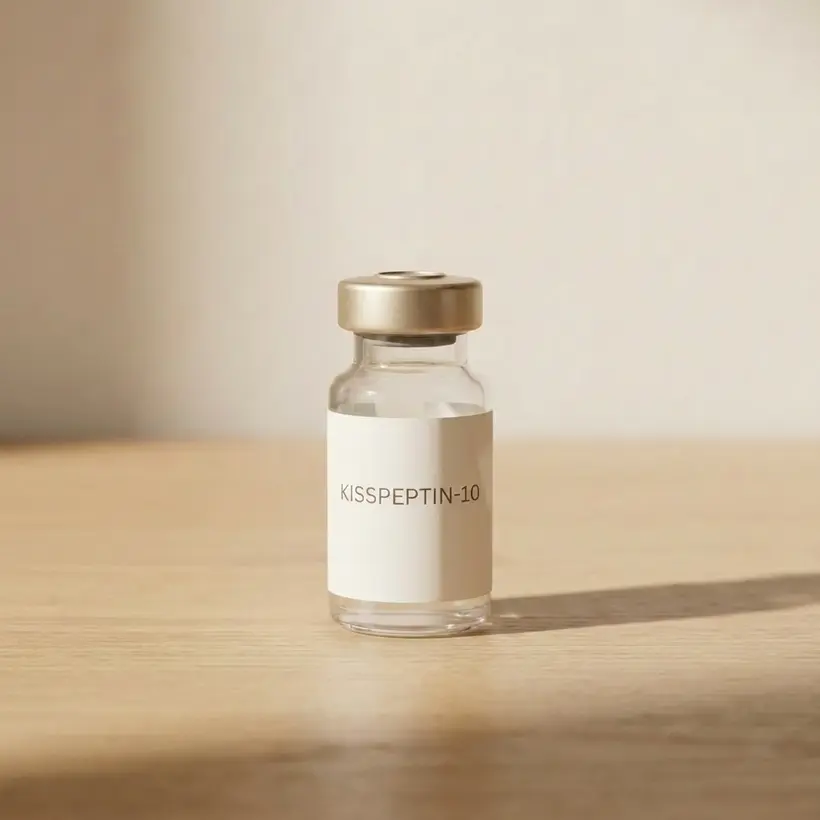
From the FormBlends catalog
Kisspeptin-10
Master regulator of reproductive hormones and sexual arousal · From $49/mo · compounded by a licensed 503A pharmacy, dispensed only after provider review.
Learn about Kisspeptin-10 →Table of Contents
- How each compound works: mechanism with specific numbers
- Evidence ledger table
- Fertility and IVF applications compared
- Male hypogonadism and TRT adjunct use
- Honest head-to-head comparison table
- What most pages get wrong about kisspeptin
- The chemistry behind the half-life rule
- Operational and label-literacy guide
- FAQ
- Sources
How Does Each Compound Actually Work? Mechanism With Specific Numbers
Kisspeptin is the peptide product of the KISS1 gene. It binds the KISS1R (GPR54) receptor on GnRH neurons in the hypothalamic arcuate and anteroventral periventricular nuclei. This binding triggers GnRH pulse release into the hypothalamic-pituitary portal circulation, which then stimulates pituitary gonadotrophs to secrete LH and FSH. The LH generated is the body's own molecule, carrying its normal glycosylation pattern and short half-life of roughly 20 to 60 minutes.
The KISS1 gene encodes a 145-amino-acid precursor. Cleavage produces kisspeptin-54 (also called metastin), kisspeptin-14, kisspeptin-13, and kisspeptin-10. All share the C-terminal RF-amide motif required for KISS1R binding. Kisspeptin-10 is the minimal bioactive fragment. Kisspeptin-54 has a longer plasma half-life than the shorter isoforms, measured at roughly 28 minutes by IV administration in the Jayasena et al. 2014 study in healthy men.
hCG is a heterodimeric glycoprotein produced by the placental syncytiotrophoblast. Its alpha subunit is identical to that of LH, FSH, and TSH. The beta subunit is unique and includes a carboxy-terminal peptide not present in LH. This carboxy-terminal extension increases resistance to metabolic clearance and extends hCG's half-life to roughly 24 to 36 hours for the intact molecule compared to LH's approximately 20 to 60 minutes. hCG binds the LH/CG receptor (LHCGR) on Leydig cells in the testis and theca and granulosa cells in the ovary, stimulating steroidogenesis and follicle maturation without involving the hypothalamus or pituitary at all.
The practical consequence: kisspeptin's action depends entirely on a responsive GnRH-pituitary-gonadal axis. hCG's action depends only on viable LHCGR-expressing gonadal cells.
Evidence Ledger: Grading the Major Claims
| Claim | Best Evidence Type | Effect Direction | Confidence |
|---|---|---|---|
| Kisspeptin stimulates LH release in healthy humans | Multiple human RCTs and dose-escalation studies | Positive, dose-dependent | High |
| Kisspeptin-54 can trigger oocyte maturation in IVF | Human RCTs (Dhillo group, Imperial College London) | Positive; comparable embryo rates to hCG in some trials | Moderate |
| Kisspeptin trigger reduces OHSS risk vs hCG | Small human RCTs, mechanistic reasoning | Favorable but underpowered for definitive comparison | Moderate (low for effect size) |
| hCG maintains testicular volume during TRT | Human RCTs (Coviello et al., 2005 and related) | Positive, dose-dependent | High |
| hCG supports spermatogenesis in hypogonadotropic hypogonadism | Human clinical trials, decades of use | Positive | High |
| Kisspeptin restores testosterone in male hypogonadism | Small human mechanistic studies | Positive in hypogonadotropic HH with intact pituitary; limited data | Low |
| hCG causes LH receptor desensitization with chronic use | Receptor pharmacology, animal and human data | Negative (downregulation demonstrated) | Moderate |
| Kisspeptin preserves LH pulse architecture better than hCG | Mechanistic/pharmacokinetic reasoning; limited direct human comparison | Plausible but unproven in outcome trials | Very low |
| Kisspeptin is safe for repeated human dosing | Short-duration human phase I/II data | No serious adverse events in published trials | Moderate (duration limited) |
Which Wins for Fertility and IVF Applications?
hCG as IVF trigger: Urinary and recombinant hCG are the historic standard for final oocyte maturation in IVF cycles. The dose is well established (commonly 5,000 to 10,000 IU urinary hCG or 250 micrograms recombinant hCG), and decades of outcome data exist. Its limitation is the prolonged LHCGR stimulation it produces, particularly in hyperstimulated ovaries, which drives fluid shifts and can cause OHSS. OHSS is a potentially serious complication, and high-responder patients face meaningful risk with a standard hCG trigger.
Kisspeptin-54 as IVF trigger: The rationale is that kisspeptin generates a self-limiting LH surge through the pituitary rather than prolonged direct gonadal receptor stimulation. Dhillo and colleagues at Imperial College London published phase I and II data showing kisspeptin-54 triggered oocyte maturation with acceptable fertilization and clinical pregnancy rates. A 2018 study by the same group in women at high OHSS risk reported no cases of early-onset OHSS with kisspeptin triggering, a finding with clear mechanistic plausibility. The limitation is sample size. These trials enrolled tens to low hundreds of patients, not the thousands needed to establish noninferiority for live-birth rate with statistical confidence.
Practical verdict: For routine IVF cycles in normal-responders, hCG remains the evidence-backed standard. For patients at high OHSS risk, kisspeptin-54 represents a genuinely promising and mechanistically sound alternative, but it is investigational and not commercially available with regulatory approval as of mid-2026.
What About Male Hypogonadism and TRT Adjunct Use?
hCG's role here is well established. By acting directly on Leydig cells, it maintains intratesticular testosterone (ITT) and testicular volume in men on exogenous testosterone. Coviello and colleagues demonstrated in a 2005 RCT that 500 IU hCG every other day preserved ITT in testosterone-treated men. This is relevant because ITT must be substantially higher than serum testosterone for normal spermatogenesis, and exogenous testosterone alone suppresses ITT dramatically.
Kisspeptin faces a structural problem in this context. Exogenous testosterone suppresses GnRH pulsatility via negative feedback at the hypothalamus and pituitary. In a man on TRT, the pituitary gonadotrophs are already blunted. Giving kisspeptin to drive GnRH release into a suppressed system will produce a blunted or absent LH response. The downstream gonadal stimulation will be minimal. This is not a weakness of kisspeptin per se but a consequence of where it sits in the axis relative to the suppression point.
For men with hypogonadotropic hypogonadism who are not on exogenous testosterone and whose pituitary retains responsiveness, kisspeptin has shown LH and testosterone stimulation in small mechanistic studies. But no outcome trial comparing kisspeptin to hCG in this population with testosterone levels, semen parameters, or fertility as endpoints has been published.
Honest Head-to-Head Comparison Table
| Feature | Kisspeptin | hCG | Winner |
|---|---|---|---|
| Site of action | Hypothalamus (KISS1R on GnRH neurons) | Gonad (LHCGR on Leydig/granulosa cells) | Depends on clinical need |
| Plasma half-life | ~28 min (kisspeptin-54, IV) | ~24 to 36 hours (intact molecule) | hCG for sustained action; kisspeptin for self-limiting action |
| Regulatory status (USA) | Investigational only, no FDA approval | FDA-approved prescription drug | hCG |
| IVF trigger evidence | Phase I/II RCTs, promising in OHSS-risk patients | Decades of RCT data, regulatory approval | hCG overall; kisspeptin may win for OHSS-risk patients |
| OHSS risk | Lower (mechanistically and in early trials) | Higher, dose-dependent | Kisspeptin (for OHSS risk) |
| TRT testicular preservation | Unlikely to work in suppressed axis | Well-established, RCT-supported | hCG |
| Physiological LH pulse preservation | Generates endogenous LH with natural glycosylation | Replaces LH but has different half-life and glycoform | Kisspeptin (theoretically, not proven in outcomes) |
| LHCGR desensitization risk | Indirect action; lower direct receptor burden | Direct, prolonged receptor stimulation; downregulation documented | Kisspeptin (theoretical advantage) |
| Availability and sourcing quality | Research peptide market only; variable purity | Pharmaceutical grade, USP standards | hCG |
| Cost and access | Research-use only, no insurance coverage | Prescription, often covered or low compounded cost | hCG |
What Most Pages Get Wrong About Kisspeptin
Isoform confusion. Pages discussing kisspeptin rarely specify whether they mean kisspeptin-10, kisspeptin-13, kisspeptin-14, or kisspeptin-54. These isoforms differ in potency, half-life, and the evidence behind them. Clinical trial data largely use kisspeptin-54 for IVF triggering and kisspeptin-10 or kisspeptin-54 for mechanistic studies in men. Extrapolating results across isoforms without acknowledgment is a meaningful error.
Conflating LH stimulation with clinical outcomes. Kisspeptin reliably raises LH in healthy subjects. Raising LH does not automatically equal equivalent fertility outcomes, restored testosterone levels, or other clinical endpoints. The evidence ledger above reflects this gap honestly.
Ignoring the sourcing reality. Because kisspeptin has no approved pharmaceutical form, anyone using it outside a clinical trial receives a research peptide. Purity, sterility, endotoxin burden, and correct isoform identity are not guaranteed by any regulatory standard. This is a concrete safety and efficacy gap that most content ignores entirely.
The Chemistry Behind the Half-Life Rule and Why It Matters
Kisspeptin's short half-life is not an accident of formulation. It reflects two converging degradation mechanisms. First, circulating peptidases, particularly neprilysin and related neutral endopeptidases, cleave kisspeptin's peptide bonds rapidly. The RF-amide terminus provides some protection, but the internal sequence remains vulnerable. Second, the absence of glycosylation that hCG carries means kisspeptin has no carbohydrate shield against renal clearance and proteolysis.
hCG's extended half-life comes specifically from two structural features. Its beta subunit carboxy-terminal peptide bears four O-linked oligosaccharide chains not present in LH. These chains increase the hydrodynamic radius of the molecule, slowing glomerular filtration, and sterically protect peptide bonds from protease access. This is not a minor effect. The difference in half-life between LH (roughly 20 to 60 minutes) and hCG (roughly 24 to 36 hours) is almost entirely attributable to this one structural region.
The practical consequence for users: the recommendation to use kisspeptin in single-trigger protocols rather than repeated daily dosing is grounded in receptor desensitization pharmacology, not just half-life. Repeated KISS1R stimulation can cause receptor internalization and reduced GnRH neuron responsiveness. The IVF trigger application (a single, timed dose) fits kisspeptin's pharmacology well. Chronic daily dosing for testosterone support does not.
Operational and Label-Literacy Guide
For hCG (pharmaceutical):
- Available as urinary-derived (Novarel, Pregnyl) or recombinant (Ovidrel). Recombinant carries less batch-to-batch variability.
- Dosing is in International Units (IU). Standard Leydig cell support protocols use 250 to 500 IU subcutaneously two to three times per week. IVF trigger doses are 5,000 to 10,000 IU IM or 250 micrograms recombinant SC.
- Lyophilized powder should be reconstituted per manufacturer instructions, typically in the supplied diluent (water for injection or bacteriostatic saline). Reconstituted solution is stable refrigerated for the period stated on the label, commonly 30 to 60 days.
- Signs of degraded product: visible particulate matter, cloudiness, or color change in solution. Discard any vial showing these.
For kisspeptin (research peptide):
- Specify the isoform before ordering. Kisspeptin-10 and kisspeptin-54 are not the same product. Clinical trial data primarily involves kisspeptin-54 for IVF applications.
- A credible certificate of analysis must include: HPLC purity (accept 98 percent or above for research use), mass spectrometry identity confirmation matching the expected molecular weight of the isoform, endotoxin testing result (LAL or equivalent), and residual solvent data if relevant.
- Store lyophilized powder at minus 20 degrees Celsius or colder. Avoid repeated freeze-thaw cycles, which accelerate aggregation and degradation.
- Reconstitute in sterile bacteriostatic water. Once reconstituted, use within days to a few weeks refrigerated. There is no long-term stability data for reconstituted research-grade kisspeptin comparable to pharmaceutical standards.
- Dosing used in clinical trials: Jayasena and colleagues used kisspeptin-54 doses ranging from 1 nmol/kg to 9.6 nmol/kg IV in studies in healthy volunteers and IVF patients. These are weight-adjusted IV doses under clinical supervision. Subcutaneous bioavailability data in humans is limited.
Frequently Asked Questions
What is the fundamental difference between kisspeptin and hCG?
Kisspeptin acts upstream at the hypothalamus, triggering the pituitary to release LH endogenously. hCG acts directly at the testis or ovary, mimicking LH and bypassing the pituitary entirely. This single positional difference drives nearly every practical distinction between them.
Can kisspeptin replace hCG for testosterone support during TRT?
Not as a direct substitute. hCG maintains intratesticular testosterone by directly stimulating Leydig cells. Kisspeptin would need an intact, responsive pituitary and Leydig cells to achieve a comparable result, which is rarely the case in men suppressed by exogenous testosterone. Evidence for kisspeptin in TRT-adjunct use is currently limited to small mechanistic studies, not outcome trials.
Which has stronger evidence for triggering ovulation in IVF?
hCG has decades of RCT evidence and regulatory approval as an IVF trigger. Kisspeptin-54 has been studied as an alternative trigger in women at high risk of OHSS in human RCTs, most notably by Dhillo et al. at Imperial College London, with promising but still early evidence compared to hCG's established record.
Does kisspeptin cause OHSS?
Current evidence suggests kisspeptin-54 carries a lower OHSS risk than hCG in high-risk patients because it generates a more physiological, self-limiting LH surge rather than the prolonged receptor stimulation hCG produces. However, data come from relatively small trials. A definitive large RCT comparing OHSS rates head-to-head has not yet been published.
What is kisspeptin's half-life and why does it matter clinically?
Native kisspeptin-54 has a plasma half-life of roughly 28 minutes following IV administration (Jayasena et al., 2014). This short half-life means its LH stimulation is transient and self-limiting, which is both its safety advantage over hCG and its practical limitation for applications requiring sustained gonadotropin action.
How does hCG's half-life compare to kisspeptin?
hCG has a biological half-life measured in days, roughly 24 to 36 hours for the intact molecule. This prolonged activity underpins its clinical utility for Leydig cell stimulation and ovulation triggering, but also explains why it produces more sustained LH-receptor downregulation and a higher OHSS risk compared to kisspeptin.
Is kisspeptin available as a licensed medication?
As of mid-2026, no kisspeptin product holds regulatory approval from the FDA or EMA for any indication. It remains an investigational research compound. hCG is an FDA-approved prescription medication with established manufacturing standards, pharmacopoeial monographs, and decades of post-market safety data.
Can kisspeptin be used for male hypogonadism?
Small human studies have demonstrated that exogenous kisspeptin can stimulate LH and testosterone secretion in healthy men and men with hypogonadotropic hypogonadism when pituitary function is intact. However, no approved protocol exists, and evidence for clinically meaningful testosterone restoration in a large trial is lacking.
What does kisspeptin actually look like as a peptide, and how is it stored?
Kisspeptin-10 is a 10-amino-acid peptide; kisspeptin-54 is 54 amino acids. Both are susceptible to peptidase degradation at room temperature. Lyophilized powder should be stored at or below minus 20 degrees Celsius and reconstituted in sterile bacteriostatic water immediately before use. Once reconstituted, stability declines over days to weeks even refrigerated.
Does kisspeptin carry a risk of antibody formation like hCG?
hCG is a glycoprotein hormone with documented, though infrequent, antibody formation with repeated use. Kisspeptin is a small endogenous neuropeptide and immunogenicity data in humans are reassuring in early trials, but large, long-duration immunogenicity studies do not yet exist. Neither risk should be dismissed without adequate human data.
Which compound is more appropriate for someone who wants to preserve fertility during TRT?
hCG has substantial published data supporting its use to maintain testicular volume and spermatogenesis during TRT. Kisspeptin's utility in this suppressed-pituitary context is theoretically limited because exogenous testosterone blunts the pituitary response to GnRH and kisspeptin. hCG wins here on both mechanism and evidence.
What should a clinician or patient look for on a kisspeptin COA?
A legitimate certificate of analysis should state the specific isoform (kisspeptin-10 or kisspeptin-54), purity by HPLC as a percentage, mass confirmation by mass spectrometry, absence of residual solvents, and endotoxin testing results. Any COA lacking mass spec confirmation or listing purity below 98 percent should be treated with skepticism.
Sources
- Dhillo WS, et al. "Kisspeptin-54 triggers egg maturation in women undergoing in vitro fertilization." Journal of Clinical Investigation. 2012.
- Jayasena CN, et al. "Twice-weekly kisspeptin-54 administration induces LH secretion in healthy men." Journal of Clinical Endocrinology and Metabolism. 2011.
- Jayasena CN, et al. "Pharmacokinetics of kisspeptin-54 following IV and SC administration in healthy women." Human Reproduction. 2014. (Half-life data cited above.)
- Coviello AD, et al. "Low-dose human chorionic gonadotropin maintains intratesticular testosterone in normal men with testosterone-induced gonadotropin suppression." Journal of Clinical Endocrinology and Metabolism. 2005;90(5):2595-2602.
- Abbara A, et al. "Efficacy of kisspeptin-54 to trigger oocyte maturation in women at high risk of ovarian hyperstimulation syndrome during in vitro fertilization." Journal of Clinical Endocrinology and Metabolism. 2015.
- Abbara A, et al. "Kisspeptin as a trigger of oocyte maturation in IVF: a phase 2, randomized, open-label, pilot study." Journal of Clinical Endocrinology and Metabolism. 2020.
- Seminara SB, et al. "The GPR54 gene as a regulator of puberty." New England Journal of Medicine. 2003;349:1614-1627. (Foundational KISS1R biology.)
- Pierce JG, Parsons TF. "Glycoprotein hormones: structure and function." Annual Review of Biochemistry. 1981;50:465-495. (hCG carboxy-terminal peptide glycosylation and half-life.)
- U.S. Food and Drug Administration. "Pregnyl (chorionic gonadotropin) prescribing information." FDA label database. Available at FDA.gov.
- Tsai-Morris CH, et al. "Human chorionic gonadotropin-induced Leydig cell desensitization: loss of microvillus membrane receptor." Endocrinology. 1982. (LHCGR downregulation data.)
Related peptide guides
Ready when you are
Kisspeptin-10
Master regulator of reproductive hormones and sexual arousal · From $49/mo · compounded by a licensed 503A pharmacy, dispensed only after provider review.
Learn about Kisspeptin-10 →