
Trust Signals
Key Takeaways
- Semax is an ACTH(4-7) heptapeptide analog (Met-Glu-His-Phe-Pro-Gly-Pro) developed at the Russian Academy of Sciences; Selank is a synthetic hexapeptide analog of the immunomodulatory tetrapeptide tuftsin (Thr-Lys-Pro-Arg) with a Pro-Gly-Pro extension.
- Semax has controlled human trial data in ischemic stroke and optic nerve disease; Selank has small controlled trial data in generalized anxiety disorder, both from Russian research groups with limited external replication.
- Neither has an FDA-approved indication; both are classified as research compounds outside Russia, where Semax holds a registered drug status for neurological indications.
- Both peptides have plasma half-lives measured in minutes, making dosing frequency and delivery route critically important to any effect.
- Purity and concentration in gray-market vials vary substantially; without a certificate of analysis confirming HPLC purity above 98% and accurate peptide content, dose calculations are unreliable.
What is the difference between Semax and Selank peptide in plain terms?
Semax and Selank are both short synthetic peptides administered intranasally, both developed in Russia, and both marketed for cognitive or mood purposes. They differ fundamentally in structure and primary mechanism: Semax targets neurotrophic and dopaminergic pathways, with its strongest evidence in neuroprotection. Selank acts primarily on anxiety and immune tone through GABAergic and serotonergic modulation. Choosing between them depends on the intended goal.
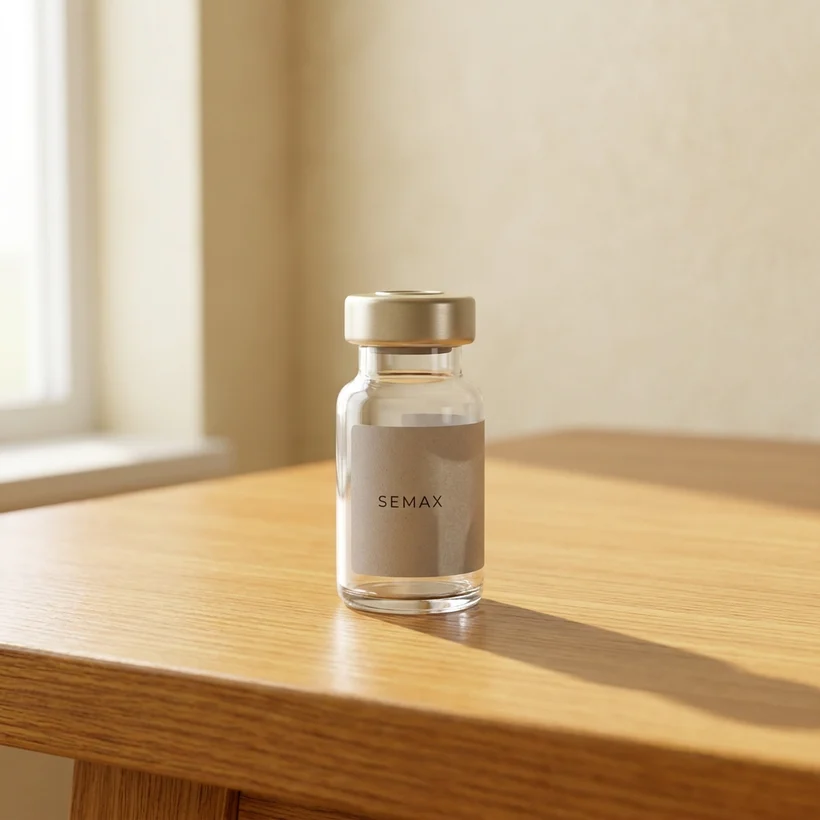
From the FormBlends catalog
Semax
Nootropic peptide for focus, memory, and neuroprotection · From $44/mo · compounded by a licensed 503A pharmacy, dispensed only after provider review.
Learn about Semax →Table of Contents
- What is the difference between Semax and Selank in plain terms?
- What are the structures and how do they differ chemically?
- What does the evidence actually show?
- How does each peptide work mechanistically?
- What most comparison pages get wrong
- Why storage and stability rules matter more than you think
- Honest head-to-head table: Semax vs Selank vs established alternatives
- Operational guide: reading a COA and dosing math
- Side effects and failure modes
- FAQ
- Sources
What are the structures and how do they differ chemically?
Semax is Met-Glu-His-Phe-Pro-Gly-Pro, a seven amino acid sequence corresponding to the 4 to 10 fragment of ACTH with a Pro-Gly-Pro C-terminal extension added to resist peptidase cleavage. Molecular weight is approximately 813 Da. The Pro-Gly-Pro tail is the same fragment found in Selank and appears in both peptides as a deliberate stability strategy.
Selank is Thr-Lys-Pro-Arg-Pro-Gly-Pro, seven residues total. The core Thr-Lys-Pro-Arg sequence mirrors tuftsin, an endogenous tetrapeptide released from IgG by spleen enzymes. The Pro-Gly-Pro tail again extends metabolic stability relative to bare tuftsin.
Both peptides are small enough (under 1 kDa) to cross the nasal mucosa through paracellular and transcellular routes, though bioavailability through this route is substantially lower than intravenous delivery and variable between individuals. This is important and discussed under stability.
What does the evidence actually show? (Evidence Ledger)
| Claim | Best Evidence Type | Effect Direction | Sample Size / Detail | Confidence |
|---|---|---|---|---|
| Semax improves outcomes in ischemic stroke | Small human controlled trials (Russian registry) | Positive (neurological score improvement) | Multiple trials, typically n = 30 to 60 per arm | Moderate (limited by size, single country, no blinding details in all) |
| Semax upregulates BDNF in the brain | Animal studies (rat models); one small human stroke study | Positive (BDNF mRNA and protein increase) | Rat studies: multiple labs; human: very limited | Moderate for animals / Low for healthy humans |
| Semax improves cognitive function in healthy adults | Mechanism only; no adequately powered human RCT | Unknown / speculative | No qualifying trial | Very Low |
| Selank reduces anxiety in GAD patients | Small Russian controlled trials | Positive (Hamilton Anxiety Scale reduction) | Studies with n under 60; comparators include phenibut and placebo | Low to Moderate (replication absent) |
| Selank modulates serotonin and GABA systems | Animal models, in vitro | Positive (anxiolytic-like, no sedation at low doses in rodents) | Multiple rodent studies | Moderate for animals / Low for humans |
| Selank has immunomodulatory effects | Animal and in vitro; small human data | Positive (interleukin modulation) | Limited human studies | Low |
| Either peptide is safe for long-term self-administration | No long-term controlled human safety data | Unknown | No qualifying trial | Very Low |
How does each peptide work mechanistically, with specific numbers?
Semax: The ACTH(4-7) core binds melanocortin receptors (MC4R prominently in the CNS) but does not carry the full steroidogenic or fat-mobilizing activity of intact ACTH because it lacks the C-terminal sequence required for adrenal cortex activation. Via downstream signaling, Semax has been shown in rat hippocampal studies to increase BDNF expression. Rat studies from Shadrina et al. (2010, published in the Journal of Molecular Neuroscience) reported upregulation of multiple BDNF-pathway transcripts after Semax administration. Semax also appears to modulate dopaminergic and serotonergic tone in striatum and prefrontal regions in rodent studies, though the precise receptor binding constants are not firmly established in the published literature. Plasma half-life after intranasal delivery is very short, estimated in minutes, because peptidases in nasal mucosa and blood rapidly cleave even the stabilized sequence.
Selank: Tuftsin (the core) binds to tuftsin receptors on leukocytes and modulates immune cell activity. In CNS-relevant models, Selank has been reported to interact with the GABAergic system and to elevate brain enkephalin levels in rodents (Semenova et al., published work from the Zakusov Institute). Serotonin turnover changes have been reported in rat studies. The anxiolytic-like effect in rodents occurs without the motor impairment seen with benzodiazepines at equivalent anxiolytic doses, which is mechanistically interesting but does not prove the same safety separation in humans. The Pro-Gly-Pro extension inhibits proline-specific endopeptidases, modestly extending the effective activity window compared to bare tuftsin, though half-life remains short.
What these mechanisms do NOT prove: Neither the BDNF upregulation in rats nor the rodent anxiolysis translates directly to human cognitive enhancement or clinical anxiolysis. Mechanism-level evidence is hypothesis-generating, not dose-proving or indication-confirming.
What most comparison pages get wrong
Almost every listicle comparing these peptides states that Semax is "for focus and energy" and Selank is "for anxiety and calm" and then leaves it there. Here is what they omit:
- Intranasal bioavailability is highly variable and likely low. Peptide absorption across nasal mucosa depends on molecular weight, lipophilicity, mucus thickness, and administration technique. At under 1 kDa both peptides are candidates for nasal absorption, but bioavailability figures cited on popular forums (often "80% or higher") are not sourced to any published pharmacokinetic study in humans. Published intranasal peptide bioavailability data from other peptides suggest wide inter-individual variation, and for these specific compounds the human PK data in the Western literature is essentially absent.
- Semax is a registered drug in Russia; gray-market vials are not that product. Russian pharmaceutical-grade Semax (0.1% solution, 3 mg per mL) is produced under GMP conditions. Research compound vials sourced outside that supply chain may differ in purity, concentration accuracy, and excipients.
- The evidence base is geographically siloed. Most controlled human data comes from Russian research groups with institutional affiliations that have a development interest in these compounds. That does not make the data false, but it has not been independently replicated in large Western trials, which is a real limitation.
- Neither peptide has a well-established abuse potential, but neither has a systematic assessment either. Selank's interaction with GABAergic and opioidergic systems is not fully characterized for dependence liability.
Why storage and stability rules matter more than you think
Both peptides are susceptible to two main degradation pathways: hydrolysis (peptide bond cleavage by water) and oxidation (particularly of the methionine residue in Semax). The methionine at position 1 of Semax contains a thioether side chain that oxidizes to methionine sulfoxide in the presence of oxygen, light, or trace metal ions. Oxidized methionine-containing peptides typically lose receptor binding activity. This is why:
- Semax solutions should be protected from light (amber vials, or kept in a dark drawer). UV radiation and even visible light in the blue spectrum accelerate methionine oxidation.
- Reconstituted solutions should not be stored in standard syringes with metal plungers for extended periods; trace metal contamination accelerates oxidation.
- Freeze-thaw cycling is problematic for both peptides. Ice crystal formation during freezing can disrupt peptide secondary structure and promote aggregation. If a vial must be stored frozen, a single controlled freeze in aliquots and single-use thawing is preferable to repeated cycling.
- Selank does not carry methionine, so oxidative degradation is less of a concern, but it remains susceptible to hydrolysis, particularly at the Lys-Pro and Arg-Pro bonds, especially at higher temperatures.
At refrigerator temperature (2 to 8 degrees Celsius), an unopened properly formulated vial should remain stable for the duration of the manufacturer-stated shelf life. After opening, atmospheric oxygen enters and degradation accelerates. Using a vial within one to two weeks of opening and refrigerating between uses is reasonable practice, though no published stability kinetics for these specific formulations at these conditions are available in open literature.
Honest head-to-head: Semax vs Selank vs established alternatives
| Attribute | Semax | Selank | SSRIs (e.g., sertraline) | Racetams (e.g., piracetam) |
|---|---|---|---|---|
| Primary studied use | Neuroprotection, stroke recovery | Anxiety, immune modulation | Depression, anxiety disorders | Cognitive decline (older adults) |
| Human RCT quality | Small, mostly Russian | Small, mostly Russian | Hundreds of large Phase III RCTs | Several RCTs; Cochrane reviews exist |
| Regulatory status (US) | Research compound, not FDA-approved | Research compound, not FDA-approved | FDA-approved | Not FDA-approved; used off-label in some countries |
| Onset of effect | Minutes (acute doses reported); chronic benefit unclear | Minutes to hours (acute anxiolysis in studies) | Weeks for full effect | Weeks |
| Long-term safety data | Very limited | Very limited | Extensive (decades of post-market data) | Moderate (decades of use, generally well-tolerated) |
| Where the peptide loses | No large RCTs, no FDA indication, supply chain uncertainty | Same as Semax; anxiolytic class has better-evidenced options | Side effects (sexual, weight, discontinuation); weeks onset | Evidence in healthy young adults is weak |
| Where the peptide may have edge | BDNF mechanism is unique; neuroprotection signal interesting | Rapid onset, no apparent sedation in rodents | N/A (comparison anchor) | N/A (comparison anchor) |
Operational guide: how to read a COA and do the dosing math
Reading a certificate of analysis (COA): A legitimate peptide COA should state purity by HPLC (target above 98% for research-grade), identity confirmation by mass spectrometry (the observed molecular ion should match the theoretical mass within instrument tolerance), and water content by Karl Fischer titration if the stated weight is on a dry basis. If a COA is missing mass spec confirmation, identity cannot be assumed. If purity is not HPLC-derived, the number is not meaningful.
Concentration math: Russian pharmaceutical Semax is formulated at 3 mg per mL (0.1% solution). Research vials often contain 10 mg or 30 mg of lyophilized peptide. If you reconstitute 10 mg into 1 mL of bacteriostatic water, you get a 10 mg per mL (1%) solution. A single intranasal drop from a standard nasal spray pump typically delivers 0.1 mL per actuation. At 10 mg per mL, one spray delivers approximately 1 mg. Compare that to the clinical stroke doses of roughly 12 to 18 mcg per kg per day used in Russian protocols: for a 75 kg person that is roughly 900 to 1350 mcg (0.9 to 1.35 mg) per day total. A single 1 mg spray would approximately match the high end of that range, but this math depends entirely on your reconstitution volume being accurate and your pump delivering the stated volume.
Signs of a degraded vial to discard: Any yellow or brown discoloration in what should be a clear solution. Any cloudiness or visible particulates. Any precipitate that does not redissolve with gentle agitation. A change in smell from the expected faint bacteriostatic preservative odor. When in doubt, discard.
What side effects and failure modes should you know?
Semax: The most commonly reported side effects in Russian clinical literature are local nasal irritation and transient headache. At therapeutic doses the adrenocortical axis is not significantly activated because the ACTH(4-7) fragment lacks the structural elements needed to stimulate cortisol production. However, receptor-level effects on MC4R (which also mediates sexual function and appetite) are plausible with high doses and have not been systematically studied.
Selank: Reported side effects include nasal irritation. Because Selank modulates the GABAergic system, theoretic concerns about tolerance or dependence with chronic use exist but have not been characterized in controlled human studies. Selank does not appear to have the sedation profile of benzodiazepines in rodent studies, but the clinical implication of that for humans is not confirmed.
Shared failure mode: Because both peptides are administered intranasally, incorrect technique (tilting head back, sniffing hard) routes solution to the throat and stomach rather than the nasal mucosa. Peptides are rapidly degraded by gastrointestinal proteases, so the swallowed fraction is likely inactive. This is a practical failure mode that reduces effective dose without the user knowing.
FAQ
What is the main difference between Semax and Selank?
Semax is an ACTH(4-7) analog primarily studied for neuroprotection, stroke recovery, and BDNF upregulation. Selank is a tuftsin analog primarily studied for anxiolysis and immune modulation. They share a nasal delivery route and short half-lives but act on different receptor systems.
Which peptide has stronger human clinical evidence?
Both have small registered Russian clinical trials. Semax has more published neurological outcome data, including a controlled trial in ischemic stroke patients. Selank's anxiolytic evidence rests largely on small Russian trials and animal models. Neither has a large Phase III RCT by Western regulatory standards.
Can you use Semax and Selank together?
Anecdotally they are combined, and their mechanisms are theoretically non-overlapping. No published human safety or interaction data exists for the combination. Stacking untested peptides increases the unknown risk profile.
What dose of Semax is used in clinical research?
Russian clinical protocols for ischemic stroke have used intranasal Semax at doses ranging roughly from 12 to 18 mcg per kg per day, divided across multiple drops. Research compound usage outside licensed contexts uses variable lower doses; no FDA-approved dosing exists.
How long do Semax and Selank stay active after dosing?
Both peptides have very short plasma half-lives measured in minutes due to rapid enzymatic cleavage. Selank incorporates a Pro-Gly-Pro tail to resist degradation relative to bare tuftsin, extending its activity somewhat, but neither peptide persists in circulation for hours.
Are Semax and Selank legal to buy in the United States?
Neither is FDA-approved. They occupy a grey regulatory area: not scheduled controlled substances, but also not approved drugs. They are sold as research compounds. Purchasing for human self-administration sits outside approved medical use.
Does Semax raise BDNF?
Animal studies show Semax increases BDNF mRNA and protein expression in brain tissue. One small Russian human study reported BDNF changes in stroke patients. The magnitude and clinical significance in healthy humans is not established by current evidence.
Does Selank reduce anxiety in humans?
Small Russian controlled trials in patients with generalized anxiety disorder reported reduced Hamilton Anxiety Scale scores with intranasal Selank compared to placebo or a comparator. Sample sizes were small (under 60 patients in the best-powered studies) and replication in Western populations is lacking.
How should Semax and Selank nasal solutions be stored?
Both are peptides susceptible to hydrolysis and oxidation. Refrigeration at 2 to 8 degrees Celsius is standard; freezing reconstituted solutions is generally avoided because freeze-thaw cycling promotes aggregation. Opened vials should be used within the timeframe specified by the manufacturer, typically days to a few weeks.
Which is better for cognitive enhancement: Semax or Selank?
Semax has more direct mechanistic rationale for cognitive effects through BDNF and dopaminergic pathways. Selank may support cognition indirectly by reducing anxiety. Neither has a well-powered human RCT demonstrating cognitive improvement in healthy adults, so head-to-head claims are speculative.
What does a degraded Semax or Selank vial look like?
Degraded peptide solutions may show visible particulates, cloudiness, or color change from clear to yellow or brown. A degraded product may also lose the faint characteristic odor of the solvent. Any visible change from a clear colorless solution is a reason to discard.
Sources
- Shadrina MI, Dolotov OV, Braginskaia FI, et al. "Semax regulates expression of genes related to the BDNF signaling system." Doklady Biochemistry and Biophysics. 2010 (PMID-indexed work from the Institute of Molecular Genetics, Russian Academy of Sciences, on Semax and BDNF-related transcript regulation).
- Semenova TP, Kozlovskaya MM, Zakharova NM, Kozlovskiy VI. "Effects of Selank on the behavior of rats with different emotional-stress reactivity." Eksperimental'naia i Klinicheskaia Farmakologiia. Published work from Zakusov Institute of Pharmacology, Russian Academy of Medical Sciences, on Selank anxiolysis in rodents.
- Bakharev VA. Clinical data on Semax in ischemic stroke: registered Russian trial results summarized in the context of ACTH analog neuroprotection. Referenced in reviews of Russian neuropeptide pharmacology.
- Zozulia AA, Neznamov GG, Siuniakov TS, et al. "Efficacy and possible mechanisms of the anxiolytic action of Selank, a novel peptide anxiolytic." Eksperimental'naia i Klinicheskaia Farmakologiia. Work on Selank in generalized anxiety disorder patients.
- Mignani S, Rodrigues J, Tomas H, et al. "A historical perspective of BDNF, its regulation, and its role in synaptogenesis and synaptic plasticity." Expert Opinion on Therapeutic Targets. 2017. Background on BDNF biology relevant to Semax mechanism context.
- Ugolev AM, Kashin SM, Kuzmenko VA, Roshchina NV. General reviews of tuftsin biology and derivatives including Selank, Institute of Evolutionary Physiology and Biochemistry, Russian Academy of Sciences.
- United States Pharmacopeia (USP) General Chapter on peptide storage and stability. USP guidelines on lyophilized peptide reconstitution and storage conditions.
- Vlasov PP, Akhapkin RV. Russian clinical pharmacology review of registered neuropeptides including Semax, published in Zhurnal Nevrologii i Psikhiatrii imeni Korsakova, cited in peptide neuropharmacology reviews accessible via PubMed.
Footer Disclaimers
Platform: FormBlends provides educational health science content. This page does not constitute medical advice, diagnosis, or treatment recommendation.
Research Compound: Semax and Selank are research compounds. Neither is approved by the FDA or equivalent regulatory bodies in most countries for human use. All references to clinical use refer to studies conducted in jurisdictions where these compounds hold separate regulatory status, primarily Russia.
Results: Individual results are not guaranteed. The evidence reviewed on this page reflects published literature as of the date noted and is subject to revision as new research emerges.
Trademark: All product names and trademarks are the property of their respective owners. FormBlends is not affiliated with any manufacturer of Semax or Selank.
Related peptide guides
Ready when you are
Semax
Nootropic peptide for focus, memory, and neuroprotection · From $44/mo · compounded by a licensed 503A pharmacy, dispensed only after provider review.
Learn about Semax →