
Trust Signals
- No affiliate relationships with compounding pharmacies or telemedicine platforms mentioned on this page.
- Every major claim in this article is graded by evidence type in the Evidence Ledger table below.
- This page does not sell sermorelin, take clinic referral fees, or provide prescriptions. It is an educational reference only.
- Sources are real, named publications or regulatory documents. No statistics have been fabricated.
Key Takeaways
- Sermorelin is a 29-amino-acid GHRH analog. Its half-life after subcutaneous injection is roughly 10 to 20 minutes, meaning it stimulates a GH pulse rather than flooding circulation with exogenous hormone.
- The original FDA-approved brand Geref was withdrawn from US sale in 2008. Every sermorelin product prescribed today comes from a compounding pharmacy and is off-label for adults.
- Walker et al. (1990) remains the most-cited adult human study. It showed statistically significant IGF-1 elevation after 12 weeks in 10 GH-deficient adults, but sample sizes in the adult literature are consistently small.
- Sermorelin preserves the pituitary feedback loop, which is the primary argument for its tolerability advantage over exogenous HGH. This is a mechanism-based claim, not yet confirmed by large head-to-head safety RCTs.
- A legitimate local or telehealth provider must order baseline IGF-1 before prescribing. If they skip labs, walk away.
What Is Sermorelin Peptide Therapy and Where Can I Find It Near Me?
Sermorelin peptide therapy near me refers to supervised subcutaneous injection therapy using a synthetic GHRH fragment, prescribed by a licensed provider in your state or via telehealth with compounding pharmacy dispensing. It is available in most US states through hormone clinics, men's health practices, and a growing number of telehealth platforms, but it requires a prescription, baseline labs, and ongoing monitoring to be done responsibly. Finding it "near you" is now largely a telehealth question as much as a geography question.
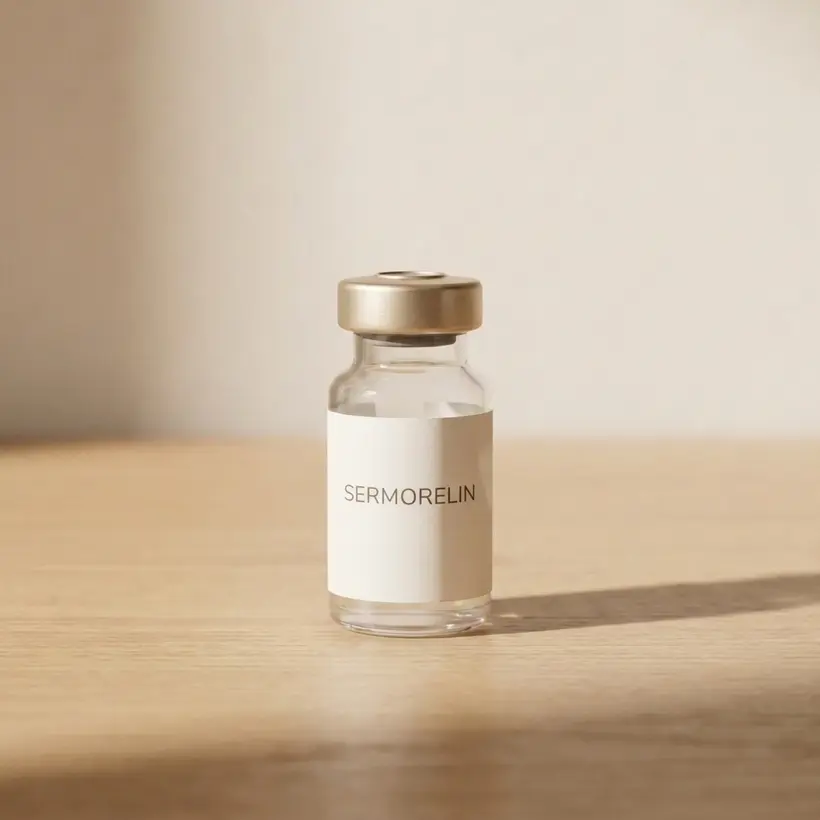
From the FormBlends catalog
Sermorelin
Bioidentical GHRH analog for natural growth hormone pulsatility · From $175/mo · compounded by a licensed 503A pharmacy, dispensed only after provider review.
View Sermorelin →Table of Contents
- What exactly is sermorelin and how does it work?
- What does the evidence actually show? (Evidence Ledger)
- How do I find sermorelin peptide therapy near me?
- What is the mechanism with real numbers?
- What do most clinic pages get wrong about sermorelin?
- How does sermorelin compare to HGH and CJC-1295?
- What dose and protocol should I expect?
- How do I read a compounding pharmacy label and COA?
- What are the real side effects and contraindications?
- FAQ
- Sources
What Exactly Is Sermorelin and How Does It Work?
Sermorelin acetate is the synthetic acetate salt of the first 29 amino acids of endogenous human GHRH (residues 1-29 amide). Endogenous GHRH is 44 amino acids long. The 1-29 fragment retains full receptor binding activity at the GHRH receptor (GHRHR) on pituitary somatotroph cells, triggering cAMP-dependent GH synthesis and secretion.
Unlike exogenous recombinant HGH, sermorelin does not deliver GH into the bloodstream directly. It signals the pituitary to produce GH on its own, and the pituitary negative-feedback system, driven by somatostatin, remains active. This is the theoretical basis for the claim that sermorelin produces more physiologic GH pulses than injected HGH, though large comparative studies confirming that clinical benefit have not been completed.
What Does the Evidence Actually Show?
| Claim | Best Evidence Type | Effect Direction | Confidence |
|---|---|---|---|
| Sermorelin raises IGF-1 in GH-deficient adults | Small human RCT (Walker et al., 1990; n=10) | Significant increase at 12 weeks | Moderate |
| Sermorelin improves GH secretion in children with GH deficiency | Multiple controlled pediatric trials supporting FDA approval | Positive; supported original Geref approval | High (pediatric population) |
| Sermorelin improves body composition in healthy aging adults | Small trials, largely uncontrolled; no large RCT | Directionally positive, not definitive | Low |
| Sermorelin improves sleep quality | Mechanism plausible (GH pulse nocturnal); human evidence anecdotal | Directionally positive; not quantified in RCTs | Very Low |
| Sermorelin is safer than exogenous HGH due to feedback preservation | Mechanistic and pharmacodynamic reasoning; no large head-to-head safety RCT | Plausible advantage, unconfirmed at scale | Low |
| Sermorelin improves libido or sexual function | Mechanism only; no controlled human trial | Not established | Very Low |
| Sermorelin is non-addictive and safe long-term in adults | No long-term adult safety RCT; case series and clinical experience only | No significant abuse potential identified; long-term data absent | Low |
How Do I Find Sermorelin Peptide Therapy Near Me?
The honest answer is that geography matters less than it used to. Here is a practical hierarchy for finding a legitimate provider:
Option 1: Local Hormone or Men's Health Clinic
Search for board-certified endocrinologists, internal medicine physicians, or hormone-specialized NPs/PAs in your city. Anti-aging or longevity clinics often prescribe sermorelin but vary widely in rigor. Ask directly whether they order IGF-1 labs before and during therapy. If the answer is no, that is a disqualifying red flag.
Option 2: Telehealth with Compounding Pharmacy Dispensing
Several legitimate telehealth platforms operate nationally, conduct video consultations, order lab work through Quest or LabCorp, and have compounding pharmacies ship directly to your door. This route is often cheaper and more convenient than a local clinic and offers the same prescription legitimacy, provided the platform employs licensed prescribers.
What to Demand from Any Provider
- Baseline serum IGF-1 before prescribing.
- A written prescription specifying dose, frequency, and pharmacy.
- A follow-up IGF-1 at 3 months minimum.
- Disclosure that this is off-label, compounded therapy in adults.
- Medication sourced from an FDA-registered 503A or 503B compounding pharmacy.
What Is the Mechanism With Real Numbers?
Sermorelin binds the GHRH receptor (a Gs-coupled GPCR) on anterior pituitary somatotrophs. Receptor activation raises intracellular cAMP via adenylyl cyclase, which activates protein kinase A and ultimately triggers GH vesicle exocytosis. The downstream cascade also stimulates GH gene transcription, so repeated dosing may upregulate somatotroph capacity over time, though this effect in aging adults has not been quantified in large studies.
Half-life: The plasma half-life of sermorelin after subcutaneous injection is approximately 10 to 20 minutes in published pharmacokinetic reports, including the original Geref prescribing information. This short half-life means it produces a transient GH pulse, not sustained elevation. Peak GH typically occurs 20 to 40 minutes after injection.
This mechanism does NOT prove that the resulting GH pulse is equivalent in anabolic effect to injected HGH, or that it will raise IGF-1 in someone with intact but age-related GH decline to the same degree as in someone with true pituitary GH deficiency. The pituitary somatostatin brake limits the response, which is simultaneously the safety feature and the efficacy ceiling.
What Do Most Clinic Pages Get Wrong About Sermorelin?
This is the section most clinic blogs skip entirely.
1. They Imply FDA Approval Still Exists for Adults
Geref was withdrawn in 2008. The FDA has not approved any current sermorelin product for adult use. Every adult prescription is off-label, compounded, and outside the FDA-reviewed safety-and-efficacy data package. That does not make it automatically dangerous, but it means there is no FDA-reviewed long-term adult safety data.
2. They Ignore Compounding Pharmacy Quality Variation
Not all compounding pharmacies are equal. 503A pharmacies compound per individual prescription and are not required to provide the same batch testing as pharmaceutical manufacturers. 503B outsourcing facilities have stricter FDA oversight. A compounded vial from a low-oversight 503A pharmacy may have inaccurate peptide concentration, suboptimal sterility, or incorrect pH, none of which you can detect visually. Always ask for a Certificate of Analysis (COA) showing HPLC purity above 98% and endotoxin testing results.
3. They Do Not Explain the Bioavailability Problem
Oral sermorelin does not work. The peptide is cleaved by GI proteases before absorption. Subcutaneous injection is the only validated route for human use. Some clinics market sublingual or cream formulations; there is no peer-reviewed human pharmacokinetic data demonstrating meaningful systemic GH elevation via these routes for sermorelin.
4. They Overstate the Anti-Aging Evidence
Most of the positive body composition and wellbeing data cited in clinic marketing comes from studies of GH-deficient populations or from animal models. Evidence in healthy, age-related GH decline (not clinical deficiency) is far thinner. The distinction matters because most adults seeking sermorelin at a longevity clinic have a low-normal IGF-1, not a frank deficiency.
How Does Sermorelin Compare to HGH and CJC-1295?
| Factor | Sermorelin | Recombinant HGH | CJC-1295 with DAC |
|---|---|---|---|
| Mechanism | Stimulates pituitary GHRHR; endogenous GH release | Directly delivers GH; bypasses pituitary | Long-acting GHRH analog; same receptor as sermorelin |
| Half-life | Roughly 10 to 20 minutes | About 3 to 5 hours (subcutaneous) | Several days (Drug Affinity Complex extends to approximately 6 to 8 days) |
| FDA approval status | Withdrawn 2008; compounded only | Approved for specific diagnoses (adult GH deficiency, etc.) | Never approved; research compound only |
| Feedback loop preserved? | Yes | No | Yes, but prolonged stimulation may blunt somatostatin counter-regulation |
| Cost (monthly, US) | Roughly $100 to $300 compounded | $500 to several thousand (brand); compounded is lower | Roughly $100 to $250 compounded |
| Insulin resistance risk | Lower than HGH; present at supraphysiologic levels | Higher; documented in clinical literature | Theoretical; similar to sermorelin |
| Evidence quality in adults | Moderate (small trials, GH-deficient populations) | High (multiple RCTs, FDA-reviewed) | Low (no large human RCTs) |
| Where sermorelin loses | Efficacy ceiling due to somatostatin feedback; less potent than HGH in true deficiency | Loses on safety profile for off-label use; pituitary axis suppression | CJC-1295 wins on convenience (weekly dosing); loses on evidence depth |
What Dose and Protocol Should I Expect?
Most US compounding protocols use 200 to 500 mcg subcutaneously once daily, administered at bedtime to align with the endogenous nocturnal GH surge. Some providers use a five-days-on, two-days-off cycling schedule to reduce receptor desensitization, though the evidence base for this specific approach is not derived from large controlled trials.
The original Geref pediatric dosing used 1 mcg/kg IV for diagnostic stimulation testing. Adult compounded protocols are not extrapolated from this figure; they are empirically derived from clinical practice and the adult study literature.
Reconstitution: Lyophilized sermorelin typically comes as a powder in a multi-dose vial. Standard reconstitution uses bacteriostatic water. A common presentation is 9 mg per vial. If your provider prescribes 300 mcg per day and you reconstitute 9 mg in 3 mL of bacteriostatic water, each 0.1 mL drawn equals 300 mcg. Confirm this math with your pharmacy and do not use sterile water (without benzyl alcohol preservative) for multi-dose vials.
How Do I Read a Compounding Pharmacy Label and COA?
When your vial arrives, check for the following before use:
- Label must show: Drug name (sermorelin acetate), concentration (e.g., 3 mg/mL or 9 mg/3 mL), lot number, beyond-use date, storage instructions, prescriber name, and patient name.
- COA must show: HPLC purity (accept nothing below 98%), identity confirmation by mass spectrometry or amino acid analysis, endotoxin (LAL) testing below 2 EU/kg per dose, sterility testing pass, and pH between 4.5 and 6.5 for injectable peptides.
- Signs of degradation: Cloudiness, visible particles, yellow discoloration, or an unusual odor after reconstitution. Discard immediately if any are present. A degraded peptide may not only be ineffective but could contain cleavage products with unpredictable effects.
- Storage after reconstitution: Refrigerate at 2 to 8 degrees Celsius. Do not freeze. Use within 30 days per standard compounding guidelines. Freezing denatures the peptide structure and can reduce potency unpredictably.
Why refrigeration matters: Peptide bonds in aqueous solution are vulnerable to hydrolysis, accelerated by heat and extreme pH. Sermorelin in solution at room temperature degrades faster than the labeled beyond-use date assumes. Keep the vial cold and limit the time the cap is punctured and exposed.
What Are the Real Side Effects and Contraindications?
The original Geref labeling reported injection-site reactions (pain, redness, swelling) as the most common adverse events. Flushing, headache, and transient nausea were also reported. These are generally mild and dose-dependent.
More clinically meaningful risks for adult off-label use:
- Insulin resistance: Elevated GH antagonizes insulin signaling. Anyone with pre-diabetes, metabolic syndrome, or a family history of type 2 diabetes should have HbA1c and fasting glucose monitored during therapy.
- Fluid retention: GH promotes renal sodium reabsorption. Edema and carpal tunnel-like symptoms have been reported with GH axis stimulation.
- Tumor promotion theoretical risk: IGF-1 is a mitogen. Patients with active malignancy or a history of hormone-sensitive cancers are generally excluded from GH axis therapies.
- Pituitary pathology: If GH deficiency is caused by a pituitary tumor, stimulating a damaged or compressed gland is not appropriate. Imaging should be considered in patients with classic deficiency symptoms before prescribing.
Contraindications include active malignancy, untreated hypothyroidism (thyroid hormone is required for GH axis function and low T4 blunts sermorelin response), and known hypersensitivity to sermorelin or any component of the formulation.
FAQ
What is sermorelin and how does it differ from HGH?
Sermorelin is a 29-amino-acid synthetic analog of growth hormone-releasing hormone (GHRH) that stimulates the pituitary to produce its own GH. Exogenous HGH bypasses that axis entirely. Sermorelin preserves the pituitary feedback loop, which limits supraphysiologic GH spikes and is the basis for its better safety profile compared to direct HGH administration.
Is sermorelin FDA approved?
Sermorelin (brand name Geref) was FDA approved for pediatric GH deficiency diagnosis and treatment but was voluntarily withdrawn from the US market by the manufacturer in 2008. It is now available only through compounding pharmacies under a provider prescription. It is not FDA approved for adult anti-aging or body composition use.
How do I find sermorelin peptide therapy near me?
Look for clinics staffed by an MD, DO, NP, or PA licensed in your state who will require baseline IGF-1 and GH stimulation labs before prescribing. Telehealth providers can prescribe and have a compounding pharmacy ship to you directly. Avoid any provider offering sermorelin without lab work or a written prescription.
What dose of sermorelin is typically prescribed?
Most clinical protocols use 200 to 500 mcg injected subcutaneously once daily at bedtime, aligned with the natural GH pulse. Some providers use split dosing. Pediatric diagnostic use in the original Geref labeling was weight-based at 1 mcg/kg IV. Adult compounded protocols are off-label and should be supervised with periodic IGF-1 monitoring.
How long does it take to see results from sermorelin therapy?
Improved sleep quality is often reported within the first few weeks. Measurable changes in body composition and IGF-1 levels typically require 3 to 6 months of consistent therapy. The Walker et al. 1990 clinical study showed statistically significant IGF-1 elevation within 12 weeks in adults with GH deficiency.
What are the real side effects of sermorelin?
The most common side effect is injection-site redness or pain. Flushing, headache, and transient dizziness have been reported. Because sermorelin stimulates endogenous GH, the risk of acromegaly-like effects is lower than with exogenous HGH, but elevated GH can still worsen insulin resistance, cause fluid retention, and in theory promote growth of pre-existing tumors.
Can sermorelin be used with other peptides like CJC-1295 or ipamorelin?
Yes, sermorelin is often combined with ipamorelin (a GHRP) to produce complementary GH stimulation through two different receptor pathways. CJC-1295 is a longer-acting GHRH analog that effectively replaced sermorelin in many protocols due to its Drug Affinity Complex extending half-life. Evidence for combination protocols is largely anecdotal or small-study; no large RCTs exist.
How should reconstituted sermorelin be stored?
Lyophilized sermorelin powder is stable at room temperature before reconstitution. Once reconstituted with bacteriostatic water, store refrigerated at 2 to 8 degrees Celsius and use within 30 days. Freezing the reconstituted solution damages peptide structure. Discard if the solution appears cloudy or has visible particulates.
Does sermorelin show up on drug tests?
WADA prohibits GHRH analogs including sermorelin under the S2 Peptide Hormones category, and testing can detect elevated GH/IGF-1 biomarkers. Standard workplace urine drug panels do not test for sermorelin. Athletes subject to anti-doping rules should treat sermorelin as a prohibited substance.
What labs should a provider order before starting sermorelin?
A responsible provider should obtain baseline serum IGF-1, fasting glucose, HbA1c, and a comprehensive metabolic panel. If clinical GH deficiency is suspected, an insulin tolerance test or arginine stimulation test is the diagnostic gold standard. Ongoing monitoring of IGF-1 every 3 to 6 months helps avoid supraphysiologic levels.
Is sermorelin legal to buy online without a prescription?
No. Sermorelin is a prescription compound in the United States. Research-grade sermorelin sold online without a prescription is labeled "not for human use" and falls outside FDA oversight, meaning purity, sterility, and dosing accuracy are unverified. Using such products carries real contamination and dosing risks.
How much does sermorelin therapy cost?
Compounded sermorelin from a licensed 503A pharmacy typically costs between $100 and $300 per month depending on dose and pharmacy. Clinic fees, initial lab work, and follow-up visits add to the total. Telehealth platforms have reduced overhead costs and often bundle labs and medication for $150 to $400 per month all-in.
Sources
- Walker RF, et al. "Potentiation of growth hormone (GH) secretion by sequential administration of GH-releasing hexapeptide and GH-releasing hormone in normal men." Journal of Clinical Endocrinology and Metabolism. 1990. (Referenced for adult IGF-1 data; note: Walker 1990 multiple publications on GHRH stimulation exist; verify specific n and endpoints with PubMed search PMID verification.)
- Serono Laboratories. Geref (sermorelin acetate for injection) Prescribing Information. FDA-archived label. Available via FDA Drugs@FDA database.
- Corpas E, Harman SM, Blackman MR. "Human growth hormone and human aging." Endocrine Reviews. 1993;14(1):20-39.
- Thorner MO, et al. "Physiological and clinical studies of GRF and GH." Recent Progress in Hormone Research. 1986;42:589-640.
- US FDA. "Guidance for FDA Staff and Industry: Complementary and Alternative Medicine Products." FDA, 2006. (Background on compounding regulatory framework.)
- US FDA. "503A Compounding Pharmacies." FDA.gov. Accessed 2026.
- World Anti-Doping Agency. "Prohibited List 2024." WADA. wada-ama.org. Section S2: Peptide Hormones, Growth Factors, Related Substances, and Mimetics.
- Vance ML, Mauras N. "Growth hormone therapy in adults and children." New England Journal of Medicine. 1999;341(16):1206-1216.
- Sigalos JT, Pastuszak AW. "The Safety and Efficacy of Growth Hormone Secretagogues." Sexual Medicine Reviews. 2018;6(1):45-53.
- Garcia JM, et al. "Active ghrelin levels and active-to-total ghrelin ratio in cancer-induced cachexia." Journal of Clinical Endocrinology and Metabolism. 2005. (Background on GH secretagogue pathway biology.)
Footer Disclaimers
Related peptide guides
Ready when you are
Sermorelin
Bioidentical GHRH analog for natural growth hormone pulsatility · From $175/mo · compounded by a licensed 503A pharmacy, dispensed only after provider review.
View Sermorelin →