Key Takeaway
Separate three questions: preparing a stated volume, interpreting KPV research and choosing a clinical regimen. The volume calculation needs the actual label; the experiments below do not supply a human injection schedule.
Quick Answer: To interpret a KPV injection amount, divide the labeled ingredient amount by final solution volume, then calculate the volume corresponding to the stated amount. Syringe markings measure volume. The existing preparation steps below are general device-handling steps, not procedures tested by the cited KPV experiments.
On this page
- What the KPV studies actually administered
- Chemical identity and reporting basis
- Nanomolar versus micromolar measurements
- Existing preparation steps
- Volume and reverse checks
- Common questions
The KPV study routes behind the claims
| Record | Model or exposure | What it contributes |
|---|---|---|
| Dalmasso et al., 2008 | Human intestinal and immune cell lines; KPV in mouse drinking water | PepT1 transport, inflammatory signaling and mouse colitis measurements |
| Viennois et al., 2016 | Mouse colitis-associated tumor experiments, plus human biopsy analysis | The mouse KPV effect depended on PepT1; biopsy observations did not constitute treatment of human patients with KPV |
| 2024 co-assembled nanodrug study | Acute and chronic DSS mouse colitis; KPV/FK506 nanoparticle formulation compared with separate components | Inflammatory and barrier measurements for a combined formulation |
These records do not compare prescribed subcutaneous KPV injections against oral capsules in people. A human cell line is not a human participant. Likewise, a nanoparticle incorporating another compound is not equivalent to a vial containing KPV alone. Those distinctions are lost when the findings are described as a standard injection protocol.
KPV identity: free peptide and acetate records
KPV denotes the amino-acid sequence lysine-proline-valine. PubChem CID 125672 lists C16H30N4O4 at 342.43 g/mol. The separate acetate record, CID 90474670, lists C18H34N4O6 at 402.5 g/mol.
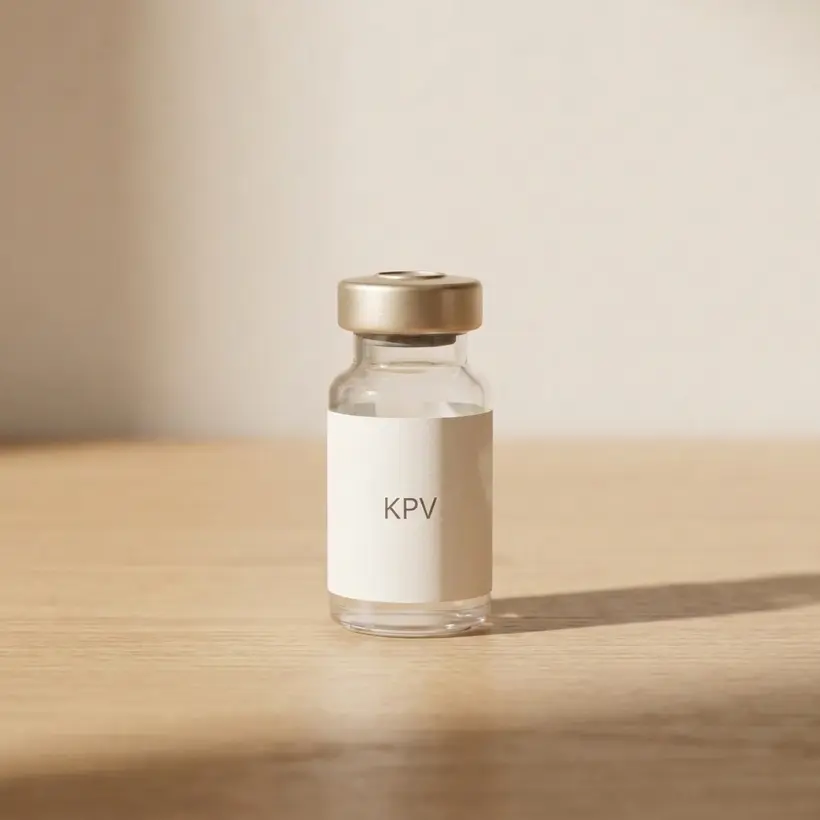
From the FormBlends catalog
KPV
Anti-inflammatory tripeptide for gut and systemic health · From $44/mo · compounded by a licensed 503A pharmacy, dispensed only after provider review.
Learn about KPV →Those record values describe different chemical compositions. A label or assay must identify whether its stated amount refers to peptide content or a salt form before the number is used as an ingredient amount. A chromatographic area percentage does not resolve that reporting basis.
Decode the study's nanomolar and micromolar values
Dalmasso's Figure 1 uses 10 nM KPV in a cell experiment. Figure 6 uses 100 micromolar KPV in mouse drinking water, with five mice per group; the TNBS comparison in Figure 8 has ten mice per group. The exposures and denominators belong to different experiments.
| Reported concentration | Moles per liter | Calculated mass per liter | Calculated mass per mL |
|---|---|---|---|
| 10 nM | 0.00000001 mol/L | 3.4243 micrograms/L | 0.0034243 micrograms/mL |
| 100 micromolar | 0.0001 mol/L | 34.243 mg/L | 34.243 micrograms/mL |
Multiply moles per liter by grams per mole, then convert grams to the displayed mass unit. The concentrations differ by 10,000-fold. That ratio describes solution concentration, not a potency comparison or a 10,000-fold difference in clinical benefit. A drinking-water concentration also does not give an individual animal's daily amount without the consumed volume.
Supplies
- Reconstituted KPV vial (refrigerated)
- The syringe specified for the preparation, with adequate capacity and readable increments
- Alcohol swabs
- Sharps container
Step-by-Step
Step 1: Prepare
Wash hands. Remove vial from refrigerator.
Step 2: Clean Vial
Swab the rubber stopper with alcohol. Allow to air dry.
Step 3: Draw Dose
Pull the insulin syringe plunger to your prescribed volume. Insert through the stopper, invert, draw your dose. Tap to remove air bubbles and push excess air out.
Step 4: Select Site
Best sites: lower abdomen (2 inches from navel), outer thigh, or back of upper arm. Clean with alcohol swab.
Step 5: Inject
Use the insertion angle and timing specified for the device. Remove the needle and apply gentle pressure.
Step 6: Dispose
Place used syringe in sharps container. Return vial to refrigerator.
An explicit volume calculation and three reverse checks
The following hypothetical preparation contains 1 mg in a final 1 mL, or 1,000 micrograms/mL. The amounts are calculation inputs, not a schedule inferred from the mouse studies. A U-100 scale maps 100 marked units to 1 mL.
| Example amount | Calculated volume | U-100 volume marking | Reverse check |
|---|---|---|---|
| 200 micrograms | 0.2 mL | 20 marked units | 0.2 x 1000 = 200 micrograms |
| 300 micrograms | 0.3 mL | 30 marked units | 0.3 x 1000 = 300 micrograms |
| 500 micrograms | 0.5 mL | 50 marked units | 0.5 x 1000 = 500 micrograms |
The 500-microgram example is 0.5 mL, which fits the stated capacity of a 0.5 mL barrel but exceeds a 0.3 mL barrel's capacity. Neither the peptide name nor a previous syringe number establishes the volume for a different concentration. The peptide calculator uses the same amount-over-concentration relationship.
What can be concluded about injection versus oral?
The oral mouse findings concern PepT1-mediated delivery in intestinal inflammation. They do not measure subcutaneous bioavailability. A clinical route comparison would require defined formulations, exposure measurements and shared outcomes.
Frequently asked questions
Do I need to inject KPV, or can I take it orally?
The studies reviewed here do not determine a preferred clinical route. Your physician will recommend the appropriate route based on your condition.
Can I inject KPV and BPC-157 at the same time?
The named studies do not test coadministration or same-syringe compatibility with BPC-157. Check with your pharmacy.
How often do I inject KPV?
The cited experiments do not establish daily or alternate-day human injection frequency. Follow your physician's specific instructions.
Primary references
Get Expert Guidance
At FormBlends, our team ensures you're comfortable and confident with your injection technique from day one.
Schedule Your Free Consultation
Disclaimer: This article is for informational purposes only and doesn't constitute medical advice. KPV isn't FDA-approved for any medical condition. Always consult with a licensed healthcare provider. Individual results may vary.
Ready when you are
KPV
Anti-inflammatory tripeptide for gut and systemic health · From $44/mo · compounded by a licensed 503A pharmacy, dispensed only after provider review.
Learn about KPV →