Key Takeaway
Your body's natural peptide production declines as you age. This peptide protocol anti-aging resource covers the important information you need to make informed decisions. By your 40s, growth hormone output may be a fraction of what it was in your 20s. Collagen production slows.
Your body's natural peptide production declines as you age. This peptide protocol anti-aging resource covers the important information you need to make informed decisions. By your 40s, growth hormone output may be a fraction of what it was in your 20s. Collagen production slows. Recovery takes longer. Sleep quality drops. A peptide protocol for anti-aging aims to address these changes by supporting your body's natural repair and regeneration systems. More adults than ever are asking their providers about peptide therapy as part of a complete longevity strategy.
Key Takeaways: - Learn how aging affects your body's peptide systems - Key Peptides Used in Anti-Aging Protocols - Building a Longevity Peptide Protocol - Lifestyle Factors That Amplify Anti-Aging Benefits
How Aging Affects Your Body's Peptide Systems
Knowing why peptide therapy may help starts with understanding what changes as you get older.
Growth hormone production peaks during your teenage years and declines steadily after. By age 60, many people produce less than 25% of the GH they made at 20. This decline is linked to changes in body composition, sleep quality, skin elasticity, cognitive function, and recovery capacity.
Collagen production also drops significantly with age. You lose approximately 1% of your collagen per year starting in your mid-20s. This affects your skin, joints, tendons, and even your gut lining.
Your body's ability to repair damaged cells slows down. Autophagy, the process of clearing out old and damaged cells, becomes less efficient. Inflammation tends to increase. Immune function shifts.
Peptide therapy doesn't reverse aging. Nothing does. But certain peptides may support the biological systems that decline with age, potentially helping you feel and function better as you get older.
"We now have cardiovascular outcomes data showing semaglutide reduces MACE events by 20% in people with obesity, independent of diabetes status. The SELECT trial[1] changed how we think about these medications.") Dr. A. Michael Lincoff, MD, Cleveland Clinic, lead author of SELECT
A licensed provider can evaluate your specific situation and determine whether peptide therapy fits into your health plan. .
Free Download: Wolverine Stack Protocol Card Plan your longevity peptide protocol with our printable schedule and tracking card. Includes cycle dates, dose tracking, and wellness check-in prompts. Get yours free (we'll email it to you instantly.
[Download CTA Button]
Key Peptides Used in Anti-Aging Protocols
Several peptides have research supporting their potential role in healthy aging. Here are the most commonly discussed options.
View data table
| Category | Clinical Interest Score | Detail |
|---|---|---|
| BPC-157 | 88 | Tissue repair and gut healing |
| TB-500 | 82 | Injury recovery |
| Sermorelin | 78 | Growth hormone support |
| Ipamorelin | 75 | Anti-aging and recovery |
| GHK-Cu | 70 | Skin and tissue repair |
CJC-1295 and Ipamorelin are the backbone of most anti-aging peptide protocols. By supporting natural growth hormone production, they may improve sleep quality, body composition, skin health, and recovery. Many providers consider this the first-line peptide stack for age-related GH decline.
GHK-Cu (Copper Peptide) is naturally present in your blood but declines with age. Research suggests it may stimulate collagen production, support wound healing, and have anti-inflammatory effects. Some studies indicate it can remodel tissue and promote skin regeneration.
is best known for healing, but its gut-protective and anti-inflammatory properties make it relevant for longevity protocols. Gut health is increasingly recognized as foundational to overall health and aging.
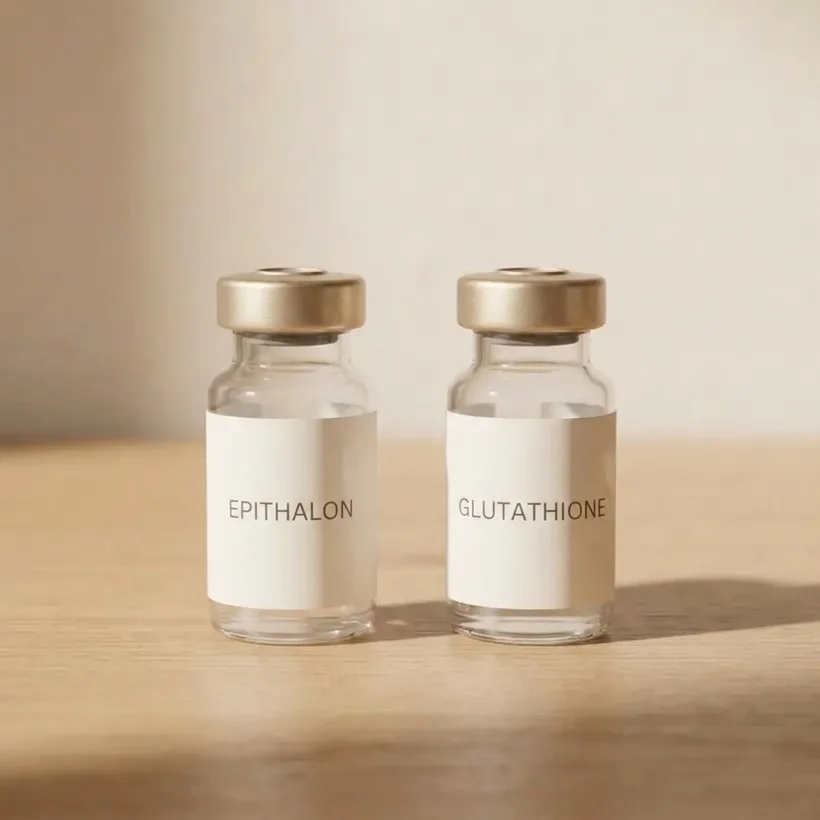
Epithalon is a synthetic version of a peptide called epithalamin, which is produced by the pineal gland. Research suggests it may support telomere length maintenance. Telomeres are the protective caps on your chromosomes that shorten with age.
Thymosin Alpha-1 supports immune function, which naturally declines with aging. A stronger, more balanced immune system may help your body fight infections and manage inflammation more effectively.
Your provider will select peptides based on your specific aging concerns, health history, and lab results. Anti-aging protocols are highly individualized.
Building a Longevity Peptide Protocol
A well-designed longevity protocol considers multiple systems working together over extended timeframes.
From the FormBlends catalog
Longevity Reset
Telomere support with the master antioxidant. · Bundle from $270 · provider-reviewed peptide bundle.
View Longevity Reset →Start with bloodwork. Before beginning any protocol, your provider will order thorough labs. These typically include IGF-1 levels, metabolic panels, inflammatory markers, thyroid function, and hormone levels. This baseline helps guide peptide selection and dosing.
Phase your approach. Most providers don't start everything at once. A typical approach might begin with CJC-1295/Ipamorelin for 2-4 weeks, then add GHK-Cu or BPC-157 once you know how your body responds to the GH peptides.
Cycle appropriately. Longevity protocols still require cycling. Running growth hormone peptides continuously can lead to receptor desensitization. Most providers recommend 8-12 weeks on, 4 weeks off, with some using 5-days-on, 2-days-off weekly patterns.
Combine with lifestyle fundamentals. Peptides work best alongside proper , regular exercise (both resistance training and cardio), quality sleep, and stress management. These lifestyle factors form the foundation that peptides build upon.
Monitor and adjust. Follow-up bloodwork every 3-6 months helps your provider track how your body is responding. The lets you log daily wellness metrics that supplement your lab data.
Lifestyle Factors That Amplify Anti-Aging Benefits
Peptides are one piece of a much larger longevity puzzle. These lifestyle strategies may amplify their effects.
Strength training is one of the most powerful anti-aging interventions available. It preserves muscle mass, strengthens bones, improves insulin sensitivity, and supports growth hormone production. Aim for 2-4 resistance training sessions per week.
Sleep improvement is non-negotiable. Growth hormone is released primarily during deep sleep. Without adequate sleep, even the best peptide protocol will underperform. Target 7-9 hours per night with consistent sleep and wake times.
Nutrient-dense eating supports every system peptides target. Adequate protein preserves muscle mass. Antioxidant-rich foods combat oxidative stress. Omega-3 fatty acids support brain health and reduce inflammation. Minimize processed foods and sugar.
Stress management matters because chronic stress improves cortisol, which accelerates aging and counteracts many benefits of peptide therapy. Find practices that work for you, whether that's meditation, walks in nature, or time with friends.
Regular health screenings catch problems early. Track your key biomarkers over time. The helps you build a full picture of your health trajectory.
Frequently Asked Questions
At what age should I consider an anti-aging peptide protocol?
Most providers begin anti-aging peptide protocols for patients in their late 30s to 40s, when natural hormone decline becomes noticeable. But there's no universal age requirement. Your provider will evaluate your individual hormone levels and symptoms to determine if peptide therapy is appropriate.
How long does it take to see anti-aging benefits from peptides?
Sleep and energy improvements often appear within 2-4 weeks. Skin and body composition changes may take 2-3 months. Longevity benefits are measured over months and years rather than days. Anti-aging peptide therapy is a long-term commitment, not a quick fix.
Are anti-aging peptide protocols safe?
When prescribed and monitored by a licensed provider, peptide therapy has a generally favorable safety profile. Regular bloodwork monitoring helps catch any issues early. The key is working with a qualified provider, not self-prescribing from unregulated sources.
Can I use anti-aging peptides alongside GLP-1 medications?
Some patients use growth hormone peptides alongside to preserve muscle mass while losing weight. This requires careful coordination. Discuss all your medications with your provider.
How much do anti-aging peptide protocols cost?
Costs vary based on which peptides are included and the duration of the protocol. FormBlends offers transparent pricing without hidden fees. for specific peptide medications.
Ready to Take the Next Step?
Your wellness plan is personal) and you deserve a plan that fits. FormBlends connects you with licensed providers who can evaluate your needs and create a personalized protocol.
Medical References
- Lincoff AM, Brown-Frandsen K, Colhoun HM, et al. Semaglutide and Cardiovascular Outcomes in Obesity without Diabetes. N Engl J Med. 2023;389(24):2221-2232. [PubMed | ClinicalTrials.gov | DOI]
Sources &. References
- Sikiric P, Hahm KB, Blagaic AB, et al. Stable Gastric Pentadecapeptide BPC 157, Robert's Cytoprotection, Adaptive Cytoprotection, and Therapeutic Effects. Curr Pharm Des. 2018;24(18):1990-2001. Doi:10.2174/1381612824666180515125918
- Chang CH, Tsai WC, Lin MS, et al. The promoting effect of pentadecapeptide BPC 157 on tendon healing involves tendon outgrowth, cell survival, and cell migration. J Appl Physiol. 2011;110(3):774-780. Doi:10.1152/japplphysiol.00945.2010
- Seiwerth S, Brcic L, Vuletic LB, et al. BPC 157 and blood vessels. Curr Pharm Des. 2014;20(7):1121-1125. Doi:10.2174/13816128113199990421
- Bock-Marquette I, Saxena A, White MD, et al. Thymosin beta4 activates integrin-linked kinase and promotes cardiac cell migration, survival and cardiac repair. Nature. 2004;432(7016):466-472. Doi:10.1038/nature03000
- Malinda KM, Sidhu GS, Mani H, et al. Thymosin beta4 accelerates wound healing. J Invest Dermatol. 1999;113(3):364-368. Doi:10.1046/j.1523-1747.1999.00708.x
- Ionescu M, Frohman LA. Pulsatile secretion of growth hormone (GH) persists during continuous stimulation by CJC-1295, a long-acting GH-releasing hormone analog. J Clin Endocrinol Metab. 2006;91(12):4792-4797. Doi:10.1210/jc.2006-1702
This article is for educational purposes only and doesn't constitute medical advice. Always consult with a licensed healthcare provider before starting, changing, or stopping any medication or supplement. FormBlends connects you with licensed providers who can evaluate your individual health needs.
Last updated: 2026-03-24
See your options in about 2 minutes
Take the free quiz and see what fits you. Quick, private, and no commitment to continue.
See my options →