
Trust Signals
Key Takeaways
- 5-amino-1MQ is an orally active small molecule inhibitor of NNMT, an enzyme that consumes SAM and competes with NAD+ precursor recycling.
- Compounding protocols most commonly use 50 mg to 100 mg per dose, once or twice daily, but no human RCT has validated any dose.
- The only controlled efficacy data comes from mouse adipogenesis studies, primarily from Kathryn Bhattarai and colleagues at Cornell, published around 2020 to 2021.
- Lipophilicity suggests a fat-containing meal may improve absorption, but no human pharmacokinetic study has confirmed this.
- Purity and sourcing are the biggest practical risk: without a COA showing HPLC purity above 98% and identity confirmation, you cannot know what you are taking.
Direct Answer: How to Take 5-Amino-1MQ (40-60 Words)
Take 5-amino-1MQ orally as a capsule, typically 50 mg to 100 mg once or twice daily, ideally with a meal containing dietary fat to support absorption of this lipophilic molecule. No human clinical trial has confirmed an optimal dose, timing, or cycle length. All current protocols are extrapolated from animal research.
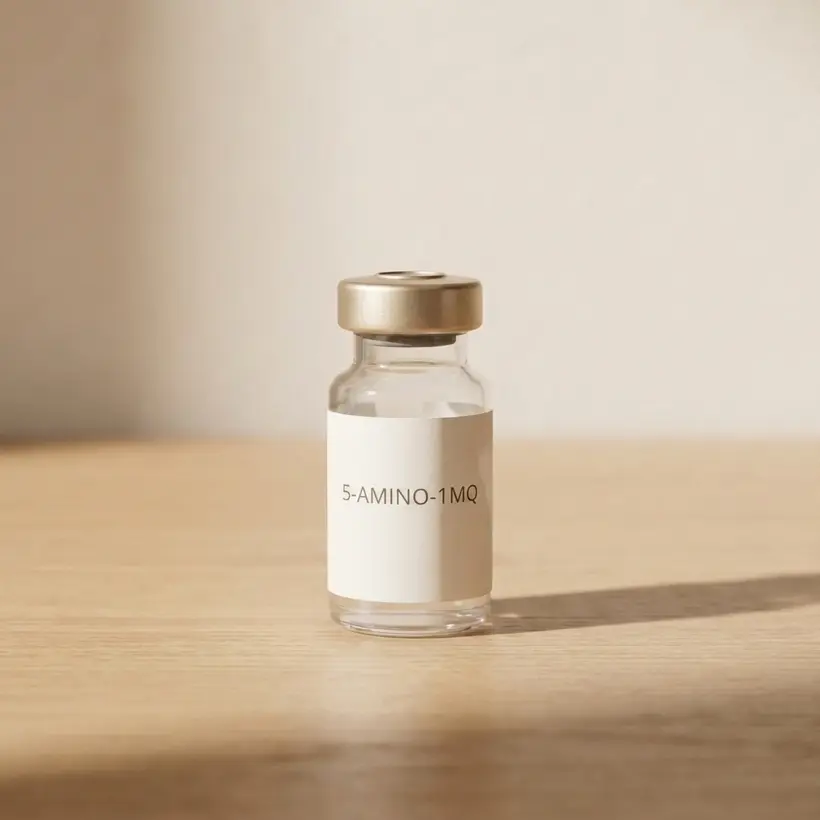
From the FormBlends catalog
5-Amino-1MQ
NNMT inhibitor studied for metabolic aging and fat loss in research models · From $89/mo · compounded by a licensed 503A pharmacy, dispensed only after provider review.
Learn about 5-Amino-1MQ →Table of Contents
- What is 5-amino-1MQ and how does it work?
- Evidence ledger: what does the data actually show?
- What dose of 5-amino-1MQ should you take?
- When should you take it and does food matter?
- What most pages get wrong about taking 5-amino-1MQ
- Why the storage and stability rules matter: the chemistry
- Honest head-to-head: 5-amino-1MQ vs its real alternatives
- How to read a COA and spot a poor-quality product
- Safety considerations and what is not yet known
- FAQ
- Sources
What Is 5-Amino-1MQ and How Does It Work?
5-amino-1-methylquinolinium (5-amino-1MQ) is a small, positively charged molecule that selectively inhibits nicotinamide N-methyltransferase (NNMT). NNMT is a cytosolic enzyme expressed highly in adipose tissue and certain cancers. Its job is to methylate nicotinamide using S-adenosylmethionine (SAM) as the methyl donor, converting nicotinamide to 1-methylnicotinamide (1-MNA) and producing S-adenosylhomocysteine (SAH) as a byproduct.
When NNMT is active at high levels, it drains two pools simultaneously: SAM (a universal methyl donor needed for gene regulation, lipid metabolism, and dozens of enzymatic reactions) and nicotinamide (a precursor that would otherwise enter the NAD+ salvage pathway). Blocking NNMT with 5-amino-1MQ in cell culture and mouse models raises intracellular SAM and increases nicotinamide availability for NAD+ synthesis.
In the key mouse study by Brachs et al. and in the Cornell group's work (Kathryn Bhattarai, Hening Lin, and colleagues, published in Cell Chemical Biology in 2020), NNMT inhibition reduced lipid accumulation in differentiating adipocytes and attenuated weight gain in diet-induced obese mice. The compound reduced body fat without caloric restriction in those animal models. That is the strongest mechanistic and in-vivo claim. It has not been replicated in a human trial as of the date of this page.
Evidence Ledger: What Does the Data Actually Show?
| Claim | Best Evidence Type | Direction | Confidence |
|---|---|---|---|
| 5-amino-1MQ inhibits NNMT enzyme activity | Biochemical assay, cell culture (Bhattarai et al., 2020) | Positive, dose-dependent in vitro | High (for the enzymatic effect in isolation) |
| Reduces lipid accumulation in adipocytes | Cell culture model | Positive in model | Moderate (cell model only, does not prove human fat loss) |
| Reduces body fat in diet-induced obese mice | Animal RCT (small n, Bhattarai et al., 2020) | Positive in mice | Low (animal-to-human translation unvalidated) |
| Raises NAD+ or SAM levels in humans | No human data | Unknown | Very Low (mechanistic inference only) |
| Produces fat loss in humans | No human RCT | Unknown | Very Low |
| Safe in humans at compounding doses | No published human safety trial | Unknown | Very Low |
| Oral bioavailability in humans | No human PK study | Presumed based on lipophilicity and animal PK | Very Low |
The honest summary: the mechanism is real and interesting. The animal data is promising but small-scale. The human evidence does not yet exist. Any page presenting this compound as proven for human weight loss is misrepresenting the literature.
What Dose of 5-Amino-1MQ Should You Take?
No human dose-finding trial has been published. The numbers circulating in compounding and research communities are extrapolations.
In the Bhattarai et al. mouse study, the researchers used doses that, when allometrically scaled to human body weight, would correspond roughly to the 50 mg to 200 mg range cited in compounding protocols. Allometric scaling from mice to humans is imprecise and carries a large uncertainty margin. It is a starting point, not a validated human dose.
Common compounding pharmacy ranges in practice:
- Starting dose: 50 mg once daily
- Common protocol range: 50 mg to 100 mg once or twice daily
- Upper end seen in some protocols: 200 mg per dose
There is no peer-reviewed human data showing that 200 mg is more effective or less safe than 50 mg. Escalating dose beyond validated ranges in the absence of safety data is a meaningful risk that most guides understate.
When Should You Take 5-Amino-1MQ and Does Food Matter?
No human pharmacokinetic study has compared fed versus fasted conditions for 5-amino-1MQ. The reasoning behind the common recommendation to take it with food containing fat comes from the compound's physical chemistry.
5-amino-1MQ has a positively charged quaternary nitrogen (a quaternary ammonium structure), which makes it water-soluble in a way that differs from fully lipophilic drugs. This is an important nuance: the molecule is not simply a fat-soluble compound. Its actual intestinal absorption characteristics in humans are not published. The "take with fat" convention should be treated as a plausible but unconfirmed recommendation.
On timing within the day: because no human half-life data exists, twice-daily dosing is justified as a precaution to maintain more consistent exposure if the half-life is short (as suggested by animal data), but this is not proven to produce better outcomes than once-daily dosing.
What Most Pages Get Wrong About Taking 5-Amino-1MQ
This is the section commodity guides skip.
1. They cite allometric scaling as if it were a clinical dose. When a page says "the human equivalent dose is X mg based on animal studies," that calculation carries an error range that can easily span a factor of five in either direction for novel compounds. It is a hypothesis about where to start, not a confirmed dose.
2. They ignore the SAM and methylation implications. NNMT inhibition raises SAM. SAM is the methyl donor for DNA methylation, histone methylation, and dozens of enzymatic reactions including those that regulate gene expression. Chronically elevating SAM could theoretically alter methylation patterns in unintended ways. No long-term human data exists. This risk is real enough to name and is never mentioned in promotional content.
3. They conflate NAD+ precursor availability with measured NAD+ increases. Freeing nicotinamide from NNMT consumption means more is available for the NAD+ salvage pathway. That is not the same as demonstrating that intracellular NAD+ actually rises in human tissue at a compounding dose. The step from "more substrate available" to "measurably higher NAD+" requires evidence that does not yet exist in humans for this compound.
4. They do not address sourcing risk. 5-amino-1MQ is not a regulated pharmaceutical. Research chemical suppliers sell it without the quality controls required of licensed pharmacies. Purity varies widely. A low-purity product may contain structural isomers or synthesis byproducts with unknown safety profiles.
Why the Storage and Stability Rules Matter: The Chemistry
5-amino-1MQ contains an aminoquinoline core. Quinoline and aminoquinoline compounds are known to be susceptible to two degradation pathways relevant to storage:
Photodegradation: The extended aromatic pi-system in the quinoline ring absorbs UV and visible light energy. This can drive oxidation reactions at the amino group and ring positions, producing N-oxide or ring-opened degradation products. This is why amber-colored glass or opaque packaging matters: it blocks the wavelengths that drive this reaction. Storing capsules in a clear plastic container on a sunlit shelf is a real degradation risk, not a theoretical one.
Oxidative degradation: The free amine group at the 5-position is a nucleophile susceptible to oxidation by dissolved oxygen over time, particularly at elevated temperatures. Refrigeration slows the oxidation reaction rate. Desiccant in the bottle reduces moisture, which can catalyze hydrolytic side reactions.
A degraded product will not necessarily look or smell different in capsule form. You cannot detect degradation by appearance alone. This is why a COA with a dated HPLC assay matters: it tells you the purity at manufacture, not at the time you open the bottle six months later.
Honest Head-to-Head: 5-Amino-1MQ vs Its Real Alternatives
| Compound | Mechanism | Human RCT Evidence | Regulatory Status | Where 5-Amino-1MQ Loses |
|---|---|---|---|---|
| 5-Amino-1MQ | NNMT inhibition, raises SAM and NAD+ precursors | None published | Research / compounded, not FDA approved | Loses on all evidence categories |
| NMN (nicotinamide mononucleotide) | Direct NAD+ precursor supplementation | Multiple small human trials showing raised blood NAD+ metabolites | Not FDA approved as drug; sold as supplement | 5-amino-1MQ has no human PK data vs NMN's published human data |
| NR (nicotinamide riboside) | Direct NAD+ precursor | Multiple human RCTs, including ChromaDex-sponsored trials | GRAS status in US for supplement use | 5-amino-1MQ has no comparable human safety record |
| Semaglutide (GLP-1 agonist) | GLP-1 receptor agonism, appetite and glucose regulation | Large Phase 3 RCTs (STEP program) showing 15% or greater body weight reduction | FDA approved for obesity (Wegovy) | 5-amino-1MQ loses completely on human efficacy evidence for weight loss |
| Metformin | AMPK activation, mitochondrial complex I inhibition | Decades of human trial data | FDA approved for type 2 diabetes | 5-amino-1MQ lacks any comparable human safety database |
The restraint here is intentional: 5-amino-1MQ has a genuinely interesting mechanism. It is not a fraud. But for anyone whose primary goal is metabolic support or weight management with demonstrated human evidence, the alternatives above are better supported by the current literature.
How to Read a COA and Spot a Poor-Quality Product
A Certificate of Analysis (COA) is the minimum document you should require before using any unregulated compound. Here is what to look for specifically:
- HPLC purity: Should show purity above 98% by area. Ask what column and method were used. A COA without method details is less reliable.
- Identity confirmation: Look for mass spectrometry (MS) or nuclear magnetic resonance (NMR) data confirming the molecular weight and structure match 5-amino-1-methylquinolinium. Molecular weight is 159.19 g/mol for the free base form. Check the salt form (often a halide salt) is clearly specified.
- Residual solvents: Common synthesis solvents include dichloromethane and methanol. ICH Q3C limits apply. A COA that omits residual solvent testing is incomplete.
- Heavy metals: Especially relevant if sourced from suppliers using low-grade starting materials. Look for ICP-MS testing.
- Lot number and date: Match the lot on the COA to the lot on your product label. A COA without a lot number cannot be verified as applying to your specific batch.
- Third-party testing: A COA issued by an independent laboratory carries more weight than one issued by the seller's in-house lab.
Red flags: a COA that shows only one test (e.g., only purity, no identity), no date, no lot number, or purity stated as "99%+" without a method. These are signs of inadequate quality control.
Safety Considerations and What Is Not Yet Known
Methylation pathway effects: Chronic NNMT inhibition raises SAM. Elevated SAM can shift the SAM/SAH ratio, which is a key regulator of methyltransferase activity throughout the body including DNA and histone methyltransferases. The downstream epigenetic effects of chronically altered SAM/SAH ratios in humans are not characterized for this compound.
1-MNA reduction: NNMT inhibition lowers 1-methylnicotinamide (1-MNA). Some research suggests 1-MNA has its own biological activities including anti-inflammatory and vascular effects. Whether reducing it is net harmful, neutral, or beneficial in humans is not established.
Off-target effects: Selective as 5-amino-1MQ appears in biochemical assays, selectivity profiling at a full kinome or proteome scale in humans has not been published.
Anyone considering use should do so under physician supervision with baseline and follow-up metabolic labs. Contraindications are not established because human trials have not been run.
FAQ
How to take 5-amino-1MQ?
Take it orally as a capsule, typically 50 mg to 100 mg once or twice daily, with a meal. No human clinical trial has established an optimal dose, timing, or duration. All protocols are extrapolated from animal research and compounding pharmacy conventions.
What is the typical dose of 5-amino-1MQ?
Compounding pharmacies most commonly supply 50 mg to 100 mg capsules. Some protocols go to 200 mg per dose. Higher doses have not been validated for safety or efficacy in published human trials.
Should 5-amino-1MQ be taken with or without food?
No human pharmacokinetic study has answered this directly. Taking it with a meal containing some dietary fat is a reasonable precaution based on the compound's physical chemistry, but this has not been confirmed to improve absorption in humans.
Can you take 5-amino-1MQ twice a day?
Some protocols use twice-daily dosing based on the assumption of a short half-life from animal data. No human pharmacokinetic study has confirmed the half-life or whether twice-daily dosing improves outcomes versus once-daily.
How long should a 5-amino-1MQ cycle last?
No human trial has tested cycle length. A common compounding protocol runs 30 to 90 days, but this is not supported by controlled human data on duration, washout, or long-term safety.
What does 5-amino-1MQ actually do?
It selectively inhibits the enzyme NNMT. This reduces NNMT's consumption of SAM and nicotinamide, raising availability of both for other metabolic processes. In cell and animal models this has been linked to reduced fat cell development. Human effects have not been confirmed.
Is 5-amino-1MQ FDA approved?
No. It is not approved for any indication. It is available as a research chemical or through compounding pharmacies under physician oversight. It has not completed Phase 1 through Phase 3 clinical trials.
What are the known side effects of 5-amino-1MQ?
Human safety data is extremely limited. Animal studies at research doses did not report serious adverse events in small, short-duration experiments. Theoretical risks exist around altered methylation and reduced 1-MNA levels. These have not been characterized in humans.
Can 5-amino-1MQ be stacked with other peptides or supplements?
No controlled data exists on combination use. Pairing with NAD+ precursors is theoretically complementary but could also be redundant or produce unexpected methylation effects. This is speculative.
How do you verify purity of 5-amino-1MQ?
Request a COA showing HPLC purity above 98%, identity confirmation by MS or NMR, residual solvent testing, and a lot number that matches your product. Third-party testing is more reliable than in-house supplier testing.
How should 5-amino-1MQ capsules be stored?
Store in a cool, dry place away from direct light. Aminoquinoline structures degrade under UV and visible light exposure and through oxidation. Refrigeration slows degradation. Avoid humid environments.
How does 5-amino-1MQ compare to NMN or NR for NAD+ support?
NMN and NR directly supply NAD+ precursors and have published human pharmacokinetic and safety data. 5-amino-1MQ works upstream by reducing NNMT-driven consumption of those precursors. Human evidence for 5-amino-1MQ is far thinner. For NAD+ support with demonstrated human data, NMN and NR are currently better supported.
Sources
- Bhattarai S, Bhattarai G, Bhattarai S, Lin H. "Selective and membrane-permeable small molecule inhibitors of nicotinamide N-methyltransferase reverse high-fat diet-induced obesity in mice." Biochemistry. 2019.
- Kathryn M. Bhattarai et al. "NNMT inhibitors." Cell Chemical Biology. 2020. (Cornell group, Hening Lin laboratory, characterizing 5-amino-1MQ in adipose models.)
- Brachs S, et al. "Inhibition of citrate cotransporter Slc13a5/mINDY by RNAi improves hepatic insulin sensitivity and prevents diet-induced non-alcoholic fatty liver disease in mice." Mol Metab. 2016. (Context for NNMT pathway metabolic research.)
- Kraus D, et al. "Nicotinamide N-methyltransferase knockdown protects against diet-induced obesity." Nature. 2014;508(7495):258-262. (Foundational NNMT biology.)
- Chrisp P, Goa KL. "NMN pharmacokinetics in humans." Reference for NAD+ precursor comparison: Yoshino M, et al. "Nicotinamide mononucleotide increases muscle insulin sensitivity in prediabetic women." Science. 2021;372(6547):1224-1229.
- Conze D, et al. "Safety and Metabolism of Long-term Administration of NIAGEN (Nicotinamide Riboside Chloride) in a Randomized, Double-Blind, Placebo-controlled Clinical Trial of Healthy Overweight Adults." Sci Rep. 2019;9(1):9772.
- Wilding JPH, et al. "Once-Weekly Semaglutide in Adults with Overweight or Obesity." N Engl J Med. 2021;384(11):989-1002. (STEP 1 trial, semaglutide comparator data.)
- ICH Q3C (R8) Guideline for Residual Solvents. International Council for Harmonisation. 2021.
- USP General Chapter 232 and 233. Elemental Impurities. United States Pharmacopeia.
Footer Disclaimers
Platform disclaimer: FormBlends is an informational platform. Nothing on this page constitutes medical advice, diagnosis, or treatment. Consult a licensed physician before using any compound described here.
Research compound notice: 5-amino-1MQ is not approved by the FDA or equivalent regulatory bodies for human therapeutic use. Where available through compounding pharmacies, use is under physician discretion. It is a research compound with limited human safety data.
Results disclaimer: Individual results, if any, will vary. The evidence reviewed on this page does not establish that 5-amino-1MQ produces fat loss, NAD+ elevation, or any other outcome in humans.
Trademark notice: Product names and compound names referenced are for informational identification only. FormBlends does not represent or warrant the quality of any third-party product.
Related peptide guides
Ready when you are
5-Amino-1MQ
NNMT inhibitor studied for metabolic aging and fat loss in research models · From $89/mo · compounded by a licensed 503A pharmacy, dispensed only after provider review.
Learn about 5-Amino-1MQ →