Trust Signals
Conflicts: FormBlends sells compounded research peptides. We have tried to present the evidence, including its limits, without promotional bias. Where the evidence is weak, we say so.
Regulatory note: AOD-9604 is not FDA-approved as a drug. It is not legal for compounding pharmacies to compound bulk AOD-9604 for human use under current FDA guidance. This page is for research and educational purposes only.
Key Takeaways
- The only published human RCTs on AOD-9604 used an oral dose of 1 mg (1000 mcg) per day; no peer-reviewed human trial has validated subcutaneous injectable dosing at 250 to 500 mcg per day.
- AOD-9604 is amino acids 177 to 191 of human growth hormone with a tyrosine modification at the N-terminus; it is proposed to engage lipolytic pathways distinct from the GH receptor, which is why it is expected to lack IGF-1 stimulation, though direct receptor binding data in human tissue remains limited.
- The Metabolic Pharmaceuticals phase 2 oral trial program found that the 1 mg daily dose did not achieve statistically significant fat loss compared to placebo, despite positive signals in earlier dose-ranging work.
- After reconstitution with bacteriostatic water, refrigerated AOD-9604 is generally considered stable for up to 28 days based on standard peptide stability principles; heat and freeze-thaw cycles degrade peptide integrity.
- WADA likely prohibits AOD-9604 under the S2 category for growth hormone and related substances; competing athletes should treat it as banned.
Direct Answer: How to Take AOD-9604
AOD-9604 is taken as a subcutaneous injection, typically 250 to 500 mcg once daily in the morning while fasted, using a 29 to 31 gauge insulin syringe into the lower abdomen or outer thigh. This dosing protocol is common in research contexts but is not validated by a human RCT; the only human trial evidence used an oral formulation at 1 mg per day.
From the FormBlends catalog
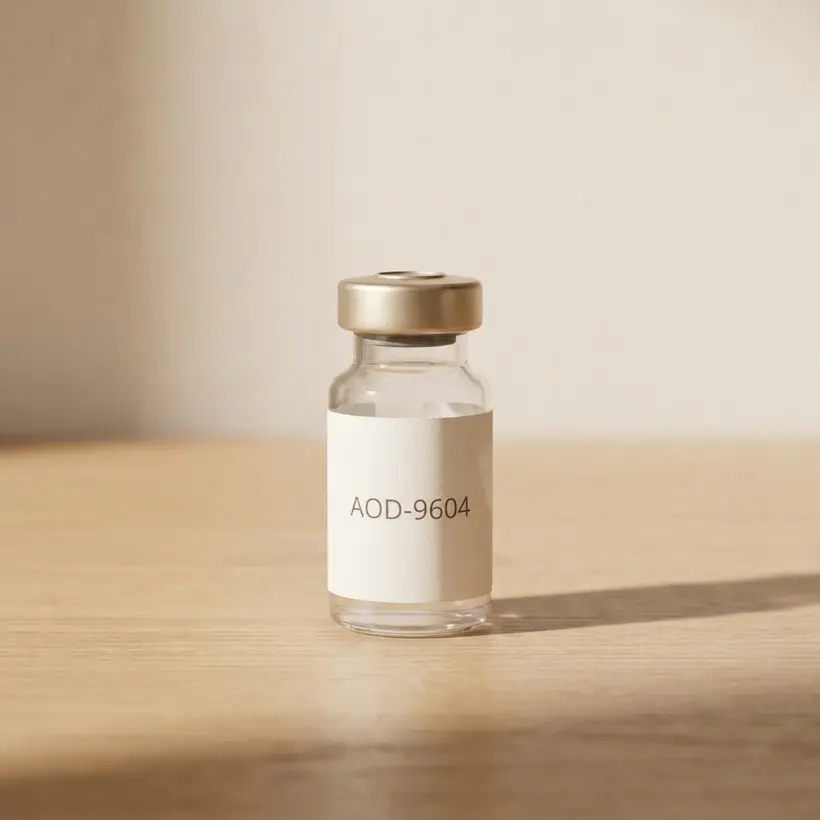
AOD-9604
Fat-targeting fragment without growth hormone side effects · From $199/mo · compounded by a licensed 503A pharmacy, dispensed only after provider review.
View AOD-9604 →Table of Contents
- What exactly is AOD-9604 and how does it work?
- Evidence ledger: what is actually proven?
- What dose of AOD-9604 should you use?
- How do you reconstitute and measure AOD-9604?
- How do you inject AOD-9604 correctly?
- When should you take AOD-9604?
- What most pages get wrong about AOD-9604
- How do you store AOD-9604 and why does it matter?
- How does AOD-9604 compare to real alternatives?
- How to read a COA and judge a product
- FAQ
What Exactly Is AOD-9604 and How Does It Work?
AOD-9604 (Anti-Obesity Drug 9604) is a synthetic peptide corresponding to amino acids 177 to 191 of human growth hormone, with a tyrosine residue added at the N-terminus to improve stability. The full sequence is Tyr-Leu-Arg-Ile-Val-Gln-Cys-Arg-Ser-Val-Glu-Gly-Ser-Cys-Gly-Phe.
The proposed mechanism involves stimulation of lipolytic pathways rather than GH receptor binding. Animal studies, primarily in rodent models published by Heffernan and colleagues at Monash University in the late 1990s and early 2000s, showed that this fragment stimulated lipolysis and inhibited lipogenesis through a pathway distinct from the IGF-1 axis. This is why proponents claim it lacks the glucose-dysregulating and tissue-proliferating effects of full growth hormone.
What the mechanism does NOT prove: Receptor interactions observed in rodent adipocytes do not establish equivalent efficacy or receptor pharmacology in humans. The fat-loss signals seen in animal models did not translate into statistically significant outcomes in the largest human trial.
Evidence Ledger: What Is Actually Proven?
| Claim | Best evidence type | Direction | Confidence |
|---|---|---|---|
| AOD-9604 stimulates lipolysis in vitro and in rodents | Animal and in vitro studies (Heffernan et al., multiple Monash University publications) | Positive | Moderate (in animals) |
| Oral 1 mg/day does not raise IGF-1 or fasting glucose in humans | Human phase 2 RCT program (Metabolic Pharmaceuticals) | Neutral (no significant change) | Moderate |
| Oral 1 mg/day produces clinically significant fat loss in humans | Human phase 2 RCT program (Metabolic Pharmaceuticals) | Negative (failed primary endpoint) | Moderate |
| Subcutaneous 250 to 500 mcg/day reduces body fat in humans | No published human RCT | Unknown | Very low |
| AOD-9604 has a favorable short-term safety profile at tested doses | Human phase 2 RCT program | Positive (mild AEs only) | Moderate |
| AOD-9604 improves cartilage repair | Animal studies only | Positive in animals | Very low (no human data) |
| Fasted-state injection improves outcomes | Mechanistic rationale only | Plausible | Very low |
What Dose of AOD-9604 Should You Use?
The only human RCT evidence comes from the Metabolic Pharmaceuticals oral trial program, which used 1 mg (1000 mcg) per day in capsule form. The injectable subcutaneous doses circulating in research protocols (250 to 500 mcg per day) are derived by analogy from other peptide research conventions, not from a published dose-finding study in humans for this route.
| Protocol type | Dose | Route | Evidence basis |
|---|---|---|---|
| Human RCT (Metabolic Pharmaceuticals program) | 1000 mcg/day | Oral capsule (proprietary formulation) | Published phase 2 trial program |
| Common research injectable | 250 to 500 mcg/day | Subcutaneous | No published human RCT |
| Higher injectable (sometimes cited) | 500 to 1000 mcg/day | Subcutaneous | No published human RCT |
How Do You Reconstitute and Measure AOD-9604?
Lyophilized AOD-9604 comes as a dry powder, typically in 5 mg vials. To reconstitute, use bacteriostatic water (0.9% benzyl alcohol, which inhibits bacterial growth and extends refrigerated shelf life compared to sterile water).
Reconstitution math example (5 mg vial):
| Bacteriostatic water added | Resulting concentration | Volume for 250 mcg dose | Volume for 500 mcg dose |
|---|---|---|---|
| 1 mL | 5000 mcg per mL | 0.05 mL (5 units on U-100 syringe) | 0.10 mL (10 units) |
| 2 mL | 2500 mcg per mL | 0.10 mL (10 units) | 0.20 mL (20 units) |
| 5 mL | 1000 mcg per mL | 0.25 mL (25 units) | 0.50 mL (50 units) |
Technique: Insert the needle of the bacteriostatic water syringe through the rubber stopper and let the water run slowly down the inside wall of the vial. Do not inject directly onto the powder or shake vigorously. Swirl gently until the powder dissolves completely. The reconstituted solution should be clear and colorless. Cloudiness, particulates, or color change indicate degradation or contamination; discard.
How Do You Inject AOD-9604 Correctly?
Use a 29 to 31 gauge, 0.5 inch (12.7 mm) or shorter insulin syringe. Clean the injection site with an alcohol swab and allow it to dry. Pinch up a fold of subcutaneous fat. Insert the needle at 45 degrees for lean individuals or up to 90 degrees if there is adequate subcutaneous tissue. Inject slowly over several seconds. Withdraw and apply light pressure; do not rub, as rubbing can accelerate local dispersion unpredictably.
Rotation matters: Injecting repeatedly into the same spot can cause lipodystrophy (localized fat loss or hardening). Rotate among the lower abdomen (staying at least 5 cm from the navel), outer thighs, and flanks. Keep a simple site log if you inject daily.
When Should You Take AOD-9604?
The most commonly recommended timing is morning, fasted, or 30 to 60 minutes before exercise. The rationale is mechanistically coherent: insulin suppresses lipolysis via phosphodiesterase activation and Akt signaling, so lower ambient insulin during fasting may allow greater lipolytic activity. Growth hormone itself pulses at its highest amplitude in the overnight fasted state.
However, no published human trial has compared fasted versus fed timing for AOD-9604 injections. This is a reasonable inference from general metabolic physiology, not a protocol validated for this specific peptide. If GI comfort, schedule, or adherence is better served by a different timing, the evidence does not firmly override that preference.
What Most Pages Get Wrong About AOD-9604
Most content on AOD-9604 conflates three separate issues that lead readers to systematically overestimate its proven benefit.
1. The pivotal trial failed its primary endpoint. The Metabolic Pharmaceuticals phase 2 study at 1 mg oral daily did not demonstrate statistically significant fat loss versus placebo. Early dose-ranging data in smaller groups showed favorable trends, but a trend in a small trial is not the same as efficacy. Most blogs cite the early positive data and omit the negative pivotal outcome.
2. Oral bioavailability of peptides is generally very poor without a specialized delivery system. The trials used a proprietary oral delivery system developed by Metabolic Pharmaceuticals. Raw AOD-9604 powder dissolved in water and drunk, or an off-the-shelf capsule, would face rapid proteolytic degradation in the stomach and small intestine. Peptide bonds are cleaved by pepsin, trypsin, and chymotrypsin at predictable cleavage sites. The Tyr-Leu bond at the N-terminus is a known trypsin target. Claiming meaningful oral bioavailability from a raw peptide preparation is not supported.
3. Purity and concentration in compounded research vials are highly variable. Without a certificate of analysis (COA) showing HPLC purity above 98%, mass spectrometry confirmation of the correct molecular weight (approximately 1817 Da for AOD-9604), and endotoxin testing, the product's identity and safety profile are unverified. Independent third-party testing of research peptides from unregulated suppliers has documented concentration discrepancies from label claims, though the frequency and magnitude vary by source.
How Do You Store AOD-9604 and Why Does the Chemistry Matter?
Lyophilized (freeze-dried) peptides are stabilized by removing water, which is the primary medium for hydrolysis of peptide bonds. Stored dry, sealed, and away from light and heat, lyophilized AOD-9604 has reasonable long-term stability. Exact degradation kinetics have not been published specifically for AOD-9604, so general peptide stability principles apply.
Once reconstituted, the peptide is in aqueous solution and vulnerable to three degradation pathways: hydrolysis of peptide bonds (accelerated by heat and extreme pH), oxidation of the cysteine residues (AOD-9604 contains two cysteines that can form incorrect disulfide bonds under oxidative conditions), and microbial growth (mitigated by bacteriostatic water's benzyl alcohol).
Practical rules from the chemistry: Keep reconstituted vials at 2 to 8 degrees Celsius. Do not freeze reconstituted peptide repeatedly; ice crystal formation can disrupt peptide conformation. Use within 28 days of reconstitution when bacteriostatic water is the diluent. If you notice the solution turning yellow or developing a precipitate, oxidation or contamination has likely occurred and the vial should be discarded.
How Does AOD-9604 Compare to Real Alternatives?
| Comparison | AOD-9604 | Semaglutide (Wegovy) | Tesamorelin | Diet and exercise |
|---|---|---|---|---|
| Human RCT fat loss evidence | Weak; pivotal trial failed primary endpoint | Strong; STEP 1 trial (Wilding et al. 2021, n=1961): roughly 15% body weight loss | Moderate; FDA-approved for HIV-related lipodystrophy; substantial visceral fat reduction in RCTs (Falutz et al. 2007) | Strong across many RCTs; magnitude varies by adherence |
| IGF-1 stimulation risk | Low (by design; no expected GH receptor binding) | None | Present; raises IGF-1, contraindicated in active malignancy | None |
| Glucose / insulin effects | Minimal in trials | Improves glycemia (primary mechanism in T2DM) | May worsen glucose tolerance in some users | Improves insulin sensitivity |
| Regulatory status (US) | Not FDA-approved; compounded use not permitted under current FDA guidance | FDA-approved (chronic weight management) | FDA-approved (HIV lipodystrophy); off-label use is common | N/A |
| Where the peptide loses | Loses on every efficacy endpoint against approved drugs with RCT evidence | Higher GI adverse event rate; cost; requires ongoing use | Narrower indicated population; IGF-1 concerns | Requires sustained behavioral change |
Bottom line: AOD-9604 does not have the human RCT evidence base to be recommended over FDA-approved weight management options. Its theoretical mechanistic advantage (no IGF-1 stimulation, no glucose dysregulation) is real but does not translate into proven clinical superiority.
How to Read a COA and Judge an AOD-9604 Product
A credible certificate of analysis for AOD-9604 should contain the following minimum elements. If any are absent, request them or source elsewhere.
| Item on COA | What to look for | Red flag |
|---|---|---|
| HPLC purity | Greater than or equal to 98% | Purity below 95% or purity not stated |
| Molecular weight confirmation (MS) | Consistent with AOD-9604: approximately 1817 Da | No MS data; wrong molecular weight |
| Endotoxin (LAL test) | Below 1 EU/mg for injectable use | Absent; or threshold not stated |
| Lot number and date | Present and traceable | Generic or absent |
| Third-party testing lab | Accredited, independent lab name and contact | In-house testing only; lab name not searchable |
| Sterility | USP sterility test pass for injectable products | Not performed |
Also inspect the physical product: lyophilized AOD-9604 is a white to off-white fluffy cake. A brown, compressed, or wet-looking powder suggests temperature abuse or moisture intrusion during storage or shipping.
FAQ
How do you take AOD-9604?
AOD-9604 is most commonly administered as a subcutaneous injection into abdominal or thigh fat, once daily in a fasted state. The dose used in human clinical trials was 1 mg (1000 mcg) orally, but the injectable form used in research settings typically ranges from 250 to 500 mcg per day subcutaneously.
What dose of AOD-9604 is typically used?
Human RCTs conducted by Metabolic Pharmaceuticals used oral doses of 1 mg per day. Compounded injectable protocols circulating in research contexts use 250 to 500 mcg subcutaneously per day, though no published human RCT has validated this injectable dose range.
When should AOD-9604 be injected?
Most protocols recommend injecting in the morning in a fasted state, or 30 to 60 minutes before exercise, on the rationale that growth hormone release and fat oxidation peak when insulin is low. This timing logic is mechanistically plausible but not validated by a controlled trial specifically for AOD-9604.
How do you reconstitute AOD-9604?
Add bacteriostatic water slowly down the side of the vial rather than directly onto the lyophilized powder. A common ratio is 2 mL bacteriostatic water into a 5 mg vial, yielding 2500 mcg per mL. For a 250 mcg dose, draw 0.1 mL on an insulin syringe.
Where do you inject AOD-9604?
Subcutaneous injection sites include the lower abdomen (at least 2 inches from the navel), outer thigh, or flank. Pinch the skin, insert a 29 to 31 gauge needle at 45 to 90 degrees, inject slowly, and rotate sites to avoid lipodystrophy.
Does AOD-9604 raise blood glucose or IGF-1?
Published human trials found AOD-9604 did not significantly affect fasting glucose or IGF-1 levels at the doses tested, which is one of its proposed advantages over full-length growth hormone. However, these trials were short-duration and powered for safety signals, not long-term metabolic endpoints.
How long should an AOD-9604 cycle last?
Human trials ran for 12 weeks. No published data exists to guide cycle length for injectable compounded protocols. Research-context users commonly run 8 to 12 week periods, but there is no evidence base to confirm that cycling is required or that longer durations are safe.
How should AOD-9604 be stored after reconstitution?
Reconstituted AOD-9604 should be stored at 2 to 8 degrees Celsius (standard refrigerator temperature) and used within 28 days when bacteriostatic water is used as the diluent. Freeze-thaw cycles degrade peptide structure. Lyophilized vials can be stored at room temperature short-term but degrade faster in heat or humidity.
What are the main risks of taking AOD-9604?
Reported adverse events in human trials were mild, including injection site reactions and headache. Risks from unregulated compounded peptides include contamination, incorrect concentration, and peptide degradation. AOD-9604 is not FDA-approved as a drug; compounded versions vary widely in quality.
Is AOD-9604 banned in sport?
WADA includes growth hormone-releasing peptides and GH fragment analogs in its Prohibited List under the S2 category. AOD-9604 is a fragment of growth hormone and is likely captured under that prohibition. Athletes subject to anti-doping rules should treat it as prohibited.
Can AOD-9604 be taken orally?
The Metabolic Pharmaceuticals RCTs used oral capsules. However, peptides are generally degraded in the GI tract, so oral bioavailability of a raw peptide is very low. The oral formulation in those trials used a specific delivery system; a raw powder taken orally would likely be largely inactive.
How does AOD-9604 compare to semaglutide for fat loss?
AOD-9604's human trial results showed modest, inconsistent fat loss that did not reach significance in the pivotal phase 2 trial. Semaglutide (Wegovy) showed roughly 15 percent body weight reduction in its phase 3 trial (STEP 1, Wilding et al. 2021, n=1961). The evidence gap is large.
Sources
- Heffernan MA, et al. Research from the Monash University group on AOD-9604 lipolytic activity and metabolic effects in rodent models, published across multiple journals in the late 1990s and early 2000s. These studies are referenced in Metabolic Pharmaceuticals regulatory submissions and conference presentations. Readers seeking primary citations should search PubMed for "AOD9604" or "Heffernan" combined with "growth hormone fragment."
- Metabolic Pharmaceuticals clinical trial program (phase 2 RCTs, oral AOD-9604, 1 mg/day, 12-week duration). Trial results presented in regulatory submissions and summarized in publicly available Australian regulatory documentation. No full peer-reviewed publication of the pivotal trial has been identified by this team; readers should verify current publication status independently.
- Wilding JPH, et al. "Once-weekly semaglutide in adults with overweight or obesity." N Engl J Med. 2021;384(11):989-1002. (STEP 1 trial, n=1961.)
- Falutz J, et al. "Metabolic effects of a growth hormone-releasing factor in patients with HIV." N Engl J Med. 2007;357(23):2359-2370. (Tesamorelin RCT evidence base.)
- World Anti-Doping Agency. "Prohibited List 2024." WADA, 2024. Available at: www.wada-ama.org.
- US FDA. "FDA's Policy on Compounding of Drugs for Use in Humans." FDA Guidance Documents. Available at: www.fda.gov.
- USP General Chapter on Injections and Implanted Drug Products. United States Pharmacopeia. (General peptide stability, endotoxin limits, and sterility testing standards.)
- Naughton G. "Development of AOD9604, a peptide fragment of human growth hormone, for use in the treatment of obesity." Presentation at Australasian Society for Clinical and Experimental Pharmacology and Toxicology, 2002. (Conference proceedings, Metabolic Pharmaceuticals.)
Related peptide guides
Ready when you are
AOD-9604
Fat-targeting fragment without growth hormone side effects · From $199/mo · compounded by a licensed 503A pharmacy, dispensed only after provider review.
View AOD-9604 →