
Trust Signals
Key Takeaways
- 5-amino-1MQ is a small-molecule NNMT inhibitor with a molecular weight of 208.26 g/mol. Its metabolic mechanism is supported by one published mouse study (Neelakantan et al., 2019, Journal of Medicinal Chemistry).
- No human clinical trial has evaluated injectable 5-amino-1MQ. Every human dosing figure in circulation is extrapolated from animal data and carries very low evidence confidence.
- For injectable use, a 50 mg vial dissolved in 2 mL bacteriostatic water yields a 25 mg/mL working solution. That is the most practical reconstitution ratio for common research dose ranges.
- Endotoxin testing below 1 EU/mg is mandatory for any injectable compound. A COA without endotoxin data and mass spec identity confirmation is not adequate for injection-grade sourcing.
- GLP-1 receptor agonists have human RCT data showing 10 to 15 percent body weight loss. 5-amino-1MQ has no equivalent human data. These are not comparable at this stage of the evidence base.
What Is a 5 Amino 1MQ Injection and What Should You Expect?
A 5 amino 1MQ injection is a subcutaneous or intramuscular administration of reconstituted 5-amino-1-methylquinolinium, a membrane-permeable small-molecule inhibitor of the enzyme nicotinamide N-methyltransferase (NNMT). Animal research shows it reduces fat mass and improves insulin sensitivity in obese mice. No human injection trial exists. Expect a research compound with a plausible mechanism and animal proof-of-concept, not a clinically validated treatment.
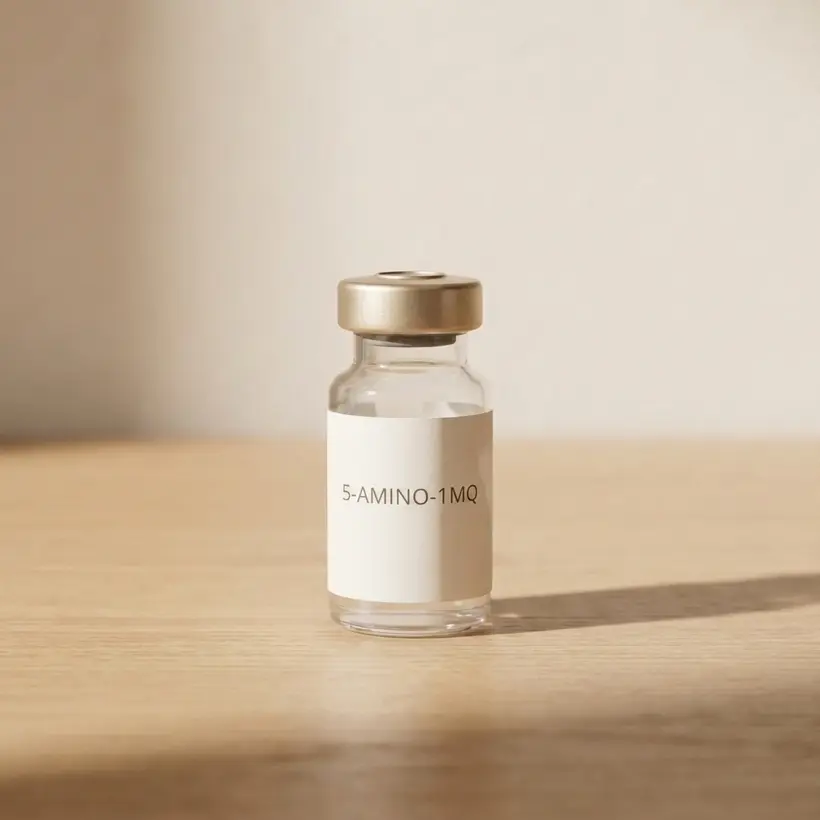
From the FormBlends catalog
5-Amino-1MQ
NNMT inhibitor studied for metabolic aging and fat loss in research models · From $89/mo · compounded by a licensed 503A pharmacy, dispensed only after provider review.
Learn about 5-Amino-1MQ →Table of Contents
- Mechanism with Specific Numbers: How 5-Amino-1MQ Works
- Evidence Ledger: What the Data Actually Shows
- 5-Amino-1MQ Reconstitution: Step-by-Step with Math
- Dosing Table: What Protocols Use and Why
- How Should You Store 5-Amino-1MQ?
- What Most Pages Get Wrong About Injectable 5-Amino-1MQ
- Why the Storage and Compatibility Rules Exist: The Chemistry
- How to Read a COA for 5-Amino-1MQ Injectable
- Honest Head-to-Head: 5-Amino-1MQ vs. Real Alternatives
- FAQ
- Sources
Mechanism with Specific Numbers: How 5-Amino-1MQ Works
5-amino-1MQ competitively inhibits NNMT, the enzyme that transfers a methyl group from S-adenosylmethionine (SAM) to nicotinamide, producing 1-methylnicotinamide (1-MNA) and S-adenosylhomocysteine (SAH). NNMT is highly expressed in white adipose tissue and, to a lesser extent, liver and skeletal muscle.
By blocking this methylation step, 5-amino-1MQ preserves intracellular SAM levels. Elevated SAM supports histone methylation and, critically, raises NAD+ precursor availability by redirecting nicotinamide toward the NAD+ salvage pathway via NAMPT. Higher NAD+ availability activates SIRT1, a deacetylase that promotes fatty acid oxidation and suppresses adipogenesis-related gene expression.
In the 2019 Neelakantan et al. study (Journal of Medicinal Chemistry), mice fed a high-fat diet and treated with 5-amino-1MQ at 50 mg/kg orally showed significantly reduced fat mass, improved glucose tolerance, and changes in adipose gene expression consistent with the SAM/NAD+ mechanism described above. The study used a cohort of diet-induced obese mice over approximately 8 weeks. Plasma NNMT activity was measurably suppressed in treated animals.
Evidence Ledger: What the Data Actually Shows
| Claim | Best Evidence Type | Key Source | Effect Direction | Confidence |
|---|---|---|---|---|
| NNMT inhibition reduces fat mass in obese mice | Animal RCT (in vivo, controlled diet) | Neelakantan et al., J Med Chem, 2019 | Positive (fat reduction) | Moderate (animal only) |
| 5-amino-1MQ improves glucose tolerance in mice | Animal study | Neelakantan et al., 2019 | Positive | Low |
| NNMT inhibition elevates SAM and NAD+ precursors | Biochemical / cell mechanism | Multiple in vitro studies; Kraus et al., 2014 | Positive (mechanistic) | Moderate (mechanism level) |
| 5-amino-1MQ produces fat loss in humans via injection | No published human trial | None identified | Unknown | Very Low |
| Injectable route produces equivalent bioavailability to oral (mice) | No published comparative PK study | None identified | Unknown | Very Low |
| Long-term safety of 5-amino-1MQ in humans | No data | None identified | Unknown | Very Low |
5-Amino-1MQ Peptide Reconstitution: Step-by-Step with Math
5-amino-1MQ is typically supplied as a lyophilized (freeze-dried) powder in vials of 25 mg, 50 mg, or 100 mg. Unlike larger peptides, it is a small molecule (MW 208.26 g/mol) and dissolves readily in bacteriostatic water without the swirling difficulties common to larger peptides.
Reconstitution Steps
- Confirm the vial amount on the label and verify against the COA before opening.
- Wipe the vial stopper and bacteriostatic water vial tops with a 70% isopropyl alcohol swab. Allow to air-dry for 30 seconds.
- Draw the appropriate volume of bacteriostatic water into a 1 mL or 3 mL syringe using a 23 to 25 gauge needle.
- Insert the needle into the vial at an angle and release the water slowly down the glass wall, not directly onto the powder. This minimizes mechanical disruption and foaming.
- Gently roll the vial between palms for 15 to 20 seconds. Do not shake. Shaking introduces air bubbles and can stress small molecules in solution.
- Confirm the solution is clear and colorless. A slight yellow tint is acceptable for some batches depending on the counterion used. Cloudiness or particulates indicate a problem.
Reconstitution Math Table
| Vial Amount | Diluent Added | Concentration | Volume per 25 mg Dose | Volume per 50 mg Dose |
|---|---|---|---|---|
| 50 mg | 2 mL | 25 mg/mL | 1.0 mL | 2.0 mL |
| 50 mg | 5 mL | 10 mg/mL | 2.5 mL | 5.0 mL |
| 100 mg | 4 mL | 25 mg/mL | 1.0 mL | 2.0 mL |
| 25 mg | 1 mL | 25 mg/mL | 1.0 mL | N/A |
For subcutaneous injection, volumes above 2 mL per site are generally uncomfortable. If your calculated dose requires more than 2 mL, either reconstitute at a higher concentration or split across two injection sites.
Dosing Table: What Protocols Use and Why
| Protocol Source | Dose Range Cited | Frequency | Route | Evidence Basis | Confidence |
|---|---|---|---|---|---|
| Neelakantan et al., 2019 (mouse) | 50 mg/kg | Daily (oral) | Oral gavage | Animal RCT | Moderate (animal) |
| Common research community extrapolation | 50 to 100 mg per day (human) | Once daily | Subcutaneous | Allometric scaling from mouse data | Very Low |
| Compounding protocols (informal) | 25 to 50 mg per day | Once daily or 5 days on, 2 off | Subcutaneous | No published basis | Very Low |
Allometric scaling from mice to humans using standard conversion factors (body surface area ratio roughly 12:1) translates the 50 mg/kg mouse dose to approximately 4 mg/kg in humans, which for an 80 kg adult is roughly 320 mg. Most circulating human protocols use substantially less than this, which may reflect safety conservatism or may simply reflect arbitrary convention. No dose-finding study in humans exists to resolve this.
How Should You Store 5-Amino-1MQ?
| Form | Recommended Storage | Estimated Usable Window | Key Risk |
|---|---|---|---|
| Lyophilized powder (unopened) | 2 to 8 degrees C, dark, dry | 12 to 24 months (manufacturer-dependent) | Moisture ingress, oxidation |
| Reconstituted solution | 2 to 8 degrees C, dark, upright | Use within 28 days | Microbial growth, hydrolysis, photodegradation |
| Reconstituted solution (frozen) | Not recommended | N/A | Freeze-thaw promotes aggregation; avoid |
What Most Pages Get Wrong About Injectable 5-Amino-1MQ
This is the section other guides skip. Three significant issues are almost universally omitted from 5-amino-1MQ injectable content.
1. Oral bioavailability vs. injectable bioavailability are not interchangeable. The mouse study used oral gavage. 5-amino-1MQ is a small, membrane-permeable molecule (MW 208.26, cationic at physiological pH), which suggests reasonable oral absorption. Injecting it subcutaneously bypasses first-pass metabolism entirely, which changes the effective concentration profile and potentially the tissue distribution. No pharmacokinetic study in humans has compared these two routes. The assumption that injectable is simply "more bioavailable and therefore better" is not documented.
2. NNMT has broad tissue expression and its inhibition is not target-selective for fat. NNMT is expressed in liver, skeletal muscle, kidney, and several cancer cell lines. Systemic NNMT inhibition affects methylation metabolism across multiple tissues. Some tumor types show reduced NNMT expression correlating with worse outcomes, meaning the oncological implications of systemic NNMT inhibition in humans are genuinely unknown. This risk is not mentioned in virtually any consumer-facing content.
3. Endotoxin contamination is the real injectable risk, not the molecule itself. Lyophilized research compounds sold for reconstitution are not manufactured under pharmaceutical GMP conditions in most cases. Endotoxin (lipopolysaccharide from gram-negative bacterial contamination) causes fever, inflammation, and at high doses, septic shock. A COA showing 99% HPLC purity tells you nothing about endotoxin load. For an injectable compound, the LAL (Limulus Amebocyte Lysate) or equivalent endotoxin test result is as important as purity. Most vendor COAs for research peptides omit this entirely.
Why the Storage and Compatibility Rules Exist: The Chemistry
Why avoid mixing with acidic solutions or vitamin C? The quinolinium ring in 5-amino-1MQ carries a permanent positive charge at physiological pH. Strong reducing agents can disrupt the aromatic system through electron donation, and acidic environments accelerate hydrolysis of the amino group at position 5. This is the same chemical logic that makes mixing most nitrogen-containing heterocycles with ascorbic acid a stability concern, and it applies here even though 5-amino-1MQ is not a traditional peptide.
Why does light matter? The conjugated aromatic system of the methylquinolinium ring absorbs UV and near-UV wavelengths. Photons at these energies can drive oxidative ring-opening reactions, breaking the aromatic structure and producing degradation products with unknown activity. Amber vials or foil-wrapping the reconstituted syringe during storage reduces this risk materially.
Why not freeze the reconstituted solution? As water crystallizes during freezing, the local concentration of solutes in remaining liquid fractions rises dramatically (freeze-concentration effect). This promotes aggregation and can force small molecules into salted-out precipitates that do not fully redissolve. The benzyl alcohol preservative in bacteriostatic water is also partially excluded during ice crystal formation, temporarily reducing antimicrobial protection at exactly the moment concentration stress peaks.
Why bacteriostatic water rather than sterile saline? Sodium chloride solutions are compatible with most small molecules, but injectable saline is preservative-free and designed for single use. Multi-day use of a saline-reconstituted vial significantly increases contamination risk. Bacteriostatic water's 0.9% benzyl alcohol maintains antimicrobial activity across the use window. Dextrose-containing solutions should be avoided because sugars can participate in glycation reactions with free amines, including the 5-amino group of 5-amino-1MQ specifically.
How to Read a COA for 5-Amino-1MQ Injectable
A COA (Certificate of Analysis) is only as useful as the tests it includes. For any compound you plan to inject, demand and verify the following elements before use.
| COA Element | Minimum Acceptable Standard for Injectable Use | Why It Matters | Red Flag |
|---|---|---|---|
| Identity (mass spec) | Confirmed MW 208.26 g/mol, correct fragmentation pattern | Confirms you have the correct compound, not an analog or adulterant | HPLC retention time only, no MS confirmation |
| HPLC purity | 98% or above | Impurities at the 2% level are acceptable; higher impurity means unknown biological activity | Purity stated without a chromatogram or method specified |
| Endotoxin (LAL test) | Below 1 EU/mg for injectable | Endotoxin causes fever and inflammation; HPLC purity does not detect it | COA omits endotoxin entirely (very common) |
| Sterility test | Pass (USP or equivalent method) | Confirms absence of viable microorganisms in injectable product | No sterility test listed |
| Residual solvents | Below ICH Q3C limits for Class 2 or Class 3 solvents | Synthesis uses organic solvents that must be removed to safe levels | No solvent testing listed |
| Moisture / water content | Below 5% by Karl Fischer or equivalent | High moisture accelerates hydrolytic degradation in storage | Not tested or tested only by loss on drying |
Honest Head-to-Head: 5-Amino-1MQ vs. Real Alternatives
| Comparison Point | 5-Amino-1MQ (Injectable) | Semaglutide (GLP-1 agonist) | AOD-9604 (lipolytic peptide) | Diet and resistance training |
|---|---|---|---|---|
| Human RCT evidence | None | Multiple large RCTs (STEP trials) | One small human trial (Heffernan et al., 2001); mixed results | Extensive |
| Fat loss magnitude (human) | Unknown | 10 to 15% body weight (Wilding et al., NEJM 2021) | Modest in available data | 5 to 10% with adherence; highly variable |
| Mechanism specificity | NNMT inhibition, broad tissue distribution | GLP-1R agonism, appetite and gastric emptying | GH fragment, adipose lipolysis | Multiple pathways, no off-target risk |
| Regulatory status | Research compound only, no approval | FDA-approved (Ozempic, Wegovy) | Research compound, no approval | N/A |
| Long-term safety data | None in humans | Multi-year trial follow-up available | Limited | Well-established safety |
| Where 5-amino-1MQ loses | Loses on every clinical evidence dimension vs. semaglutide. No approved drug comparison is favorable for 5-amino-1MQ at this evidence stage. | |||
The honest conclusion: for anyone seeking metabolic or fat-loss benefit with evidence behind it, semaglutide and lifestyle intervention are substantially better supported than 5-amino-1MQ. 5-amino-1MQ remains interesting as a research tool for understanding NNMT biology, not as a validated clinical intervention.
FAQ
What is the standard reconstitution volume for 5-amino-1MQ injection?
Most research protocols dissolve a 50 mg vial in 2 mL of bacteriostatic water, yielding a 25 mg/mL solution. That gives a 50 mg dose at a 2 mL draw, or a 25 mg dose at 1 mL. Adjust the diluent volume to match your target dose per draw.
What dose of 5-amino-1MQ has been used in research?
The peer-reviewed mouse study by Neelakantan et al. (2019) used 50 mg per kg of body weight administered orally. No human injection dose has been established in a published clinical trial. Extrapolated human equivalents are speculative and carry low evidence confidence.
Can 5-amino-1MQ be injected subcutaneously?
The compound has been studied orally in animals. Injectable use in humans is off-label and not validated in clinical trials. Subcutaneous injection is the most common research administration route when the injectable form is used, but bioavailability data for the injectable route in humans does not exist in the published literature.
What diluent should I use for 5-amino-1MQ reconstitution?
Bacteriostatic water (0.9% benzyl alcohol) is the standard choice for multi-use vials because benzyl alcohol inhibits microbial growth. Sterile water for injection is acceptable for single-use draws but offers no preservative protection. Never use tap water or saline containing dextrose, which can accelerate oxidative degradation.
How long does reconstituted 5-amino-1MQ remain stable?
No published stability kinetic study exists specifically for 5-amino-1MQ in solution. General peptide and small-molecule stability guidance suggests refrigerated reconstituted solutions should be used within 28 to 30 days. Visible particulates, color change, or cloudiness indicate degradation and the vial should be discarded.
Does 5-amino-1MQ actually work for fat loss in humans?
Current evidence is animal-only. Neelakantan et al. (2019) showed reduced fat mass and improved metabolic markers in diet-induced obese mice. No published human RCT exists. The mechanism is plausible but human efficacy and safety have not been demonstrated.
What is 5-amino-1MQ's mechanism of action?
5-amino-1MQ is a small-molecule inhibitor of NNMT (nicotinamide N-methyltransferase), an enzyme that consumes S-adenosylmethionine and produces 1-methylnicotinamide. Inhibiting NNMT raises intracellular SAM and NAD+ precursor availability, which in theory activates SIRT1 and shifts adipocyte metabolism toward lipolysis.
What are the known or theoretical risks of 5-amino-1MQ injection?
Injection-site reactions (pain, bruising, redness) are the most common practical risks. Because NNMT is expressed in multiple tissues including liver and muscle, off-target effects are plausible but unstudied in humans. Long-term safety data does not exist. Impurity risk from non-pharmaceutical-grade sourcing is significant.
How do I read a COA to verify my 5-amino-1MQ vial?
Look for HPLC purity at or above 98%, correct molecular weight confirmation by mass spectrometry (MW 208.26 g/mol), endotoxin testing below 1 EU/mg for injectable use, and sterility testing. A COA without mass spec confirmation or endotoxin data is insufficient for injectable use.
How should I store lyophilized and reconstituted 5-amino-1MQ?
Store lyophilized powder at 2 to 8 degrees Celsius away from light. Once reconstituted, keep refrigerated and use within 28 days. Do not freeze the reconstituted solution, as freeze-thaw cycling promotes aggregation. Protect from fluorescent light, which can drive photodegradation of the methylquinolinium ring.
Is 5-amino-1MQ approved by the FDA?
No. 5-amino-1MQ has no FDA approval for any indication. It is not an approved drug, not on any compounding allowable list for injection, and is classified as a research compound. Human use is off-label and unregulated.
How does 5-amino-1MQ compare to GLP-1 agonists for metabolic outcomes?
GLP-1 agonists such as semaglutide have robust human RCT data showing 10 to 15 percent body weight reduction. 5-amino-1MQ has only mouse data. There is no valid head-to-head comparison possible at this stage. For evidence-based metabolic intervention, GLP-1 agonists are substantially better supported.
Sources
- Neelakantan H, et al. "5-Amino-1-methylquinolinium is a novel inhibitor of nicotinamide N-methyltransferase that reduces fat mass in obese mice." Journal of Medicinal Chemistry. 2019;62(14):6697-6708. PubMed PMID: 31260294.
- Kraus D, et al. "Nicotinamide N-methyltransferase knockdown protects against diet-induced obesity." Nature. 2014;508(7495):258-262. PubMed PMID: 24717514.
- Wilding JPH, et al. "Once-weekly semaglutide in adults with overweight or obesity." New England Journal of Medicine. 2021;384(11):989-1002. PubMed PMID: 33567185.
- Heffernan MA, et al. "The effects of human GH and its lipolytic fragment (AOD9604) on lipid metabolism following chronic treatment in obese mice and beta(3)-AR knock-out mice." Endocrinology. 2001;142(12):5182-5189. PubMed PMID: 11713213.
- ICH Expert Working Group. "Impurities: Guideline for Residual Solvents Q3C(R8)." International Council for Harmonisation of Technical Requirements for Pharmaceuticals for
Related peptide guides
Browse the full catalog →Ready when you are
5-Amino-1MQ
NNMT inhibitor studied for metabolic aging and fat loss in research models · From $89/mo · compounded by a licensed 503A pharmacy, dispensed only after provider review.
Learn about 5-Amino-1MQ →