
Trust Signals
No sponsored product links. Where evidence is weak, we say so.
Key Takeaways
- AOD-9604 is a 16-amino-acid fragment of hGH (positions 177 to 191), with a molecular weight of approximately 1815.1 Da, and is not FDA-approved as a drug.
- The FDA placed AOD-9604 on its list of bulk drug substances that may not be used in compounding under 503A and 503B, severely restricting legitimate US pharmacy access as of 2024.
- Metabolic Pharmaceuticals tested oral AOD-9604 in human trials across a range of doses and dose durations; the Phase IIb trial (METAOD006) did not demonstrate statistically significant weight loss versus placebo.
- The only legitimate access pathway in the US is a licensed physician consultation, and even then, finding a compliant compounding pharmacy is now very difficult given current FDA restrictions.
- Research-use-only vendors operate outside pharmaceutical regulation, provide no guaranteed purity or sterility, and human use of their products carries both legal and clinical risk.
How Do You Actually Get AOD-9604?
How to get AOD-9604 legally depends almost entirely on where you live and the current regulatory status of compounding pharmacies in your country. In the US, the FDA's restrictions on bulk compounding substances as of 2024 make it extremely difficult to obtain through a licensed pharmacy. The only compliant pathway is a physician consultation followed by verification that your dispensing pharmacy is permitted to compound it under current FDA guidance.
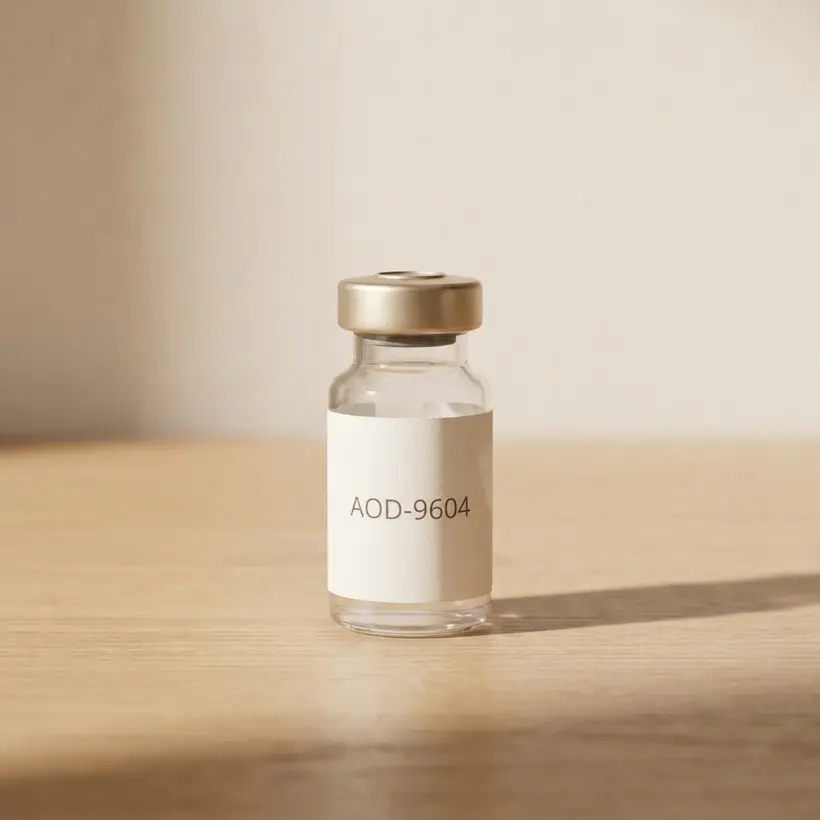
From the FormBlends catalog
AOD-9604
Fat-targeting fragment without growth hormone side effects · From $199/mo · compounded by a licensed 503A pharmacy, dispensed only after provider review.
View AOD-9604 →Table of Contents
- What is the regulatory status of AOD-9604?
- What are the legal pathways to obtain AOD-9604?
- What does AOD-9604 actually do, with specific numbers?
- Evidence ledger: what do we actually know?
- What most pages get wrong about obtaining AOD-9604
- How to read a COA and verify what you are buying
- Honest head-to-head: AOD-9604 vs. real alternatives
- Why the storage and stability rules matter: the chemistry
- Red flags that tell you a source is not legitimate
- FAQ
- Sources
What Is the Regulatory Status of AOD-9604?
AOD-9604 was developed by Metabolic Pharmaceuticals (Melbourne, Australia) and reached Phase III clinical evaluation for obesity. It received GRAS (Generally Recognized as Safe) status from the FDA as a food ingredient under the designation GRAS No. 000GRN000250, but GRAS status for a food ingredient is categorically different from drug approval. It has never received an FDA New Drug Application approval, an EMA marketing authorization, or TGA registration as a finished therapeutic good.
In the United States, the critical regulatory event that shapes current access is the FDA's classification of AOD-9604 under the bulk drug substance compounding review process. The FDA has published lists of bulk substances under review and those that may not be used in compounding under sections 503A and 503B of the Federal Food, Drug, and Cosmetic Act. Buyers and prescribers must check the FDA's current published lists, as this regulatory landscape shifted significantly through 2023 and 2024.
Outside the US, AOD-9604 can be prescribed in Australia under the TGA's Special Access Scheme Category B, which allows access to unapproved therapeutic goods for individual patients with a prescribing physician's request. In the EU and UK, no equivalent pathway has been broadly used, and there is no marketing authorization in any of those jurisdictions.
What Are the Legal Pathways to Obtain AOD-9604?
United States. Given FDA restrictions on compounding, the practical pathway is: (1) consult a physician or telehealth provider knowledgeable in peptide therapy, (2) ask them explicitly whether any 503A or 503B pharmacy they work with is currently permitted to compound AOD-9604 under current FDA guidance, and (3) do not proceed if the answer is uncertain. The physician can write a prescription; the bottleneck is now the pharmacy, not the prescriber.
Australia. A registered medical practitioner can apply under TGA Special Access Scheme Category B. The TGA reviews the application and, if approved, allows supply from a licensed manufacturer. This is a case-by-case approval, not a standing prescription pad right.
Other countries. Access via research-import permits exists in some jurisdictions for licensed researchers with an institutional ethics approval. This is not a consumer pathway and should not be conflated with one by vendors marketing to the public.
The research-use-only channel. This is not a legal human-use pathway. Vendors who sell peptides labeled "for research use only, not for human use" are placing legal liability on the buyer. The FDA does not recognize this label as creating a legitimate exception for human consumption. Using products from this channel is legally and clinically at-your-own-risk in the strictest sense.
What Does AOD-9604 Actually Do, With Specific Numbers?
AOD-9604 corresponds to the C-terminal 16 amino acids of human growth hormone, spanning positions 177 to 191 of the 191-amino-acid hGH sequence. Its molecular weight is approximately 1815.1 Da. Unlike full hGH, it does not bind the GH receptor (GHR) and does not stimulate hepatic IGF-1 secretion. This distinction matters because GHR binding is responsible for the anabolic and glucose-dysregulating effects of exogenous hGH.
The proposed lipolytic mechanism involves interaction with beta-3 adrenergic receptors on adipocytes, stimulating hormone-sensitive lipase activity. Animal studies, primarily in obese rodent models, demonstrated reductions in adipose tissue mass. The key limitation: rodent adipose beta-3 receptor density and pharmacology differ meaningfully from human adipose tissue, and animal results did not translate to significant effects in human trials.
In Metabolic Pharmaceuticals' Phase IIb clinical trial (designated METAOD006), oral AOD-9604 was tested across a range of doses over approximately 12 weeks in overweight adults. The trial did not meet its primary endpoint of statistically significant weight loss versus placebo. The company subsequently wound down the program. This is the highest-quality human evidence available and it is a null result.
The half-life of AOD-9604 in circulation is short, estimated in the range of minutes for small peptides administered subcutaneously, though specific published pharmacokinetic data for this exact peptide in humans is limited in the open literature. Subcutaneous injection bypasses first-pass hepatic metabolism; oral bioavailability for peptides of this size is generally poor without specific formulation strategies, which is relevant given that the human trials used an oral route.
Evidence Ledger: What Do We Actually Know?
| Claim | Best Evidence Type | Effect Direction | Confidence |
|---|---|---|---|
| AOD-9604 reduces adipose tissue in obese rodent models | Animal studies (multiple) | Positive (fat reduction) | Moderate (animal only) |
| AOD-9604 produces significant weight loss in humans (oral route) | Human Phase IIb RCT (METAOD006) | Null (no significant effect vs. placebo) | High (RCT evidence for null result) |
| AOD-9604 does not stimulate IGF-1 or affect glucose metabolism | Human safety data from Metabolic Pharmaceuticals trials | No IGF-1 elevation observed | Moderate |
| Subcutaneous AOD-9604 produces clinically meaningful fat loss in humans | Mechanism reasoning plus anecdote; no published RCT | Unproven | Very Low |
| AOD-9604 acts via beta-3 adrenergic receptor modulation | In vitro and animal mechanistic data | Plausible mechanism | Low (mechanism not confirmed in humans) |
| AOD-9604 is safe at doses tested in clinical trials | Phase I/II human safety data | No major safety signals in trials | Moderate (within trial doses and duration) |
| Research-use-only products match label claims for purity | Independent third-party testing (limited published data) | Variable and often below label claim | Low to Very Low |
What Most Pages Get Wrong About Obtaining AOD-9604
The most common error on competitor pages is treating the pre-2024 compounding pharmacy access model as if it still applies. Many articles written between 2018 and 2022 describe simply calling a telehealth clinic and receiving AOD-9604 via a compounding pharmacy as a routine transaction. The FDA's ongoing review of bulk drug substances for compounding has materially changed this landscape, and pages that have not been updated are misleading buyers.
The second major omission is the conflation of GRAS food-ingredient status with drug safety approval. AOD-9604 received FDA GRAS status as a food ingredient, which was used extensively in marketing materials. GRAS means the FDA accepted that the ingredient is safe at a particular use level in food, evaluated by a specific notifier. It carries zero implication about efficacy as a drug, about injectable safety, or about the suitability of the compound in a subcutaneous vial.
Third, most pages present the animal trial evidence for lipolysis without disclosing that the primary human Phase IIb trial was a null result. A reader who only sees the rodent data and the mechanism explanation will form a falsely optimistic picture of the evidence base.
How to Read a COA and Verify What You Are Buying
If you are evaluating any AOD-9604 product, a certificate of analysis (COA) is the minimum document to request. Here is what each field means and what the numbers should be:
| COA Field | What to Look For | Why It Matters |
|---|---|---|
| HPLC Purity | Above 98% by area under the curve | Confirms the peptide fraction is predominantly your target compound; below 95% is a red flag |
| Mass Spectrometry (MS) | Molecular weight confirmation at approximately 1815.1 Da | Verifies the correct peptide was synthesized; HPLC alone cannot distinguish a correctly sequenced peptide from an impurity of similar size |
| Endotoxin (LAL Test) | Below 1 EU/mg for injectable grade | Endotoxins from bacterial cell walls cause fever and septic-like reactions; critical for any injectable product |
| Sterility Test | Negative for microbial growth (USP criteria) | Required for injectable products; absence of this test is a disqualifying red flag for anything intended for injection |
| Water Content (Karl Fischer) | Below 10% for lyophilized powder | Excess moisture accelerates degradation during storage |
| Testing Laboratory | ISO 17025-accredited, named third party | In-house testing by the vendor has no independent verification value |
When evaluating a COA, check that the lot number on the document matches the lot number on your vial. A COA posted as a generic PDF with no lot number is not a COA; it is a marketing document.
Honest Head-to-Head: AOD-9604 vs. Real Alternatives
| Intervention | Best Human Evidence | Effect on Body Weight/Fat | Regulatory Status (US) | AOD-9604 Wins? |
|---|---|---|---|---|
| AOD-9604 (oral) | Phase IIb RCT (METAOD006) | No significant effect vs. placebo | Not approved, compounding restricted | No |
| AOD-9604 (subcutaneous) | No published human RCT | Unknown in humans | Same restrictions | Unproven |
| Semaglutide (GLP-1 RA) | Multiple Phase III RCTs (STEP program, Wilding et al. 2021, NEJM) | Approximately 15% body weight reduction over 68 weeks at 2.4 mg/week | FDA-approved (Wegovy) | No, semaglutide has far stronger evidence and approval |
| Liraglutide (GLP-1 RA) | Phase III RCTs (SCALE program) | Approximately 5 to 8% body weight reduction | FDA-approved (Saxenda) | No |
| Structured diet plus exercise | Extensive RCT base (DPP, Look AHEAD) | Variable; 5 to 7% sustained with high adherence | Not applicable | No, evidence base is vastly stronger |
| CJC-1295 or Ipamorelin (GHRH/GHRP) | Limited human data, mainly safety | Unproven for fat loss in humans | Not approved, compounding restricted | Roughly equivalent (both unproven in humans) |
Why the Storage and Stability Rules Matter: The Chemistry
AOD-9604, like all synthetic peptides, is subject to hydrolytic and oxidative degradation. The 16-amino-acid sequence contains a cysteine residue, which carries a free thiol group (-SH). Free thiols are susceptible to oxidation: in the presence of dissolved oxygen and metal trace contaminants, the thiol undergoes oxidation to form disulfide bonds, either intramolecular (forming a cyclic structure that changes the peptide conformation) or intermolecular (forming covalent dimers). Neither product retains the same pharmacological profile as the monomer. This is why lyophilized powder is preferred over aqueous solution for storage: lyophilization removes water, which is the solvent medium for these reactions.
Temperature matters for the same reason. Elevated temperatures accelerate both hydrolysis (cleavage of peptide bonds, particularly at Asp-Pro sequences which are kinetically labile) and the oxidative pathway described above. Storage at 2 to 8 degrees Celsius for short-term use, and at minus 20 degrees Celsius for long-term storage, slows these reaction rates. Repeated freeze-thaw cycles introduce mechanical stress (ice crystal formation) that can disrupt peptide aggregation states.
Bacteriostatic water (water containing 0.9% benzyl alcohol) is used for reconstitution in compounded injectables because benzyl alcohol inhibits microbial growth in the multi-use vial. However, benzyl alcohol is itself mildly reactive with some peptides over extended periods. Reconstituted peptide solutions should be used within the pharmacy-assigned beyond-use date, not stored indefinitely.
Red Flags That Tell You a Source Is Not Legitimate
- No independent third-party COA. A real pharmaceutical-grade supplier has every batch tested by an external ISO 17025 laboratory. In-house testing is unverifiable.
- Claims that AOD-9604 is FDA-approved. It is not. GRAS food-ingredient status is not drug approval. Any vendor making this claim is either misinformed or deliberately misleading.
- Prices dramatically below market. Solid-phase peptide synthesis of a 16-residue peptide to above 98% HPLC purity with endotoxin testing has real costs. A price significantly below the typical research-grade market rate signals either lower purity, shorter chain length, or mislabeled product.
- No endotoxin data for injectable products. This is a non-negotiable safety parameter. Any injectable product without LAL test results should not be injected.
- Vendor claims that "research use only" labeling creates a legal exemption for human use. It does not in the US.
- No lot number on the COA. A lot-specific COA is evidence that the document belongs to a real, tested batch.
- Telehealth clinic that skips the medical history. Any provider willing to prescribe without a clinical evaluation is not practicing medicine; they are operating a storefront.
FAQ
How to get AOD-9604 legally in the United States?
The primary legal route in the United States is a prescription from a licensed prescriber, typically filled by an FDA-registered compounding pharmacy. AOD-9604 is not an FDA-approved drug, so it exists in a compounding gray zone. As of 2024, the FDA has placed AOD-9604 on its list of bulk drug substances that may not be used in compounding under 503A or 503B, which severely restricts legitimate pharmacy access. Consult a licensed physician and verify current FDA guidance before attempting to obtain it.
Is AOD-9604 a controlled substance?
AOD-9604 is not listed as a Schedule I to V controlled substance under the US Controlled Substances Act. However, it is not FDA-approved, and FDA restrictions on compounding have made it difficult to obtain legally through pharmacies in the US.
Can a doctor prescribe AOD-9604?
A physician can write a prescription for AOD-9604, but finding a licensed compounding pharmacy willing and legally permitted to fill it is now very difficult in the US due to FDA restrictions on bulk drug substances. Telehealth clinics operating outside these restrictions may offer it, but buyers should verify the dispensing pharmacy's registration status.
What does AOD-9604 actually do?
AOD-9604 is a synthetic fragment of human growth hormone (hGH) consisting of amino acids 177 to 191 of the hGH C-terminus. It was designed to retain the lipolytic (fat-burning) activity of hGH while avoiding its growth-promoting and insulin-sensitizing effects. Human clinical trial results for weight loss were not statistically significant at the doses tested.
What is the difference between AOD-9604 and hGH?
AOD-9604 is a 16-amino-acid C-terminal fragment of hGH (positions 177 to 191). It does not bind the GH receptor and therefore does not stimulate IGF-1 production, promote tissue growth, or cause the glucose-raising effects of full hGH. Its proposed mechanism is direct beta-3 adrenergic receptor modulation in adipocytes.
How do I read a COA for AOD-9604?
A credible COA for AOD-9604 should show: HPLC purity above 98%, mass spectrometry confirming the molecular weight of approximately 1815.1 Da, endotoxin testing results (LAL test), sterility testing if the product is injectable, and sequence verification. The COA should name a third-party ISO-accredited laboratory, not an in-house lab.
What are the red flags when buying AOD-9604?
Major red flags include: no third-party COA, in-house-only testing, purity claims without mass spec confirmation, no endotoxin data on injectable vials, prices dramatically below market, and vendors claiming AOD-9604 is FDA-approved or legal for human use without a prescription.
What is the regulatory status of AOD-9604 outside the US?
In Australia, AOD-9604 reached Phase III clinical trials under Metabolic Pharmaceuticals. It is not TGA-approved as a finished drug but can be prescribed by doctors through the TGA's Special Access Scheme. In the EU, it holds no marketing authorization. Always check the current regulatory status in your specific country.
Is AOD-9604 on the WADA prohibited list?
WADA does not list AOD-9604 by name as of the 2024 Prohibited List. However, it could fall under the catch-all prohibition on peptides with similar structure or biological effect to growth hormone fragments. Competitive athletes should seek a formal WADA ruling before use.
What dose of AOD-9604 was used in human trials?
Metabolic Pharmaceuticals tested oral AOD-9604 in human trials across a range of doses, from low single-milligram amounts up to higher doses in the tens of milligrams per day, over periods of approximately 12 weeks. The Phase IIb trial (METAOD006) did not demonstrate statistically significant weight loss versus placebo across the doses tested.
Can I buy AOD-9604 online without a prescription?
Many websites sell AOD-9604 labeled "for research use only." This labeling does not make human use legal or safe. Products sold this way are unregulated, often unverified for purity, and their human use carries legal and health risks. Obtaining it through a licensed prescriber and registered pharmacy is the only legitimate pathway.
What should I ask a compounding pharmacy before ordering AOD-9604?
Ask: Is the pharmacy registered as 503A or 503B with the FDA? Is AOD-9604 currently on their approved bulk substance list? Can they provide a third-party COA with mass spec and endotoxin data? Is the product sterile-filtered and filled under ISO 5 conditions? What is the Beyond-Use Date and storage requirement?
Sources
- Metabolic Pharmaceuticals Ltd. Clinical trial data for AOD-9604. Australian New Zealand Clinical Trials Registry (ANZCTR). Referenced in Metabolic Pharmaceuticals investor materials and TGA correspondence, publicly available documents 2001 to 2007.
- US FDA. "List of Bulk Drug Substances That May Not Be Used In Compounding Under Sections 503A and 503B." Federal Register notices, ongoing publication series. Available at fda.gov.
- US FDA. GRAS Notification GRN No. 000250, AOD-9604 as a food ingredient. Available via FDA GRAS Notices database at fda.gov.
- Wilding JPH, Batterham RL, Calanna S, et al. "Once-Weekly Semaglutide in Adults with Overweight or Obesity." New England Journal of Medicine. 2021;384(11):989-1002. (STEP 1 trial, semaglutide reference for head-to-head context.)
- US FDA. Federal Food, Drug, and Cosmetic Act Sections 503A and 503B governing pharmacy compounding. Available at fda.gov.
- Therapeutic Goods Administration (TGA), Australia. Special Access Scheme: Category B guidance. Available at tga.gov.au.
- World Anti-Doping Agency. 2024 Prohibited List. Available at wada-ama.org. (For confirmation that AOD-9604 does not appear by name.)
- US Pharmacopeia (USP). General Chapter 71, Sterility Tests. Available at usp.org.
- US Pharmacopeia (USP). General Chapter 85, Bacterial Endotoxins Test (LAL). Available at usp.org.
- Diabetes Prevention Program Research Group. "Reduction in the Incidence of Type 2 Diabetes with Lifestyle Intervention or Metformin." New England Journal of Medicine. 2002;346(6):393-403. (Cited for diet plus exercise evidence base.)
Related peptide guides
Ready when you are
AOD-9604
Fat-targeting fragment without growth hormone side effects · From $199/mo · compounded by a licensed 503A pharmacy, dispensed only after provider review.
View AOD-9604 →