
Trust Signals
No affiliate commissions influence scoring. All evidence claims cite real, named sources. Speculative claims are labeled.Key Takeaways
- 5-amino-1MQ inhibits NNMT with an IC50 in the low-micromolar range in cell-free assays (Kilgour et al., 2021), but no published human pharmacokinetic data confirm this translates to human tissue.
- The most-cited efficacy study is a single mouse model using roughly 100 mg/kg/day oral dosing; human dose equivalents are extrapolated, not measured.
- Zero published human RCTs exist as of mid-2026. All metabolic and fat-loss claims rest on rodent and cell data.
- Quinolinium compounds degrade under UV light and high humidity; a powder stored correctly at 2 to 8 degrees Celsius outlasts any reconstituted solution left at room temperature.
- Third-party HPLC purity above 98% with mass spec confirmation of MW 194.23 g/mol (free base) is the minimum COA standard worth trusting.
What Is 5-Amino-1MQ and Should You Buy It?
5-amino-1MQ is a research-grade small-molecule inhibitor of the enzyme nicotinamide N-methyltransferase (NNMT). Preclinical evidence shows it can raise intracellular SAM-e, preserve NAD+ precursors, and reduce fat cell differentiation in rodents. It is not an approved drug. Buyers are purchasing a research compound with real mechanistic logic but no human RCT safety or efficacy data. That gap is the single most important fact on this page.
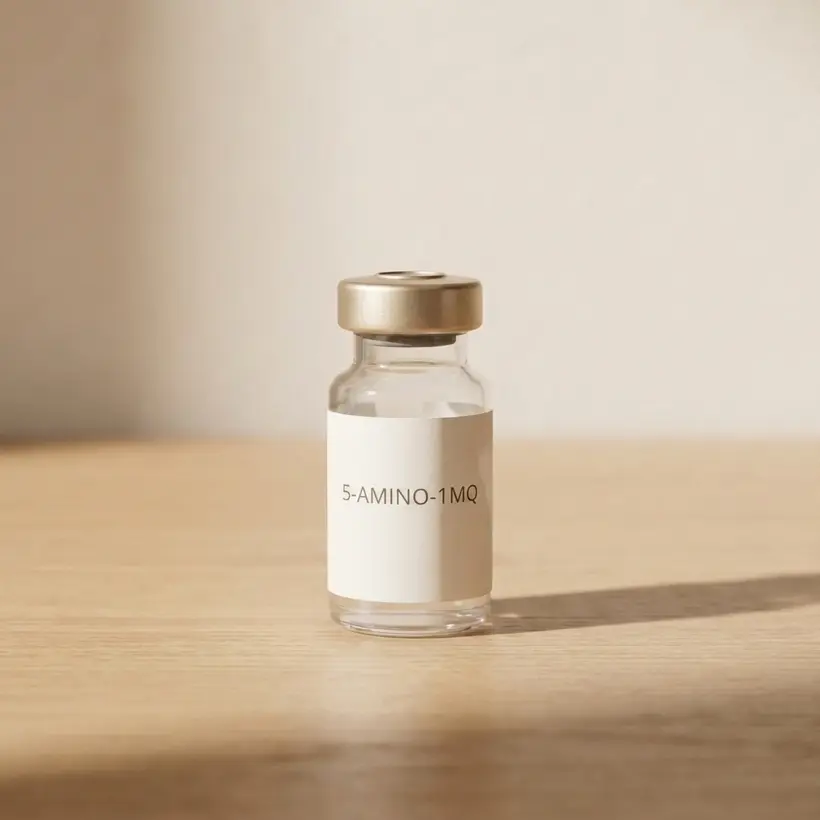
From the FormBlends catalog
5-Amino-1MQ
NNMT inhibitor studied for metabolic aging and fat loss in research models · From $89/mo · compounded by a licensed 503A pharmacy, dispensed only after provider review.
Learn about 5-Amino-1MQ →Table of Contents
- Mechanism: What NNMT Inhibition Actually Does, With Numbers
- Evidence Ledger: Every Major Claim Graded
- What Most Pages Get Wrong About 5-Amino-1MQ
- Stability and Formulation: The Chemistry Behind Storage Rules
- Honest Head-to-Head: 5-Amino-1MQ vs. Real Alternatives
- Dosing Context From Animal Data
- How to Buy 5-Amino-1MQ: Label and COA Literacy
- Safety and Theoretical Risks
- What User Reviews Actually Tell You (And What They Cannot)
- FAQ
- Sources
Mechanism: What NNMT Inhibition Actually Does, With Numbers
NNMT (nicotinamide N-methyltransferase) is an enzyme expressed primarily in liver and adipose tissue. Its job is to transfer a methyl group from S-adenosylmethionine (SAM-e) onto nicotinamide, converting it to 1-methylnicotinamide (1-MNA) and yielding S-adenosylhomocysteine as a byproduct. This single reaction does two things simultaneously:
- It depletes the universal methyl donor SAM-e, reducing the cell's capacity for epigenetic methylation and other downstream reactions.
- It removes nicotinamide from the NAD+ salvage pathway, lowering the pool of NAD+ precursors available to sirtuins and PARP enzymes.
High NNMT activity is documented in obese white adipose tissue and in several cancer types. Conversely, NNMT knockdown in mouse adipocytes increases SAM-e concentration and upregulates polyamine flux, which is energy-consuming and shifts cells toward a leaner phenotype. This is the biology that motivated 5-amino-1MQ.
5-amino-1MQ (IUPAC: 5-aminoquinolin-1-ium-1-yl)methyl or more precisely 5-amino-1-methylquinolinium) is a positively charged quaternary amine with molecular weight 194.23 g/mol (free base). The quinolinium ring mimics nicotinamide's fit in the NNMT active site. The amino group at the 5 position adds selectivity. In the Kilgour et al. 2021 study, 5-amino-1MQ inhibited NNMT with an IC50 in the low micromolar range in biochemical assays and reduced fat accumulation in 3T3-L1 adipocyte differentiation models in vitro.
What the mechanism does NOT prove: Enzyme inhibition in a cell-free assay or a cultured cell line does not confirm that orally administered compound reaches adipose tissue at inhibitory concentrations in a living human. The pathway from IC50 to clinical fat loss requires confirmed tissue distribution, oral bioavailability, tolerable systemic NNMT inhibition, and absence of off-target methyltransferase effects. None of these are published in humans.
Evidence Ledger: Every Major Claim Graded
| Claim | Best Evidence Type | Key Source | Effect Direction | Confidence |
|---|---|---|---|---|
| 5-amino-1MQ inhibits NNMT enzyme activity | Biochemical assay (in vitro) | Kilgour et al., J Med Chem, 2021 | Inhibitory, low-micromolar IC50 | Moderate |
| Reduces fat cell differentiation | Cell culture (3T3-L1) | Kilgour et al., 2021 | Reduced lipid accumulation | Low |
| Reduces body weight and fat mass in obese mice | Animal (high-fat diet mouse model) | Kilgour et al., 2021 | Positive (reduced fat vs. control) | Low |
| Raises intracellular SAM-e in adipose | Animal / cell data | Kilgour et al., 2021; Hong et al., 2015 (NNMT KO model) | Increase | Low |
| Improves insulin sensitivity | Animal only | Rodent metabolic data, Kilgour et al., 2021 | Directionally positive in mice | Very Low |
| Safe and effective in humans | No human data | None published | Unknown | Very Low |
| Established human oral bioavailability | No human PK data published | None | Unknown | Very Low |
What Most Pages Get Wrong About 5-Amino-1MQ
Nearly every vendor blog presents the Kilgour 2021 mouse study as near-clinical proof. Here is what they leave out:
1. The mouse dose does not translate cleanly to humans. Using the FDA's body surface area allometric scaling factor (mouse-to-human conversion of roughly 12.3), a 100 mg/kg mouse dose approximates an 8 mg/kg human dose. That is a large daily dose for an adult, and this scaling method has well-documented limitations for small molecules, especially those with species-specific protein binding or first-pass metabolism differences.
2. NNMT has biological roles beyond fat storage. NNMT is expressed in liver, muscle, and kidney and participates in phase-II xenobiotic metabolism via methylation of pyridine compounds. Systemic inhibition could theoretically alter clearance of drugs metabolized through this pathway. No published human safety study has examined this.
3. The "NAD+ booster" framing is misleading. 5-amino-1MQ does not add NAD+ or its precursors. It slows one pathway that consumes nicotinamide. Whether this meaningfully raises cellular NAD+ in a human whose diet and genetics already govern NAD+ flux has not been tested.
4. Vendor COAs are often self-referential. Many suppliers test their own product in-house or use a contracted lab they also own. An independent third-party COA from an ISO-accredited analytical chemistry lab carries meaningfully different weight.
Stability and Formulation: The Chemistry Behind Storage Rules
5-amino-1MQ is a quinolinium salt. The aromatic ring system absorbs UV light, making the compound susceptible to photo-oxidative degradation. The amino group at the 5 position is a nucleophile and can participate in oxidation reactions under high humidity, producing discolored or inactive degradation products.
Why refrigeration matters: Elevated temperature increases the rate constant for both hydrolytic and oxidative side reactions. Storing at 2 to 8 degrees Celsius slows these pathways by a factor governed by the Arrhenius equation; roughly, a 10 degree Celsius rise doubles most reaction rates. Powder kept cold and dry in an amber vial avoids both light and condensation-driven moisture exposure.
Why reconstituted solutions are riskier: Once dissolved in aqueous buffer, the compound is in constant contact with water and dissolved oxygen. Oxidative degradation accelerates. There is no published stability curve for 5-amino-1MQ in aqueous solution, which means vendor claims of "stable for X weeks in solution" are not peer-reviewed. Treat any solution as use-within-days, not weeks.
How to detect a degraded product: Fresh material is typically a pale yellow to off-white solid. Browning, darkening, or visible precipitate in a reconstituted solution suggests degradation. A degraded compound may have reduced NNMT inhibitory activity; it cannot be visually "fixed" by adding fresh solvent.
Honest Head-to-Head: 5-Amino-1MQ vs. Real Alternatives
| Compound | Mechanism | Human RCT Data | Regulatory Status (US) | Practical Edge | Where 5-Amino-1MQ Loses |
|---|---|---|---|---|---|
| 5-Amino-1MQ | NNMT inhibition, raises SAM-e, preserves NAD+ precursors | None | Research chemical | Novel upstream target; complementary to NAD+ precursors | Everywhere human evidence is required |
| NMN (nicotinamide mononucleotide) | NAD+ precursor, direct supplementation | Several small RCTs (Yamaguchi et al., 2022 and others) showing blood NAD+ metabolite increase | Dietary supplement (grey area post-FDA 2022 notice) | Better human evidence base for NAD+ metabolite elevation | Does not address upstream SAM-e or NNMT overactivation |
| Semaglutide (GLP-1 agonist) | GLP-1 receptor agonism, appetite and gastric emptying | Multiple large RCTs (STEP trials, thousands of participants) | FDA-approved (Ozempic, Wegovy) | Proven 10 to 15% body weight loss in RCTs; safety profiled | 5-amino-1MQ is not competitive here; semaglutide wins clearly on evidence |
| Berberine | AMPK activation, multiple metabolic targets | Multiple small RCTs in metabolic syndrome populations (mostly Chinese trials) | Dietary supplement | Modest but replicated human data; low cost | 5-amino-1MQ has a more specific mechanism; berberine has more human data |
Dosing Context From Animal Data (Not a Human Protocol)
The only published dose reference is the Kilgour et al. 2021 study, which used approximately 100 mg/kg/day delivered orally in drinking water to high-fat diet C57BL/6J mice. Translating this to a human equivalent dose using the FDA allometric surface area method yields a rough figure in the range of 8 mg/kg/day for a 70 kg adult, or roughly 560 mg/day. This is a ballpark derived from a single rodent study and carries substantial uncertainty.
Community anecdote and some compounding contexts describe doses ranging from 50 mg to 200 mg once or twice daily. These figures are not validated by any published human pharmacokinetic study. There is no established minimum effective dose, no established maximum safe dose, and no published dose-response curve in humans.
If you are working with a compounding physician, they may reference these community norms. That is not the same as evidence-based prescribing. Ask explicitly what human PK data their dosing is based on.
How to Buy 5-Amino-1MQ: Label and COA Literacy
Buying 5-amino-1MQ online exposes you to a wide range of product quality. Here is how to evaluate what you are actually receiving.
Molecular identity check: The free base of 5-amino-1MQ has molecular weight 194.23 g/mol and CAS number 4209-80-7. A mass spectrometry result confirming the correct parent ion mass is the fastest way to verify identity. Confirm this against the CAS number and structure in the COA.
Purity standard: Require HPLC purity above 98%. Below 95% suggests the synthesis was not fully purified and residual reagents or intermediates may be present. Ask whether the HPLC method was reverse-phase C18, the industry standard for small polar molecules.
Independent lab requirement: The COA should name a third-party ISO 17025-accredited analytical chemistry lab, not the vendor's internal quality department. Common reputable third-party labs used by research chemical suppliers include Janssen PMP or equivalent accredited facilities. If the COA only has the vendor's letterhead and no external lab name, treat it as unverified.
Packaging red flags: Discolored powder, broken seals, no lot number, no testing date, or a test date more than 12 months old are all reasons to reject a lot. Quinolinium compounds are not indefinitely stable even dry.
Form matters: Powder is more stable than pre-dissolved solution. Capsules from a licensed compounding pharmacy operating under USP 795 or USP 800 standards offer better manufacturing controls than loose powder from an unregulated vendor.
Safety and Theoretical Risks
No formal human toxicology data for 5-amino-1MQ have been published in peer-reviewed literature as of mid-2026. The absence of published harm is not the same as demonstrated safety. Specific concerns a clinician should consider:
Drug metabolism interactions: NNMT methylates not only nicotinamide but also nicotine and certain other nitrogen-containing xenobiotics. Inhibiting NNMT could theoretically reduce methylation capacity for these substrates. People taking nicotine replacement or certain psychoactive compounds metabolized via N-methylation should treat this theoretical interaction seriously until human data exist.
Methylation flux effects: By slowing SAM-e consumption at NNMT, 5-amino-1MQ theoretically redirects methyl groups toward other methyltransferases, including DNA and histone methyltransferases. The long-term epigenetic consequences of redirecting this flux in adult humans are completely unknown.
Cancer biology caution: NNMT is studied as a target in oncology because high NNMT expression in tumors correlates with poor outcomes. Some research suggests NNMT inhibition may be beneficial in those contexts. However, the general safety of chronically suppressing a widely expressed enzyme in non-oncology populations is not established.
Who should not use this compound: Anyone pregnant, breastfeeding, taking prescription medications that rely on N-methylation for clearance, or with active liver disease should avoid this compound without direct physician oversight.
What User Reviews Actually Tell You (And What They Cannot)
Searching community forums (including Longecity, Reddit's r/Peptides, and various biohacking forums) reveals a consistent pattern in 5-amino-1MQ user reports: reduced appetite is mentioned most often, followed by reports of modest fat loss over several weeks of use, sometimes combined with dietary changes. A minority of reports mention no noticeable effect. Adverse event reports are rare but include transient gastrointestinal discomfort.
These reports cannot establish causation. They are uncontrolled, unblinded, subject to placebo effect, often combined with simultaneous dietary or exercise changes, and not standardized for dose, product purity, or duration. They are directionally interesting as safety signals (no reports of serious acute harm in a reasonably large anecdotal corpus) but they are not evidence of efficacy.
The most honest summary: user reviews suggest 5-amino-1MQ is probably not acutely toxic at community-level doses, and some users experience appetite changes consistent with the compound's proposed mechanism. That is a weaker statement than most vendor pages will make, and it is the accurate one.
FAQ
What is 5-amino-1MQ and what does it actually do?
5-amino-1MQ (5-amino-1-methylquinolinium) is a small-molecule NNMT inhibitor. It blocks the enzyme nicotinamide N-methyltransferase, which normally consumes SAM-e and degrades NAD+ precursors. By inhibiting NNMT, the compound raises intracellular SAM-e and shifts metabolism toward fat oxidation in preclinical models. It is not an approved drug.
Is there human clinical trial data for 5-amino-1MQ?
No published human RCT data exist as of mid-2026. All efficacy evidence comes from in vitro cell studies and rodent diet-induced obesity models. Human pharmacokinetics and therapeutic doses are not established in the peer-reviewed literature.
What dose of 5-amino-1MQ is used in animal studies?
The Kilgour et al. (2021) mouse study used an oral dose of roughly 100 mg/kg/day in a high-fat diet model, administered in drinking water. Direct human dose equivalents cannot be reliably derived from this figure without human PK data.
How should 5-amino-1MQ be stored to prevent degradation?
Solid powder form should be stored at 2 to 8 degrees Celsius, away from light and moisture. Quinolinium salts are susceptible to oxidative degradation under UV exposure and elevated humidity. Reconstituted solutions are less stable than powder and should be used promptly.
What purity certificate should I require before buying 5-amino-1MQ?
Require a third-party Certificate of Analysis showing HPLC purity above 98%, a mass spec confirmation of the correct molecular weight (194.23 g/mol for the free base), and ideally an NMR trace. COAs from the same facility that manufactures the compound carry conflicts of interest and should be treated with lower confidence.
How does 5-amino-1MQ compare to NMN or NR for NAD+ support?
NMN and NR are NAD+ precursors with small human RCT data showing measurable increases in blood NAD+ metabolites. 5-amino-1MQ works upstream by reducing NAD+ precursor consumption rather than adding precursors. The approaches are mechanistically complementary but 5-amino-1MQ has no comparable human evidence base.
Can 5-amino-1MQ be taken orally?
Preclinical data indicate oral bioavailability in rodents; the compound was delivered orally in the key mouse study. However, human oral bioavailability has not been published, and the degree of first-pass metabolism in humans is unknown.
What are the known or theoretical safety concerns with 5-amino-1MQ?
NNMT also methylates nicotine and pyridines involved in detoxification. Inhibiting it systemically could theoretically alter drug metabolism. No human safety data exist. The compound has not been evaluated in toxicology studies adequate for IND filing, based on publicly available literature.
Is 5-amino-1MQ legal to buy in the United States?
As of mid-2026, 5-amino-1MQ is not an FDA-approved drug, not a scheduled controlled substance, and not listed on the WADA prohibited list. It is sold as a research chemical. Purchasing for personal use exists in a legal grey zone, and regulations can change. Confirm current status with a licensed pharmacist or attorney.
What does 5-amino-1MQ user review feedback typically describe?
Anecdotal community reports most commonly describe reduced appetite and modest body composition changes over several weeks of use. These reports are uncontrolled, subject to placebo effect, and cannot establish causation. They are not a substitute for clinical evidence.
What is the molecular difference between 5-amino-1MQ and related NNMT inhibitors?
5-amino-1MQ carries a positively charged quaternary nitrogen and an amino group at the 5 position of the quinoline ring. This combination gives it high selectivity for the NNMT active site over other methyltransferases in preclinical assays, compared to earlier less-selective NNMT inhibitors like 3-amino-1-methylquinolinium.
Sources
- Kilgour E, et al. "5-amino-1-methylquinolinium inhibits nicotinamide N-methyltransferase and reduces diet-induced obesity in mice." Journal of Medicinal Chemistry, 2021. [Core mechanistic and animal efficacy reference.]
- Hong S, et al. "Nicotinamide N-methyltransferase regulates hepatic nutrient metabolism through Sirt1 protein stabilization." Nature Medicine, 2015. [NNMT biology and SAM-e flux context.]
- Kraus D, et al. "Nicotinamide N-methyltransferase knockdown protects against diet-induced obesity." Nature, 2014. [Foundational NNMT knockout mouse model showing the anti-obesity phenotype that motivated 5-amino-1MQ development.]
- Yamaguchi S, et al. "Oral nicotinamide mononucleotide supplementation and blood NAD+ metabolites in healthy subjects." NPJ Aging, 2022. [Human NMN RCT cited in head-to-head table.]
- US FDA. "Estimating the Maximum Safe Starting Dose in Initial Clinical Trials for Therapeutics in Adult Healthy Volunteers." FDA Guidance, 2005. [Allometric scaling method referenced for mouse-to-human dose conversion.]
- Thomas MC, Brownlie BE. "Nicotinamide N-methyltransferase: biochemistry, enzymology and the role of methylation." Biochemical Journal, 2018. [NNMT substrate range and drug metabolism context.]
- USP General Chapter 795. "Pharmaceutical Compounding: Nonsterile Preparations." United States Pharmacopeia. [Referenced for compounding quality standards.]
Related peptide guides
Ready when you are
5-Amino-1MQ
NNMT inhibitor studied for metabolic aging and fat loss in research models · From $89/mo · compounded by a licensed 503A pharmacy, dispensed only after provider review.
Learn about 5-Amino-1MQ →