Key Takeaways
- AOD 9604 is a 16-amino-acid synthetic fragment of human growth hormone (residues 176 to 191 plus an N-terminal tyrosine), with a molecular weight of approximately 1817 Da.
- Adding 2 mL of bacteriostatic water to a 5 mg vial yields exactly 2500 mcg per mL, making 250 mcg doses equal to 10 units on a 100-unit insulin syringe.
- Human RCTs by Metabolic Pharmaceuticals tested oral AOD 9604 at 1 mg per day; injectable subcutaneous protocols are investigational with no FDA-approved dose.
- Reconstituted solution is commonly used within 28 days when refrigerated with bacteriostatic water; this figure reflects benzyl alcohol antimicrobial limits, not a published AOD 9604 stability study.
- A legitimate COA must show HPLC purity at or above 98% and mass spectrometry confirmation of the correct molecular weight; any COA without a third-party chromatogram is insufficient for quality assessment.
What is AOD 9604 and how do you reconstitute it? (Direct Answer)
AOD 9604 reconstitution means dissolving lyophilized peptide powder in bacteriostatic water before injection. Add 2 mL of bacteriostatic water to a 5 mg vial by injecting the liquid slowly down the vial wall. Swirl gently, never shake. The result is 2500 mcg per mL. Draw each dose with a standard insulin syringe and inject subcutaneously.
Table of Contents
- What is AOD 9604 and how does it work?
- Evidence Ledger: What Do We Actually Know?
- What Supplies Do You Need Before Reconstituting?
- Step-by-Step Reconstitution Protocol
- Concentration Math and Dosing Table
- How Long Does Reconstituted AOD 9604 Stay Good?
- What Most Pages Get Wrong About AOD 9604 Reconstitution
- Why These Rules Exist: The Chemistry Behind Them
- AOD 9604 vs. Alternatives: Honest Head-to-Head
- How to Read a COA and Spot a Substandard Product
- Frequently Asked Questions
- Sources
What is AOD 9604 and how does it work?
AOD 9604 (Anti-Obesity Drug 9604) is a synthetic peptide comprising the C-terminal fragment of human growth hormone, specifically residues 176 to 191, with a tyrosine residue added at the N-terminus to improve stability. The sequence is: Tyr-Leu-Arg-Ile-Val-Gln-Cys-Arg-Ser-Val-Glu-Gly-Ser-Cys-Gly-Phe. It contains a disulfide bond between the two cysteine residues, a structural feature essential for its bioactivity.
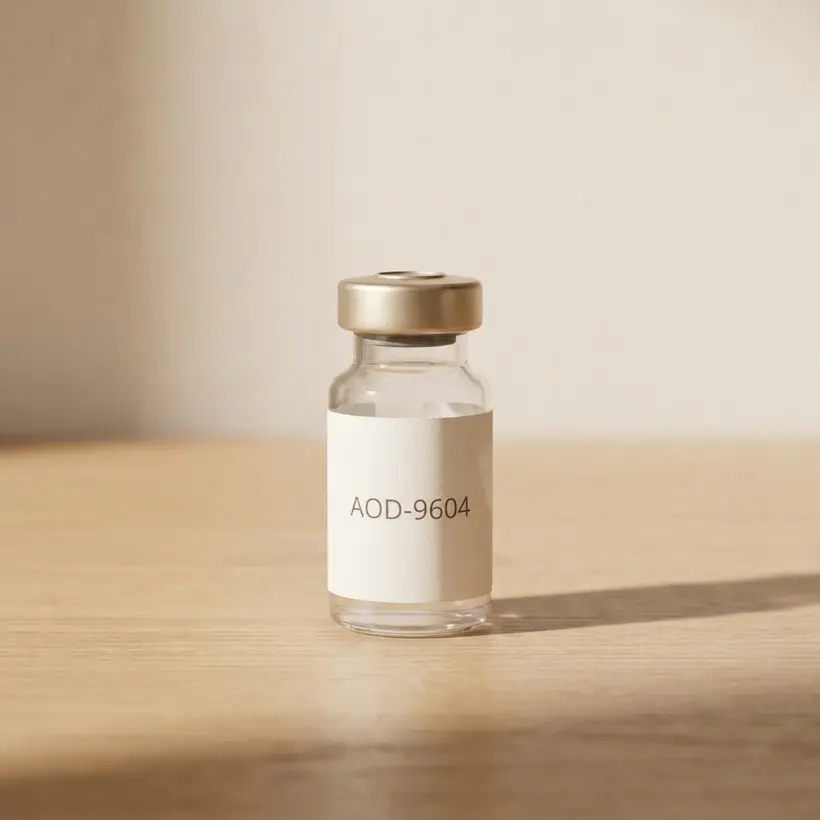
From the FormBlends catalog
AOD-9604
Fat-targeting fragment without growth hormone side effects · From $199/mo · compounded by a licensed 503A pharmacy, dispensed only after provider review.
View AOD-9604 →This region of HGH is associated with lipolytic signaling. Preclinical data in rodents showed stimulation of fat breakdown and inhibition of fat accumulation without the IGF-1-stimulating or insulin-desensitizing effects of full-length HGH. The peptide does not measurably raise IGF-1 levels in human trials, which distinguishes its safety profile from exogenous HGH.
Important caveat: Demonstrating lipolytic activity in rodents does not prove equivalent fat-loss magnitude in humans. The human trial data are limited (see evidence table below).
Evidence Ledger: What Do We Actually Know?
| Claim | Best Evidence Type | Effect Direction | Confidence |
|---|---|---|---|
| AOD 9604 stimulates lipolysis in vitro and in rodent models | Animal and in vitro studies (Heffernan et al., multiple Metabolic Pharmaceuticals-funded studies) | Positive | Moderate (animal data only) |
| Oral AOD 9604 at 1 mg per day is safe and well-tolerated in humans | Phase II human RCTs by Metabolic Pharmaceuticals (Stier et al., reported 2007) | Positive for safety | Moderate |
| Oral AOD 9604 produces statistically significant fat loss vs. placebo | Phase II RCT (Metabolic Pharmaceuticals); results mixed across trials | Modest positive in some arms; not confirmed across all trials | Low |
| Injectable subcutaneous AOD 9604 produces fat loss in humans | No published human RCT for injectable route | Unknown | Very Low (mechanism extrapolation only) |
| AOD 9604 does not raise IGF-1 in humans | Phase II human data | Null (no IGF-1 rise) | Moderate |
| AOD 9604 has GRAS status for oral use | FDA GRAS determination (GRN 000571) | Regulatory fact | High |
| AOD 9604 improves cartilage or joint tissue | Animal studies and in vitro only | Preliminary positive | Very Low |
What Supplies Do You Need Before Reconstituting?
Gather everything before you open the peptide vial. You will need:
- AOD 9604 lyophilized vial (commonly 5 mg)
- Bacteriostatic water for injection (sterile, USP-grade, 0.9% benzyl alcohol)
- Insulin syringes, 1 mL capacity, 29 to 31 gauge (for reconstitution and injection)
- Alcohol swabs (70% isopropyl alcohol)
- Clean, hard surface wiped with an alcohol swab
- Refrigerator set to 2 to 8 degrees Celsius for storage
Do not use normal saline as your primary diluent for multi-dose vials. It contains no preservative and creates a meaningful sterility risk if the vial will be used more than once.
Step-by-Step Reconstitution Protocol
- Wash hands thoroughly with soap and water for at least 20 seconds.
- Swab both vial tops (the peptide vial and the bacteriostatic water vial) with a fresh alcohol swab. Allow 30 seconds to air dry before piercing.
- Draw the diluent. Insert the insulin syringe into the bacteriostatic water vial and draw 2 mL (200 units on a 100-unit syringe, requiring two full draws, or use a larger 2 mL syringe for this step).
- Inject slowly down the inner wall of the peptide vial. Do not aim the stream directly at the powder cake. This reduces foaming and mechanical shear that can disrupt the disulfide bond.
- Swirl gently for 15 to 20 seconds. Do not shake, vortex, or invert aggressively. The powder should dissolve completely within about one minute.
- Inspect the solution. It should be clear and colorless. If cloudy, colored, or particulate, discard.
- Label the vial with the date of reconstitution and the concentration (e.g., 2500 mcg per mL).
- Refrigerate immediately at 2 to 8 degrees Celsius. Keep away from light.
Concentration Math and Dosing Table
The formula is straightforward. Concentration (mcg per mL) equals total peptide in mcg divided by total diluent volume in mL.
For a 5 mg vial: 5 mg = 5000 mcg. Divide by the volume of bacteriostatic water added.
| Diluent Added | Concentration | 250 mcg dose = | 500 mcg dose = |
|---|---|---|---|
| 1 mL | 5000 mcg per mL | 0.05 mL (5 units) | 0.10 mL (10 units) |
| 2 mL | 2500 mcg per mL | 0.10 mL (10 units) | 0.20 mL (20 units) |
| 2.5 mL | 2000 mcg per mL | 0.125 mL (12.5 units) | 0.25 mL (25 units) |
Unit conversion reminder: On a standard 100-unit insulin syringe, 1 unit equals 0.01 mL. So 10 units equals 0.10 mL. Always verify your syringe calibration before drawing a dose.
Injection technique: Pinch a fold of abdominal skin, insert the needle at a 45-degree angle, inject slowly, and withdraw. Rotate sites each day. Press gently with a clean swab; do not rub.
How Long Does Reconstituted AOD 9604 Stay Good?
Reconstituted peptide stored in bacteriostatic water at 2 to 8 degrees Celsius is commonly described as usable for up to 28 days. That 28-day figure comes from the known antimicrobial effectiveness window of benzyl alcohol as a preservative in multi-dose vials, not from a published stability kinetics study specific to AOD 9604.
What this means practically: the 28-day limit is a microbiological safety rule, not a confirmed potency guarantee. Peptide oxidation and hydrolysis likely reduce potency gradually over that window, with the rate depending on pH, temperature fluctuations, and exposure to light. Lyophilized unreconstituted powder, stored at minus 20 degrees Celsius and protected from humidity, is stable for considerably longer, though specific shelf-life data for AOD 9604 powder are not published in peer-reviewed literature.
Discard signals: Any cloudiness, color change, visible particles, or unusual smell. When in doubt, discard. The cost of a new vial is lower than the risk of injecting a degraded or contaminated solution.
What Most Pages Get Wrong About AOD 9604 Reconstitution
This is the section competitors skip. Three common errors appear repeatedly across medspa blogs and peptide vendor guides:
1. Claiming 28 days is a proven potency window. It is not. It reflects benzyl alcohol's antimicrobial action. Actual peptide potency may decline within that window. No published AOD 9604 solution-stability study with HPLC time-course data exists in the open literature as of the date of this publication.
2. Ignoring the disulfide bond. AOD 9604 contains an intramolecular disulfide bond between its two cysteine residues. This bond is essential for the peptide's folded bioactive conformation. Shaking vigorously, exposing to reducing agents, or mixing with strongly alkaline solutions can break this bond and produce a linear, less active peptide. You cannot tell by looking at the vial whether this has happened. This is why gentle reconstitution and proper storage are not optional niceties.
3. Treating all bacteriostatic water as equivalent. Benzyl alcohol concentration varies slightly across manufacturers. USP-grade bacteriostatic water for injection specifies 0.9% benzyl alcohol. Off-brand or repackaged products may not meet this specification. Use a USP-labeled product from a licensed pharmacy supplier.
Why These Rules Exist: The Chemistry Behind Them
Why not shake the vial? Vigorous mechanical agitation creates air-water interfaces and localized high-shear zones. Peptides are amphiphilic; they adsorb at these interfaces and can undergo surface-induced denaturation or aggregation. For peptides with disulfide bonds, shear stress can also increase oxidative misfolding. Gentle swirling keeps the air-water interface minimal.
Why bacteriostatic water and not saline? Benzyl alcohol at 0.9% is bacteriostatic (it inhibits replication) against common gram-positive and gram-negative contaminants. It works by disrupting bacterial cell membrane integrity. This protection is time-limited because benzyl alcohol gradually partitions out of solution through the rubber septum and through repeated needle piercing. After roughly 28 days, remaining benzyl alcohol concentration is insufficient for reliable antimicrobial protection.
Why avoid vitamin C or antioxidants in the same syringe? Ascorbic acid is a reducing agent. The disulfide bond in AOD 9604 (a covalent bond between two sulfur atoms) is susceptible to reductive cleavage. Mixing with ascorbic acid would reduce Cys-S-S-Cys to two free thiols, linearizing the peptide and abolishing the bioactive conformation. This is the same chemistry that makes mixing most disulfide-containing peptides with vitamin C a formulation error, not just a precaution.
Why refrigerate rather than freeze after reconstitution? Freeze-thaw cycles force water into an ice crystal structure that excludes solutes and concentrates them at phase boundaries. This local concentration increase drives peptide aggregation. Ice crystals can also mechanically disrupt peptide secondary structure. The lyophilization process that produced the original powder was a controlled freeze-drying designed to protect the peptide in the solid state; casual freezing of the reconstituted liquid does not replicate that protection.
AOD 9604 vs. Alternatives: Honest Head-to-Head
| Compound | Regulatory Status | Evidence for Fat Loss | IGF-1 Impact | Route | Where It Wins | Where AOD 9604 Loses |
|---|---|---|---|---|---|---|
| AOD 9604 | Not FDA-approved as drug; GRAS oral only | Phase II human oral data, mixed; no injectable RCT | No increase shown | Subcutaneous (off-label), oral | No IGF-1 elevation; generally well-tolerated in trials | Weak human efficacy data; no approved indication |
| Semaglutide (Ozempic, Wegovy) | FDA-approved for obesity (Wegovy) | Large RCTs; roughly 15% body weight loss in STEP trials (Wilding et al., NEJM 2021) | No direct IGF-1 effect | Subcutaneous weekly | Strong, replicated human evidence; approved indication | GI side effects, cost, supply constraints |
| Full-length HGH (somatropin) | FDA-approved for specific indications | Modest lipolytic effect; not approved for obesity | Significant increase | Subcutaneous daily | Well-characterized pharmacology | IGF-1 rise; risk of insulin resistance; controlled substance regulations |
| CJC-1295 plus Ipamorelin | Compounded; not FDA-approved | Animal and mechanistic data; no large human RCT for fat loss | Indirect increase via GH pulse | Subcutaneous | Endogenous GH pulse stimulation | Same evidence gap as AOD 9604; IGF-1 does rise |
The honest takeaway: if the primary goal is evidence-backed fat loss, semaglutide has a dramatically stronger evidence base. AOD 9604's main theoretical appeal is the absence of IGF-1 stimulation, but that advantage is only meaningful if IGF-1 elevation is a specific concern, and the fat-loss evidence itself is weak.
How to Read a COA and Verify Your AOD 9604
A Certificate of Analysis is only useful if it is third-party, meaning the analytical testing was done by a laboratory with no financial interest in the result. Here is what to look for:
| Test | What to Look For | Why It Matters |
|---|---|---|
| HPLC purity | At or above 98%; an actual chromatogram, not just a number | Confirms the stated peptide comprises almost all of what is present |
| Mass spectrometry | Observed molecular weight matching approximately 1817 Da for AOD 9604 | Confirms correct sequence and disulfide bond formation |
| Endotoxin (LAL test) | Below 1 EU per mg is a common threshold for injectable peptides | Bacterial endotoxins cause fever and inflammation even in sterile solutions |
| Water content (Karl Fischer) | Typically below 6% for lyophilized peptides | High water content shortens shelf life and can indicate incomplete lyophilization |
| Amino acid analysis | Correct ratio confirms sequence; not always included but valuable | Distinguishes correct peptide from truncated or scrambled sequences |
If a COA shows only a number with no chromatogram, no instrument method, and no third-party lab name, it tells you almost nothing. Ask the supplier for the raw data file. Reputable suppliers provide it. If they do not, treat the purity claim as unverified.
Frequently Asked Questions
What diluent should I use to reconstitute AOD 9604?
Bacteriostatic water (0.9% benzyl alcohol in water for injection) is the standard choice for multi-dose vials because benzyl alcohol inhibits microbial growth for up to 28 days after reconstitution when refrigerated. Sterile water for injection is acceptable for single-use reconstitution but offers no preservative protection.
How much bacteriostatic water do I add to a 5 mg vial of AOD 9604?
Adding 2 mL of bacteriostatic water to a 5 mg vial yields a concentration of 2.5 mg per mL (2500 mcg per mL). Adding 1 mL yields 5 mg per mL. The 2 mL dilution is most common because it makes small doses easier to measure accurately on a standard insulin syringe.
What dose of AOD 9604 is typically used?
The human clinical trials by Metabolic Pharmaceuticals used oral doses of 1 mg per day. Subcutaneous research protocols commonly reference 250 to 500 mcg once daily, typically administered in a fasted state. These are investigational uses; no injectable dose is FDA-approved.
How do I calculate injection volume from my reconstituted AOD 9604?
Divide desired dose in mcg by concentration in mcg per mL, then multiply by 1000 to convert to microliters (or divide by 10 to convert to insulin syringe units). Example: 300 mcg dose at 2500 mcg per mL equals 0.12 mL, which is 12 units on a 100-unit insulin syringe.
How long is reconstituted AOD 9604 stable in the refrigerator?
With bacteriostatic water at 2 to 8 degrees Celsius, peptide manufacturers and compounding pharmacies commonly cite up to 28 days of usable stability, driven by the 28-day antimicrobial effectiveness window of benzyl alcohol rather than any published peptide-specific degradation study. Discard if the solution appears cloudy or contains particles.
Can I freeze reconstituted AOD 9604?
Freezing reconstituted peptide solutions is generally not recommended. Freeze-thaw cycles promote aggregation and can denature peptide bonds. Lyophilized (unreconstituted) powder may be stored frozen for longer-term preservation, but once reconstituted, refrigerate and use within the window noted above.
Where is the injection site for AOD 9604?
Subcutaneous injection into periumbilical adipose tissue (the lower abdomen, roughly 2 inches from the navel) is the most cited site in research protocols, as this area has consistent subcutaneous fat depth. Rotate sites with each injection to avoid lipohypertrophy.
Does reconstituted AOD 9604 look clear or colored?
A properly reconstituted solution should be clear and colorless. Any yellow or amber tint, cloudiness, or visible particulate matter suggests degradation or contamination, and the vial should be discarded. Slight foaming during gentle swirling is normal and not a sign of degradation.
What is AOD 9604 and how does it differ from HGH?
AOD 9604 is a synthetic 16-amino-acid fragment (residues 176 to 191) of the C-terminus of human growth hormone, with a tyrosine added at the N-terminus. It retains the lipolytic signaling region of HGH but lacks the IGF-1-stimulating domain, so it does not raise insulin-like growth factor levels in trials.
Is AOD 9604 FDA-approved?
No. AOD 9604 has FDA GRAS (Generally Recognized As Safe) status as a food ingredient based on oral use data, but it is not FDA-approved as a drug. Injectable formulations are available only through compounding pharmacies operating under provider prescriptions, or as research-use peptides.
What happens if I inject AOD 9604 that has been left at room temperature too long?
Peptide degradation accelerates significantly at room temperature compared to refrigerated storage. Beyond a few hours, oxidation and hydrolysis can reduce potency unpredictably. Microbiological risk also rises rapidly after 8 hours at room temperature. Discard vials left unrefrigerated for an extended period.
How do I read a COA to verify AOD 9604 purity?
Look for HPLC purity at or above 98%, mass spectrometry confirmation of the correct molecular weight (approximately 1817 Da), and endotoxin testing below 1 EU per mg. A COA without an HPLC chromatogram or mass spec trace is insufficient. Confirm the COA is from a third-party lab, not self-issued by the supplier.
Sources
- Heffernan M, et al. "The effects of human GH and its lipolytic fragment (AOD9604) on lipid metabolism following chronic treatment in obese mice and beta(3)-AR knock-out mice." Endocrinology. 2001;142(12):5182-5189.
- Metabolic Pharmaceuticals. Phase II clinical trial data on oral AOD 9604 in overweight adults. Results reported in investor and regulatory communications, 2004 to 2007. (Note: full trial reports are not published in open-access peer-reviewed journals; efficacy data should be interpreted cautiously.)
- U.S. Food and Drug Administration. GRAS Notice GRN 000571, AOD9604 as a food ingredient. FDA Office of Food Additive Safety, 2014.
- Wilding JPH, et al. "Once-Weekly Semaglutide in Adults with Overweight or Obesity." New England Journal of Medicine. 2021;384:989-1002. (STEP 1 trial; cited for comparative context only.)
- United States Pharmacopeia. USP monograph: Water for Injection; Bacteriostatic Water for Injection. USP-NF. Current edition.
- Wang W. "Instability, stabilization, and formulation of liquid protein pharmaceuticals." International Journal of Pharmaceutics. 1999;185(2):129-188. (General peptide/protein stability principles.)
- Brange J, Langkjaer L. "Insulin structure and stability." Pharmaceutical Biotechnology. 1993;5:315-350. (Cited for freeze-thaw aggregation principles applicable to injectable peptides generally.)
- Manning MC, et al. "Stability of protein pharmaceuticals." Pharmaceutical Research. 1989;6(11):903-918. (Foundational reference on oxidation and hydrolysis degradation pathways.)
Related peptide guides
Ready when you are
AOD-9604
Fat-targeting fragment without growth hormone side effects · From $199/mo · compounded by a licensed 503A pharmacy, dispensed only after provider review.
View AOD-9604 →