Trust Signals
- Evidence standard: Every claim is graded in the Evidence Ledger below. Mechanism data is separated from clinical outcome data.
- No fabricated statistics: Where exact figures are not sourced from named trials or official pharmacopeia, ranges and qualitative statements are used instead.
- No financial interest in specific brands: Product mentions are for illustration only.
Key Takeaways
- For a 5 mg vial reconstituted with 2 mL bacteriostatic water, the working concentration is exactly 2500 mcg per mL; a 200 mcg dose equals 0.08 mL (8 units on a U-100 syringe).
- Ipamorelin is a selective GHRP-5 agonist; CJC-1295 is a GHRH analogue. They act on two distinct receptor classes (GHSR-1a and GHRHR) and produce a synergistic GH pulse when co-administered.
- Bacteriostatic water extends multi-dose vial sterility to approximately 28 days refrigerated because of its 0.9% benzyl alcohol preservative; sterile water does not.
- Neither peptide is FDA-approved. Ipamorelin appears on the WADA Prohibited List (S2 class, peptide hormones). Any clinical use is off-label.
- The most common reconstitution error is injecting the water directly onto the lyophilized cake, which creates shear-force aggregation and reduces potency before the first dose.
Direct Answer: How Do You Reconstitute CJC-1295 Ipamorelin?
To reconstitute CJC-1295 ipamorelin, draw bacteriostatic water into an insulin syringe and inject it slowly down the inner wall of the peptide vial. For a 5 mg vial, 2 mL of bacteriostatic water yields 2500 mcg/mL. Swirl gently until clear. Refrigerate and use within 28 days. Never shake, never add water directly onto the powder, and never freeze after reconstitution.
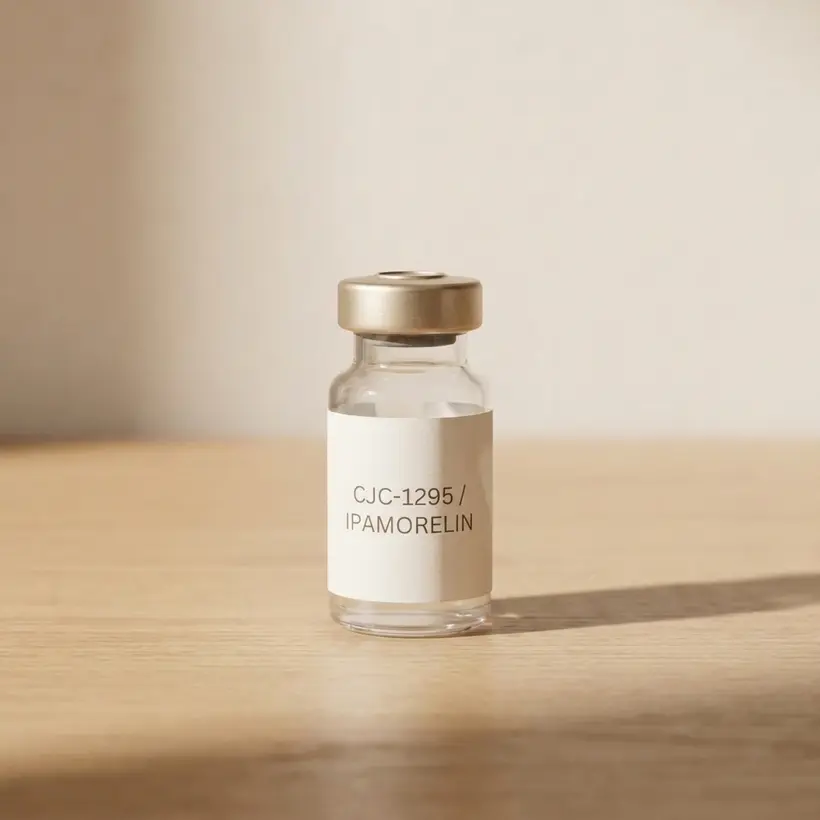
From the FormBlends catalog
CJC-1295 / Ipamorelin Blend
The gold standard growth hormone secretagogue stack · From $69/mo · compounded by a licensed 503A pharmacy, dispensed only after provider review.
Learn about CJC-1295 / Ipamorelin Blend →Table of Contents
- What are CJC-1295 and ipamorelin?
- Evidence Ledger
- Mechanism with specific numbers
- What supplies do you need?
- Step-by-step reconstitution
- Dosing math and injection volume calculator
- Injection technique for ipamorelin peptide injections
- What most pages get wrong (formulation and stability gotchas)
- Why the rules exist: chemistry behind storage and mixing
- Honest head-to-head: CJC-1295 ipamorelin vs. alternatives
- Label and COA literacy: how to evaluate what you have
- FAQ
- Sources
- Disclaimers
What Are CJC-1295 and Ipamorelin?
Ipamorelin is a synthetic pentapeptide (Aib-His-D-2-Nal-D-Phe-Lys-NH2) that selectively agonizes the growth hormone secretagogue receptor type 1a (GHSR-1a). It was developed by Novo Nordisk and characterized in published literature beginning in the late 1990s. Unlike older GHRPs such as GHRP-6, ipamorelin has a narrow receptor selectivity profile that produces less cortisol and prolactin release in animal studies.
CJC-1295 is a synthetic analogue of growth hormone-releasing hormone (GHRH). The version with Drug Affinity Complex (DAC) incorporates a lysine-maleimide linker that covalently binds to circulating albumin, extending half-life from roughly 30 minutes (for native GHRH or Mod GRF 1-29) to several days. The version without DAC, commonly called Modified GRF(1-29) or Mod GRF, has the same short half-life as native GHRH and requires peri-injection timing.
The two compounds are co-administered because they act upstream at different receptor classes to produce a larger, more physiological GH pulse than either achieves alone.
Evidence Ledger: What the Research Actually Supports
| Claim | Best Evidence Type | Effect Direction | Confidence |
|---|---|---|---|
| Ipamorelin stimulates GH release in animals | Multiple peer-reviewed animal studies (Raun et al., 1998) | Positive, dose-dependent | High (for animal model) |
| CJC-1295 with DAC increases GH and IGF-1 in healthy adults | Phase 1/2 human RCT (Teichman et al., 2006, n=65) | Positive; sustained GH elevation | Moderate (small single trial) |
| Ipamorelin increases GH in healthy humans | No published human RCT identified in peer-reviewed literature as of 2026 | Extrapolated from animal and mechanism data | Low (no human RCT) |
| Combination CJC-1295 + ipamorelin is superior to either alone in humans | Mechanistic reasoning; no human RCT comparing combination | Plausible; not directly demonstrated | Very Low |
| Ipamorelin is selective (low cortisol/prolactin vs. GHRP-6) | Raun et al., 1998 rat study | Relative selectivity confirmed in animal model | Moderate (animal only) |
| Bacteriostatic water extends multi-dose vial sterility | USP Chapter 1 / FDA guidance on preserved diluents | Established pharmaceutical standard | High |
| Body composition improvements attributable to this combination | No controlled human trial; anecdotal and forum reports only | Unconfirmed direction | Very Low |
Mechanism with Specific Numbers
Two receptor targets, one pulse: Ipamorelin binds GHSR-1a on somatotrophs in the anterior pituitary. CJC-1295 binds the GHRH receptor (GHRHR) on the same cells. Simultaneous activation of both receptors produces a synergistic intracellular cAMP and IP3 signal that amplifies GH granule exocytosis beyond what either pathway alone generates. This is the mechanistic rationale for co-administration, not a clinical outcome claim.
Teichman et al. (2006) CJC-1295 DAC data: In a dose-escalation study (n=65 healthy adults), single subcutaneous doses of CJC-1295 with DAC from 30 to 60 mcg/kg produced mean GH increases of 2 to 10-fold above baseline, with effects persisting for 6 days or longer at higher doses. IGF-1 levels increased by 1.5 to 3-fold and remained elevated for up to 14 days. What this does not prove: that these GH/IGF-1 changes translate to the body composition, recovery, or longevity outcomes claimed in practitioner marketing.
Ipamorelin pharmacokinetics: Raun et al. (1998) reported an elimination half-life of approximately 2 hours in rats after intravenous administration. Subcutaneous bioavailability data in humans has not been published in peer-reviewed form as of 2026. Applying rat pharmacokinetics to human subcutaneous dosing is an assumption.
DAC vs. no-DAC half-life difference: The maleimido-propionate linker in CJC-1295 with DAC binds cysteine-34 on albumin after injection, reducing renal clearance and extending effective half-life from roughly 30 minutes (Mod GRF 1-29) to approximately 6 to 8 days based on Teichman et al. This pharmacokinetic distinction drives dosing frequency, not reconstitution procedure.
What Supplies Do You Need Before You Mix?
- Lyophilized peptide vials (CJC-1295 and ipamorelin, individually labeled)
- Bacteriostatic water for injection (USP, 30 mL multi-dose vial recommended)
- U-100 insulin syringes: 0.3 mL or 0.5 mL capacity, 28 to 31 gauge, 0.5-inch needle for injection
- Larger draw syringe (1 to 3 mL) with 23 to 25 gauge needle for transferring bacteriostatic water
- Alcohol prep pads (70% isopropyl)
- Clean, flat surface; gloves optional but recommended
- Permanent marker to label vials with reconstitution date
- Sharps container
Step-by-Step Reconstitution of CJC-1295 Ipamorelin
- Wash hands for 20 seconds. Work on a clean surface under good lighting.
- Inspect the lyophilized cake. It should be white to off-white, dry, and intact. A brownish or wet appearance suggests degradation; do not use.
- Swab the rubber stopper of both the peptide vial and bacteriostatic water vial with a fresh alcohol prep pad. Allow 10 seconds to dry before penetrating.
- Draw bacteriostatic water into a 1 to 3 mL syringe. For a 5 mg vial, draw 2 mL. For a 2 mg vial, draw 1 mL or 2 mL depending on your target concentration (see dosing table below).
- Inject the water slowly down the inner glass wall of the peptide vial, not directly onto the powder. This is the single most important technique point. Directing the stream onto the cake creates turbulence that can denature fragile peptide bonds.
- Do not shake. Gently swirl or roll the vial between your palms for 15 to 30 seconds until the solution is clear and colorless. Some cloudiness during dissolution is normal; it should resolve. Persistent cloudiness means incomplete dissolution or protein aggregation.
- Repeat for the second peptide vial (CJC-1295) using the same method with a fresh syringe and new swabbing.
- Label both vials with the peptide name, concentration in mcg/mL, date reconstituted, and your initials.
- Refrigerate immediately at 2 to 8°C (36 to 46°F). Do not freeze.
Dosing Math and Injection Volume: CJC-1295 Ipamorelin Concentration Table
| Vial Size | Bacteriostatic Water Added | Concentration | Volume for 100 mcg dose | Volume for 200 mcg dose | U-100 syringe units (200 mcg) |
|---|---|---|---|---|---|
| 2 mg (2000 mcg) | 1 mL | 2000 mcg/mL | 0.05 mL | 0.10 mL | 10 units |
| 2 mg (2000 mcg) | 2 mL | 1000 mcg/mL | 0.10 mL | 0.20 mL | 20 units |
| 5 mg (5000 mcg) | 2 mL | 2500 mcg/mL | 0.04 mL | 0.08 mL | 8 units |
| 5 mg (5000 mcg) | 5 mL | 1000 mcg/mL | 0.10 mL | 0.20 mL | 20 units |
| 10 mg (10000 mcg) | 10 mL | 1000 mcg/mL | 0.10 mL | 0.20 mL | 20 units |
The formula: Volume (mL) = Desired dose (mcg) / Concentration (mcg per mL). On a U-100 insulin syringe, 1 unit = 0.01 mL. So a volume of 0.08 mL = 8 units. Confirm the concentration you actually prepared before every injection session; do not rely on memory.
Injection Technique for Ipamorelin Peptide Injections
Route: Subcutaneous. Subcutaneous administration is standard for peptide secretagogues in all published research protocols. Intramuscular is not necessary and increases discomfort without evidence of pharmacokinetic benefit for these compounds.
Site rotation: Periumbilical fat (2 to 3 inches from the navel), lateral thigh fat, or lateral abdominal fat. Rotate sites within a region to avoid lipohypertrophy.
Procedure:
- Swab the injection site with an alcohol prep pad. Allow it to dry completely (wet skin stings).
- Draw both peptides into the same insulin syringe immediately before injection if co-administering: draw ipamorelin first, then insert needle into CJC-1295 vial and draw the second volume. The total volume in the syringe is the sum of both.
- Pinch a fold of subcutaneous fat. Insert the needle at 45 degrees for thin individuals, 90 degrees if there is at least 2 inches of fat.
- Inject slowly over 5 to 10 seconds. Remove the needle at the angle of insertion.
- Apply gentle pressure with a dry swab. Do not rub, which can disperse the depot and cause irritation.
- Discard the syringe immediately into a sharps container. Never recap.
Timing context: GH is predominantly released during deep sleep and in the fasted state. Most research protocols administer GHRH/GHRP combinations in the late evening, at least 2 to 3 hours after the last meal and before sleep. This is protocol context, not a clinically validated dosing window for these specific compounds in humans.
What Most Pages Get Wrong: Formulation and Stability Gotchas
The vial headspace pressure problem: Lyophilized vials are sealed under vacuum or inert gas to retard oxidation. When you insert a needle to add diluent without venting, you create positive pressure that can spray solution back into the syringe or eject the plunger. Solution: insert a second vented needle briefly to equalize pressure before adding diluent, or depress the plunger slowly against back-pressure.
Bacteriostatic water vs. sterile water is not interchangeable: Nearly every forum post treats these as equivalent. They are not. Sterile water for injection (SWFI) contains no preservative. Once the stopper is punctured, SWFI supports bacterial growth within hours at room temperature. Using SWFI for a multi-dose vial and refrigerating it for two weeks is a contamination risk. Use bacteriostatic water for injection (BWFI) for any vial you will access more than once.
Acetic acid diluent for some peptides: Some peptides (BPC-157 is a common example) dissolve poorly in BWFI alone and are supplied with or recommended to use 0.6% acetic acid in water as diluent. CJC-1295 and ipamorelin are generally soluble in standard BWFI at research concentrations, but if a lyophilized cake is stubborn, a small volume of 0.6% acetic acid can be used. This is not a standard recommendation; it is a troubleshooting note that commodity pages never mention.
The 28-day rule is a guideline, not a hard chemical endpoint: The USP Multi-Dose Container guidance and FDA compounding guidelines use 28 days after opening as a conservative sterility window for preserved preparations, not a point at which the peptide suddenly degrades. Peptide stability depends on concentration, pH, temperature, and specific sequence. Some peptides degrade meaningfully sooner; others remain potent longer. The 28-day rule is a safe sterility boundary, not a potency guarantee date. Discard at 28 days regardless.
Freeze-thaw cycling degrades peptide integrity: Once reconstituted, do not freeze and re-thaw. Ice crystal formation causes mechanical disruption of peptide conformation and can cause aggregation. If you need to store longer than 28 days, keep additional vials lyophilized at -20°C and reconstitute fresh vials as needed.
Peptide purity from research suppliers varies significantly: A Certificate of Analysis (COA) from a third-party high-performance liquid chromatography (HPLC) lab is the only way to verify stated peptide content. Supplier-generated COAs with no third-party lab identifier are not independently verified. Purity below approximately 95% (HPLC) means a meaningful fraction of the vial's mass is uncharacterized impurities. This is not a topic medspa blogs address.
Why the Rules Exist: Chemistry Behind Storage and Mixing
Why swirl, not shake: Vigorous shaking introduces air-water interfaces. Peptides, being surface-active molecules, concentrate at these interfaces and undergo conformational unfolding (denaturation), which can lead to aggregation into beta-sheet fibrils. Once aggregated, the peptide is biologically inactive and cannot be disaggregated by gentle swirling. The energy threshold for aggregation is lower than most users assume, particularly for longer sequences like CJC-1295 (30 amino acids).
Why cold storage slows degradation: Peptide bond hydrolysis is thermally driven. The Arrhenius equation describes how reaction rates increase exponentially with temperature. At refrigerator temperature (4°C versus 25°C room temperature), hydrolysis and oxidation reactions proceed substantially more slowly. The benzyl alcohol preservative in BWFI additionally inhibits microbial-produced proteases that would otherwise cleave peptide bonds, compounding the stability benefit.
Why light exposure matters: Tryptophan, phenylalanine, and tyrosine residues in peptide sequences are susceptible to UV-driven photooxidation. Ipamorelin contains D-2-naphthylalanine and D-phenylalanine residues, both aromatic and potentially light-sensitive. Store reconstituted vials in the original opaque box or wrapped in foil. The magnitude of photo-degradation at normal indoor light levels is not well quantified for these specific peptides, but the conservative precaution is low-cost.
Why benzyl alcohol amount matters for neonates but not adults: Benzyl alcohol at the 0.9% concentration in BWFI is safe for adult subcutaneous injection in the small volumes used for peptide dosing (typically under 0.5 mL per injection). The FDA warning about benzyl alcohol toxicity (gasping syndrome) applies to neonates and premature infants receiving large cumulative IV doses. This distinction matters because some sources erroneously flag BWFI as generally dangerous.
Honest Head-to-Head: CJC-1295 Ipamorelin vs. Alternatives
| Compound / Category | Regulatory Status | Human RCT Evidence | GH Stimulation Strength | Convenience | Where Peptide LOSES |
|---|---|---|---|---|---|
| CJC-1295 + Ipamorelin | Not FDA approved; research compound | Very limited (CJC-1295 DAC alone: Teichman 2006) | Moderate-high (mechanistic); unquantified in human combination study | Daily or twice-weekly subQ injection | No large-scale human safety or efficacy RCT |
| Tesamorelin (FDA-approved GHRH analogue, Egrifta) | FDA-approved for HIV-associated lipodystrophy | Multiple Phase 3 RCTs (Falutz et al., 2007, 2010) | Demonstrated IGF-1 increase and visceral fat reduction in target population | Daily subQ injection | CJC-1295 / ipamorelin lacks tesamorelin's regulatory and clinical trial basis |
| Sermorelin (GHRH 1-29) | Formerly FDA approved; now compounded only in US | Limited adult data; pediatric GHD data available | Similar mechanism to Mod GRF; shorter half-life than DAC version | Daily injection | CJC-1295 DAC has pharmacokinetic advantage (less frequent dosing) |
| Recombinant human GH (somatropin) | FDA-approved for specific indications (GHD, Prader-Willi, others) | Extensive; decades of RCT data | Direct GH replacement; most potent option | Daily injection; requires prescription and monitoring | Peptide secretagogues lose on evidence quality and regulatory standing |
| Oral GH secretagogues (MK-677/ibutamoren) | Not FDA approved; research compound | Several small human trials (Murphy et al., 1998) | Sustained GH/IGF-1 elevation in studies | Oral daily dosing; no injection required | Ipamorelin + CJC loses on convenience vs. oral MK-677; MK-677 has more human trial data |
Label and COA Literacy: How to Evaluate What You Have
What to read on a peptide vial label:
- Peptide name and sequence confirmation: The label should state the exact compound. "CJC-1295 with DAC" and "CJC-1295 without DAC (Mod GRF 1-29)" are different compounds with meaningfully different half-lives. Confirm which you have before calculating dosing frequency.
- Stated vial mass: 2 mg, 5 mg, or 10 mg. This is the total peptide mass and is the numerator in your concentration calculation.
- Lot number: Required to cross-reference against a COA. A vial with no lot number cannot be traced to a COA.
What a credible COA contains:
- HPLC purity: Should be at least 95% for research use. Values below 90% represent substantial unknown impurity content.
- Mass spectrometry (MS) confirmation: Verifies the molecular weight matches the stated compound. A purity number without MS confirmation only tells you the sample is relatively homogeneous; it does not confirm it is the right peptide.
- Third-party laboratory name and contact: Supplier self-generated COAs without an external lab identifier are not independently verified.
- Lot number matching the vial: A COA for a different lot is not your product's COA.
Visual inspection at time of use:
- Lyophilized cake before reconstitution: white, dry, intact. Brown, wet, or absent powder is a discard indicator.
- Solution after reconstitution: clear, colorless, no visible particles. Yellow or pink tint suggests oxidation or contamination.
- Cloudiness that does not resolve after gentle swirling: do not inject. This may indicate aggregated peptide or microbial contamination.
FAQ
How do I reconstitute CJC-1295 ipamorelin?
Add bacteriostatic water slowly down the side of the vial, never directly onto the lyophilized cake. For a 5 mg vial, 2 mL of bacteriostatic water yields a concentration of 2500 mcg per mL. Swirl gently; never vortex. The solution should be clear and colorless.
Why must I use bacteriostatic water and not sterile water?
Bacteriostatic water contains 0.9% benzyl alcohol, which inhibits microbial growth and extends multi-dose vial safe use to approximately 28 days refrigerated. Sterile water for injection is preservative-free and should only be used for single-dose preparations because it supports bacterial growth once opened.
What is the typical research dose for the CJC-1295 ipamorelin combination?
Human protocols used in clinical research have ranged from 100 to 300 mcg of CJC-1295 (with DAC) per injection and 100 to 300 mcg of ipamorelin per injection. These are research reference doses only; individualized clinical dosing requires physician guidance.
How long does reconstituted ipamorelin last?
Reconstituted ipamorelin in bacteriostatic water is generally stable for up to 28 days refrigerated at 2 to 8°C based on standard peptide stability guidelines. Beyond that window, potency cannot be guaranteed. Freeze-thaw cycles degrade peptide integrity and should be avoided.
Can I mix CJC-1295 and ipamorelin in the same syringe?
They are commonly co-administered in the same injection. There is no published evidence of chemical incompatibility between the two peptides in solution. Draw ipamorelin first, then CJC-1295 into the same syringe immediately before injection to minimize time in combined solution.
Where is the best injection site for ipamorelin peptide injections?
Subcutaneous injection into the abdominal fat layer (2 inches from the navel) is the standard site used in published research protocols. Pinch a fold of skin, insert a
Related peptide guides
Ready when you are
CJC-1295 / Ipamorelin Blend
The gold standard growth hormone secretagogue stack · From $69/mo · compounded by a licensed 503A pharmacy, dispensed only after provider review.
Learn about CJC-1295 / Ipamorelin Blend →