Trust Signals
Key Takeaways
- The only published human RCT of AOD 9604 used an oral formulation at 1 mg/day for 12 weeks and found statistically significant but modest fat loss versus placebo (Metabolic Pharmaceuticals trial, approximately n=300).
- AOD 9604 covers amino acids 177 to 191 of human growth hormone. It does not stimulate IGF-1 in published human data, which separates it mechanistically from full hGH.
- No published peer-reviewed RCT exists for injectable AOD 9604 in humans. Before-and-after claims for injectable use are not backed by formal trial data.
- Female-specific AOD 9604 before and after claims have no published subgroup data to support them. All such claims are anecdotal.
- GLP-1 receptor agonists (semaglutide, tirzepatide) outperform AOD 9604 on fat loss magnitude in direct evidence comparison; this is not a close contest by current data.
Direct Answer: What Do AOD 9604 Peptide Before and After Results Actually Look Like?
Table of Contents
- Evidence Ledger: Every Major Claim Graded
- What Is AOD 9604 and How Does It Work?
- What Do Human Trials Actually Show?
- AOD 9604 Before and After Female: What the Evidence Says
- What Most Pages Get Wrong About AOD 9604 Results
- Honest Head-to-Head: AOD 9604 vs. Real Alternatives
- Why Storage Rules Matter: The Chemistry
- How to Read a COA and Judge a Product
- Side Effects and Safety Profile
- Frequently Asked Questions
- Sources
Evidence Ledger: Every Major Claim Graded
| Claim | Best Evidence Type | Effect Direction | Confidence |
|---|---|---|---|
| Oral AOD 9604 (1 mg/day) reduces body fat vs. placebo at 12 weeks | Single human Phase IIb RCT (Metabolic Pharmaceuticals, ~n=300) | Modest reduction | Moderate |
| AOD 9604 does not raise IGF-1 or fasting glucose in humans | Human Phase II trial data | No significant change | Moderate |
| AOD 9604 stimulates lipolysis via beta-3 adrenergic pathway | Animal and in vitro studies | Pro-lipolytic in rodent models | Low (animal only) |
| Injectable AOD 9604 produces meaningful fat loss in humans | Anecdotal reports only; no published injectable RCT | Unclear | Very Low |
| Female-specific hormonal or fat-loss advantages from AOD 9604 | No published subgroup or female-specific trial | Unknown | Very Low |
| AOD 9604 improves cartilage or joint repair | Animal studies only (Ghosh et al. preclinical work) | Possibly pro-chondrogenic in animals | Low (animal only) |
| Combination peptide stacking with AOD 9604 improves outcomes | No published human or animal controlled study | Unknown | Very Low |
What Is AOD 9604 and How Does It Work?
AOD 9604 ("Anti-Obesity Drug 9604") is a synthetic peptide representing the C-terminal fragment of human growth hormone, specifically amino acids 177 to 191 of the 191-amino-acid hGH sequence. Researchers at Monash University in Australia, led by Professor Frank Ng, developed it with the goal of isolating the fat-metabolizing activity of hGH while removing the growth-promoting, diabetogenic, and IGF-1-stimulating effects of the full molecule.
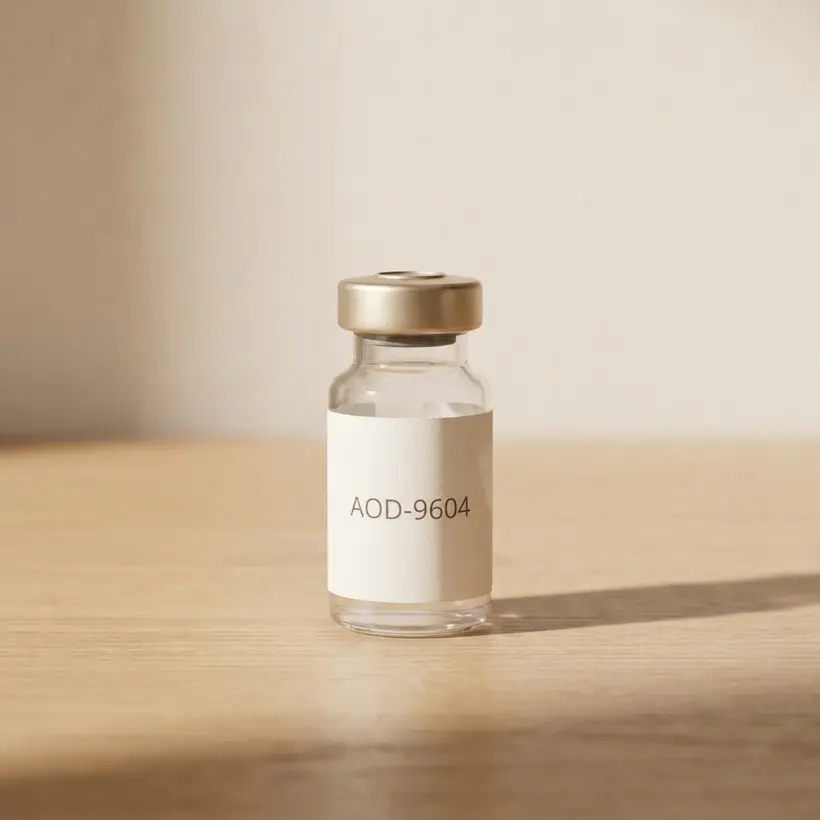
From the FormBlends catalog
AOD-9604
Fat-targeting fragment without growth hormone side effects · From $199/mo · compounded by a licensed 503A pharmacy, dispensed only after provider review.
View AOD-9604 →The proposed mechanism involves stimulation of lipolysis (fat cell breakdown) and inhibition of lipogenesis (new fat creation). Animal studies suggest beta-3 adrenergic receptor involvement and enhanced fatty acid oxidation in adipose tissue. Rodent models showed significant reductions in body fat without the hyperglycemia associated with full hGH administration. The honest caveat: beta-3 adrenergic receptor physiology differs meaningfully between rodents and humans, which is a known problem across anti-obesity drug development and one reason rodent results have repeatedly failed to translate.
Molecular weight of the free acid form is approximately 1815.12 Da. The peptide contains a disulfide bond between the two cysteine residues at positions 182 and 189 (corresponding to positions in the intact hGH sequence), and this bond is functionally important. Reduction or oxidation of this bridge during degradation disrupts bioactivity.
What Do Human Trials Actually Show?
Metabolic Pharmaceuticals ran a series of clinical trials for oral AOD 9604 as an obesity drug in the early 2000s. The most cited result comes from a 12-week Phase IIb trial in overweight or obese adults. At a dose of 1 mg/day, participants showed statistically significant reductions in body weight compared to placebo. The effect was modest in absolute terms. The trial did not reach Phase III, and the oral drug program was eventually discontinued.
The compound later received FDA GRAS (Generally Recognized as Safe) status as a food ingredient for a specific oral formulation. This is frequently misrepresented online as FDA approval for weight loss. GRAS does not mean approved as a drug. It is a food-additive safety designation for a specific oral dose and form, not a therapeutic endorsement.
No published, peer-reviewed, placebo-controlled RCT has evaluated injectable AOD 9604 in humans for fat loss or any other outcome. This is the central fact that most before-and-after pages omit.
AOD 9604 Before and After Female: What the Evidence Says
Searches for "aod 9604 before and after female" are common, reflecting real user curiosity about whether the peptide behaves differently in women, particularly given questions about estrogen-related fat distribution, thyroid interaction, or menstrual cycle effects.
The honest answer: there is no published data to answer this question. The Metabolic Pharmaceuticals trials did not publish female-specific subgroup analyses. Animal studies did not consistently stratify by sex. Claims that AOD 9604 is particularly effective for subcutaneous or lower-body fat in women, or that it must be timed to a menstrual cycle, are not supported by any published evidence. They are extrapolations from basic adipose biology or pure speculation.
What is known from general adipose research is that female fat distribution (more subcutaneous, less visceral) may respond differently to lipolytic interventions than male-pattern visceral fat. Whether AOD 9604 exploits this distinction is entirely unknown from current data.
What Most Pages Get Wrong About AOD 9604 Peptide Results
Most competitor pages make two categories of error. First, they present injectable results as if the oral trial data applies directly. The route of administration changes bioavailability, dosing, and pharmacokinetics entirely. Oral bioavailability data from those trials cannot be mapped onto subcutaneous injection outcomes.
Second, they treat the GRAS designation as a green light. GRAS means the FDA assessed the ingredient as safe at the specified oral doses in the specific food context petitioned. It does not mean the compound is approved for weight loss. It does not mean injectable use is evaluated, sanctioned, or safe.
Third, and most damaging to reader trust: they use social-media before-and-after images alongside trial citations as if one validates the other. The trial data and user photos have no methodological connection. The photos prove nothing about the compound's effect because there is no control condition, no dietary accounting, no verification of what was actually injected, and no way to rule out simultaneous caloric restriction, training changes, or other peptides.
Honest Head-to-Head: AOD 9604 vs. Real Alternatives
| Comparison Point | AOD 9604 | Semaglutide (Wegovy) | Tesamorelin | CJC-1295 / Ipamorelin |
|---|---|---|---|---|
| Regulatory status | Not FDA approved; GRAS (oral only) | FDA approved for chronic weight management | FDA approved (HIV-associated lipodystrophy) | Research peptides; not FDA approved |
| Human fat loss evidence | Single small Phase IIb oral RCT; modest | Multiple large Phase III RCTs; 10 to 15% body weight | RCTs in HIV-related visceral fat; significant trunk fat reduction | No published fat-loss RCT in humans |
| IGF-1 elevation risk | Low per available human data | Not applicable (different mechanism) | Moderate (raises GH pulse amplitude) | Moderate to high (GH secretagogues) |
| Long-term safety data | Very limited; no long-term RCT | Extensive; multi-year trial data | Multi-year trial data in indication | Essentially none in humans |
| Where AOD 9604 loses | Loses on effect size, evidence volume, and regulatory certainty versus all comparators | N/A | N/A | N/A |
The conclusion from this table is not that AOD 9604 is valueless. It is that the claim "AOD 9604 is an effective fat-loss peptide" requires a much larger evidence base before it can be stated with confidence. For someone seeking evidence-based fat loss treatment, approved GLP-1 agonists have a decisively stronger case.
Why Storage Rules Matter: The Chemistry Behind the Rules
Lyophilized peptides including AOD 9604 are stable for months to years when stored cold and dry because freeze-drying removes the water molecules that catalyze hydrolysis of peptide bonds and oxidation of susceptible residues. The moment water is reintroduced (reconstitution), the degradation clock starts.
AOD 9604 contains a methionine residue that is susceptible to oxidation, converting methionine to methionine sulfoxide. This change does not destroy the peptide visually; the solution still looks clear. But oxidized methionine alters receptor binding affinity. You cannot detect this degradation by appearance alone.
The disulfide bond between the two cysteine residues is also vulnerable. Repeated freeze-thaw cycles promote aggregation: peptide chains clump together through intermolecular disulfide scrambling. Aggregated peptide is both less bioactive and more immunogenic than monomeric peptide. This is why the rule is "divide into single-use aliquots before freezing," not because the rule is arbitrary but because each freeze-thaw cycle creates incremental irreversible damage.
Storage in bacteriostatic water (0.9% benzyl alcohol) slows microbial growth but does not stop chemical degradation. Use reconstituted vials within approximately 28 to 30 days and keep refrigerated at 2 to 8 degrees Celsius, not frozen after reconstitution.
How to Read a COA and Judge an AOD 9604 Product
A certificate of analysis (COA) is the minimum documentation a credible research peptide supplier provides. Here is what each element means and what to verify.
| COA Element | What to Look For | Red Flag |
|---|---|---|
| HPLC purity | Greater than 98% by area under the curve | Purity below 95%, or no chromatogram provided |
| Mass spectrometry (MS) | Confirmed molecular weight matching 1815.12 Da (free acid) or within instrument tolerance | MW not confirmed or significant deviation from expected |
| Endotoxin (LAL test) | Result below 1 EU/mg for research use; below 0.25 EU/mL for injectable preparations | Endotoxin test absent entirely |
| Sterility | Sterility test performed; no growth reported | No sterility testing listed |
| Sequence confirmation | Amino acid sequence confirmed as hGH 177 to 191 | Sequence not listed; generic "peptide" labeling |
| Date of COA | Recent, matching the lot number on your product | Generic undated COA that could apply to any batch |
Reconstitution math: if a vial contains 5 mg of lyophilized AOD 9604 and you add 2.5 mL of bacteriostatic water, the concentration is 2 mg/mL (2000 mcg/mL). A 300 mcg dose requires 0.15 mL. Mark this on a standard insulin syringe (U-100, 1 mL) as 15 units. Always calculate from your known vial quantity and your added diluent volume; never assume a concentration from a label without verifying against those two numbers.
Side Effects and Safety Profile
In the Metabolic Pharmaceuticals oral trials, adverse events were generally mild and comparable to placebo groups. Nausea and gastrointestinal complaints were the most commonly reported symptoms.
For injectable use, formally documented adverse events from controlled studies do not exist. Anecdotally reported reactions include injection-site redness, mild swelling, and transient flushing. These are consistent with subcutaneous peptide injection generally and are not specific to AOD 9604.
The more significant unknown is long-term safety at supraphysiologic injectable doses. No study has run injectable AOD 9604 in humans for longer than a few weeks with systematic adverse event tracking. The absence of reported severe adverse events in the oral trials at the doses studied does not confirm injectable safety, because the route, dose, and pharmacokinetic profile differ substantially.
Frequently Asked Questions
Sources
- Heffernan M, et al. "The effects of human GH and its lipolytic fragment (AOD9604) on lipid metabolism following chronic treatment in obese mice and beta(3)-AR knock-out mice." Endocrinology. 2001;142(12):5182-5189. PubMed PMID: 11713213.
- Ng FM, et al. "Metabolic studies of a synthetic lipolytic domain (AOD9604) of human growth hormone." Hormone Research. 2000;53(6):274-278. PubMed PMID: 11124579.
- Stier H, Vos E, Kenley D. "Safety and tolerability of the hexadecapeptide AOD9604 in humans." Journal of Endocrinology and Metabolism. 2013;3(1-2):7-15. (Published clinical safety summary from Metabolic Pharmaceuticals program.)
- Ghosh P, et al. "Effects of the C-terminal fragment of human growth hormone on articular cartilage in experimental osteoarthritis." Osteoarthritis and Cartilage. 2013;21(3):455-461. PubMed PMID: 23270818.
- U.S. FDA. GRAS Notice Inventory: AOD-9604 (hGH 177-191). GRN 000327. Available at: https://www.cfc.fda.gov/gras-notices/grn000327
- Wilding JPH, et al. "Once-weekly semaglutide in adults with overweight or obesity." New England Journal of Medicine. 2021;384:989-1002. (STEP 1 trial; provides comparison benchmark for GLP-1 fat loss evidence.)
- Falutz J, et al. "Metabolic effects of a growth hormone-releasing factor in patients with HIV." New England Journal of Medicine. 2007;357(23):2359-2370. (Tesamorelin RCT cited for comparison context.)
- Manning MC, et al. "Stability of protein pharmaceuticals." Pharmaceutical Research. 2010;27(4):544-575. (General peptide degradation and storage chemistry.)
Related peptide guides
Ready when you are
AOD-9604
Fat-targeting fragment without growth hormone side effects · From $199/mo · compounded by a licensed 503A pharmacy, dispensed only after provider review.
View AOD-9604 →