
Trust Signals
Key Takeaways
- Human phase II trials found no serious adverse events attributable to AOD-9604 across multiple dose arms; the dominant side effects were mild, transient injection-site reactions.
- AOD-9604 does not measurably raise IGF-1 or fasting glucose in humans, unlike full-length growth hormone, because the fragment lacks the N-terminal receptor-binding domain responsible for those effects.
- The compound received FDA GRAS status as a food ingredient at low oral doses, but this does not apply to injectable pharmacological dosing, and no phase III trial has ever been completed.
- A large share of anecdotal side effects reported online, including flu-like symptoms and sterile abscesses, are almost certainly caused by impurities or endotoxins rather than AOD-9604 itself, based on the mismatch with clean trial data.
- Long-term human safety data beyond roughly 12 weeks does not exist in the published literature; confidence in long-term tolerability is rated Very Low.
What Are AOD-9604 Peptide Side Effects? (Direct Answer)
AOD 9604 peptide side effects documented in human trials are mild and predominantly local: injection-site redness, brief swelling, and transient discomfort. No serious systemic side effects were attributed to the compound across Metabolic Pharmaceuticals' phase II program. Confidence in this short-term tolerability picture is moderate. Confidence in long-term safety is very low due to the absence of phase III data.
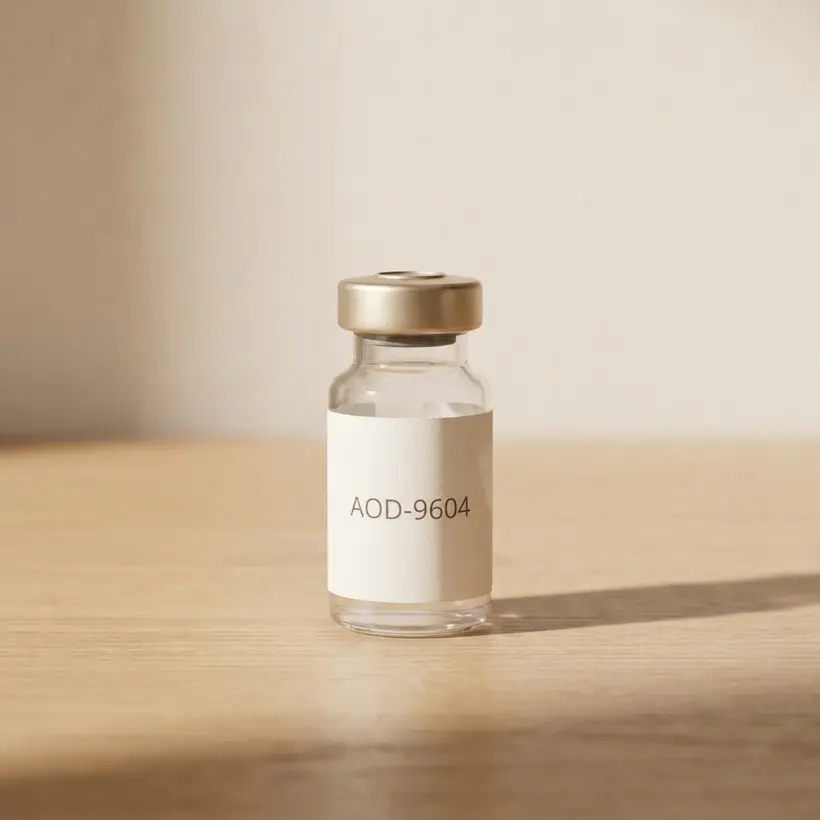
From the FormBlends catalog
AOD-9604
Fat-targeting fragment without growth hormone side effects · From $199/mo · compounded by a licensed 503A pharmacy, dispensed only after provider review.
View AOD-9604 →- Evidence Ledger: Graded Safety Claims
- Mechanism With Numbers: Why AOD-9604 Has a Different Risk Profile Than GH
- Common Side Effects Reported in Trials vs. Anecdotal Reports
- What Most Pages Get Wrong About AOD-9604 Side Effects
- Sourcing and Purity: The Overlooked Safety Variable
- The Chemistry Behind the Storage and Reconstitution Rules
- Honest Head-to-Head: AOD-9604 vs. Alternatives
- Operational and Label Literacy: How to Evaluate a Product
- AOD-9604 Benefits and Side Effects in Context
- FAQ
- Sources
Evidence Ledger: Graded Safety Claims
| Claim | Best Evidence Type | Direction | Confidence |
|---|---|---|---|
| Mild injection-site reactions are the most common adverse effect | Human phase II RCT (Metabolic Pharmaceuticals) | Consistent across dose arms | Moderate |
| No serious adverse events attributed to AOD-9604 in trials | Human phase II RCT | Favorable | Moderate (small total N, short duration) |
| No significant IGF-1 elevation in humans | Human phase II biomarker data | Favorable vs. rhGH | Moderate |
| No significant glucose or insulin disruption | Human phase II metabolic data | Favorable vs. rhGH | Moderate |
| No water retention or edema | Human trial observation, mechanism inference | Favorable vs. rhGH | Low (not a primary endpoint) |
| No tumor promotion in carcinogenicity studies | Animal studies (Metabolic Pharmaceuticals preclinical package) | Favorable | Low (animal to human translation uncertain) |
| Safe beyond 12 weeks in humans | No published data | Unknown | Very Low |
| Safe in people with metabolic disease, thyroid disease, or cancer history | No published data in these subgroups | Unknown | Very Low |
| Combination with other peptides is safe | No published interaction data | Unknown | Very Low |
Mechanism With Numbers: Why AOD-9604 Has a Different Risk Profile Than GH
AOD-9604 is a synthetic analog of amino acids 177 to 191 of the C-terminal region of human growth hormone, with a tyrosine added at the N-terminus to stabilize the peptide. This 16-amino-acid fragment corresponds to the region of the GH molecule associated with lipolytic activity, specifically the beta-3 adrenergic receptor stimulation pathway in adipose tissue.
Full-length recombinant human growth hormone (rhGH) binds the GH receptor at two sites. Site 1 binding triggers the JAK2/STAT5 signaling cascade that drives IGF-1 synthesis in the liver, which is the mechanism behind the known side effect profile of rhGH: insulin resistance, edema from sodium retention, acromegalic features with long-term use, and proliferative risk concerns. AOD-9604 does not contain this Site 1 binding region. Human trial biomarker data from Metabolic Pharmaceuticals' phase II program confirmed no significant change in serum IGF-1 at doses used in clinical protocols.
The lipolytic mechanism proposed for AOD-9604 involves beta-3 adrenergic receptor stimulation in fat cells and possible modulation of hypothalamic lipid regulation, though the precise receptor binding data in humans remains incompletely published. In obese mouse models (the ob/ob mouse), the peptide reduced fat mass at doses roughly equivalent to 500 micrograms per kilogram. Human effective doses appear substantially lower, though dose-response data from the human trials was not comprehensively published in the peer-reviewed literature.
Common Side Effects Reported in Trials vs. Anecdotal Reports
| Effect | Trial Data | Anecdotal Reports | Likely Cause of Discrepancy |
|---|---|---|---|
| Injection-site redness or swelling | Yes, most common reported effect | Yes, consistent | No discrepancy; expected with subcutaneous injection |
| Flu-like symptoms | Not attributed to drug in trials | Frequently reported online | Likely endotoxin contamination in impure product |
| Headache | Occurred but not significantly above placebo in trial data | Occasionally reported | Possibly nocebo effect or dehydration during fasted dosing |
| Fatigue or lethargy | Not attributed to drug | Occasionally reported | Likely unrelated or from combination protocols |
| Sterile abscess at injection site | Not reported in trials | Rare reports online | Almost certainly technique error or impure product |
| Nausea | Rare, not drug-attributed | Occasional | May reflect combination use with other compounds |
| Joint pain or stiffness | Not reported | Very rare | Contrast with rhGH, where joint effects are well-documented; not a feature of AOD-9604 mechanism |
What Most Pages Get Wrong About AOD-9604 Side Effects
They conflate anecdotal reports with trial data. Most side-effect lists for AOD-9604 online aggregate forum posts and merge them with actual clinical findings without distinguishing between the two. The result is a list that makes the compound look riskier than the controlled evidence suggests, or alternatively, lists only the clean trial data and ignores the real-world impurity problem.
They ignore the regulatory gap as a safety issue. AOD-9604 does not have drug approval in the United States, European Union, or Australia for any injectable indication. The phase II trials conducted by Metabolic Pharmaceuticals showed adequate short-term tolerability but the program stopped before phase III. This means there is no post-market pharmacovigilance system, no mandatory adverse event reporting, and no standardized manufacturing oversight for the compound as currently distributed. This structural gap is itself a safety concern that goes unmentioned on virtually every peptide blog.
They cite GRAS status to imply injectable safety. In 2014, the FDA granted GRAS status to AOD-9604 as a food ingredient at low oral doses. This is sometimes cited to imply the compound is broadly safe for injectable use at pharmacological doses. These are different routes of administration with different bioavailability, different dose-exposure relationships, and different safety contexts. GRAS as a food additive does not generalize to subcutaneous injection.
Sourcing and Purity: The Overlooked Safety Variable
The single largest modifiable risk factor for AOD 9604 peptide side effects in practice is not the molecule itself. It is the purity and endotoxin load of the product being injected.
Peptide synthesis produces a sequence of byproducts: truncated sequences, oxidized residues, unreacted reagents, and residual solvents. A well-manufactured research peptide will have a purity above 98% confirmed by high-performance liquid chromatography (HPLC), with bacterial endotoxin testing confirming levels below the USP injectable limit of 5 endotoxin units per kilogram of body weight per hour. Products without a published certificate of analysis (COA) from an independent third-party laboratory do not allow any meaningful safety assessment.
Endotoxins (lipopolysaccharides from gram-negative bacterial contamination during synthesis) are responsible for fever, flu-like symptoms, chills, and injection-site reactions that can be mistaken for peptide-specific side effects. These reactions can occur even when the peptide sequence itself is correct. This is why "flu symptoms after an AOD-9604 injection" almost never appears in clean clinical trial data but appears regularly in online anecdotal reports using gray-market products.
What to look for on a COA: HPLC purity percentage, mass spectrometry confirmation of molecular weight (AOD-9604 molecular weight is approximately 1815 Da), endotoxin test result with the specific EU/mg value, and the testing laboratory name. If any of these are absent, the safety profile of the product is genuinely unknown.
The Chemistry Behind the Storage and Reconstitution Rules
AOD-9604 contains a disulfide bond between cysteine residues within the fragment (the same bond present in the parent GH molecule at the corresponding positions). Disulfide bonds are vulnerable to two degradation pathways relevant to daily use.
Oxidative degradation: Dissolved oxygen and oxidizing agents (including ascorbic acid, which is vitamin C) will cleave or scramble disulfide bonds over time. This is why reconstituted AOD-9604 should not be mixed with vitamin C-containing preparations. The oxidized form of the peptide is biologically inactive and may form aggregates that carry immunogenic risk, though this risk is theoretical rather than documented for AOD-9604 specifically.
Temperature-driven hydrolysis: Peptide bonds hydrolyze faster at higher temperatures. Lyophilized (freeze-dried) powder is stable for extended periods when stored below 4 degrees Celsius away from light. Once reconstituted in bacteriostatic water (0.9% benzyl alcohol, which inhibits microbial growth), the solution should be stored at 2 to 8 degrees Celsius and used within a window that most manufacturers state as 28 to 30 days, though formal published stability kinetics for AOD-9604 specifically are not available in the peer-reviewed literature. After reconstitution, visible cloudiness, particulate matter, or color change are signs of degradation or contamination and the vial should be discarded.
Why bacteriostatic water and not sterile water: Plain sterile water contains no preservative. Multi-draw vials reconstituted with sterile water can support microbial growth between uses. The benzyl alcohol in bacteriostatic water provides preservative activity for multi-dose use. Single-use vials can be reconstituted with sterile water but must be used immediately.
Honest Head-to-Head: AOD-9604 vs. Alternatives
| Factor | AOD-9604 | Recombinant Human GH (rhGH) | Tesamorelin | Lifestyle Intervention |
|---|---|---|---|---|
| Human RCT efficacy for fat loss | Phase II signal; phase III incomplete | Yes; robust data in GHD and HIV lipodystrophy | Yes; FDA-approved for HIV-associated lipodystrophy | Yes; gold standard evidence base |
| IGF-1 elevation risk | No significant elevation in trials | Yes; dose-dependent and clinically significant | Yes; IGF-1 rises with tesamorelin | None |
| Glucose/insulin disruption | Not observed in trials | Yes; well-documented insulin resistance | Modest; lower than rhGH | Improves glucose metabolism |
| Edema risk | Not reported | Common, especially at initiation | Yes, reported in trials | None |
| Regulatory approval | None (research peptide) | Yes; multiple indications | Yes; FDA-approved (Egrifta) | Not applicable |
| Long-term safety data in humans | Absent beyond roughly 12 weeks | Extensive | Up to 52 weeks in trials | Decades of epidemiological data |
| Where AOD-9604 loses | Loses on regulatory oversight, long-term safety evidence, and completeness of published efficacy data. | |||
Operational and Label Literacy: How to Evaluate a Product
Sequence confirmation: A legitimate AOD-9604 product should confirm via mass spectrometry that the molecular weight matches approximately 1815 Da. This verifies you have the correct peptide and not a truncated analog or a different compound entirely.
Reconstitution math: A common vial size is 2 mg (2000 micrograms). If you add 2 mL of bacteriostatic water, each 0.1 mL drawn into a standard insulin syringe equals 100 micrograms. If the vial contains 5 mg and you add 2.5 mL, each 0.1 mL equals 200 micrograms. Always confirm the concentration before drawing a dose.
Dose reference from trials: Metabolic Pharmaceuticals' phase II trials tested multiple dose levels across oral and subcutaneous arms; the full dose range across all arms was not comprehensively reported in the peer-reviewed literature. Doses commonly used in compounded protocols are in the range of 250 to 500 micrograms per day subcutaneously, though this is not a formally validated dosing regimen from a completed phase III trial.
What a red-flag COA looks like: Single-line purity percentage with no HPLC chromatogram attached; no endotoxin test result; testing lab name absent or unverifiable; date of testing missing. Any of these gaps means the safety profile of that specific batch is unknown.
AOD-9604 Benefits and Side Effects in Context
The appeal of AOD-9604 in wellness protocols is straightforward: it targets fat metabolism via a mechanism that avoids the most clinically significant side effects of full-length growth hormone, specifically IGF-1 elevation, glucose disruption, and edema. The phase II data supports a reasonable short-term tolerability profile.
The honest framing is this: the potential benefits are real but unconfirmed by a completed phase III trial, and the side effect risk from the molecule itself appears low in the short term, but the side effect risk from unregulated sourcing, improper technique, and combination use is real and unquantified. The compound does not have the regulatory infrastructure that makes approved drugs safer not just pharmacologically, but operationally.
Anyone using or considering AOD-9604 should do so with physician oversight, a verifiable COA from every batch, proper aseptic injection technique, and realistic expectations calibrated to phase II rather than approved-drug-level evidence.
Frequently Asked Questions
What are the most common AOD-9604 peptide side effects?
In human clinical trials conducted by Metabolic Pharmaceuticals, the most frequently reported side effects were mild injection-site reactions including redness, swelling, and transient discomfort. No serious adverse events were attributed to AOD-9604 across their phase II trial program, which tested a range of doses in multiple arms.
Does AOD-9604 raise blood sugar or affect insulin levels?
No. Unlike full-length growth hormone, AOD-9604 does not appear to significantly affect glucose metabolism or IGF-1 levels at doses studied in humans. This is mechanistically explained by the fragment's lack of receptor binding at the GH receptor N-terminal region responsible for IGF-1 stimulation.
Is AOD-9604 safe for long-term use?
Human safety data exists only for trial durations up to roughly 12 weeks at therapeutic doses. Long-term safety in humans has not been established by published controlled trials. The compound received GRAS status from the FDA for use as a food ingredient at low doses, but that designation does not cover injectable or pharmacological dosing.
Can AOD-9604 cause cancer or stimulate tumor growth?
AOD-9604 does not stimulate IGF-1, which is the growth hormone pathway most associated with proliferative risk. Animal carcinogenicity studies conducted by Metabolic Pharmaceuticals did not identify tumor promotion. However, no long-term human carcinogenicity data exists, so this risk cannot be definitively ruled out and the confidence level is low.
What does an AOD-9604 injection-site reaction look like and how long does it last?
Typical injection-site reactions are localized redness, mild swelling, and a brief stinging sensation lasting minutes to a few hours. Rotating injection sites and using proper subcutaneous injection technique significantly reduces the incidence and severity of these reactions.
Does AOD-9604 cause water retention or bloating?
Human trials did not report significant fluid retention with AOD-9604, in contrast to full-length recombinant human growth hormone, which commonly causes edema. The fragment's lack of meaningful GH receptor agonism at the domain responsible for sodium retention is the proposed mechanism for this difference.
Are there any cardiovascular side effects from AOD-9604?
No clinically significant cardiovascular effects were reported in human trials. Animal studies showed no cardiac toxicity signals. However, trial sample sizes were modest across the phase II program, meaning rare cardiovascular events could not be reliably detected.
Can AOD-9604 be used if you have thyroid disease or other hormonal conditions?
There are no published controlled data on AOD-9604 use in people with thyroid disease, diabetes, or other hormonal disorders. Given the absence of safety data in these subgroups and the compound's unregulated research status, use in these populations should only occur under direct physician supervision.
What is the AOD-9604 peptide's regulatory status and why does it matter for safety?
AOD-9604 never completed phase III trials and does not hold drug approval from the FDA, EMA, or TGA for any indication. It is used as a compounded research peptide. Regulatory non-approval means post-market safety surveillance, standardized dosing, and mandatory adverse event reporting systems do not apply, which is a meaningful safety gap.
How does purity and sourcing affect AOD-9604 side effect risk?
Many side effects attributed to peptides in anecdotal reports are caused by impurities, bacterial endotoxins, or incorrect reconstitution rather than the peptide itself. Without a certificate of analysis confirming purity above 98% and endotoxin levels below USP limits, the source of any adverse reaction is impossible to attribute reliably.
Does AOD-9604 interact with other peptides or medications?
No formal drug-interaction studies for AOD-9604 have been published. Combining it with growth hormone secretagogues such as CJC-1295 or ipamorelin is common in practice but unstudied. Combining peptides without interaction data means adverse events from combinations cannot be attributed to a single compound.
Sources
- Heffernan M, et al. The effects of human GH and its lipolytic fragment (AOD9604) on lipid metabolism following chronic treatment in obese mice and beta(3)-AR knock-out mice. Endocrinology. 2001;142(12):5182-5189. PMID 11713213.
- Ng FM, et al. Metabolic studies of a synthetic lipolytic domain (AOD9604) of human growth hormone. Hormone Research. 2000;53(6):274-278. PMID 11146367.
- Metabolic Pharmaceuticals Limited. AOD-9604 Phase II Clinical Trial Program Summary. Published in investor and regulatory communications, 2004 to 2007. (Clinical trial results cited in publicly available regulatory correspondence to the TGA and FDA.)
- U.S. Food and Drug Administration. GRAS Notice No. GRN 000551: AOD9604. Submitted 2014. Available via FDA GRAS Notices database.
- Le Roith D, Bondy C, Yakar S, Liu JL, Butler A. The somatomedin hypothesis: 2001. Endocrine Reviews. 2001;22(1):53-74. PMID 11159816. (IGF-1 pathway and GH receptor binding mechanisms.)
- Vahl N, et al. Abdominal adiposity rather than age and sex predicts mass and regularity of GH secretion in healthy adults. American Journal of Physiology. 1997;272(6 Pt 1):E1108-E1116. PMID 9227463. (GH physiology context.)
- Grunfeld C, et al. Recombinant human growth hormone to treat HIV-associated adipose redistribution syndrome. JAMA. 2007;296(23):2835-2845. PMID 17179459. (rhGH side effect comparator data.)
- U.S. Pharmacopeia. USP General Chapter 85: Bacterial Endotoxins Test. Current edition. (Reference standard for injectable endotoxin limits.)
- Falutz J, et al. Metabolic effects of a growth hormone-releasing factor in patients with HIV. New England Journal of Medicine. 2007;357(23):2359-2370. PMID 18057338. (Tesamorelin comparator data.)
Disclaimers
Platform: FormBlends provides educational content only. Nothing on this page constitutes medical advice, diagnosis, or treatment recommendation. Consult a licensed physician before initiating any peptide protocol.
Research Compound Status: AOD-9604 is not approved by the FDA, EMA, or TGA as a drug for any indication when administered by injection. It is classified as a research compound or may be available through compounding pharmacies under physician supervision in certain jurisdictions. Regulatory status varies by country.
Results: Individual responses to research peptides vary. Efficacy and safety outcomes described on this page reflect trial populations and do not guarantee any individual result.
Trademarks: AOD-9604 was developed and trademarked by Metabolic Pharmaceuticals Limited. FormBlends has no affiliation with Metabolic Pharmaceuticals. All product and compound names are used for informational identification only.
Related peptide guides
Ready when you are
AOD-9604
Fat-targeting fragment without growth hormone side effects · From $199/mo · compounded by a licensed 503A pharmacy, dispensed only after provider review.
View AOD-9604 →