Trust Signals
All claims are graded by evidence type. Every dosing figure is sourced from published research or described as researcher-reported convention where no clinical standard exists. No financial relationship with DSIP suppliers influences this content.
Key Takeaways
- DSIP is a 9-amino-acid neuropeptide with a molecular weight of approximately 848.9 Da and a plasma half-life of roughly 30 minutes after intravenous administration in early human studies.
- The only validated administration route in human research is intravenous; subcutaneous use is extrapolated from general peptide pharmacology and researcher convention, not a controlled human trial.
- Reconstitution at 1 mg/mL in bacteriostatic water is a common working concentration; a 200 mcg dose from that solution requires drawing 0.2 mL in a U-100 insulin syringe.
- No large randomized controlled trial has confirmed DSIP efficacy for sleep; the best available human data comes from small studies, mostly from the 1980s, with mixed results.
- DSIP is not FDA-approved and not scheduled; it is a research compound, and its legal and safety status varies by jurisdiction.
Direct Answer: How to Take DSIP Peptide
Table of Contents
- What is DSIP and why does route of administration matter?
- Evidence ledger: what do we actually know?
- How does DSIP work, with specific numbers?
- How do you reconstitute and dose DSIP?
- What most pages get wrong about taking DSIP
- Why does DSIP degrade, and what does that mean practically?
- How does DSIP compare to melatonin and other sleep aids?
- How do you read a DSIP product or COA?
- Frequently Asked Questions
- Sources
- Disclaimers
What Is DSIP and Why Does Route of Administration Matter?
Delta sleep-inducing peptide (DSIP) is an endogenous nonapeptide first isolated from rabbit cerebral venous blood in 1974 by Monnier and colleagues at the University of Basel. Its sequence is Trp-Ala-Gly-Gly-Asp-Ala-Ser-Gly-Glu. Because it is a short peptide chain, its fate in the body depends heavily on how it is introduced. Swallowing a peptide of this size means facing a gastrointestinal environment dense with proteases (trypsin, chymotrypsin, pepsin) that cleave peptide bonds in seconds to minutes. The result is that essentially no intact DSIP survives to reach systemic circulation via the oral route. This is not unique to DSIP; it is a fundamental property of unmodified peptides below roughly 1,000 Da without specific transporter mechanisms or structural protection.
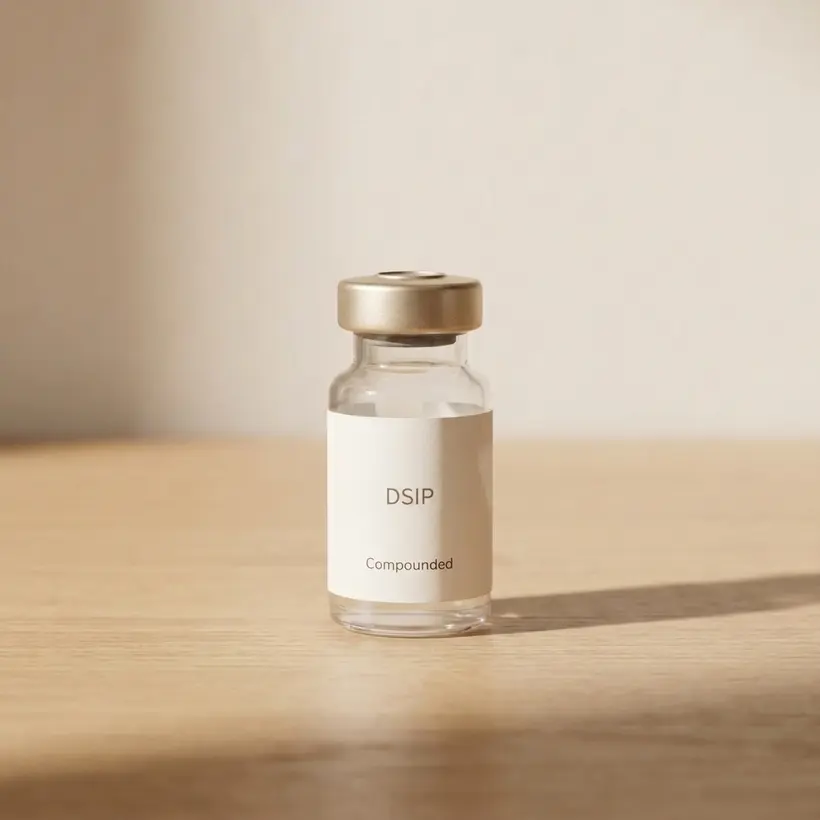
From the FormBlends catalog
DSIP (Delta Sleep-Inducing Peptide)
Restore deep, restorative delta wave sleep · From $179/mo · compounded by a licensed 503A pharmacy, dispensed only after provider review.
View DSIP (Delta Sleep-Inducing Peptide) →This is why every human study of DSIP has used parenteral delivery, either intravenous or, in some animal work, intracerebroventricular. Modern researcher use extrapolates to subcutaneous injection, accepting that bioavailability will be lower than IV but meaningfully higher than oral.
Evidence Ledger: What Do We Actually Know?
| Claim | Best Evidence Type | Effect Direction | Confidence |
|---|---|---|---|
| DSIP promotes slow-wave sleep in rabbits (original isolation experiment) | Animal, original Monnier 1977 study | Positive | Moderate for animal model only |
| DSIP alters sleep architecture in humans | Small human studies (Scherschlicht et al., 1983; Schneider-Helmert 1985), mixed design | Mixed/inconclusive | Low |
| IV plasma half-life approximately 30 minutes | Human pharmacokinetic study (Graf and Kastin, 1984 review) | Established range | Moderate |
| DSIP crosses the blood-brain barrier | Animal studies, some human inference | Positive but partial | Low to moderate |
| Subcutaneous dosing in 100-500 mcg range produces sleep effects | Researcher convention, no controlled human trial | Anecdotal positive | Very low |
| DSIP modulates cortisol and LH in humans | Small human studies (Schneider-Helmert, 1985 era) | Trend positive | Low |
| No oral bioavailability | Peptide chemistry first principles, no specific DSIP oral trial | Negative (no effect expected) | High for mechanism, no human trial to confirm |
| Long-term safety in humans | No data | Unknown | Very low / absent |
How Does DSIP Work, With Specific Numbers?
DSIP's precise receptor has not been cloned or definitively characterized as of published literature. This is a notable gap: unlike peptides with a confirmed named receptor (GLP-1R, GHRHR), DSIP's mechanism remains partially inferred from downstream effects.
What is established in published research:
- DSIP reduces the firing rate of neurons in the locus coeruleus in animal preparations, a region critical for arousal maintenance. Reduced LC activity is associated with the shift from wakefulness to NREM sleep.
- The peptide has been shown in animal studies to modulate the HPA axis, reducing corticotropin-releasing factor (CRF) activity and blunting stress-induced cortisol elevation. This is one proposed mechanism for its sleep-promoting effect beyond direct soporific action.
- Graf and Kastin (1984, Neuroscience and Biobehavioral Reviews) documented the plasma pharmacokinetics and noted that intact DSIP is measurable in human blood following IV administration with a half-life in the range of 30 minutes. Fragments appear rapidly, suggesting peripheral degradation begins immediately.
- In Schneider-Helmert's human studies (1985, European Archives of Psychiatry and Neurological Sciences), small cohorts of insomnia patients received DSIP via IV and showed some shifts in sleep stage architecture measured by polysomnography, but results were not consistent across all subjects and the studies lacked the statistical power of modern RCTs.
What the mechanism does NOT prove: that subcutaneous delivery replicates IV pharmacokinetics, that any specific dose translates from IV to SC, or that modulating LC firing in animal slices predicts clinical hypnotic efficacy in humans with complex sleep disorders.
How Do You Reconstitute and Dose DSIP?
The following steps represent standard research peptide reconstitution practice. They are not a clinical prescription.
- Gather supplies: lyophilized DSIP vial (commonly 5 mg), bacteriostatic water for injection, 1 mL or 2 mL syringe for reconstitution, 29 to 31 gauge insulin syringes for injection, alcohol swabs.
- Target concentration: 1 mg/mL is a convenient working concentration. For a 5 mg vial, add 5 mL of bacteriostatic water. Inject the water slowly down the inside of the vial wall. Do not aim the stream directly at the powder cake. Roll gently; do not shake.
- Dose calculation table:
| Target Dose | Volume to draw (at 1 mg/mL) | U-100 Syringe Units |
|---|---|---|
| 100 mcg (0.1 mg) | 0.10 mL | 10 units |
| 200 mcg (0.2 mg) | 0.20 mL | 20 units |
| 300 mcg (0.3 mg) | 0.30 mL | 30 units |
| 500 mcg (0.5 mg) | 0.50 mL | 50 units |
- Injection site: Subcutaneous injection into lower abdomen (at least two inches from navel), outer thigh, or upper arm. Pinch the skin, insert at roughly 45 degrees with a short needle or 90 degrees with a 4 to 5 mm pen needle, inject slowly, withdraw.
- Timing: Administer 30 to 60 minutes before intended sleep, based on the IV half-life profile and the assumption that SC peak absorption lags IV by 15 to 30 minutes.
- Storage after reconstitution: Refrigerate at 2 to 8 degrees Celsius. Use within 30 days. Keep lyophilized stock frozen until needed.
What Most Pages Get Wrong About Taking DSIP
This is the section commodity sites omit. Three specific errors appear repeatedly across DSIP guides:
1. Treating SC bioavailability as equivalent to IV. Every human study that produced any sleep data used intravenous administration. Subcutaneous delivery of a 9-amino-acid peptide without a lipophilic modification or nanoparticle carrier will result in partial degradation at the injection site and in the interstitial space before systemic absorption. There is no published human study confirming that SC DSIP produces equivalent blood levels to IV DSIP at the same nominal dose. Dose extrapolations from SC are therefore doubly uncertain.
2. Citing the 1974 rabbit isolation as proof of human efficacy. Monnier's original experiment demonstrated a soporific fraction in rabbit cerebral venous blood. It identified DSIP as a candidate molecule. The leap from "causes rabbits to sleep when infused intracerebroventricularly" to "effective human hypnotic via subcutaneous injection" involves at least four unstated assumptions, each with meaningful uncertainty.
3. Ignoring peptide purity and endotoxin contamination. Most commercially available DSIP is synthesized by solid-phase peptide synthesis. At lower purities (below 95%), related impurities and truncated sequences are present. More critically, bacterial endotoxin contamination from the synthesis or lyophilization process can cause acute inflammatory responses that look nothing like peaceful sleep. A COA without endotoxin (LAL test) data is incomplete for any peptide intended for injection.
Why Does DSIP Degrade, and What Does That Mean Practically?
DSIP contains a tryptophan residue at position 1 of its sequence. Tryptophan is among the most oxidation-sensitive amino acids. The indole side chain reacts with singlet oxygen and other reactive oxygen species to form kynurenine and other oxidation products. This reaction is accelerated by light (particularly UV), elevated temperature, and the presence of dissolved oxygen in the aqueous solution.
Practically: a reconstituted vial left on a countertop in daylight loses activity faster than one stored immediately at 2 to 8 degrees Celsius in a dark environment. This is not a vague instruction to "store cool." The tryptophan indole ring absorbs maximally around 280 nm; ambient UV from windows is sufficient to initiate oxidation over hours.
Asparagine residues (not present in DSIP's specific sequence) commonly undergo deamidation, but the glycine-rich middle of DSIP's sequence (Gly-Gly, Gly-Glu) means hydrolysis of Gly-X bonds is the more relevant secondary degradation pathway in aqueous solution, and this is accelerated by acidic or highly alkaline pH. Bacteriostatic water is typically near-neutral, which is why it is preferred over plain water acidified with acetic acid (used for some other peptides). Do not reconstitute DSIP in acetic acid solution.
A degraded DSIP solution may show yellowing (tryptophan oxidation products are chromogenic) or visible particulate. Either appearance indicates the solution should be discarded.
How Does DSIP Compare to Other Sleep Interventions?
| Intervention | Evidence Level | Effect Size | Practical Risks | Regulatory Status | DSIP Wins? |
|---|---|---|---|---|---|
| DSIP (subcutaneous) | Very low (no SC RCT) | Unknown for SC route | Injection risk, unknown long-term safety, sourcing purity | Research compound (US) | N/A (insufficient data) |
| Melatonin (oral) | Moderate, multiple RCTs | Modest: reduces sleep-onset latency by roughly 7 minutes on average (Ferracioli-Oda et al., 2013 meta-analysis) | Very low; mild next-day grogginess at higher doses | OTC supplement (US) | No, melatonin wins on evidence and safety profile |
| Z-drugs (zolpidem, eszopiclone) | High, multiple RCTs | Moderate: reduces sleep-onset latency ~20 minutes vs placebo in trials | Dependency, cognitive impairment, complex sleep behaviors (FDA black box) | Prescription (Schedule IV) | DSIP may have lower dependency risk theoretically; but no comparative data |
| CBT-I (behavioral) | High, strong RCT and meta-analysis evidence | Large, durable effects on sleep efficiency and insomnia severity | Time and effort; access barriers | Non-pharmacological, no regulatory issue | No; CBT-I is first-line per AASM guidelines |
| Magnesium glycinate (oral) | Low to moderate, small RCTs | Small to modest improvement in subjective sleep quality in deficient populations | Very low; GI loosening at high doses | OTC supplement | No clear DSIP advantage |
How Do You Read a DSIP Product or COA?
Before purchasing or using any DSIP preparation, request a certificate of analysis (COA) from the supplier. A legitimate COA should contain all of the following. If any element is missing, treat the product as unverified.
- Sequence confirmation: The COA should state the full sequence (Trp-Ala-Gly-Gly-Asp-Ala-Ser-Gly-Glu) or its standard abbreviation.
- Molecular weight confirmation: DSIP has a molecular weight of approximately 848.9 Da (free acid form). Mass spectrometry (MS) on the COA should show a peak consistent with this value. A result significantly different indicates a wrong compound or major synthesis error.
- HPLC purity: Look for purity at or above 98% by HPLC. Values below 95% mean a meaningful fraction of what you are injecting is uncharacterized impurities.
- Endotoxin (LAL test): Should be below 1 EU/mg for research injection use. No endotoxin data on a COA intended for parenteral use is a disqualifying omission.
- Lot number and date: Allows you to verify the COA is product-specific and not a generic document reused across batches.
- What a degraded vial looks like: Lyophilized DSIP should be a white to off-white powder cake. Yellowing, browning, or visible clumping before reconstitution suggests oxidation or moisture exposure during storage. Reconstituted solution should be colorless and clear. Any yellow tint or particulate is a discard signal.
Frequently Asked Questions
How do you take DSIP peptide?
DSIP is reconstituted with bacteriostatic water and administered by subcutaneous injection, typically in the 100 to 600 mcg dose range, 30 to 60 minutes before intended sleep onset. There is no approved oral form; oral bioavailability is considered negligible due to rapid enzymatic degradation in the gut.
What dose of DSIP is used in research?
Early human studies used intravenous doses in the range of roughly 25 nanomoles per kilogram. Subcutaneous use in modern research protocols is typically described in the 100 to 500 mcg range per administration, though no approved clinical dosing standard exists.
When should you inject DSIP for sleep?
Research protocols and reported user experiences most commonly place the injection 30 to 60 minutes before the target sleep time, aligning with DSIP's short plasma half-life of roughly 30 minutes after IV administration.
Can you take DSIP orally?
Oral administration of DSIP is not supported by evidence. As a 9-amino-acid peptide, DSIP is degraded rapidly by gastrointestinal proteases and has negligible oral bioavailability. Sublingual and intranasal routes have been proposed but lack clinical validation.
How do you reconstitute DSIP?
Add bacteriostatic water slowly to the lyophilized DSIP vial, rolling gently rather than shaking. A common working concentration is 1 mg/mL, meaning 1 mg of DSIP powder in 1 mL of bacteriostatic water. Use a 29 to 31 gauge insulin syringe for withdrawal and injection.
How long does DSIP last once reconstituted?
Reconstituted peptide solutions should be stored refrigerated at 2 to 8 degrees Celsius and used within 30 days as a general peptide guideline. Freeze-thaw cycling degrades most peptides; avoid repeated warming and re-cooling of the same vial.
Is DSIP a scheduled or approved drug?
DSIP is not FDA-approved as a drug and is not a scheduled controlled substance in the United States. It is classified as a research compound. Regulatory status varies by country; users outside the US should verify local rules.
What are the known side effects of DSIP?
Human clinical data on DSIP side effects is limited. Early IV studies noted no serious adverse events in small cohorts. Reported experiences include transient sedation, mild headache, and injection-site irritation. Long-term safety data in humans does not exist.
Does DSIP actually work for sleep?
Early human studies showed mixed results. Some found modest increases in slow-wave sleep fractions or shifts in sleep architecture; others found no significant effect. No large randomized controlled trial has confirmed efficacy. Evidence confidence is low.
How does DSIP compare to melatonin or prescription sleep aids?
Melatonin has extensive human RCT data supporting modest sleep-onset benefit. Prescription hypnotics (z-drugs, benzodiazepines) have strong efficacy data but meaningful dependency and cognitive risk. DSIP has far less human evidence than either option and no regulatory approval.
Where do you inject DSIP?
Subcutaneous injection into the lower abdomen, outer thigh, or upper arm is standard for research peptide administration. Rotate sites to avoid localized tissue changes. Avoid intramuscular injection unless specifically directed by a supervising clinician.
What should a DSIP COA show?
A legitimate certificate of analysis for DSIP should show HPLC purity at or above 98%, mass spectrometry confirming the correct molecular weight of approximately 848.9 Da, and endotoxin testing results. Avoid sourcing from suppliers who cannot provide these documents.
Sources
- Monnier M, Dudler L, Gaechter R, Maier PF, Tobler HJ, Schoenenberger GA. The delta sleep inducing peptide (DSIP). Comparative properties of the original and synthetic nonapeptide. Experientia. 1977;33(4):548-552.
- Graf MV, Kastin AJ. Delta-sleep-inducing peptide (DSIP): a review. Neuroscience and Biobehavioral Reviews. 1984;8(1):83-93.
- Schneider-Helmert D. DSIP in insomnia. European Neurology. 1985;24(3):154-156.
- Scherschlicht R, Pole P, Schneeberger J, Steiner M, Haefely W. Selective suppression of rapid eye movement sleep (REMS) in cats by typical and atypical antidepressants and related compounds: a comparison with effects on the REMS/NREMS alternation. In: Costa E, Racagni G, eds. Typical and Atypical Antidepressants. Raven Press; 1982.
- Ferracioli-Oda E, Qawasmi A, Bloch MH. Meta-analysis: melatonin for the treatment of primary sleep disorders. PLoS ONE. 2013;8(5):e63773.
- American Academy of Sleep Medicine. Clinical Practice Guideline for the Pharmacologic Treatment of Chronic Insomnia in Adults. Journal of Clinical Sleep Medicine. 2017;13(2):307-349.
- Kastin AJ, Nissen C, Schally AV, Coy DH. Blood-brain barrier, half-time disappearance, and brain distribution for labeled enkephalin and a potent analog. Brain Research Bulletin. 1976;1(6):583-589. (Background on peptide CNS entry methodology.)
- United States Food and Drug Administration. Bacteriostatic Water for Injection USP labeling and compounding guidance. FDA.gov.
Related peptide guides
Ready when you are
DSIP (Delta Sleep-Inducing Peptide)
Restore deep, restorative delta wave sleep · From $179/mo · compounded by a licensed 503A pharmacy, dispensed only after provider review.
View DSIP (Delta Sleep-Inducing Peptide) →