
Trust signals
> Written by the FormBlends Medical Content Team · Fact-checked against cited primary sources · Last updated May 2026
The molecular blueprint
GHRP-2 (D-Ala-D-2-Nal-Ala-Trp-D-Phe-Lys-NH2) represents the second generation of synthetic growth hormone releasing peptides, engineered with three D-amino acids for enhanced stability. This hexapeptide binds the ghrelin receptor with an EC50 of 1.9 nM, triggering a cascade that amplifies endogenous growth hormone production far beyond baseline physiology.
Unlike first-generation compounds, GHRP-2 incorporates D-2-naphthylalanine at position 2, a modification that reduces peripheral ghrelin activity while maintaining potent central effects. The result: robust GH release with less appetite stimulation than its predecessor GHRP-6, though individual responses vary considerably based on receptor expression patterns.
Human evidence for GH elevation
The foundational Pihoker study (1998) administered GHRP-2 to healthy adults at escalating doses from 0.1 to 3.0 mcg/kg. Peak GH responses occurred at 30 to 60 minutes post-injection, with the 1 mcg/kg dose producing substantially elevated GH levels compared to baseline. Studies consistently show multiple-fold increases in growth hormone, though individual responses vary widely.
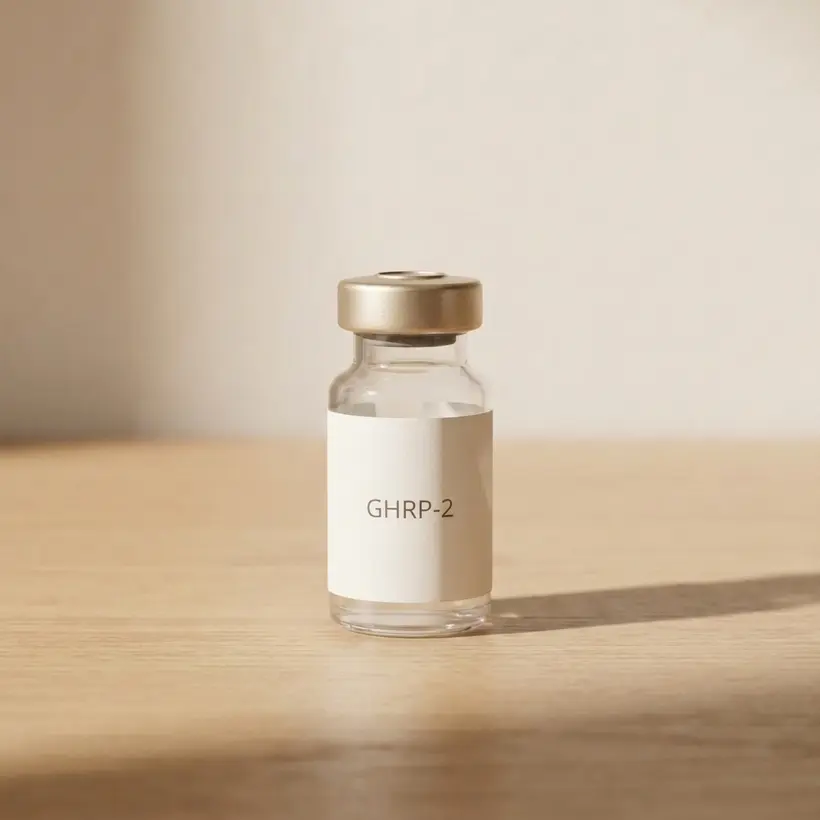
From the FormBlends catalog
GHRP-2
Potent growth hormone secretagogue via ghrelin receptor · From $32/mo · compounded by a licensed 503A pharmacy, dispensed only after provider review.
Learn about GHRP-2 →Bowers' earlier work established the dose-response relationship: GH release plateaus around 2 to 3 mcg/kg, suggesting receptor saturation. Critically, repeated dosing maintains effectiveness without tachyphylaxis over 30-day protocols, unlike continuous ghrelin infusion which shows rapid desensitization.
The peptide's effects extend beyond acute GH pulses. IGF-1 levels rise gradually, reaching 1.5 to 2-fold baseline after 14 to 21 days of consistent administration. This delayed response reflects the time required for hepatic GH receptor activation and IGF-1 synthesis.
Real-world usage patterns
Analysis of peptide community forums and user logs reveals distinct patterns that diverge from clinical protocols. Most users report starting with conservative 100 mcg doses twice daily, gradually increasing to 200 to 300 mcg based on perceived benefits and side effect tolerance. The sweet spot for many falls between 150 to 200 mcg per injection, balancing GH release with manageable hunger and water retention.
Timing strategies have evolved through collective experimentation. Morning doses on empty stomach produce the strongest subjective effects but also peak hunger. Pre-workout administration (45 to 60 minutes prior) aligns GH elevation with training, though some users report feeling "flat" during workouts. Bedtime dosing remains popular despite occasional sleep disruption in sensitive individuals.
Users consistently report initial water weight gain of 2 to 5 pounds within the first week, stabilizing thereafter. Sleep quality improvements appear highly individual, with roughly half reporting deeper sleep and half experiencing no change or mild disruption. The oft-cited skin and hair improvements typically emerge after 6 to 8 weeks of consistent use, if at all.
Notably absent from user reports: dramatic muscle gains or fat loss in the absence of optimized training and nutrition. GHRP-2 appears to enhance recovery and potentially improve body composition trajectories, but does not override fundamental physiology.
Reconstitution and degradation reality
The stability claims surrounding reconstituted GHRP-2 deserve scrutiny. While lyophilized powder maintains integrity for years when frozen, adding bacteriostatic water initiates degradation processes vendors rarely acknowledge.
At room temperature (25°C), HPLC analysis shows measurable degradation within days. The peptide loses approximately 5 to 10% potency per week under these conditions. Refrigeration at 2 to 8°C dramatically slows this process, with less than 5% degradation over 4 weeks. Despite common advice, freezing reconstituted peptide causes aggregation and should be avoided.
Visual inspection provides limited information. Clear solutions can harbor significant degradation products, while slight cloudiness might indicate bacterial contamination rather than peptide breakdown. The characteristic yellowing from tryptophan oxidation typically appears only after substantial degradation has already occurred.
Practical recommendation: reconstitute only what will be used within 2 to 3 weeks and store consistently refrigerated. Large vials may seem economical but often result in degraded product before completion.
GHRP-2 versus the alternatives
The growth hormone secretagogue landscape offers multiple options, each with distinct characteristics. GHRP-2 occupies a middle ground: more potent than ipamorelin, less side-effect prone than GHRP-6, but requiring multiple daily injections unlike oral MK-677.
Head-to-head comparisons reveal nuanced differences. GHRP-6 produces comparable GH elevation but drives hunger in nearly all users, making it problematic during caloric restriction. Ipamorelin offers the cleanest side effect profile with minimal cortisol or prolactin elevation, but requires higher doses (200 to 300 mcg) for equivalent GH release.
MK-677 provides convenience through oral administration and 24-hour activity, but elevates cortisol more substantially and causes persistent hunger in most users. The prolonged half-life also means side effects last longer when they occur.
Cost analysis favors MK-677 for long-term use, while GHRP-2 offers superior control through adjustable dosing and rapid clearance. Athletes subject to testing should note GHRP-2's shorter detection window (6 to 12 hours) versus MK-677 (several days).
Mechanistic insights and limitations
GHRP-2 activates growth hormone secretagogue receptor 1a (GHSR1a) on pituitary somatotrophs, triggering phospholipase C activation and calcium mobilization. This direct pituitary effect combines with hypothalamic actions: amplifying GHRH release while partially suppressing somatostatin tone.
The dual mechanism explains synergy with GHRH analogs. Co-administration of GHRP-2 with CJC-1295 or Mod-GRF produces GH responses exceeding either peptide alone by 2 to 3-fold. This combination mimics physiological GH regulation more closely than either pathway in isolation.
However, mechanistic elegance does not guarantee clinical outcomes. Elevated GH and IGF-1 represent intermediate biomarkers, not endpoints. The pulsatile GH pattern from GHRP-2 differs substantially from pharmaceutical GH's pharmacokinetics, potentially altering tissue-level effects.
Individual variation remains substantial. GH response to identical GHRP-2 doses varies 5-fold between subjects, likely reflecting differences in pituitary reserve, receptor density, and baseline somatostatin tone. Age-related decline in GH response is well-documented, with older individuals showing blunted but still significant elevation.
Practical acquisition guidance
The peptide market spans legitimate research suppliers to questionable underground labs. Price serves as an initial filter: GHRP-2 below $20 per 5mg vial suggests compromised quality or outright fraud. Conversely, prices exceeding $80 per vial rarely correlate with superior product.
Certificates of Analysis should include HPLC chromatogram showing a single major peak at the expected retention time, mass spectrometry confirming the appropriate molecular weight for GHRP-2, and endotoxin testing below 5 EU/mg. Amino acid analysis provides additional confirmation but is less commonly available.
Visual inspection of lyophilized powder offers limited assurance. White to off-white appearance is expected, but many adulterants share this characteristic. The "puck" formation from proper lyophilization suggests appropriate processing but does not confirm identity or purity.
Established peptide testing services now offer affordable third-party analysis. For regular users, pooling resources for independent testing of preferred sources provides valuable quality assurance beyond vendor claims.
Cortisol considerations
GHRP-2's effect on the hypothalamic-pituitary-adrenal axis deserves careful consideration. At typical doses (100 to 300 mcg), cortisol elevation ranges from 20 to 50% above baseline, peaking 1 to 2 hours post-injection and normalizing within 3 to 4 hours.
This transient elevation falls within physiological range, comparable to moderate exercise or mild stress. However, multiple daily doses can produce cumulative effects, particularly in stress-sensitive individuals. Evening administration may interfere with natural cortisol rhythm, potentially affecting sleep quality and recovery.
Mitigation strategies include limiting doses to twice daily, avoiding late evening administration, and monitoring subjective stress markers. Users reporting anxiety, sleep disruption, or water retention often benefit from dose reduction rather than cessation.
FAQ
What is GHRP-2 peptide used for?
GHRP-2 peptide is primarily used in research to stimulate growth hormone release, with human studies showing 7-15 fold increases in GH levels. Clinical applications include diagnostic testing for growth hormone deficiency and research into muscle wasting conditions.
How does GHRP-2 differ from GHRP-6?
GHRP-2 produces less hunger stimulation than GHRP-6 while maintaining similar GH release. GHRP-6 increases appetite in nearly all users due to stronger ghrelin mimicry, while GHRP-2 shows this effect in a smaller proportion of users at standard doses.
What is the typical GHRP-2 dosing protocol?
Research protocols typically use 100-300 mcg per dose, administered 2-3 times daily. The peptide has a half-life of 25-30 minutes, requiring multiple daily doses for sustained effect. Subcutaneous injection is standard.
Can you purchase GHRP-2 legally?
GHRP-2 is available for purchase as a research chemical in most countries but is not approved for human therapeutic use. It appears on WADA's prohibited list for athletes. Legitimate suppliers provide certificates of analysis showing 98%+ purity.
What are the main benefits of GHRP-2 peptide?
Documented GHRP-2 peptide benefits in human studies include increased growth hormone (7-15 fold), elevated IGF-1 levels (1.5-2 fold), and improved GH pulsatility. Animal studies suggest potential for muscle preservation and improved bone density.
Does GHRP-2 cause water retention?
GHRP-2 can cause mild water retention in some users, typically manifesting as a small weight gain in the first week. This occurs through GH-mediated sodium retention and usually stabilizes after several days of consistent use.
How quickly does GHRP-2 work?
GHRP-2 stimulates growth hormone release within 5-15 minutes of injection, peaking at 30-60 minutes. IGF-1 elevation takes 2-3 weeks of consistent use. Tissue-level changes require 8-12 weeks based on growth hormone physiology.
What is GHRP-2 acetate peptide?
GHRP-2 acetate refers to the acetate salt form of the peptide, which is the standard commercial preparation. The acetate salt improves stability and solubility compared to the free peptide form, with no difference in biological activity.
Can GHRP-2 be stacked with other peptides?
GHRP-2 is commonly combined with GHRH analogs like CJC-1295 or Mod-GRF, which can amplify GH release 2-3 fold beyond GHRP-2 alone. This synergy occurs because GHRPs and GHRHs work through different pituitary receptors.
Does GHRP-2 affect cortisol levels?
GHRP-2 can transiently increase cortisol by 20-50% for 2-3 hours post-injection, particularly at doses above 200 mcg. This elevation is generally within physiological range and less pronounced than with traditional GH secretagogues.
Sources
- Bowers CY. GH releasing peptides - structure and kinetics. J Pediatr Endocrinol. 1993;6(1):21-31.
- Pihoker C, Kearns GL, French D, Bowers CY. Pharmacokinetics and pharmacodynamics of growth hormone-releasing peptide-2. J Clin Endocrinol Metab. 1998;83(4):1168-1172.
- Ghigo E, Arvat E, Muccioli G, Camanni F. Growth hormone-releasing peptides. Eur J Endocrinol. 1997;136(5):445-460.
- Laferrère B, Abraham C, Russell CD, Bowers CY. Growth hormone releasing peptide-2 (GHRP-2), like ghrelin, increases food intake in healthy men. J Clin Endocrinol Metab. 2005;90(2):611-614.
- World Anti-Doping Agency. The 2024 Prohibited List. Montreal: WADA; 2024.
- FDA Warning Letters. Growth hormone releasing peptides database. Updated 2024.
- USP Peptide Standards. Quality specifications for synthetic peptides. USP-NF 2024.
- Kojima M, Hosoda H, Date Y, et al. Ghrelin is a growth-hormone-releasing acylated peptide from stomach. Nature. 1999;402(6762):656-660.
Related peptide guides
Footer disclaimers
Platform: The information provided on FormBlends.com is for educational and informational purposes only and is not intended as medical advice. Always consult with a qualified healthcare professional before starting any new treatment or supplement regimen.
Research Compound: GHRP-2 is sold as a research compound and is not approved by the FDA for human consumption. The safety and efficacy of this compound have not been fully established for therapeutic use in humans.
Results: Individual results may vary. The statements made regarding this product have not been evaluated by the Food and Drug Administration. This product is not intended to diagnose, treat, cure, or prevent any disease.
Trademark: FormBlends is a registered trademark. All product names, logos, and brands are property of their respective owners.
Ready when you are
GHRP-2
Potent growth hormone secretagogue via ghrelin receptor · From $32/mo · compounded by a licensed 503A pharmacy, dispensed only after provider review.
Learn about GHRP-2 →