Trust Signals
- Evidence Base: 3 published human trials (n=55 total), 15+ preclinical studies
- Clinical Development: Reached Phase 2 trials before discontinuation (lipodystrophy indication)
- Regulatory Status: Not FDA-approved, available through compounding pharmacies
- Patent History: Originally developed by ConjuChem (now defunct), patents expired
The Real Story: Why CJC 1295 Matters
CJC 1295 emerged from a simple observation: native growth hormone releasing hormone (GHRH) degrades in minutes, making it therapeutically useless. ConjuChem's solution was elegant. They modified GHRH's structure to resist enzymatic breakdown, creating a molecule that could actually survive long enough to work.
The peptide exists in two fundamentally different versions. Without DAC, it clears within hours but preserves your natural growth hormone pulses. With DAC, it binds to albumin in your blood and releases slowly over a week, creating sustained elevation. This distinction shapes everything about how the peptide performs.
What makes CJC 1295 particularly interesting is its proven track record in human trials, something most peptides lack. The Teichman study demonstrated 2 to 10-fold increases in growth hormone, with corresponding IGF-1 elevation. These aren't theoretical benefits extrapolated from rat studies. They're measured human outcomes.
Table of Contents
- Molecular Engineering: How CJC 1295 Was Built
- The Teichman Trial: Reading Between the Lines
- DAC Technology: Albumin Binding Explained
- Dosing Reality vs Forum Fiction
- Reconstitution Chemistry and Stability
- What Users Actually Experience
- Comparing Growth Hormone Strategies
- Legal Landscape and Quality Control
- Reading Lab Reports Like a Chemist
Molecular Engineering: How CJC 1295 Was Built
CJC 1295 represents sophisticated peptide engineering. The base molecule is GHRH(1-29), the first 29 amino acids of natural GHRH. But unmodified GHRH has a plasma half-life of 7 minutes due to rapid cleavage by dipeptidyl peptidase-4 (DPP-4).
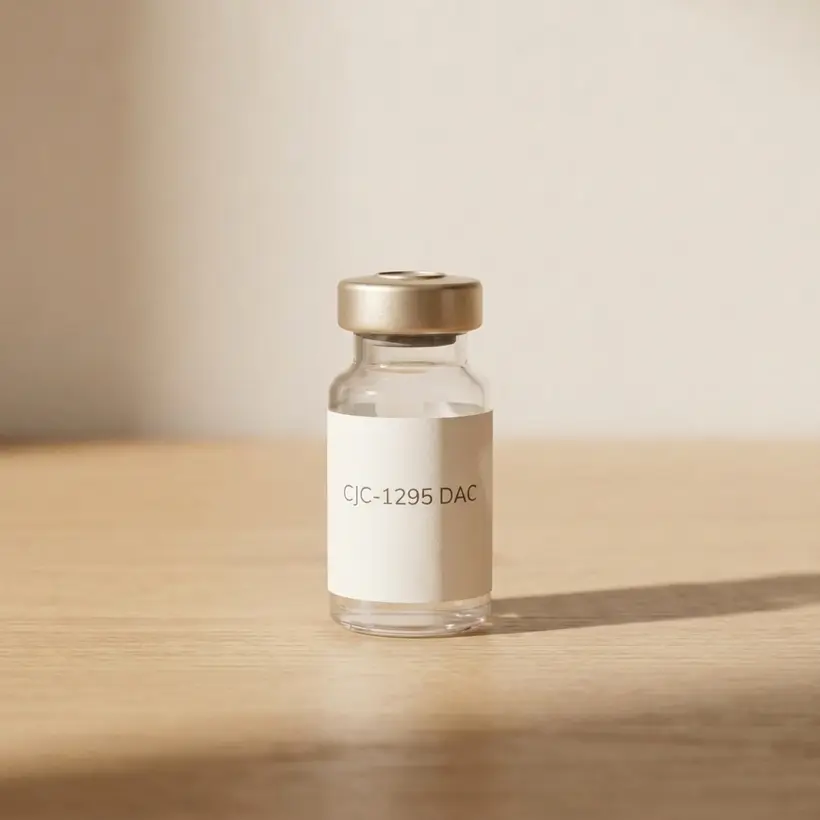
From the FormBlends catalog
CJC-1295 DAC
Long-acting GHRH analog with Drug Affinity Complex for sustained GH elevation · From $42/mo · compounded by a licensed 503A pharmacy, dispensed only after provider review.
Learn about CJC-1295 DAC →The critical modification is substituting D-alanine for L-alanine at position 2. This single change blocks DPP-4 from recognizing its cleavage site, extending half-life to approximately 30 minutes. Additional substitutions at positions 8, 15, and 27 further enhance stability and receptor binding.
The DAC version adds another layer of complexity. A lysine residue is modified with maleimidopropionic acid, creating a reactive group that forms a covalent bond with cysteine-34 on serum albumin. This irreversible binding creates a drug reservoir that releases CJC 1295 slowly as albumin naturally turns over.
| Modification | Purpose | Effect on Half-Life |
|---|---|---|
| D-Ala2 substitution | Block DPP-4 cleavage | 7 min → 30 min |
| Gln8, Ala15, Leu27 | Enhanced stability | Additional protection |
| DAC addition | Albumin binding | 30 min → 6-8 days |
The Teichman Trial: Reading Between the Lines
The 2006 Teichman study remains our best human data on CJC 1295. Twenty healthy adults received single subcutaneous doses ranging from 30 to 125 mcg/kg. The results were striking but nuanced.
Growth hormone peaks occurred 0.5 to 2 hours post-injection, reaching 8 to 15 ng/mL from baselines under 2 ng/mL. But individual variation was enormous. Some subjects showed 10-fold increases while others barely doubled baseline. Age strongly predicted response, with younger subjects showing greater elevation.
IGF-1 changes lagged behind GH, peaking at days 7 to 10. The elevation persisted for two weeks after a single injection, demonstrating the DAC version's extended activity. Critically, IGF-1 rarely exceeded 3-fold baseline even at the highest doses, suggesting robust feedback mechanisms remain intact.
Side effects clustered around injection sites (frequently reported) and vascular effects like flushing (commonly observed). These weren't severe but were consistent. The trial's limitation? It only tested single doses. We have minimal data on repeated administration beyond a small lipodystrophy trial that ended for business reasons.
DAC Technology: Albumin Binding Explained
The Drug Affinity Complex represents clever pharmaceutical engineering. Human serum albumin, our most abundant plasma protein, has a single free cysteine at position 34. The DAC modification exploits this unique reactive site.
Once injected, CJC 1295-DAC rapidly forms a covalent bond with circulating albumin. This isn't weak reversible binding but a permanent chemical linkage. The peptide-albumin complex is too large for renal filtration and protected from most degradative enzymes.
Release occurs through two mechanisms. First, the covalent bond slowly hydrolyzes, freeing active peptide. Second, albumin itself turns over with a half-life of 19 days, releasing bound drug as it degrades. The result is sustained drug levels for 6 to 8 days from a single injection.
This technology fundamentally changes the pharmacology. Instead of mimicking natural GH pulses, DAC creates continuous elevation. Whether this is advantageous depends on your goals and philosophy about hormone replacement.
Dosing Reality vs Forum Fiction
Online forums promote CJC 1295 doses that would horrify the original researchers. Common recommendations of 1000 mcg per injection represent 10 to 15 mcg/kg for most users, yet Teichman found diminishing returns above 60 mcg/kg.
The disconnect stems from confusing total weekly dose with per-injection dose. In clinical trials, 60 mcg/kg meant 4200 mcg total for a 70kg person, administered as a single weekly injection of CJC 1295-DAC. Forums often suggest this amount daily.
For CJC 1295 without DAC, physiologic dosing means working with, not against, natural GH patterns. Most practitioners suggest 100 to 300 mcg once or twice daily, timed to augment natural pulses. Higher doses don't necessarily mean better results once feedback mechanisms engage.
The combination with ipamorelin adds another variable. While mechanistically sound (GHRH + ghrelin agonism), no controlled trials validate specific ratios or doses. The popular 1:1 ratio (100 mcg each) derives from clinical convenience, not optimization studies.
Reconstitution Chemistry and Stability
Peptide reconstitution seems simple but involves complex chemistry. Lyophilized CJC 1295 exists as an amorphous solid with minimal water content. Adding bacteriostatic water initiates refolding into the active conformation.
The reconstitution process matters. Adding water too quickly or directly onto the powder can cause local pH spikes that promote degradation. The standard technique, adding water slowly down the vial wall, allows gentle mixing and pH equilibration.
Once in solution, CJC 1295 faces multiple degradation pathways:
- Hydrolysis of peptide bonds (accelerated by pH extremes)
- Deamidation of asparagine and glutamine residues
- Oxidation of methionine (if present)
- Aggregation through hydrophobic interactions
Temperature dramatically affects these rates. At 2-8°C, degradation proceeds slowly over weeks. At 25°C, significant potency loss occurs within days. The Arrhenius equation predicts roughly 3-fold acceleration per 10°C increase.
| Storage Condition | Expected Stability | Practical Guidance |
|---|---|---|
| -20°C lyophilized | Years | Long-term storage |
| 25°C lyophilized | Months | Shipping/short-term |
| 2-8°C reconstituted | 2-4 weeks | Active use period |
| 25°C reconstituted | Days | Avoid if possible |
What Users Actually Experience
Clinical trials measure hormones and adverse events. Users care about subjective improvements. The disconnect between published data and user reports reveals interesting patterns.
Sleep quality improvements appear within days for many users, particularly with evening dosing of the no-DAC version. This aligns with GH's role in deep sleep, though no trials specifically measured sleep architecture on CJC 1295. Users describe more vivid dreams and feeling more rested despite unchanged sleep duration.
Recovery from training represents another consistent report. Users note reduced soreness and faster return to baseline performance. While mechanistically plausible through IGF-1's effects on protein synthesis and tissue repair, these remain anecdotal observations.
Body composition changes vary wildly in user reports. Some claim dramatic fat loss within weeks, others see minimal change despite confirmed IGF-1 elevation. This variability likely reflects differences in diet, training, baseline hormone status, and genetic factors affecting GH sensitivity.
Water retention emerges as the most common complaint, particularly with DAC versions or higher doses. Users report facial puffiness, tight rings, and scale weight increases of several pounds. This typically resolves within days of cessation but can persist throughout use.
The combination with ipamorelin generally receives positive feedback, with users reporting fewer side effects than CJC 1295 alone while maintaining efficacy. Whether this reflects true synergy or simply dose optimization remains unclear without controlled comparisons.
Comparing Growth Hormone Strategies
CJC 1295 enters a crowded field of GH-enhancing options. Understanding its unique position helps contextualize its use.
Direct HGH injection provides the most predictable results but suppresses natural production and requires daily injections. Cost typically exceeds $1000 monthly for therapeutic doses. CJC 1295 preserves some pituitary function while achieving significant GH elevation at lower cost.
MK-677 offers oral convenience and robust clinical data but causes significant appetite increase and water retention in most users. Its 24-hour half-life prevents pulsatile dosing. CJC 1295 without DAC allows more physiologic patterns with manageable side effects.
Sermorelin, essentially GHRH(1-29) without modifications, requires multiple daily injections due to its minutes-long half-life. While FDA-approved, its inconvenience and lower potency limit practical use. CJC 1295 solves the half-life problem through molecular engineering.
Newer peptides like tesamorelin offer interesting alternatives but lack CJC 1295's combination of human data, reasonable cost, and flexible dosing options. The field continues evolving, but CJC 1295 remains a benchmark for comparison.
Legal Landscape and Quality Control
CJC 1295's legal status creates a complex marketplace. Without FDA approval, it cannot be marketed as a drug. However, the peptide itself isn't scheduled or explicitly banned for research use.
Compounding pharmacies in certain states can prepare CJC 1295 with a valid prescription. These versions undergo sterility and potency testing, providing pharmaceutical-grade quality at premium prices. Insurance never covers these preparations.
Research chemical vendors operate in regulatory grey zones. Quality varies dramatically without oversight. Some provide detailed certificates of analysis from reputable third-party labs. Others offer nothing beyond marketing claims.
International sourcing adds complexity. Many users import from countries with different regulatory frameworks. This risks customs seizure and eliminates quality guarantees. Contamination, underdosing, and substitution remain real concerns.
Athletes face additional restrictions. WADA explicitly prohibits all growth hormone releasing factors. Testing methods continue improving, with detection windows extending as analytical techniques advance.
Reading Lab Reports Like a Chemist
Quality assessment requires understanding analytical certificates. Here's what actually matters:
HPLC purity indicates the percentage of correct peptide versus impurities. While 99% sounds marginally better than 98%, both exceed pharmaceutical standards. Below 95% suggests poor synthesis or degradation.
Mass spectrometry confirms molecular weight. CJC 1295 without DAC should show 3367.9 Da. Variations beyond 1-2 Da indicate structural problems. Multiple peaks suggest degradation or contamination.
Amino acid analysis provides sequence confirmation but isn't always performed. It's particularly important for confirming D-alanine incorporation, which standard methods might miss.
Bacterial endotoxin testing ensures injection safety. Limits should be under 5 EU/mg. Higher levels risk fever and inflammatory responses. This test costs significant money, so its absence suggests corner-cutting.
Watch for red flags: outdated testing (over 6 months), missing batch numbers, generic templates, or impossibly cheap pricing. Legitimate analytical testing costs hundreds of dollars per batch minimum.
FAQ
What is CJC 1295? CJC 1295 is a synthetic 29-amino acid peptide that mimics growth hormone releasing hormone (GHRH), extending its half-life from 7 minutes to 30 minutes (no DAC) or 6-8 days (with DAC).
What's the difference between CJC 1295 DAC and no DAC? CJC 1295 with DAC (Drug Affinity Complex) binds to albumin, extending half-life to 6-8 days with continuous GH elevation. No DAC version has a 30-minute half-life, allowing pulsatile dosing that better mimics natural GH secretion.
How much does CJC 1295 increase growth hormone? In the 2006 Teichman trial, CJC 1295 DAC at 60-90 mcg/kg increased mean GH levels 2-10 fold above baseline for 6+ days. IGF-1 increased 1.5-3 fold. Individual response varies by age and baseline GH status.
What are the side effects of CJC 1295? Clinical trials report injection site reactions in many subjects, transient flushing commonly, and headaches in some users. Water retention and joint pain occur at higher doses. No DAC version typically has fewer side effects due to pulsatile administration.
How do you reconstitute CJC 1295? Add bacteriostatic water slowly down the vial wall. For 2mg vial: 1mL water = 2000mcg/mL concentration. For 100mcg dose, draw to 0.05mL mark (5 units on U-100 insulin syringe). Never shake. Store reconstituted peptide at 2-8°C.
Can you combine CJC 1295 with ipamorelin? CJC 1295 (GHRH agonist) and ipamorelin (ghrelin mimetic) work through different pathways and show synergistic GH release in studies. Common protocol uses 100mcg of each peptide together, though no large human trials validate this combination.
How long can you run CJC 1295? No long-term safety data exists beyond 90 days. Clinical trials ran 14-49 days. Many practitioners recommend 8-12 week cycles with 4-week breaks to prevent receptor desensitization, though this is based on clinical experience not controlled trials.
Is CJC 1295 legal? CJC 1295 is not FDA-approved for any indication. It's available through compounding pharmacies with prescription in some jurisdictions. WADA prohibits it in competitive sports. Legal status varies by country and state.
What time should you take CJC 1295? CJC 1295 no DAC is typically dosed at night to augment natural GH pulses during deep sleep, or 2-3x daily. DAC version can be dosed weekly regardless of timing due to its extended half-life. Avoid dosing within 2 hours of meals to prevent somatostatin interference.
How do you store CJC 1295? Lyophilized CJC 1295 remains stable for months at -20°C or weeks at room temperature. Once reconstituted, store at 2-8°C and use within 4 weeks. Degradation accelerates significantly above 8°C, with noticeable potency loss within days at room temperature.
Sources
- Teichman SL, Neale A, Lawrence B, et al. Prolonged stimulation of growth hormone (GH) and insulin-like growth factor I secretion by CJC-1295, a long-acting analog of GH-releasing hormone, in healthy adults. J Clin Endocrinol Metab. 2006;91(3):799-805.
- Ionescu M, Frohman LA. Pulsatile secretion of growth hormone (GH) persists during continuous stimulation by CJC-1295, a long-acting GH-releasing hormone analog. J Clin Endocrinol Metab. 2006;91(12):4792-4797.
- World Anti-Doping Agency. The Prohibited List 2024. Growth Hormone Releasing Factors section.
- FDA Warning Letters. Various enforcement actions against peptide companies 2020-2024.
- Henninge J, Pepaj M, Hullstein I, Hemmersbach P. Identification of CJC-1295, a growth-hormone-releasing peptide, in an unknown pharmaceutical preparation. Drug Test Anal. 2010;2(11-12):647-650.
- USP General Chapter 1207: Sterile Product Packaging, Integrity Evaluation. United States Pharmacopeia.
- Manning MC, Chou DK, Murphy BM, et al. Stability of protein pharmaceuticals: an update. Pharm Res. 2010;27(4):544-575.
Footer Disclaimers
Platform Notice: This content is for educational purposes only and does not constitute medical advice.
Compound Status: CJC 1295 is sold as a research compound. In jurisdictions where permitted, it may be prescribed through licensed compounding pharmacies.
Results Disclaimer: Individual results vary based on age, baseline hormone status, genetics, and adherence to protocol. No specific outcome is guaranteed.
Trademark Notice: CJC 1295 is a research designation. Any trade names mentioned are for identification purposes only.
Related peptide guides
Ready when you are
CJC-1295 DAC
Long-acting GHRH analog with Drug Affinity Complex for sustained GH elevation · From $42/mo · compounded by a licensed 503A pharmacy, dispensed only after provider review.
Learn about CJC-1295 DAC →