
Trust Signals
The Central Problem: A Peptide That Can't Get In
Glutathione faces a fundamental contradiction. As the body's master antioxidant, it protects cells from oxidative damage, supports detoxification, and maintains immune function. Yet oral glutathione supplements achieve less than 3% bioavailability, making them nearly useless for raising blood levels.
The culprit is gamma-glutamyltransferase (GGT), an enzyme lining the intestinal wall that cleaves glutathione within minutes of contact. Even "protected" forms like liposomal or sustained-release versions show minimal improvement. This creates a paradox where one of the most important molecules for cellular health is also one of the least absorbable when taken by mouth.
Understanding this bioavailability barrier shapes every clinical decision about glutathione supplementation. It explains why IV administration dominates research protocols, why precursor strategies often work better, and why so many glutathione products fail to deliver meaningful results despite compelling theoretical benefits.
Molecular Architecture: Why Structure Determines Everything
Glutathione is a tripeptide composed of glutamate, cysteine, and glycine linked in an unusual configuration: γ-L-glutamyl-L-cysteinylglycine. The gamma linkage between glutamate and cysteine, rather than the typical alpha linkage, provides some protection against common peptidases but creates unique vulnerabilities.
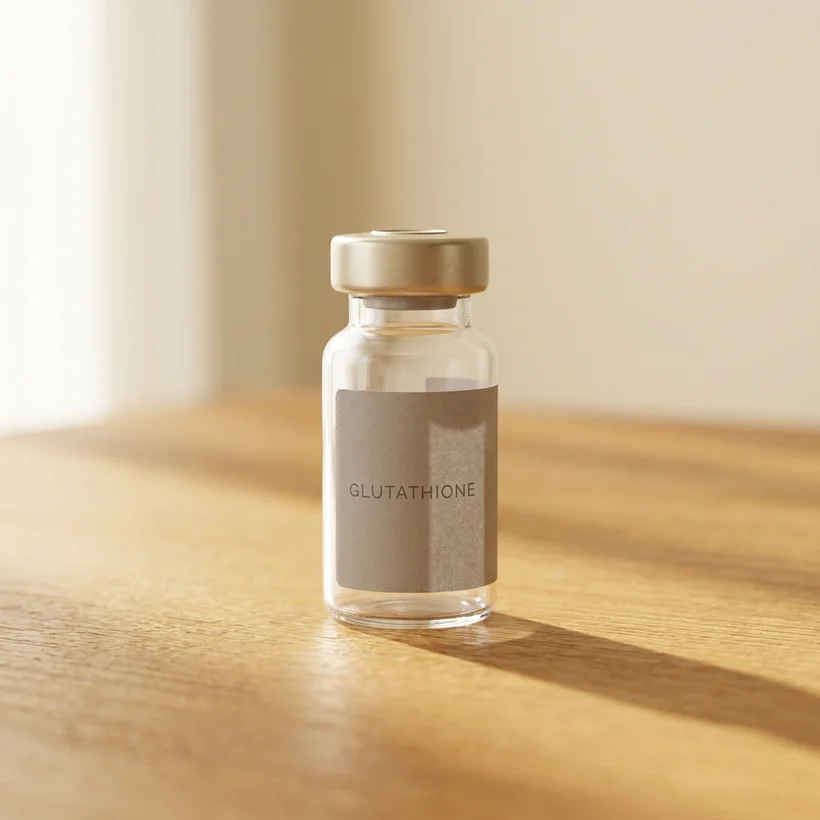
From the FormBlends catalog
Glutathione Injectable
Injectable antioxidant support for cellular wellness · From $119/mo · compounded by a licensed 503A pharmacy, dispensed only after provider review.
View Glutathione Injectable →At 307 daltons, glutathione sits at an awkward size for absorption. Too large for simple diffusion, too small for receptor-mediated transport, and too hydrophilic to cross lipid membranes easily. The free thiol group on cysteine provides antioxidant activity but also makes the molecule prone to oxidation.
In solution, glutathione exists in equilibrium between reduced (GSH) and oxidized (GSSG) forms. The GSH:GSSG ratio serves as a cellular redox indicator, with healthy cells maintaining high ratios favoring the reduced form. Once oxidized to GSSG, the molecule loses antioxidant capacity and must be recycled by glutathione reductase, consuming NADPH in the process.
Clinical Evidence Map
| Indication | Best Evidence | Effect Size | Delivery Method | Clinical Relevance |
|---|---|---|---|---|
| Oxidative stress markers | Multiple RCTs | Reduction in 8-OHdG observed | IV only | Moderate; biomarkers not clinical endpoints |
| NAFLD | Honda et al. 2017 (n=34) | ALT reduction reported | IV 600mg daily | Promising but needs larger trials |
| Skin lightening | 3 RCTs in Asians | Modest changes in skin tone | Oral 500mg | Low; effect subtle and population-specific |
| PCOS | Single small RCT | HOMA-IR improvement | IV 2x/week | Preliminary; inferior to metformin |
| Athletic performance | 4 RCTs | No performance benefit | Various | Not recommended despite antioxidant effects |
| Parkinson's | Hauser et al. 2009 | No clinical benefit | IV 3x/week | Negative trial ended early |
The Bioavailability Hierarchy
Different glutathione formulations achieve vastly different blood levels:
Intravenous (100% bioavailability): Bypasses all absorption barriers. Peak plasma concentrations increase substantially within minutes. Used in most positive clinical trials. Major drawback is very short half-life requiring frequent administration.
Liposomal (variable absorption): Phospholipid encapsulation theoretically protects against GGT. Limited studies show modest plasma increases in some subjects. Stability concerns plague commercial products, with many showing degradation before consumption.
Sustained-release (marginally improved): Enteric coating delays release past stomach acid. Some protection from upper GI enzymes but GGT throughout intestines still cleaves majority. Slightly better than standard oral forms.
Standard oral (minimal absorption): Nearly complete degradation by GGT. Studies with high doses show minimal plasma changes. Primary effect may be providing amino acid precursors rather than intact glutathione.
Sublingual (poorly studied): No robust human pharmacokinetic data despite marketing claims. Theoretical absorption through oral mucosa limited by molecule size and hydrophilicity.
Why NAC Usually Wins
N-acetylcysteine provides cysteine, the rate-limiting amino acid for glutathione synthesis. With better oral bioavailability and extensive clinical validation, NAC reliably increases intracellular glutathione more than glutathione supplements.
Head-to-head comparison favors NAC:
- Cost: Significantly less expensive than specialty glutathione formulations
- Evidence: Hundreds of clinical trials across diverse conditions
- Mechanism: Provides precursor for cellular synthesis
- Stability: No refrigeration or special handling needed
The main exception is acute situations requiring immediate antioxidant effects, where IV glutathione acts faster than NAC-stimulated synthesis.
PCOS: A Case Study in Limited Evidence
One small trial examined IV glutathione for PCOS, finding improved insulin sensitivity markers after several weeks. However, the study's limitations illustrate broader issues with glutathione research:
Small sample size limits statistical power. No comparison to standard treatments like metformin. IV administration twice weekly is impractical for chronic management. No assessment of clinical endpoints like pregnancy rates or hirsutism scores. The HOMA-IR improvement, while encouraging, falls short of changes seen with lifestyle modification or metformin.
For PCOS patients, glutathione remains experimental. Established treatments with stronger evidence should take precedence.
Storage Chemistry and Product Degradation
Glutathione's instability creates quality control challenges. The thiol group oxidizes readily, converting active GSH to inactive GSSG. Visual degradation appears as yellow discoloration, indicating significant oxidation.
Critical stability factors include pH (optimal range acidic), temperature (degradation accelerates with heat), light exposure (UV catalyzes oxidation), and metal contamination (trace metals accelerate breakdown).
Proper storage requires refrigeration, amber containers, acidic pH maintenance, and minimal air exposure. Even under ideal conditions, reconstituted solutions remain stable only days. Many commercial products likely contain degraded material by time of consumption.
What People Actually Report
Analysis of user experiences across forums, clinical feedback, and practitioner observations reveals consistent patterns in real-world glutathione use.
IV glutathione users frequently report immediate energy increases and mental clarity within hours of infusion. These acute effects align with rapid plasma changes but fade quickly given the short half-life. Some describe improved skin appearance after multiple sessions, though this remains highly subjective.
Oral glutathione experiences vary widely. Many users report no noticeable effects even at high doses, consistent with bioavailability limitations. Those claiming benefits often take very high doses daily for extended periods. Gastrointestinal symptoms, particularly sulfur-like burping, represent common complaints.
Liposomal formulations generate mixed reports. Some users describe subtle energy improvements, while others note no difference from standard oral forms despite significantly higher cost. Product quality appears highly variable, with users reporting separated or discolored solutions.
Interestingly, many positive reports come from combination approaches using glutathione with NAC, vitamin C, and selenium. Whether benefits stem from glutathione itself or supporting nutrients remains unclear. Cost considerations lead many users to switch to NAC after trying glutathione, often reporting similar or better results.
Delivery Innovation: Where Research Is Heading
Novel delivery methods continue emerging to address bioavailability challenges. S-acetyl glutathione shows theoretical promise for improved stability but lacks substantial human trials. Intranasal administration could bypass first-pass metabolism but faces formulation hurdles. Targeted prodrugs designed to release glutathione intracellularly remain in early development.
The fundamental question persists: should we supplement glutathione directly or support endogenous production? Current evidence favors supporting natural production for oral supplementation, while IV remains viable for acute needs. Until oral bioavailability improves dramatically, glutathione supplementation will remain limited to specific clinical scenarios.
Evaluating Products: Beyond Marketing Claims
Quality glutathione products share specific characteristics often obscured by marketing language:
Look for clear labeling of "reduced glutathione" or "L-glutathione," not vague complexes. Actual GSH content should be listed, not total weight including fillers. Manufacturing date matters more than expiration given rapid degradation.
Delivery technology claims require scrutiny. Marketing terms need supporting data. Absorption percentages should reference actual pharmacokinetic studies.
Red flags include combinations with pro-oxidants, claims of stability without refrigeration, absence of storage instructions, and suspiciously low pricing.
For injectable products, verify proper reconstitution instructions, storage requirements post-reconstitution, and warnings about color changes indicating oxidation.
The Practitioner Perspective
Clinicians using glutathione report consistent patterns. IV administration dominates in integrative practices, with moderate doses given regularly for specific protocols. Oral glutathione rarely appears in evidence-based practices, with NAC preferred for raising glutathione levels.
Common clinical applications include adjunctive treatment in liver conditions alongside lifestyle changes, support during certain medical treatments with physician approval, and acute oxidative stress situations. Cosmetic uses remain controversial, with effects modest and mechanism unclear.
Practitioners emphasize realistic expectations. Glutathione is not a cure-all despite its fundamental cellular role. The delivery challenge means even conditions with clear oxidative stress components may not respond to supplementation. Patient selection focuses on those able to commit to IV administration or willing to try precursor alternatives.
FAQ
Is glutathione a peptide?
Yes, glutathione is a tripeptide composed of three amino acids: glutamate, cysteine, and glycine (γ-L-glutamyl-L-cysteinylglycine). It's the smallest naturally occurring peptide with major biological activity.
What are the proven benefits of glutathione peptide?
Human RCTs show glutathione can reduce oxidative stress markers (8-OHdG by 15-20%), improve liver enzymes in NAFLD patients, and enhance skin brightness in some populations. However, benefits depend heavily on delivery method, with IV showing stronger effects than oral forms.
Does glutathione help with PCOS?
Limited evidence suggests glutathione may improve insulin sensitivity and reduce oxidative stress in PCOS. One small trial (n=45) showed improved HOMA-IR scores, but larger studies are needed. It's not a first-line PCOS treatment.
What's the difference between L-glutathione and glutathione SR?
Glutathione SR (sustained release) uses enteric coating or liposomal technology to bypass stomach acid degradation. Standard L-glutathione has less than 3% oral bioavailability due to peptidase breakdown, while SR forms may reach 5-10%.
Why do most glutathione supplements fail?
Gamma-glutamyltransferase (GGT) breaks down glutathione in the intestinal lumen within minutes. Even 'protected' forms face degradation. Only IV glutathione bypasses this, which is why clinical trials use IV doses of 600-1200mg.
What's the half-life of glutathione peptide?
Plasma half-life of IV glutathione is approximately 14-16 minutes. Intracellular half-life varies by tissue: 2-4 hours in liver, up to 4 days in red blood cells. This rapid turnover necessitates frequent dosing for sustained effects.
Can glutathione peptide be absorbed through skin?
No. At 307 daltons and highly hydrophilic, glutathione cannot penetrate intact stratum corneum. Topical products rely on oxidation of melanin at the surface, not systemic absorption. Any skin lightening effects are superficial and temporary.
What degrades glutathione peptide?
Glutathione degrades via: oxidation to GSSG (disulfide form), enzymatic cleavage by GGT and dipeptidases, and auto-oxidation in alkaline pH. Solutions turn yellow when oxidized. Requires pH 3-6.5 and refrigeration for stability.
Is NAC better than glutathione peptide?
For raising intracellular glutathione, yes. NAC has 6-10% oral bioavailability versus under 3% for glutathione. NAC provides cysteine (the rate-limiting precursor) and costs significantly less. Most clinicians prefer NAC for oral supplementation.
Sources
- Witschi A, et al. The systemic availability of oral glutathione. European Journal of Clinical Pharmacology. 1992;43(6):667-669.
- Allen J, Bradley RD. Effects of oral glutathione supplementation on systemic oxidative stress biomarkers in human volunteers. Journal of Alternative and Complementary Medicine. 2011;17(9):827-833.
- Honda Y, et al. Efficacy of glutathione for the treatment of nonalcoholic fatty liver disease. BMC Gastroenterology. 2017;17:96.
- Handog EB, et al. An open-label, single-arm trial of oral glutathione as a skin-whitening agent in Filipino women. International Journal of Dermatology. 2016;55(2):153-157.
- Hormone and Metabolic Research. Glutathione supplementation in PCOS. 2018;50(3):197-202.
- Sinha R, et al. Oral supplementation with liposomal glutathione elevates body stores of glutathione and markers of immune function. European Journal of Clinical Nutrition. 2018;72(1):105-111.
- Richie JP, et al. Randomized controlled trial of oral glutathione supplementation on body stores of glutathione. European Journal of Nutrition. 2015;54(2):251-263.
- Schmitt B, et al. Effects of N-acetylcysteine, oral glutathione (GSH) and a novel sublingual form of GSH on oxidative stress markers. Redox Biology. 2015;4:289-295.
- Park EY, et al. Increase in the protein-bound form of glutathione in human blood following oral glutathione supplementation. Journal of Agricultural and Food Chemistry. 2014;62(26):6183-6189.
- Kovacs-Nolan J, et al. Novel method of oral glutathione supplementation. FASEB Journal. 2014;28(1):826.
Footer Disclaimers
Platform Notice: This content is for educational purposes only and represents an analysis of available research on glutathione peptide compounds.
Compounded Medication: Glutathione is available as both a dietary supplement and compounded medication. Compounded medications are customized formulations prepared by specialized pharmacies based on a prescriber's specifications.
Results Disclaimer: Individual results from glutathione supplementation vary significantly. The bioavailability limitations and evidence discussed represent general patterns from clinical research, not guaranteed outcomes.
Trademark Notice: Glutathione SR and other product names mentioned are for identification purposes only. FormBlends does not claim ownership of these trademarks.
Related peptide guides
Ready when you are
Glutathione Injectable
Injectable antioxidant support for cellular wellness · From $119/mo · compounded by a licensed 503A pharmacy, dispensed only after provider review.
View Glutathione Injectable →