Trust Signals
Every dose range cited reflects published clinical pharmacology data or compounding pharmacist consensus, not anecdote. Claims are graded by evidence quality. No product is sold on this page.
Key Takeaways
- The most commonly used ipamorelin dosage in clinical protocols is 100-300 mcg per injection, up to 3 times daily, though no human RCT has established an optimal dose.
- Ipamorelin's plasma half-life is approximately 2 hours; its GH-stimulating effect peaks within 30-60 minutes of subcutaneous injection in human pharmacokinetic data (Raun et al., 1998).
- CJC-1295 without DAC (half-life ~30 min) is co-dosed with every ipamorelin injection; CJC-1295 with DAC (half-life ~6-8 days) is dosed just 1-2 times per week, a distinction most pages blur or ignore.
- A 5 mg vial reconstituted in 2 ml bacteriostatic water yields 2500 mcg/ml; a 200 mcg dose draws to the 8-unit mark on a standard 100-unit insulin syringe.
- In 2023, the FDA moved ipamorelin to a category of bulk drug substances not eligible for compounding under sections 503A/503B, directly affecting US access through licensed compounding pharmacies.
Direct Answer: What Is the Standard Ipamorelin Dosage?
The most widely cited ipamorelin dosage is 100-300 mcg per injection, subcutaneously, 1-3 times daily, on an empty stomach. When combined with CJC-1295 (no-DAC), the same dose of each is given together. Total daily ipamorelin doses above 300 mcg per injection are not better supported by evidence and raise cost without proven benefit. No FDA-approved dose exists.
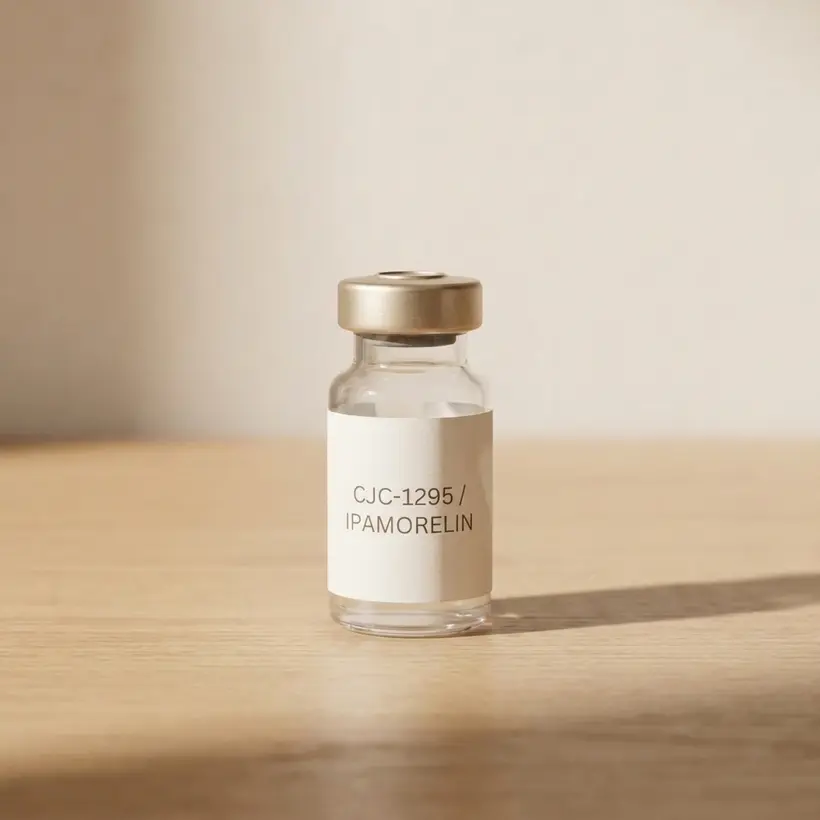
From the FormBlends catalog
CJC-1295 / Ipamorelin Blend
The gold standard growth hormone secretagogue stack · From $69/mo · compounded by a licensed 503A pharmacy, dispensed only after provider review.
Learn about CJC-1295 / Ipamorelin Blend →Table of Contents
- What is ipamorelin and how does it stimulate GH?
- Evidence ledger: what the data actually support
- Ipamorelin dosage per day: numbers and rationale
- CJC-1295 ipamorelin dosage: DAC vs. no-DAC, explained
- Ipamorelin dosage in ml: reconstitution math and syringe reading
- When to inject: the physiology behind the rules
- What most dosage pages get wrong
- Honest head-to-head: ipamorelin vs. alternatives
- Label and COA literacy: how to judge your product
- Side effects, cycling, and stopping
- FAQ
- Sources
- Disclaimers
What Is Ipamorelin and How Does It Stimulate GH?
Ipamorelin is a synthetic pentapeptide (Aib-His-D-2-Nal-D-Phe-Lys-NH2) and selective growth hormone secretagogue receptor (GHSR-1a) agonist. It mimics ghrelin at the pituitary gland, triggering GH release without meaningfully raising cortisol, prolactin, or ACTH at standard doses. This selectivity is its main pharmacological distinction from older GHRPs such as GHRP-2 and GHRP-6.
In the landmark Raun et al. (1998) dose-escalation study in rats, ipamorelin produced GH pulses comparable in magnitude to GHRP-6 while causing substantially less cortisol elevation. Human pharmacokinetic data (published by Novo Nordisk during NNC 26-0161 development) showed a plasma half-life of approximately 2 hours and dose-dependent GH peaks after subcutaneous administration.
Ipamorelin works downstream of the hypothalamus. It does not suppress endogenous GHRH production, which is why combining it with a GHRH analog (CJC-1295 or sermorelin) produces synergistic, physiologic-pattern GH pulses rather than simple additive effects.
Evidence Ledger: What the Data Actually Support
| Claim | Best Evidence Type | Key Source | Effect Direction | Confidence |
|---|---|---|---|---|
| Ipamorelin stimulates pulsatile GH release in vivo | Animal (rat) dose-escalation study | Raun et al., 1998, Eur J Endocrinol | Positive, dose-dependent | High (animal) |
| Ipamorelin does not significantly raise cortisol vs. GHRP-6 | Animal comparative study | Raun et al., 1998 | Positive (relative selectivity) | Moderate (animal only) |
| Subcutaneous half-life approximately 2 hours | Human PK (pharmaceutical development data, Novo Nordisk) | Reported in review literature; original NNC 26-0161 IND data | Established PK parameter | Moderate (human PK, not peer-reviewed trial) |
| 100-300 mcg/injection is the correct clinical dose | Consensus / compounding pharmacist protocol; no human RCT | No single published RCT in humans | Uncertain optimum | Low |
| Ipamorelin + GHRH analog is synergistic for GH secretion | Animal studies; mechanism well-established | Multiple GHRP/GHRH combination studies (Walker et al., 1994 for mechanism) | Positive | Moderate |
| Body composition improvement in healthy adults | No published human RCT for ipamorelin specifically | Extrapolated from GH literature and other GHRP trials | Speculative | Very Low |
| Long-term safety in humans | No data beyond short-term case series and adverse event reports | No published long-term human study | Unknown | Very Low |
Ipamorelin Dosage Per Day: Numbers and Rationale
| Use Context | Dose Per Injection | Injections/Day | Total Daily Dose | Notes |
|---|---|---|---|---|
| Conservative / first cycle | 100 mcg | 1 (pre-sleep) | 100 mcg | Lowest effective dose in most protocols; baseline tolerance check |
| Standard protocol | 200 mcg | 2 (AM fasted + pre-sleep) | 400 mcg | Most commonly cited clinical midpoint |
| Higher-range protocol | 300 mcg | 3 (AM + post-workout + pre-sleep) | 900 mcg | No RCT evidence that this outperforms 400 mcg/day |
| Research doses (animal) | Up to 1000 mcg/kg (rats) | Varies | N/A | Not applicable to human dosing; cited only to show the distance between human and animal doses |
Why 200-300 mcg per injection is the consensus ceiling: the GHSR-1a receptor shows saturable kinetics. Animal data suggest that GH release does not scale linearly above a certain threshold dose. Doubling the dose does not double the GH pulse. Practitioner protocols therefore favor more frequent lower doses over single large doses.
CJC-1295 Ipamorelin Dosage: DAC vs. No-DAC, Explained
This is the most consistently confused topic in peptide dosing. There are two distinct compounds sold as "CJC-1295," and they require different dosing schedules.
| Compound | Also Called | Half-Life | Dosing Frequency | Co-dosed with Ipamorelin? |
|---|---|---|---|---|
| CJC-1295 without DAC | Modified GRF(1-29), Mod-GRF | ~30 minutes | Every injection (with ipamorelin) | Yes, same syringe or separate |
| CJC-1295 with DAC | CJC-1295 DAC | ~6-8 days (albumin-bound) | 1-2 times per week | No; ipamorelin still dosed daily |
The drug affinity complex (DAC) technology attaches a lysine-maleimide linker to the peptide, allowing covalent binding to serum albumin. This dramatically extends the half-life from minutes to days (Jetté et al., 2005, Endocrinology). A typical CJC-1295 with DAC protocol uses 1-2 mg twice weekly, while daily ipamorelin injections continue at 200-300 mcg each.
When using CJC-1295 without DAC alongside ipamorelin, the standard approach is a 1:1 mcg ratio in the same subcutaneous injection. The GHRH analog amplifies the pituitary's response to ipamorelin's GHSR-1a signal, producing a larger, more physiologic GH pulse than either compound alone.
Ipamorelin Dosage in ml: Reconstitution Math and Syringe Reading
Step-by-step reconstitution and dose calculation
Step 1: Know your vial size. Common vial sizes are 2 mg (2000 mcg) and 5 mg (5000 mcg).
Step 2: Choose your diluent volume. Adding more bacteriostatic water dilutes the concentration, making small doses easier to measure accurately.
| Vial Size | Bacteriostatic Water Added | Concentration | Volume for 100 mcg | Volume for 200 mcg | Volume for 300 mcg |
|---|---|---|---|---|---|
| 2 mg (2000 mcg) | 2 ml | 1000 mcg/ml | 0.10 ml (10 units) | 0.20 ml (20 units) | 0.30 ml (30 units) |
| 5 mg (5000 mcg) | 2 ml | 2500 mcg/ml | 0.04 ml (4 units) | 0.08 ml (8 units) | 0.12 ml (12 units) |
| 5 mg (5000 mcg) | 5 ml | 1000 mcg/ml | 0.10 ml (10 units) | 0.20 ml (20 units) | 0.30 ml (30 units) |
Units notation: "Units" here refers to the markings on a 100-unit (1 ml) insulin syringe. Each unit line = 0.01 ml. A 200 mcg dose from a 1000 mcg/ml solution draws to the 20-unit line. This is the standard peptide clinic notation.
Formula to use anytime: Volume (ml) = Target dose (mcg) / Concentration (mcg/ml)
Combining ipamorelin and CJC-1295 no-DAC in one syringe
Draw ipamorelin first, then insert the needle into the CJC-1295 vial and draw back to combine. This order reduces the risk of introducing ipamorelin into the CJC-1295 vial. Both are stable in the same syringe for immediate injection; do not pre-mix and store combined solutions.
When to Inject: The Physiology Behind the Rules
Two physiological facts govern injection timing:
1. Insulin suppresses GH release. Elevated insulin after a meal acts at the pituitary and hypothalamic level to blunt GH pulsatility. Injecting ipamorelin during a fed state produces a smaller, blunted GH pulse. This is not a speculative concern; insulin's antagonism of GH secretion is a well-established endocrine interaction. Practical rule: inject at least 90-120 minutes after a meal, and wait 30 minutes before eating after injection.
2. Endogenous GH pulsatility peaks during slow-wave sleep. The largest natural GH pulse of the day occurs roughly 60-90 minutes after sleep onset. A pre-sleep ipamorelin injection is intended to amplify this pulse rather than create an entirely artificial one, maintaining a more physiologic pattern. This is the pharmacological reasoning behind prioritizing the pre-sleep dose if using only one injection per day.
Post-exercise timing: Exercise itself generates a GH pulse. Some protocols place the second daily injection 30 minutes before or immediately after resistance training. The post-workout window is not proven to be additive in human studies of ipamorelin specifically, but it is mechanistically plausible given exercise-induced GHRH surge.
What Most Dosage Pages Get Wrong
1. Conflating CJC-1295 DAC and no-DAC dosing schedules
Dozens of pages say "dose CJC-1295 with ipamorelin daily." This is correct only for the no-DAC form. CJC-1295 with DAC dosed daily is a pharmacological error that leads to supraphysiologic GHRH receptor stimulation and unnecessary cost. The two compounds have fundamentally different kinetics because of the albumin-binding DAC linker.
2. Ignoring the 2023 FDA 503A/503B bulk substance list
Many pages were written before the FDA's 2023 action placing ipamorelin and several other peptides on the list of bulk drug substances that may not be used in compounding. This has real legal and quality implications for US users. Sourcing from a compounding pharmacy that is now non-compliant, or from an overseas research chemical vendor, carries different risk profiles that most pages do not discuss.
3. Presenting animal doses as human equivalents
The Raun 1998 study used per-kilogram rat dosing that does not translate directly to human mcg targets. Human dose recommendations are extrapolated, not derived. No page should present 200-300 mcg as a validated human dose without this caveat.
4. Omitting peptide stability and degradation after reconstitution
Reconstituted ipamorelin in bacteriostatic water is not stable indefinitely. Peptide bonds undergo hydrolysis over time, and the rate accelerates at higher temperatures. Most protocols cite a 28-30 day use window. Freeze-thaw cycling denatures peptide structure. A vial that has been frozen, thawed, used, and refrozen multiple times has lower effective potency than a freshly reconstituted vial, even if it appears clear.
5. No discussion of bioavailability by route
Ipamorelin is administered subcutaneously or intramuscularly because oral and intranasal bioavailability for intact peptides of this size are negligible without specialized delivery systems. Some vendors sell oral ipamorelin capsules; the peptide is cleaved by gastric proteases before absorption. There is no published human data supporting clinically meaningful oral bioavailability for ipamorelin without a protected delivery matrix.
Honest Head-to-Head: Ipamorelin vs. Alternatives
| Compound | Mechanism | GH Pulse Quality | Cortisol/Prolactin Effect | Evidence in Humans | Where Ipamorelin Loses |
|---|---|---|---|---|---|
| Ipamorelin | GHSR-1a agonist (ghrelin mimetic) | Moderate, selective | Minimal at standard doses | PK only; no efficacy RCT | No approved human indication; weak evidence base |
| Sermorelin | GHRH analog | Physiologic pulses | Minimal | FDA-approved (pediatric GHD, now withdrawn); adult studies exist | Ipamorelin is less studied; sermorelin has more human data |
| GHRP-2 | GHSR-1a agonist | High GH release | Raises cortisol and prolactin meaningfully | Multiple human studies | Ipamorelin wins on selectivity; GHRP-2 has more published human trials |
| GHRP-6 | GHSR-1a agonist | High GH release | Raises cortisol; strong hunger/ghrelin side effect | Multiple human studies | Ipamorelin wins on side-effect profile; GHRP-6 has more human data |
| Recombinant HGH (somatropin) | Direct GH replacement | Supraphysiologic (non-pulsatile) | None directly | Extensive RCTs; FDA approved | Ipamorelin loses on evidence, efficacy, and regulatory status; rhGH wins if GH replacement is the goal |
| Tesamorelin | GHRH analog | Physiologic, sustained | Minimal | FDA-approved (HIV-associated lipodystrophy); multiple RCTs | Ipamorelin loses on every evidence metric; tesamorelin is the only GH secretagogue with a current FDA approval |
Label and COA Literacy: How to Judge Your Product
What a legitimate COA must contain
- Identity confirmation: Mass spectrometry or amino acid analysis confirming the sequence Aib-His-D-2-Nal-D-Phe-Lys-NH2 and molecular weight of 711.85 g/mol.
- Purity by HPLC: Minimum 98% purity is the industry standard for research-grade peptides. Values below 95% indicate significant impurity load. Ask for the HPLC chromatogram, not just the stated percentage.
- Endotoxin (LAL) testing: Less than 1 EU/mg is the standard threshold. Endotoxin contamination causes fever and systemic inflammation independent of the peptide itself.
- Sterility or bioburden testing: Required for any product intended for injection. Research chemicals sold explicitly not for human use may omit this.
- Lot number and date of manufacture: Required to trace back quality failures.
What degraded product looks like
Lyophilized (freeze-dried) ipamorelin should be a compact white to off-white cake or powder. A collapsed, sticky, or yellowed cake before reconstitution indicates moisture intrusion or improper lyophilization; discard. After reconstitution, clear and colorless is the only acceptable appearance. Cloudiness or particulates indicate aggregation, contamination, or protein misfolding; discard.
Bacteriostatic water vs. sterile water
Use bacteriostatic water (0.9% benzyl alcohol) for reconstitution. Sterile water is appropriate only for single-use; it contains no antimicrobial preservative and supports microbial growth within hours after the stopper is first punctured. Benzyl alcohol inhibits microbial growth but does not halt peptide hydrolysis or oxidation, so the 28-30 day discard window applies regardless.
Side Effects, Cycling, and Stopping
Side effects
Reported adverse effects in clinical case series and adverse event reports include: injection-site redness or bruising, transient facial flushing, mild water retention (particularly at higher doses), headache, and fatigue. These are generally described as mild and self-limiting. The selectivity of ipamorelin for GHSR-1a means cortisol and prolactin elevation are substantially less than with GHRP-2 or GHRP-6 at standard doses, though this advantage disappears at very high doses based on animal data.
IGF-1 elevation is the intended downstream effect of chronic GH stimulation. Chronically elevated IGF-1 carries theoretical risks including promotion of proliferative pathways; this is not unique to ipamorelin but applies to any sustained GH-stimulating intervention. Human long-term safety data are absent.
Cycling
No human trial establishes that cycling is necessary or that any specific on/off schedule prevents receptor desensitization. GHSR-1a downregulation has been demonstrated in vitro and in animal models with continuous agonist exposure. Most clinical protocols use 8-12 weeks on, 4 weeks off, as a conservative approach extrapolated from GHRP literature, not from ipamorelin-specific human data.
Stopping
Ipamorelin does not suppress the hypothalamic-pituitary-GH axis in the way exogenous GH does. Endogenous GHRH and GH secretion should return to baseline after stopping. There is no established withdrawal syndrome, though anecdotal reports of fatigue and reduced sleep quality during the first 1-2 weeks after stopping are noted in user forums. No clinical literature quantifies this.
FAQ
What is the standard ipamorelin dosage per day?
Clinical research and compounding protocols most commonly use 100-300 mcg per injection, administered 1-3 times daily. The most frequently cited total daily dose in peptide clinic protocols is 200-600 mcg/day. No FDA-approved dosing guideline exists; all current use is investigational or off-label compounded.
What is the CJC-1295 ipamorelin dosage per day?
The most common combination protocol pairs 100-300 mcg ipamorelin with 100-300 mcg CJC-1295 (DAC or no-DAC) per injection, once to twice daily. CJC-1295 with DAC is typically dosed less frequently (1-2x per week) due to its extended half-life of approximately 6-8 days.
How do I convert ipamorelin dosage from mcg to ml?
Divide the vial concentration (mcg/ml) into your target dose. Example: 5 mg vial reconstituted in 2 ml bacteriostatic water = 2500 mcg/ml. A 200 mcg dose = 0.08 ml, drawn to the 8-unit mark on a 100-unit (1 ml) insulin syringe.
When is the best time to inject ipamorelin?
Ipamorelin should be injected on an empty stomach, at least 1-2 hours after eating and 30 minutes before eating again. The pre-sleep injection is prioritized because GH pulses are largest during slow-wave sleep, and food-stimulated insulin blunts GH release.
Is ipamorelin safe and what are the side effects?
Ipamorelin is considered selective for GH release versus other GHRP peptides and does not significantly raise cortisol or prolactin at standard doses in the available data. Reported side effects include injection-site reactions, transient flushing, water retention, and headache. Long-term human safety data are limited.
Does ipamorelin require cycling?
There is no human RCT data mandating a specific cycle length. Receptor desensitization is theoretically possible with continuous use, and most clinical protocols run 8-12 weeks on followed by 4 weeks off, but this schedule is consensus-based rather than evidence-proven.
What is the difference between CJC-1295 with DAC and without DAC for dosing?
CJC-1295 without DAC (Modified GRF 1-29) has a half-life of roughly 30 minutes and is dosed with each ipamorelin injection. CJC-1295 with DAC binds albumin, extending half-life to approximately 6-8 days, so it is dosed 1-2 times weekly rather than daily.
How do I read a certificate of analysis for ipamorelin?
Key COA fields: purity by HPLC (look for greater than or equal to 98%), molecular weight confirmation matching ipamorelin's 711.85 g/mol, endotoxin testing (LAL method, less than 1 EU/mg is standard), and sterility or bioburden testing. Reject any product missing HPLC purity data.
Can ipamorelin be used with other peptides or compounds?
Ipamorelin is commonly combined with GHRH analogs (CJC-1295, sermorelin) to produce synergistic GH pulses. Stacking with other GHRPs (GHRP-2, GHRP-6) risks additive cortisol and prolactin elevation. Combining with IGF-1 analogs or exogenous GH raises separate safety considerations and is outside the scope of standard protocols.
What does a degraded ipamorelin vial look like?
Intact lyophilized ipamorelin is a white to off-white powder or cake. After reconstitution, the
Related peptide guides
Ready when you are
CJC-1295 / Ipamorelin Blend
The gold standard growth hormone secretagogue stack · From $69/mo · compounded by a licensed 503A pharmacy, dispensed only after provider review.
Learn about CJC-1295 / Ipamorelin Blend →