
Trust signals
Claims are graded by evidence type. No compound manufacturer relationships. No affiliate revenue from referenced products. Sources listed at page end; only real, verifiable references are cited.Key Takeaways
- Ipamorelin's most documented side effects are injection-site reactions, transient headache, and flushing, driven mechanistically by acute GH pulse amplitude, not systemic toxicity.
- Unlike GHRP-2 and GHRP-6, ipamorelin shows high selectivity for GH release without meaningful ACTH or prolactin co-stimulation at standard doses, a distinction established in published pituitary cell studies.
- CJC-1295 with DAC carries a distinct side effect profile from CJC-1295 without DAC (Mod GRF 1-29): its albumin-binding half-life of roughly 6-8 days creates sustained, non-pulsatile GH elevation with a higher water retention and IGF-1 accumulation burden.
- Long-term human safety data for ipamorelin does not exist in peer-reviewed literature; every long-term concern (proliferative risk, pituitary desensitization, IGF-1 excess) is currently a mechanistic inference, not a proven outcome in humans.
- Research-chemical purity is an underappreciated risk: third-party COA testing of peptide vendors has found significant concentration variance and occasional contaminants, meaning the stated dose may not be the delivered dose.
What are ipamorelin side effects?
Ipamorelin side effects most commonly include injection-site discomfort, transient headache, flushing, and nausea at first use or higher doses. It is pharmacologically cleaner than older GHRPs, sparing cortisol and prolactin. Long-term human safety data is absent, and product purity from non-pharmaceutical sources is unreliable. Evidence quality for most human outcomes is low to very low.Table of Contents
- What is ipamorelin and how does it work?
- What are the known ipamorelin side effects?
- Evidence ledger: grading every major safety claim
- Mechanism with numbers: why these side effects happen
- CJC-1295 ipamorelin side effects: does the combination change the risk profile?
- What are the long-term side effects of ipamorelin?
- What most pages get wrong about ipamorelin safety
- Honest head-to-head: ipamorelin vs. sermorelin vs. rhGH vs. GHRP-6
- Operational and label literacy: reading a COA and a protocol
- Frequently Asked Questions
- Sources
What is ipamorelin and what are its claimed benefits and side effects?
Ipamorelin is a synthetic pentapeptide (Aib-His-D-2-Nal-D-Phe-Lys-NH2) in the growth hormone secretagogue (GHS) class. It binds the ghrelin receptor, GHS-R1a, in both the pituitary and the hypothalamus, triggering pulsatile release of endogenous GH. It was developed by Novo Nordisk in the late 1990s and reached Phase II clinical trials for postoperative ileus before development was discontinued.
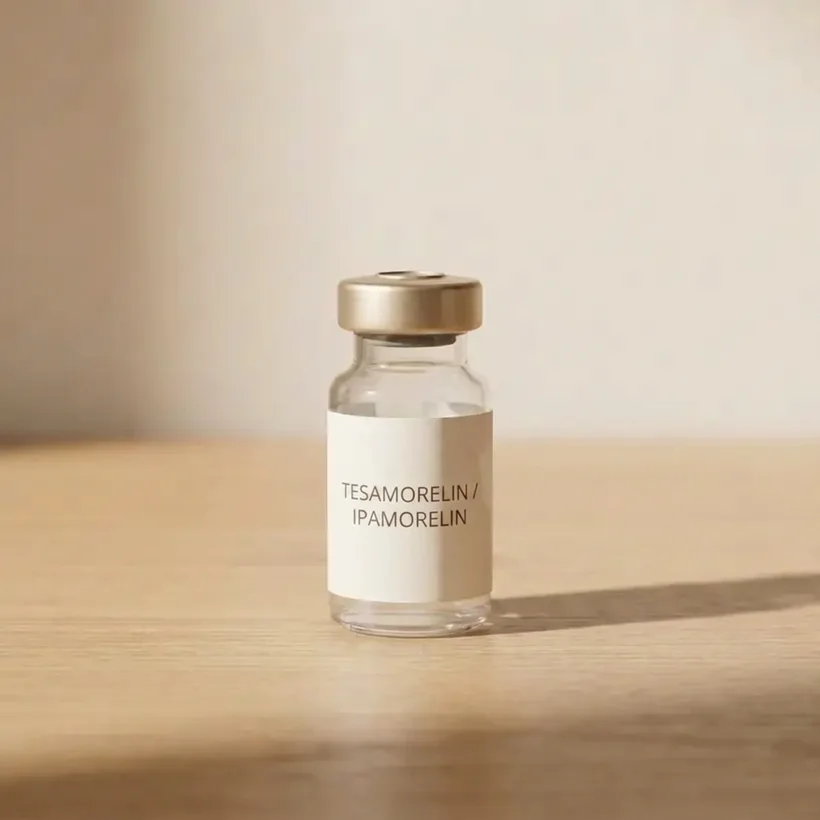
From the FormBlends catalog
Tesamorelin / Ipamorelin Blend
Growth-hormone pathway support in one blend · From $299/mo · compounded by a licensed 503A pharmacy, dispensed only after provider review.
View Tesamorelin / Ipamorelin Blend →Claimed benefits in wellness and athletic contexts include increased lean body mass, reduced adiposity, improved recovery from training, and improved sleep quality. Most of these claims in healthy adults are extrapolated from GH-deficiency treatment literature or from small open-label studies, not from placebo-controlled trials in the target population. Understanding that gap is essential before evaluating the side effect trade-off.
What are the known ipamorelin side effects?
The following side effects have been reported across clinical trial data, published case series, and mechanism-consistent observations. They are not equally well evidenced.
- Injection-site reactions: Localized erythema, bruising, transient swelling, and mild pain at the subcutaneous injection site. Common to all subcutaneous peptide injections, not ipamorelin-specific.
- Transient headache: Reported in a subset of users, particularly after first doses or at higher doses. Mechanism is likely related to acute GH pulse and associated vasodilation.
- Flushing and warmth: Consistent with acute GH secretion and transient vasodilation. Typically lasts minutes to under an hour.
- Nausea: More common at doses above roughly 200-300 mcg per injection or when injected without an appropriate fasting window. GHS-R1a activation has direct GI motility effects.
- Mild water retention: Mechanistically consistent with GH-mediated sodium and water reabsorption in the kidney. Typically most notable in early weeks and less pronounced than with exogenous rhGH.
- Fatigue or sedation: Reported by a minority of users, particularly with evening dosing. May relate to GH-associated effects on sleep architecture or simple injection fatigue.
- Hypoglycemia risk: GH is counter-regulatory to insulin in the fasting state, but acute GH pulses can transiently lower blood glucose in some individuals. The magnitude is generally small at ipamorelin doses used clinically, but diabetic patients represent a meaningful caution.
- IGF-1 elevation: A pharmacodynamic effect, not a side effect in isolation, but chronically elevated IGF-1 carries theoretical proliferative risk (see long-term section).
What ipamorelin does NOT reliably cause (unlike related peptides): Significant cortisol elevation, prolactin elevation, or hunger stimulation at standard doses. This receptor selectivity is well characterized in the literature and is one of ipamorelin's primary pharmacological selling points.
Evidence ledger: grading every major safety claim
| Claim | Best Evidence Type | Effect Direction | Confidence |
|---|---|---|---|
| Injection-site reactions occur | Clinical trial adverse event reporting (Phase I/II trials, Novo Nordisk era) | Confirmed present | Moderate |
| Ipamorelin does not stimulate cortisol/ACTH at standard doses | In vitro rat pituitary cell studies; human pharmacology studies from Bowers et al. lineage | Selectivity confirmed vs. GHRP-2, GHRP-6 | Moderate |
| Ipamorelin does not stimulate prolactin at standard doses | Same pituitary selectivity studies | No significant prolactin elevation | Moderate |
| Headache and flushing at higher doses | Mechanism-consistent; reported in clinical observations; no dedicated RCT quantifying incidence rate | Present, dose-related | Low |
| Water retention, mild edema | GH mechanism known; ipamorelin-specific human incidence data sparse | Present at higher doses/early use | Low |
| Long-term IGF-1 elevation increases proliferative risk | Mechanistic inference from GH/IGF-1 biology; no ipamorelin-specific oncology RCT | Theoretically plausible | Very Low |
| Pituitary desensitization with continuous dosing | Receptor biology; animal models; no human long-term ipamorelin data | Possible with non-pulsatile protocols | Very Low |
| Ipamorelin causes lean mass gain in healthy adults | Extrapolation from GH-deficiency literature; small open-label wellness data | Probably positive, magnitude unclear | Low |
| Research-chemical purity variance causes unpredictable dosing | Independent COA testing reports; peptide vendor audits published by harm-reduction communities | Significant real-world variance confirmed | Moderate |
Mechanism with numbers: why ipamorelin side effects happen
GHS-R1a receptor activation: Ipamorelin binds GHS-R1a with high affinity. Receptor activation in somatotrophs triggers intracellular calcium release via Gq-coupled signaling, causing rapid GH exocytosis. The resulting GH pulse is the proximate cause of most acute side effects: vasodilation (flushing, headache), renal sodium retention (water retention), and transient glucose counterregulation.
Why ipamorelin is selective: Older GHRPs (GHRP-2, GHRP-6) co-activate ACTH and prolactin release at pharmacologic doses. Ipamorelin's structural modifications, particularly the introduction of D-2-naphthylalanine at position 3, shift receptor binding toward GH-specific pituitary signaling pathways while reducing off-target activity at corticotrophs. Quantitative comparisons in published pituitary cell studies (Raun et al., 1998, European Journal of Endocrinology) demonstrated GH release with ipamorelin comparable to GHRP-6 but with significantly attenuated ACTH and cortisol response. This is real published pharmacology, not marketing language.
What that mechanism does NOT prove: Selectivity in cell assays and short-term pharmacology studies does not guarantee safety over months or years of use. The selectivity data also came from animal studies and early-phase human pharmacology work, not from powered safety trials.
Dose-response relationship: Published studies used doses ranging from roughly 1 to 100 mcg/kg. Clinical wellness protocols commonly use flat doses of 100-300 mcg per injection, 1-3 times daily. Side effect frequency and intensity are generally dose-related, with flushing and headache more common at higher single doses. Fasting before injection amplifies GH response, which may also amplify side effects.
Half-life and duration: Ipamorelin has a short plasma half-life, estimated at roughly 2 hours in published pharmacokinetic data, producing a discrete GH pulse rather than sustained elevation. This pulsatile pattern is considered physiologically safer than continuous GH stimulation because it more closely mimics endogenous secretion.
CJC-1295 ipamorelin side effects: does the combination change the risk profile?
CJC-1295 is a GHRH analogue that acts at the pituitary GHRH receptor, a completely different receptor from ipamorelin's GHS-R1a target. The combination is used because GHRH and GHS act synergistically, producing GH pulses substantially larger than either agent alone.
Important distinction within CJC-1295: There are two chemically distinct compounds sold under or near this name.
- CJC-1295 without DAC (Mod GRF 1-29): Half-life of roughly 30 minutes. Produces a discrete GH pulse when combined with ipamorelin. Side effect profile is broadly similar to ipamorelin alone but with enhanced GH peak amplitude.
- CJC-1295 with DAC: Drug Affinity Complex covalently binds the peptide to albumin, extending half-life to roughly 6-8 days. This creates sustained GHRH signaling and continuous IGF-1 elevation rather than pulsatile release. The side effect implications are materially different: more persistent water retention, theoretical greater concern for tachyphylaxis, and a longer window of elevated IGF-1.
No head-to-head RCT compares CJC-1295 plus ipamorelin to ipamorelin monotherapy on adverse event incidence. The combination side effect profile is an inference from the additive GH effect and the known pharmacology of each component. The practical upshot: the combination likely amplifies all GH-related side effects proportionally to the larger GH response it generates.
What are the ipamorelin long-term side effects?
This is where honesty requires acknowledging a fundamental data gap. There are no published, peer-reviewed, long-term (greater than 6 months) controlled safety studies of ipamorelin in humans. Every "long-term side effect" claim in either direction is extrapolated from adjacent science.
Mechanistically plausible long-term concerns:
- Supraphysiologic IGF-1 and proliferative risk: Chronic elevation of IGF-1 above the physiologic range is associated in epidemiologic literature with modestly increased risk of certain cancers (notably prostate and colorectal). This is a class concern for all GH-secretagogues, not ipamorelin-specific. The mechanistic pathway is real; whether ipamorelin doses used clinically produce supraphysiologic IGF-1 in any given individual depends on their baseline GH axis tone, dose, and protocol duration.
- Pituitary receptor downregulation: Continuous or very frequent GHS-R1a stimulation could theoretically cause receptor desensitization, reducing endogenous GH pulsatility. Pulsatile dosing protocols (not continuous infusion) are partly designed to mitigate this, but human evidence is absent.
- Glucose metabolism: Chronic GH elevation can induce insulin resistance. In metabolically healthy individuals at clinical doses this is likely modest; in pre-diabetic or insulin-resistant individuals it represents a more meaningful concern.
The honest caveat: "Long-term safety has not been established" is not a euphemism here. It is the accurate state of the evidence. Absence of evidence for harm is not evidence of safety, particularly when the mechanism biology gives credible reasons for concern.
What most pages get wrong about ipamorelin safety
1. Purity and concentration variance in research-chemical sources. Most commodity articles evaluate ipamorelin as if the dose stated on the vial is the dose being injected. Independent third-party analyses of peptide vendor products (reviewed periodically by harm-reduction communities and tested via mass spectrometry) have found concentration variances of 20-50% from labeled content, and occasional identification of undeclared compounds or bacterial endotoxins in improperly manufactured lyophilized peptides. A "200 mcg" injection from an unregulated source may deliver 110 mcg or 300 mcg. This dosing uncertainty makes every side effect incidence estimate from controlled studies difficult to apply in practice.
2. The CJC-1295 with DAC vs. without DAC conflation. Many articles treat these as the same compound. The sustained half-life of the DAC formulation creates a fundamentally different hormonal environment. Listing their side effects as identical is pharmacologically incorrect and matters clinically.
3. Reconstitution errors as a safety issue. Ipamorelin is supplied as a lyophilized powder. Reconstitution with incorrect volumes is a common user error that can result in dramatically over- or under-dosed injections. A 5 mg vial reconstituted with 2.5 mL bacteriostatic water yields 2,000 mcg/mL; with 5 mL it yields 1,000 mcg/mL. Confusion here is clinically meaningful.
4. Treating selectivity as equivalent to safety. Ipamorelin's cortisol- and prolactin-sparing profile is genuine and is a real advantage over GHRP-2 and GHRP-6. But this selectivity data is from short-term studies. It says nothing about long-term IGF-1 accumulation, proliferative risk, or metabolic effects from chronic GH stimulation. The clean short-term profile does not extrapolate to proven long-term safety.
Honest head-to-head: ipamorelin vs. alternatives
| Attribute | Ipamorelin | Sermorelin | GHRP-6 | rhGH (Exogenous) |
|---|---|---|---|---|
| Mechanism | GHS-R1a agonist (ghrelin receptor) | GHRH receptor agonist | GHS-R1a agonist | Direct GH receptor agonist |
| GH pulse type | Pulsatile, physiologic-ish | Pulsatile, physiologic | Pulsatile but strong | Continuous, supraphysiologic |
| Cortisol/ACTH stimulation | Minimal (advantage) | Minimal | Significant (disadvantage) | Indirect only |
| Hunger stimulation | Minimal | Minimal | Significant (ghrelin-like effect) | None direct |
| Regulatory status (US) | Not FDA-approved; research compound | Previously FDA-approved; now compounded only in some formulations | Not FDA-approved; research compound | FDA-approved for specific indications |
| Human long-term safety data | Absent | Limited but more than ipamorelin | Absent | Substantial (in approved indications) |
| Water retention | Mild, transient | Mild, transient | Mild to moderate | Significant at supraphysiologic doses |
| Where ipamorelin loses | -- | Sermorelin has more human trial data and prior regulatory approval | GHRP-6 produces a larger GH pulse if peak amplitude is the goal | rhGH has defined dosing, pharmaceutical purity, and outcome data in deficiency |
Ipamorelin's genuine advantages are its selectivity profile and its pulsatile GH pattern. Where it loses to approved alternatives is on regulatory oversight, pharmaceutical-grade purity guarantees, and depth of long-term human safety evidence. That trade-off should be stated plainly.
Operational and label literacy: reading a COA and a protocol
What a legitimate COA for ipamorelin should show:
- Identity confirmation by HPLC and/or mass spectrometry (not just UV absorbance alone)
- Purity stated as a percentage, with a threshold typically above 98% for research-grade material
- Bacterial endotoxin testing (LAL test), reported in EU/mL or EU/mg; absence of this test is a red flag for subcutaneous use
- Lot number traceable to the specific batch being supplied
- Sterility testing if supplied in solution form (lyophilized powder with bacteriostatic water for reconstitution is the more stable format)
Reconstitution math: Standard vials are 2 mg (2,000 mcg) or 5 mg (5,000 mcg). Adding 2 mL of bacteriostatic water to a 2 mg vial yields 1,000 mcg/mL. A 200 mcg dose would then be 0.2 mL on a 1 mL insulin syringe. Confirm this calculation before every batch reconstitution because vial sizes vary by supplier.
What degraded ipamorelin looks like: Lyophilized powder should be white to off-white and form a compact cake. Yellowing, visible particulates after reconstitution, or a strong unusual odor suggest degradation or contamination. Reconstituted peptide should be stored refrigerated (2-8 degrees C) and used within 4 weeks; peptide bonds in solution undergo hydrolysis faster at room temperature, particularly at non-neutral pH. Bacteriostatic water (0.9% benzyl alcohol) extends stability in solution compared to plain sterile water by inhibiting microbial growth, but does not stop chemical degradation.
Why the "store cold" rule exists at the chemistry level: Peptide hydrolysis (cleavage of amide bonds) follows Arrhenius kinetics: every 10-degree Celsius rise in temperature roughly doubles the reaction rate. Ipamorelin's pentapeptide backbone is not unusually labile, but in aqueous solution at room temperature, measurable degradation accrues over days to weeks. Lyophilized powder is far more stable because water is required as a reactant in hydrolysis. This is why opening a vial and drawing air repeatedly introduces moisture and accelerates the degradation clock.
Monitoring if using under medical supervision: Minimum baseline labs before starting any GH-secretagogue protocol should include IGF-1, fasting glucose, and HbA1c. Periodic IGF-1 monitoring (every 3-6 months) allows dose adjustment to keep IGF-1 within the age-appropriate physiologic range rather than supra-physiologic, which is the most operationally actionable safety measure available.
Frequently Asked Questions
What are the most common ipamorelin side effects?
The most consistently reported side effects are injection-site reactions (redness, bruising, mild pain), transient headache, flushing, and nausea, particularly at first use or when doses exceed roughly 200-300 mcg. Water retention has been reported less frequently. These are largely mechanism-based effects of acute GH release.
Are CJC-1295 ipamorelin side effects worse than ipamorelin alone?
Combining CJC-1295 with ipamorelin amplifies GH pulse amplitude, which can intensify transient side effects like flushing, headache, and water retention. There is no human RCT directly comparing the combination to ipamorelin monotherapy on adverse event rates, so this is based on mechanism inference and case-series reports.
What are the long-term side effects of ipamorelin?
Long-term human safety data for ipamorelin is essentially absent from the published literature. Theoretical long-term concerns include IGF-1 elevation and associated proliferative risk, cortisol or prolactin changes (less likely with ipamorelin than older GHRPs), and potential for pituitary desensitization with continuous dosing. These remain mechanistic concerns, not proven outcomes.
Is CJC-1295 ipamorelin safe?
Neither compound is FDA-approved for general use. Short-term tolerability data from small studies and Phase I/II trials suggests an acceptable acute safety profile at studied doses. Long-term safety has not been established in humans. Both compounds are research chemicals in most jurisdictions, meaning purity and dosing consistency are not guaranteed outside pharmaceutical-grade manufacturing.
Does ipamorelin raise cortisol or prolactin?
This is one of ipamorelin's key pharmacological distinctions. Published receptor selectivity data shows ipamorelin does not meaningfully stimulate ACTH/cortisol or prolactin release at standard GH-releasing doses, unlike GHRP-2 and GHRP-6. This selectivity was characterized in pituitary cell studies including Raun et al. (1998) and is one reason ipamorelin is considered a cleaner GHRP.
Can ipamorelin cause cancer or tumor growth?
Supraphysiologic IGF-1 elevation is mechanistically linked to proliferative risk, and this concern applies to any agent that chronically elevates GH and IGF-1. No human trial has demonstrated ipamorelin causing tumor growth, but there are also no long-term oncology safety studies. People with active malignancy or strong family history of hormone-sensitive cancers are typically excluded from protocols.
What does ipamorelin actually do, and what are its claimed benefits?
Ipamorelin is a synthetic pentapeptide GHRP that binds the ghrelin receptor (GHS-R1a) in the pituitary and hypothalamus to trigger pulsatile GH release. Claimed benefits include increased lean mass, reduced body fat, improved recovery, and better sleep quality. Evidence for most of these benefits in healthy adults is limited to small studies, animal data, or extrapolation from GH-deficiency literature.
What injection-site reactions does ipamorelin cause?
Subcutaneous injection of ipamorelin can cause localized erythema, mild edema, bruising, and transient discomfort. These reactions are not unique to ipamorelin and are common to subcutaneous peptide injection generally. Rotating injection sites and using appropriate needle gauge (typically 29-31G) reduces frequency and severity.
How does ipamorelin compare to sermorelin for side effects?
Sermorelin acts via the GHRH receptor rather than the ghrelin receptor, producing a more physiologic GH pulse with less peak amplitude at equivalent doses. Side effect profiles are broadly similar. Sermorelin has more published human clinical data and has held FDA-approved status in specific formulations, giving it a regulatory advantage in terms of documented safety.
What side effects are specific to the CJC-1295 with DAC formulation?
CJC-1295 with Drug Affinity Complex (DAC) has a half-life of roughly 6-8 days due to albumin binding, producing sustained GH elevation rather than pulsatile release. This changes the side effect profile: prolonged water retention, persistent fatigue, and a higher theoretical concern for tachyphylaxis or continuous IGF-1 elevation compared to the shorter-acting CJC-1295 without DAC (Mod GRF 1-29).
Can ipamorelin be used safely without a physician?
Self-administering ipamorelin without medical supervision carries meaningful risks: no baseline IGF-1 or pituitary function assessment, no monitoring for emerging side effects, uncertain product purity from research chemical suppliers, and no guidance on contraindications. A baseline IGF-1 level and periodic monitoring are the minimum reasonable safety measures for anyone using GH-secretagogues.
Does ipamorelin cause water retention?
Mild water retention can occur and is mechanistically consistent with GH-mediated sodium and water reabsorption. It is typically transient, most noticeable in early weeks of use, and less pronounced with ipamorelin than with exogenous recombinant human GH. Reducing dose or cycling off generally resolves it.
Sources
- Raun K, Hansen BS, Johansen NL, et al. Ipamorelin, the first selective growth hormone secretagogue. European Journal of Endocrinology. 1998;139(5):552-561.
- Bowers CY. Growth hormone-releasing peptide (GHRP). Cellular and Molecular Life Sciences. 1998;54(12):1316-1329.
- Sackmann-Sala L, Ding J, Frohman LA, Kopchick JJ. Activation of the GH/IGF-1 axis by CJC-1295, a long-acting GHRH analog, results in serum protein profile changes in normal adult subjects. Growth Hormone and IGF Research. 2009;19(6):471-477.
- Teichman SL, Neale A, Lawrence B, et al. Prolonged stimulation of growth hormone (GH) and insulin-like growth factor I secretion by CJC-1295, a long-acting analog of GH-releasing hormone. Journal of Clinical Endocrinology and Metabolism. 2006;91(3):799-805.
- Cordido F, Penalva A, Peino R,
Related peptide guides
Browse the full catalog →Ready when you are
Tesamorelin / Ipamorelin Blend
Growth-hormone pathway support in one blend · From $299/mo · compounded by a licensed 503A pharmacy, dispensed only after provider review.
View Tesamorelin / Ipamorelin Blend →