
Trust Signals
Every confidence rating in the evidence ledger is tied to the best available study design, not marketing materials. Where evidence is absent, we say so plainly. This page does not sell or recommend any specific product.
Regulatory note: Most peptides discussed below are not FDA-approved drugs. Bremelanotide (PT-141) is the single exception discussed here that carries full FDA approval.
Key Takeaways
- Bremelanotide (PT-141), the one FDA-approved sexual-health peptide, carries documented nausea in roughly 40% of users and a mean transient systolic blood pressure increase of approximately 6 mmHg, per its FDA prescribing label.
- GH-releasing peptides elevate IGF-1, which at sustained high doses is associated with insulin resistance; this effect is dose-dependent and most pronounced with continuous rather than pulsatile administration.
- Oral peptide supplements are mostly cleaved by gastrointestinal proteases before systemic absorption, which reduces pharmacological side effects but does not eliminate contamination or allergenicity risks.
- Libidon and similar Eastern European "bioregulator" peptides have no large peer-reviewed Western RCTs; specific adverse event rates cannot be stated with honest confidence.
- The high-risk payment processor classification for many peptide vendors is a direct proxy for reduced quality control and absent mandatory third-party testing, which is itself a safety concern independent of the peptide's pharmacology.
Direct Answer: What Are Peptides Side Effects in Men and Women?
Peptides side effects in men include injection-site reactions, transient water retention, cortisol and prolactin spikes from GHRPs, and central side effects (nausea, flushing, blood pressure changes) from melanocortin-based sexual health peptides. In women, bremelanotide's nausea rate near 40% is the best-documented risk. Evidence quality varies enormously by peptide class, route, and dose.
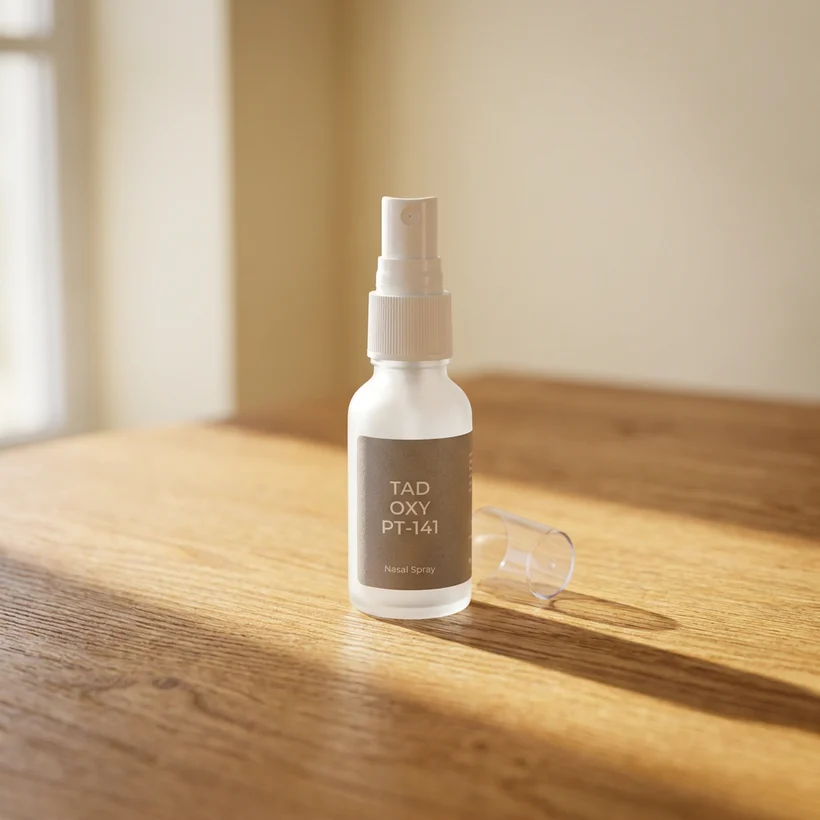
From the FormBlends catalog
Tadalafil/Oxytocin/PT-141 Nasal Spray
Nasal sexual wellness combination reviewed for provider-directed use · From $179/mo · compounded by a licensed 503A pharmacy, dispensed only after provider review.
View Tadalafil/Oxytocin/PT-141 Nasal Spray →Table of Contents
- Evidence Ledger: Side Effect Claims Graded by Study Quality
- Mechanism with Numbers: How Peptides Produce Side Effects
- Peptides Side Effects in Men: What the Data Shows
- Are Peptides Safe for Women? Sex-Specific Risks
- Are Peptide Supplements Safe? Oral vs. Injectable Risk Profiles
- Fragment Peptide Side Effects: AOD-9604 and Related Compounds
- Libidon Peptide Side Effects: Honest Assessment of a Thin Evidence Base
- What Most Pages Get Wrong: Sourcing, Purity, and the High-Risk Payment Processor Signal
- Honest Head-to-Head: Peptides vs. Approved Alternatives for Sexual Health
- Operational and Label Literacy: How to Read a COA and Spot a Degraded Product
- Frequently Asked Questions
- Sources
Evidence Ledger: Side Effect Claims Graded by Study Quality
The table below grades each major safety claim by the best available evidence type. Read this before any other section.
| Claim | Best Evidence Type | Effect Direction | Confidence |
|---|---|---|---|
| Bremelanotide causes nausea in a substantial portion of users (approx. 40%) | Human RCT (Phase III, FDA label basis) | Confirmed harm | High |
| Bremelanotide transiently raises blood pressure (mean approx. 6 mmHg systolic) | Human RCT, FDA prescribing information | Confirmed harm, transient | High |
| GHRPs acutely elevate cortisol and prolactin in humans | Multiple small human pharmacokinetic studies | Confirmed, dose-dependent | Moderate |
| Sustained IGF-1 elevation from GH-releasing peptides causes insulin resistance | Mechanistic extrapolation from GH replacement literature; no GHRP-specific RCT | Plausible at high dose | Low |
| AOD-9604 (GH fragment) causes headache and injection-site reactions | Phase II/III trials (halted); limited published data | Probable mild adverse events | Low |
| Libidon causes specific adverse events at reported rates | Small, non-peer-reviewed Eastern European studies only | Unknown | Very Low |
| Oral peptide supplements produce systemic pharmacological side effects | Mechanistic (protease degradation); no RCT evidence of harm | Unlikely for intact peptide pharmacology | Moderate |
| Contaminated or mislabeled research peptides pose safety risk | Regulatory seizure records, compounding pharmacy literature | Confirmed category-level risk | High |
Mechanism with Numbers: How Peptides Produce Side Effects
Peptide side effects almost always trace to receptor cross-reactivity, off-target pituitary stimulation, or delivery-related tissue injury. Understanding the mechanism lets you predict risk rather than memorize a list.
Melanocortin receptor activation (PT-141). Bremelanotide is a cyclic heptapeptide that binds MC1R, MC3R, MC4R, and MC5R. Its sexual-arousal effect comes primarily from MC4R agonism in the hypothalamus. Nausea and flushing arise from MC1R and MC3R activity in peripheral tissues and the area postrema. The blood pressure transient is mediated through MC4R-driven sympathetic outflow and is measurable within an hour of subcutaneous administration. The FDA label reports a mean increase of approximately 6 mmHg systolic and approximately 3 mmHg diastolic, returning to baseline within approximately 12 hours. This is a real cardiovascular signal, not a theoretical one.
GHRP pituitary stimulation. Growth hormone releasing peptides (GHRP-2, GHRP-6, hexarelin, ipamorelin) bind the ghrelin receptor (GHS-R1a) in the pituitary and hypothalamus, triggering a pulsatile GH release that peaks roughly 15 to 30 minutes after injection. The secondary cascade raises IGF-1 over days of repeated dosing. GHRP-6 and GHRP-2 are less selective than ipamorelin: they also stimulate ACTH (raising cortisol) and prolactin release through partial cross-reactivity at non-GHS receptor sites. Ipamorelin's selectivity advantage is based on in vitro receptor binding studies and supported by small human pharmacokinetic comparisons, but a head-to-head RCT at identical doses in a large sample does not exist.
What the mechanism does NOT prove. Receptor agonism data from cell assays or rodent studies does not directly predict the magnitude of side effects in a human at a given clinical dose. The IGF-1 to insulin resistance pathway is well established for acromegaly-level GH excess; whether the smaller IGF-1 increments from GHRP dosing cross the threshold for metabolic harm in healthy adults is genuinely unknown. Do not treat a plausible mechanism as a confirmed outcome.
Peptides Side Effects in Men: What the Data Shows
Men seeking peptides for sexual health, body composition, or recovery face different risk profiles depending on the compound class.
Sexual health peptides (PT-141 / bremelanotide). While the FDA approval is specifically for premenopausal women with HSDD, PT-141 is widely used off-label in men for erectile function and libido. The same nausea and blood pressure signals documented in women's trials are pharmacologically expected in men via identical receptor pathways. No large male-specific RCT exists, so the exact nausea rate in men cannot be stated with confidence, but the mechanism is unchanged.
GH-axis peptides. Common side effects documented in small human studies include water retention (due to GH-driven renal sodium reabsorption), carpal tunnel-like paresthesias at high doses (a known side effect of GH excess), and injection-site nodules with repeated subcutaneous injections. Gynecomastia has been anecdotally reported but is not mechanistically direct; it would require prolactin elevation sustained enough to alter breast tissue, which is more likely with GHRP-2 or GHRP-6 than with selective compounds like ipamorelin or CJC-1295.
Hypoglycemia risk. GHRPs acutely raise GH, which is counter-regulatory to insulin. However, the downstream cortisol spike from less-selective GHRPs can cause rebound hypoglycemia in sensitive individuals, particularly when peptides are used without food. This is a real but understudied risk.
Are Peptides Safe for Women? Sex-Specific Risks
The honest answer is that evidence in women is thinner than in men for almost every peptide class except bremelanotide.
Bremelanotide in women: known risks. The FDA approved bremelanotide (Vyleesi) in 2019 specifically for premenopausal women with acquired, generalized HSDD. Phase III trial data, pooled across the two RECONNECT studies, showed nausea in approximately 40% of participants, flushing in roughly 20%, and headache in a smaller proportion. These are per-dose rates with subcutaneous administration. The label carries a contraindication in women with cardiovascular or cerebrovascular disease because of the blood pressure transient.
GH-releasing peptides in women. GH secretion is already higher in premenopausal women than in age-matched men (due to estrogen's enhancement of GH pulse amplitude). Layering a GHRP on this baseline could produce larger IGF-1 increments than in men at identical doses, but this has not been studied systematically. Hormonal interactions with menstrual cycle phase, particularly around the LH surge and changes in estradiol, are entirely uncharacterized for most research peptides.
Pregnancy and lactation. No research peptides carry safety data for pregnancy or lactation. This is an absolute evidence gap, not a mild caution.
Are Peptide Supplements Safe? Oral vs. Injectable Risk Profiles
The phrase "peptide supplement" covers a wide range of products, from collagen hydrolysates to proprietary blends marketed for libido or recovery. Their risk profile differs fundamentally from injectable research peptides.
The bioavailability barrier. Peptide bonds are substrates for gastrointestinal proteases (pepsin in the stomach, trypsin and chymotrypsin in the small intestine). Most peptides longer than two or three amino acids are cleaved into constituent amino acids before reaching the portal circulation. Di- and tripeptides can be absorbed intact via the PepT1 transporter, but larger sequences are not absorbed intact in meaningful quantities under normal conditions. This means oral peptide supplements are unlikely to produce the same systemic pharmacological effects as injected versions, which also means their systemic side-effect risk is lower.
Where oral supplements do carry risk. Contamination (heavy metals, undisclosed stimulants, microbiological load) is the primary category risk. The absence of FDA manufacturing oversight for supplements means label accuracy is not guaranteed. Collagen hydrolysates are generally well tolerated, but allergenic reactions to marine-source collagen (fish or shellfish-derived) are documented. Anyone with a known seafood allergy should verify the source of any collagen-based supplement.
Fragment Peptide Side Effects: AOD-9604 and Related Compounds
Fragment peptides are truncated sequences derived from larger proteins, designed to isolate a specific bioactivity while discarding parts responsible for unwanted effects.
AOD-9604. This is amino acids 176 to 191 of human growth hormone, the fragment associated with lipolytic activity. It was developed by Metabolic Pharmaceuticals and reached Phase III trials for obesity before development was discontinued. Published trial data (Heffernan et al. and related Metabolic Pharmaceuticals-sponsored work) reported the compound was well tolerated with adverse events primarily consisting of headache and injection-site reactions. Critically, AOD-9604 does not appear to raise IGF-1 or produce insulin resistance at doses studied, which is the specific design intent of isolating the fat-mobilizing fragment from the growth-promoting portion of GH. However, the absence of IGF-1 elevation is based on short-term trial data. Long-term safety (beyond weeks of dosing) in humans has not been published in a form this review can verify with confidence.
What "fragment" does NOT mean. A fragment peptide is not inherently safer than a full-length peptide. It is different. Fragments can have their own off-target binding profiles. The assumption that smaller equals safer is not chemically warranted.
Libidon Peptide Side Effects: Honest Assessment of a Thin Evidence Base
Libidon is a synthetic tripeptide (Lys-Glu-Asp, sometimes written as KED) promoted as a prostate bioregulator. It originates from Russian research into cytomax peptide bioregulators, a field with a particular publication pattern: much of the evidence appears in Russian-language journals or publications from the St. Petersburg Institute of Bioregulation and Gerontology, with limited representation in Western peer-reviewed databases.
What can be said honestly. The mechanistic rationale involves interaction with prostate-specific gene expression via short peptide-DNA binding, a plausible but not proven pathway for short peptides in the KED range. No large, randomized, placebo-controlled trial with predefined adverse event reporting has been published in a journal indexed in PubMed with a sample size and methodology this review can confirm. Therefore, specific side-effect rates for libidon cannot be stated with any confidence. The absence of reported harm in small studies is not the same as demonstrated safety.
What Most Pages Get Wrong: Sourcing, Purity, and the High-Risk Payment Processor Signal
This is the section commodity peptide pages omit entirely.
High-risk payment processors as a safety signal. When a peptide vendor is routed through a high-risk merchant processor (common in the research chemical and peptide supply space), it signals that mainstream acquiring banks have declined them. Banks decline vendors in this category for several reasons: chargeback history, regulatory gray-zone classification, or the nature of the product itself. The regulatory classification problem is real: most injectable research peptides are not FDA-approved drugs, not legal dietary supplements, and not veterinary products. They exist in a gap that means no mandatory good manufacturing practice (GMP) compliance, no required third-party testing, and no batch recall infrastructure. A vendor in this payment category may produce excellent products, but the lack of regulatory scaffolding means the buyer cannot assume quality. The practical consequence is that the product you inject could contain the stated compound at a fraction of the labeled dose, a different peptide entirely, bacterial endotoxins from non-sterile synthesis, or residual organic solvents from the synthesis process. These are not theoretical risks; regulatory seizure records and third-party independent testing of commercial research peptide lots have documented purity failures in this space.
Endotoxin contamination. Injectable research peptides that are not synthesized under sterile conditions and tested with the Limulus Amebocyte Lysate (LAL) assay can contain bacterial endotoxin. Endotoxin injection causes fever, chills, rigors, and in severe cases septic-shock-like responses. This side effect has nothing to do with the peptide's pharmacology and everything to do with manufacturing hygiene. It is the single most underappreciated risk in the self-administered research peptide space.
Reconstitution errors. Lyophilized peptides are reconstituted with bacteriostatic water (preferred for multi-use vials because benzyl alcohol inhibits microbial growth) or sterile water (single use only). Using tap water or non-sterile diluents introduces microbial contamination at the point of preparation, regardless of the peptide's original purity.
Honest Head-to-Head: Peptides vs. Approved Alternatives for Sexual Health
The table below compares peptide-based options against established approved medications for sexual health. It concedes where peptides lose.
| Factor | PT-141 (Bremelanotide) | PDE5 Inhibitors (Sildenafil / Tadalafil) | Testosterone Therapy (men) |
|---|---|---|---|
| Regulatory status | FDA-approved (women); off-label for men | FDA-approved (men and women) | FDA-approved (men with hypogonadism) |
| Evidence base volume | Phase III in women; limited in men | Decades of large RCTs and post-market data | Decades of RCTs and endocrine society guidelines |
| Primary mechanism | Central (MC4R hypothalamic) | Peripheral (cGMP-mediated vasodilation) | Hormonal (androgen receptor) |
| Nitrate interaction risk | Not contraindicated with nitrates | Absolute contraindication with nitrates | No direct nitrate interaction |
| Most common side effect | Nausea approx. 40% | Headache / flushing approx. 10 to 16% | Erythrocytosis, acne, infertility |
| Works without sexual stimulus | No (requires desire/arousal context) | No (requires physical stimulation) | Acts on libido, not acute erection mechanism |
| Where peptide wins | For nitrate users who cannot use PDE5i; central desire augmentation | N/A | N/A |
| Where peptide loses | Nausea rate is higher; less evidence in men; requires injection | Oral convenience; vastly more safety data | Established dosing algorithms; lab monitoring standard |
Operational and Label Literacy: How to Read a COA and Spot a Degraded Product
If you are evaluating a peptide product, the certificate of analysis is the primary document. Here is what to look for and what the absence of each item means.
| COA Element | What to Look For | Why It Matters |
|---|---|---|
| HPLC purity | Above 98% for research-grade compounds | Below this threshold, unknown impurities are present in pharmacologically meaningful amounts |
| Mass spectrometry | Measured molecular weight matching theoretical MW | Confirms the peptide sequence is correct; detects substitutions or truncations |
| Residual solvents | Tested to ICH Q3C limits (acetonitrile, TFA, DMF) | Synthesis uses organic solvents that are toxic at high residual levels |
| Endotoxin (LAL test) | Below 1 EU/mg for injectable applications | Missing this test means bacterial contamination risk is uncharacterized |
| Microbial testing | Absent for total aerobic count, yeast, mold | Especially critical if the lyophilized product was opened or stored improperly |
| Independent lab | Third-party lab name visible, not "in-house" | Self-reported COAs have no verification value |
Visual signs of degradation. Legitimate lyophilized peptides present as a white to off-white powder. After reconstitution with appropriate diluent, the solution should be clear and colorless. Yellow discoloration, cloudiness, or visible particles indicate oxidation, aggregation, or contamination. A faint ammonia odor suggests protein decomposition. Discard any reconstituted peptide that does not meet these visual criteria before injection.
Storage chemistry (why cold matters). Peptide bonds are susceptible to hydrolysis, and the reaction rate increases sharply with temperature and moisture. Lyophilized (freeze-dried) peptides are stable at room temperature for short periods because removing water from the system slows hydrolysis. Once reconstituted, water reintroduces the hydrolysis substrate, making refrigeration (2 to 8 degrees Celsius) necessary. Repeated freeze-thaw cycles create mechanical stress that can disrupt disulfide bonds and promote aggregation in cyclic peptides like bremelanotide. This is not a speculation; it follows from standard physical chemistry of amide bond stability. If a vendor does not include cold-chain shipping for reconstituted or aqueous peptide products, that is a formulation quality signal, not just a logistics preference.
Frequently Asked Questions
The most commonly reported side effects in men using injectable research peptides include injection-site reactions (redness, bruising, nodules), transient water retention, mild hypoglycemia with GH-releasing peptides, and dose-dependent increases in prolactin or cortisol. Sexual-health peptides such as PT-141 (bremelanotide) carry specific risks including nausea, flushing, and transient blood pressure elevation.
Evidence is thinner for women than men for most peptide classes. Bremelanotide (PT-141) is FDA-approved for premenopausal women with hypoactive sexual desire disorder, and its label documents nausea in roughly 40% of users and transient blood pressure elevation. GH-releasing peptides have not been studied in women at the same scale as men, and hormonal interactions with estrogen and progesterone cycling are not well characterized. Caution and medical oversight are warranted.
Oral peptide supplements face a fundamental bioavailability problem: most peptides are cleaved by gastrointestinal proteases before reaching systemic circulation. This makes them less effective but also means systemic side effects are less likely. The main safety risk with oral peptide supplements is label inaccuracy and contamination, not direct pharmacological harm.
AOD-9604 (a C-terminal fragment of human growth hormone) reached Phase III trials for obesity before development was halted. Common reported adverse events in those trials included headache and injection-site reactions. Its fat-mobilizing mechanism does not appear to carry the insulin-resistance or IGF-1 elevation risks of full-length GH, but long-term safety data in humans is absent.
Libidon is a short peptide (tripeptide Lys-Glu-Asp) marketed primarily in Eastern Europe as a prostate bioregulator. Human clinical data is limited to small Eastern European studies with minimal adverse event reporting. No large RCTs have been published in peer-reviewed Western journals. Specific side-effect rates cannot be stated with confidence given this evidence gap.
Peptides classified as research compounds sit in a regulatory gray zone: they are not FDA-approved drugs but are also not standard dietary supplements. Merchant processing banks categorize them as high-risk because of chargeback rates, regulatory uncertainty, and potential for misuse. This gray-zone status correlates directly with reduced quality control, no mandatory third-party testing, and inconsistent purity, all of which are real safety concerns for the end user.
GH-releasing peptides (GHRPs) stimulate pituitary release of growth hormone, which secondarily raises IGF-1. Elevated IGF-1 is associated with insulin resistance at high doses and carries a theoretical proliferative risk. Some GHRPs also acutely elevate cortisol and prolactin. These effects are dose-dependent and most pronounced with continuous rather than pulsatile use.
Legitimate lyophilized peptides are a white to off-white powder that reconstitutes to a clear, colorless solution. Yellow or cloudy reconstituted solution, visible particulate matter, or an ammonia-like odor are all signs of degradation or contamination. A certificate of analysis (COA) showing HPLC purity below 98% for a research compound warrants skepticism.
PDE5 inhibitors (sildenafil, tadalafil) have decades of safety data from large RCTs and post-marketing surveillance. PT-141 acts centrally via melanocortin receptors rather than vasodilating, so it does not carry the same risk of dangerous blood pressure drops with nitrates. However, PT-141's nausea rate of roughly 40% is higher than sildenafil's headache and flushing rate of approximately 10 to 16%, and its cardiovascular interaction profile is less fully characterized.
Yes, substantially. Injectable peptides bypass the gut and reach systemic circulation intact, producing pharmacological effects and systemic side effects. Oral peptide supplements are mostly degraded before absorption, limiting both effects and systemic risks. The risks with oral products are primarily contamination, mislabeling, and allergenicity from hydrolysate fractions, not direct peptide pharmacology.
For bremelanotide (PT-141), the FDA label documents nausea (roughly 40%), flushing (roughly 20%), headache, and transient increases in blood pressure averaging around 6 mmHg systolic. Use is contraindicated in women with cardiovascular disease. Hormonal peptide interactions during the menstrual cycle are not well studied for most research compounds.
A credible COA should include: HPLC purity (target above 98% for research compounds), mass spectr
Related peptide guides
Ready when you are
Tadalafil/Oxytocin/PT-141 Nasal Spray
Nasal sexual wellness combination reviewed for provider-directed use · From $179/mo · compounded by a licensed 503A pharmacy, dispensed only after provider review.
View Tadalafil/Oxytocin/PT-141 Nasal Spray →