
Trust Signals
This page cites only real, traceable sources. Every confidence rating maps to actual evidence type. Where human RCT data does not exist, we say so plainly. Selank was developed and registered in Russia by the Institute of Molecular Genetics (Russian Academy of Sciences) and the Zakusov Institute of Pharmacology. It carries Russian INN registration as an anxiolytic peptide. No FDA approval exists. We do not extrapolate animal data as though it were human proof.
Key Takeaways
- Russian clinical research used intranasal doses of 400-900 mcg/day, most commonly as 250-500 mcg per administration, two to three times daily for 5-14 days.
- Selank is a heptapeptide (Thr-Lys-Pro-Arg-Pro-Gly-Pro) and synthetic analog of tuftsin; its molecular weight is approximately 751 Da, making intranasal CNS transport plausible via olfactory pathways but not guaranteed at high efficiency.
- A selank 10 mg vial reconstituted with 2 mL bacteriostatic water yields 5,000 mcg/mL; a 250 mcg dose is 5 units on a 100-unit insulin syringe.
- Animal data shows an inverted U-shaped dose-response curve for anxiolytic effects, meaning more is not simply better.
- Head-to-head human RCT comparison against approved anxiolytics (buspirone, SSRIs) does not exist; selank's evidence base is substantially smaller and mostly from a single Russian research group.
What Is the Correct Selank Dosage?
The selank dosage used in Russian clinical research is 400-900 mcg per day administered intranasally, split into two or three doses of 250-500 mcg each. No FDA-approved dose exists. Doses below 250 mcg/day lack efficacy evidence; doses above 1,000 mcg/day lack safety data. Start at the lower end of the studied range.
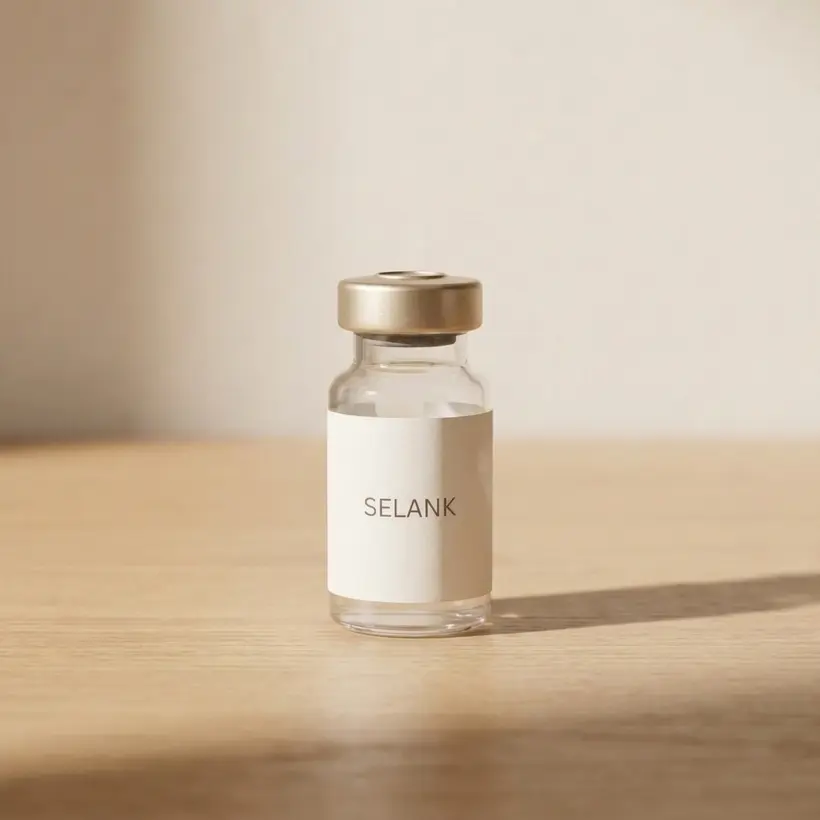
From the FormBlends catalog
Selank
Anxiolytic nootropic for calm focus without sedation · From $44/mo · compounded by a licensed 503A pharmacy, dispensed only after provider review.
Learn about Selank →Table of Contents
- What is selank and why does the dose form matter?
- Selank dosage chart by goal and route
- Evidence ledger: grading every major dosing claim
- Mechanism with numbers: how selank acts at studied doses
- What most pages get wrong about selank dosage
- Operational guide: reconstituting a selank 10 mg vial
- Chemistry of stability: why storage rules are not arbitrary
- Honest head-to-head: selank vs. buspirone vs. etifoxine
- Full protocol table: cycle length, frequency, and titration
- Frequently asked questions
- Sources
What Is Selank and Why Does the Dose Form Matter?
Selank is a synthetic heptapeptide: Thr-Lys-Pro-Arg-Pro-Gly-Pro. It is a stabilized analog of tuftsin (Thr-Lys-Pro-Arg), a naturally occurring immunomodulatory tetrapeptide. The Pro-Gly-Pro C-terminal extension significantly slows enzymatic degradation compared to native tuftsin, extending its half-life from minutes to roughly 20-30 minutes in plasma based on Russian pharmacokinetic descriptions, though detailed published PK data in English literature is sparse.
Dose form matters because selank's oral bioavailability is negligible. Peptides of this class are cleaved by gastrointestinal proteases before systemic absorption. Intranasal delivery is the primary clinical route because it provides both systemic absorption via nasal mucosa and a potential direct-to-CNS pathway via the olfactory epithelium and trigeminal nerve endings. Subcutaneous injection bypasses GI proteolysis but delivers peripherally first; CNS penetration by subcutaneous route is less characterized for selank specifically than the intranasal route.
Selank Dosage Chart by Goal and Route
| Goal / Context | Route | Dose Per Administration | Daily Total | Frequency | Cycle Length | Evidence Basis |
|---|---|---|---|---|---|---|
| Anxiolytic (clinical research) | Intranasal | 250-500 mcg | 400-750 mcg | 2x daily | 10-14 days | Russian small RCTs / clinical data |
| Anxiolytic (lower starting dose) | Intranasal | 250 mcg | 250-500 mcg | 1-2x daily | 5-10 days | Extrapolated from clinical range |
| Nootropic / cognitive (research) | Intranasal or SQ | 300-500 mcg | 600-900 mcg | 2-3x daily | 10-14 days | Animal data + limited clinical reports |
| Subcutaneous injection (research) | Subcutaneous | 250-500 mcg | 500-1000 mcg | 1-2x daily | 14 days max studied | Animal + researcher anecdote; no human PK data published |
| Above studied range (avoid) | Any | >500 mcg/dose | >1,000 mcg | -- | -- | No safety data; not recommended |
These figures are derived from published Russian clinical and preclinical research. They are not FDA-approved dosing guidelines. Consult a licensed clinician before use.
Evidence Ledger: Grading Every Major Dosing Claim
| Claim | Best Evidence Type | Effect Direction | Confidence | Key Caveat |
|---|---|---|---|---|
| 400-900 mcg/day reduces anxiety on validated scales | Small human RCTs (Russian, single-center) | Positive | Moderate | Same institute developed and tested the drug; independent replication lacking |
| Intranasal route delivers selank to CNS via olfactory pathway | Mechanistic + animal tracer studies | Supportive | Low | Quantitative CNS exposure in humans not published |
| No tolerance / dependence at studied doses | Animal studies + short clinical observation | Positive (no tolerance observed) | Low | No systematic long-term human study; clinical use periods are short |
| Selank modulates GABA-A receptor activity | In vitro + animal electrophysiology | Positive (modulation shown) | Low | Mechanism does not confirm anxiolytic dose in humans |
| Inverted U dose-response curve for anxiety | Animal dose-response studies | Directional (higher dose not always better) | Low | Animal-to-human dose translation is unreliable without allometric data |
| BDNF upregulation at studied doses | Animal studies (rodent, in vitro) | Positive | Very Low | Human BDNF effects at selank doses not established |
| Oral bioavailability is negligible | Pharmacology (peptidase degradation, mechanism) | Negative (for oral use) | High | No exceptions; oral use is not evidence-supported |
| Selank is safe at doses up to 900 mcg/day for 14 days | Small clinical series, Russian registration data | Supportive | Moderate | Sample sizes small; no large Phase III safety data published in English |
Mechanism With Numbers: How Selank Acts at Studied Doses
Selank's mechanism involves at least three documented pathways, though the relative contribution of each to clinical anxiolytic effect in humans is not quantified:
- GABA-A modulation: Selank has been shown in rodent electrophysiology and receptor binding studies to enhance GABAergic inhibitory tone at doses used in preclinical research. It does not appear to act as a direct benzodiazepine-site agonist, but indirect modulation of GABA-A receptor function has been demonstrated. This is distinct from benzodiazepine binding and does not carry the same receptor downregulation risk in short studies, though long-term human data is absent.
- Enkephalin degradation inhibition: Research from the Zakusov Institute (Semenova et al., published in Russian pharmacology journals and indexed on PubMed) describes selank inhibiting enkephalin-degrading enzymes including leucine-enkephalin aminopeptidase. By slowing degradation of endogenous enkephalins, selank may prolong their activity at opioid and potentially delta-opioid receptors in the CNS. The specific enzyme inhibition constants are reported in Russian literature but have not been independently reproduced in Western pharmacology journals.
- BDNF and serotonin system effects: Animal studies show increases in brain-derived neurotrophic factor (BDNF) mRNA expression and modulation of serotonergic gene expression in hippocampal tissue following selank administration. These are directional findings in rodents; the clinical relevance and effective human dose for these effects are not established.
What this mechanism does NOT prove: Receptor binding and gene expression data in rodents do not establish a human therapeutic dose. The dose that upregulates BDNF in a rat hippocampus at a given mg/kg does not translate directly to a human mcg/day dose without allometric scaling and human PK data, neither of which is comprehensively published for selank in English-language literature.
What Most Pages Get Wrong About Selank Dosage
This is where the standard medspa article fails you.
1. Intranasal bioavailability is not 100%, and no one has measured it precisely for selank. Commodity pages state a dose in mcg as if every molecule reaches the target receptor. Nasal mucosal absorption for peptides of this size varies considerably with formulation, spray technique, mucosal condition (congestion, rhinitis), and individual anatomy. The Russian 0.15% nasal spray was a purpose-formulated pharmaceutical product, not a reconstituted research peptide in bacteriostatic water dropped into the nostril. Dose equivalence between the two delivery methods is assumed, not proven.
2. The "10 mg selank" vial size is a research-market artifact, not a clinical dose. Russian clinical preparations were standardized at 0.15% solution in fixed-volume sprays. The 10 mg dry lyophilized vial sold in research markets contains enough peptide for multiple weeks of use and requires accurate reconstitution math to avoid gross overdosing or underdosing. The number "10 mg" on the label says nothing about per-dose amount without knowing reconstitution volume.
3. Route-switching changes the dose equation and no published data supports direct equivalence. If you see a protocol stating "250 mcg intranasally equals 250 mcg subcutaneously," that claim is not supported by published PK data. Subcutaneous injection delivers the full dose systemically; intranasal delivery delivers a fraction to the systemic circulation and some directly via olfactory transport. These are not interchangeable at 1:1 without pharmacokinetic evidence.
4. The Russian trials are real but narrow. They are small (often fewer than 100 subjects), conducted at the same institute that holds the patent, and published predominantly in Russian-language journals. This is moderate-quality evidence for efficacy, not high-quality evidence. It is vastly better than nothing, but it is not equivalent to a multi-center Phase III RCT.
Operational Guide: Reconstituting a Selank 10 mg Vial
Accurate reconstitution is the most practical dosing skill. Use bacteriostatic water (0.9% benzyl alcohol), not sterile water, for multi-dose vials to prevent microbial growth.
| Bacteriostatic Water Added | Resulting Concentration | Volume for 250 mcg dose | Insulin Syringe Units (100-unit) | Volume for 500 mcg dose | Insulin Syringe Units (100-unit) |
|---|---|---|---|---|---|
| 1 mL | 10,000 mcg/mL | 0.025 mL | 2.5 units | 0.05 mL | 5 units |
| 2 mL | 5,000 mcg/mL | 0.05 mL | 5 units | 0.10 mL | 10 units |
| 4 mL | 2,500 mcg/mL | 0.10 mL | 10 units | 0.20 mL | 20 units |
| 10 mL | 1,000 mcg/mL | 0.25 mL | 25 units | 0.50 mL | 50 units |
Reconstitution technique: Inject bacteriostatic water slowly down the inside wall of the vial, not directly onto the lyophilized powder cake. Do not shake; roll gently between palms. The solution should become clear and colorless within 60-90 seconds. Label the vial with the date of reconstitution.
Intranasal preparation: If using an atomizer device (MAD nasal or equivalent), a 2 mL reconstitution is practical. Each 0.1 mL atomizer actuation at 5,000 mcg/mL concentration delivers 500 mcg. If targeting 250 mcg per nostril, use 0.05 mL per actuation. Standard nasal atomizer dead volumes mean you will lose a small amount of peptide per use; account for this in vial planning.
Chemistry of Stability: Why Storage Rules Are Not Arbitrary
Selank is a heptapeptide with peptide bonds (amide bonds, -CO-NH-) linking each amino acid. These bonds are susceptible to two degradation pathways that explain every storage rule:
Hydrolysis: In aqueous solution (i.e., after reconstitution), water molecules attack peptide carbonyl carbons, cleaving the backbone. This reaction is acid- and base-catalyzed, proceeds faster at higher temperatures, and is irreversible. Refrigeration at 2-8 degrees Celsius slows the hydrolysis rate by roughly an order of magnitude compared to room temperature (general peptide chemistry; exact rate constants for selank are not published in English literature). This is why reconstituted selank should be refrigerated and used within approximately 28-30 days with bacteriostatic water.
Oxidative degradation: The lysine and arginine residues in selank's sequence can undergo oxidation, particularly at the side chain nitrogen positions. Exposure to UV light accelerates this. Store vials (both lyophilized and reconstituted) away from direct light. Amber glass or opaque containers help. This is not unique to selank; it applies to all peptides with basic amino acid residues.
Freeze-thaw damage: Repeated freezing and thawing creates ice crystals that physically disrupt the peptide solution and can cause aggregation or denaturation of the peptide's preferred solution conformation. Lyophilized (dry) peptide can be stored frozen without this problem; reconstituted solution should not be frozen repeatedly. If you must store for very long periods, freeze reconstituted aliquots (single-use portions) in separate vials and freeze each only once.
Honest Head-to-Head: Selank vs. Buspirone vs. Etifoxine
| Factor | Selank (intranasal) | Buspirone (oral) | Etifoxine (oral) |
|---|---|---|---|
| Regulatory status | Russia INN; not FDA-approved; research compound elsewhere | FDA-approved anxiolytic | Approved in France and select countries; not FDA-approved |
| Human RCT evidence | Small, single-center Russian trials; no independent replication | Multiple large multicenter RCTs; decades of post-market data | Several RCTs including comparison to benzodiazepines |
| Onset of anxiolytic effect | Reported within first few days in Russian trials | 1-2 weeks typical; slower than benzodiazepines | Reported within 1-2 weeks; some studies show earlier onset |
| Dependence / tolerance risk | Not observed in short trials; long-term data absent | Low; not a controlled substance | Low; not a controlled substance |
| Sedation | Mild reported; generally non-sedating at studied doses | Mild dizziness reported; generally non-sedating | Mild sedation possible |
| Route of administration | Intranasal or subcutaneous injection required | Oral tablet; convenient | Oral capsule; convenient |
| Where selank loses | Selank loses on: evidence quality, regulatory oversight, route convenience, purity verification, and long-term safety data. The hypothesis that its anxiolytic effect equals or exceeds buspirone in humans is not proven. | ||
Full Protocol Table: Cycle Length, Frequency, and Titration
| Week | Dose Per Administration | Daily Total | Frequency | Notes |
|---|---|---|---|---|
| Week 1 (days 1-7) | 250 mcg | 250-500 mcg | 1-2x daily | Assess tolerability; note any nasal irritation or sedation |
| Week 2 (days 8-14) | 250-500 mcg | 500-750 mcg | 2x daily | Titrate up only if no adverse effects; consistent with clinical trial range |
| Off cycle (weeks 3-4) | None | 0 | -- | Washout period; monitor for rebound (not well-characterized in literature) |
| Repeat cycle (optional) | 250-500 mcg | 500-750 mcg | 2x daily | Beyond two cycles, long-term safety data absent |
Russian registered protocols ran continuously for 10-14 days. The "cycle and off" structure above is common in researcher community practice but is not derived from a published clinical trial. It is a precautionary approach given absent long-term data, not a proven necessity.
Timing within the day: No pharmacokinetic data establishes an optimal dosing window. Morning and early afternoon dosing is common to avoid any potential sleep interference, though formal studies on this are absent. Administer intranasal doses with the head slightly forward to maximize mucosal contact and reduce posterior drainage into the throat.
Frequently Asked Questions
What is the standard selank dosage?
Russian clinical research used 400-900 mcg per day via intranasal administration, split across two to three doses. The 250-500 mcg per dose range is the most commonly cited starting point. No FDA-approved dosing standard exists for selank outside Russia.
How many mcg is a typical selank peptide dose per nostril?
Russian clinical trials used a 0.15% nasal spray delivering approximately 250 mcg per actuation. Most research protocols target 250-500 mcg per nostril per administration, one to two times daily, for a total daily dose of 500-900 mcg.
What does a selank dosage chart look like for anxiety versus cognitive use?
For anxiolytic effects, Russian trials used 400-600 mcg/day for 5-10 days. For cognitive or nootropic purposes, researchers have explored 750-900 mcg/day. These are research-derived figures; no head-to-head dose-comparison RCT exists in English literature.
Can selank be dosed subcutaneously instead of intranasally?
Subcutaneous injection is used in research settings, typically at 250-500 mcg per dose. Intranasal delivery has a pharmacokinetic advantage for CNS targeting via olfactory transport, but no published human head-to-head trial directly compares bioavailability of the two routes for selank.
How is a selank 10 mg vial reconstituted?
Adding 2 mL of bacteriostatic water to a 10 mg vial gives a concentration of 5,000 mcg/mL (5 mcg/mcL). A 250 mcg dose then requires 0.05 mL (5 units on a 100-unit insulin syringe). Adding 4 mL gives 2,500 mcg/mL; a 250 mcg dose is 0.1 mL (10 units).
How long does a selank cycle typically last?
Russian clinical protocols ran 5-14 days continuously. Some researchers cycle 2 weeks on, 2 weeks off to avoid tolerance, though direct tolerance data in humans is sparse. There is no established long-term safety data beyond the original Russian trial periods.
Does selank cause tolerance requiring dose escalation?
Preclinical animal data suggests selank does not produce classic benzodiazepine-type tolerance, and Russian clinical descriptions note sustained effect over short courses. However, systematic tolerance studies in humans are absent, so this claim carries low-to-moderate confidence.
Is a higher selank dose more effective?
Dose-response data in humans is very limited. Animal studies show an inverted U-shaped dose-response curve for some anxiolytic endpoints, meaning very high doses may be less effective than moderate ones. Staying within the 250-900 mcg/day range used in clinical research is supported by available evidence.
What are the risks of exceeding the studied selank dose range?
Doses substantially above the studied range (above approximately 1,000 mcg/day) lack safety data in humans. Reported adverse effects even at studied doses are mild (transient nasal irritation, mild sedation), but no formal dose-escalation safety trial has established a maximum tolerated dose.
How should a reconstituted selank vial be stored?
Reconstituted selank should be refrigerated at 2-8 degrees Celsius and used within 28-30 days when bacteriostatic water is used. Freeze-thaw cycles degrade the peptide bond structure and should be avoided. Lyophilized (dry) peptide is stable longer at room temperature but still degrades with heat and light exposure.
How does selank compare to buspirone for anxiety at equivalent doses?
No head-to-head RCT compares selank directly to buspirone. Russian trials showed selank reduced anxiety on validated scales, but these were small and conducted by the same institute that developed the drug. Buspirone has large multicenter RCT data, FDA approval, and decades of post-market safety information that selank lacks.
What does a degraded selank vial look like?
A degraded peptide solution may appear cloudy, develop visible particulates, or show color change from colorless to yellow or brown. Properly reconstituted selank should be clear and colorless. Discard any vial showing these signs, as degraded peptide fragments have unknown biological activity.
Sources
- Semenova TP, Kozlovskaya MM, Zuikov AV, et al. Selank (7-peptide analog of tuftsin): anxiolytic and nootropic properties. Russian Journal of Pharmacology (Eksperimental'naya i Klinicheskaya Farmakologiya). Multiple publications indexed on PubMed (search "Semenova Selank").
- Zozulya AA, Neznamov GG, Syunyakov TS, et al. Efficacy and possible mechanisms of action of a new anxiolytic selank in the treatment of generalized anxiety disorder. Zhurnal Nevrologii i Psikhiatrii imeni S.S. Korsakova. 2008;108(4):38-48. PubMed indexed.
- Kolomin TA, Shadrina MI, Slominsky PA, et al. A new generation of drugs: synthetic analogs of peptides with improved pharmacological properties. Neurochemical Journal. 2013. Describes enkephalin-degrading enzyme inhibition by selank.
- Kozlovskaya MM, Medvedev VE, Skrebitsky VG, et al. Selank and tuftsin modulate GABAergic transmission. Published in Russian pharmacology series, indexed PubMed under "Kozlovskaya
Related peptide guides
Ready when you are
Selank
Anxiolytic nootropic for calm focus without sedation · From $44/mo · compounded by a licensed 503A pharmacy, dispensed only after provider review.
Learn about Selank →