
Trust Signals
Conflicts: FormBlends sells compounded peptide protocols. We disclose this and present evidence against our commercial interest where the data requires it.
Status: Sermorelin is a prescription compound in the United States. This page is for educational use; nothing here constitutes medical advice.
Key Takeaways
- Sermorelin is a 29-amino-acid GHRH analogue with a plasma half-life of roughly 10-20 minutes, preserving natural GH pulsatility in a way longer-acting analogues do not.
- The original branded product (Geref) held FDA approval for pediatric GH deficiency; adult anti-aging and body composition use is off-label and evidence quality is moderate at best.
- Compounded sermorelin costs $150-$350/month through licensed U.S. pharmacies, compared to $500-$2,000+/month for direct recombinant HGH, but the body-composition evidence base is substantially weaker.
- Sleep quality improvement is the most reproducible subjective outcome in both trial data and consistent user reviews; measurable fat loss typically requires 3-6 months of daily dosing.
- A legitimate COA for any sermorelin peptide for sale should show HPLC purity above 98%, mass-spec molecular weight confirmation at 3357.9 Da, endotoxin testing, and sterility data.
What Is Sermorelin and Does It Work? (Direct Answer)
Sermorelin is a prescription GHRH analogue that stimulates your own pituitary to release growth hormone rather than replacing it. Sermorelin reviews from clinical trials support modest IGF-1 increases, improved sleep architecture, and favorable safety versus direct HGH. Evidence for meaningful body composition change exists but is moderate quality and effect sizes are smaller than HGH.
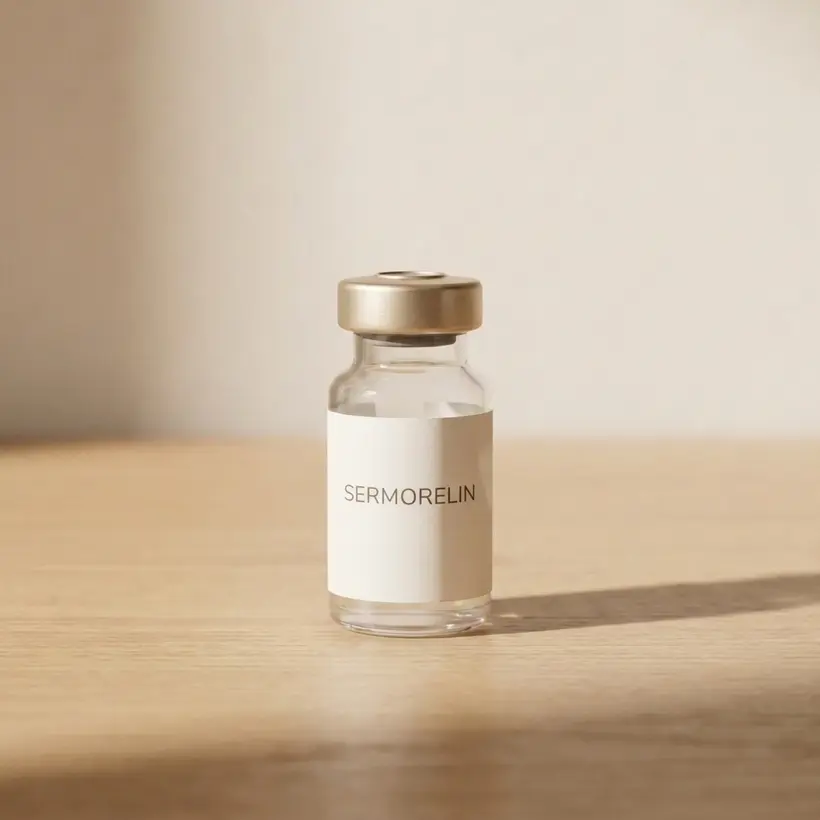
From the FormBlends catalog
Sermorelin
Bioidentical GHRH analog for natural growth hormone pulsatility · From $175/mo · compounded by a licensed 503A pharmacy, dispensed only after provider review.
View Sermorelin →Table of Contents
- Mechanism with specific numbers
- Evidence ledger: what the trials actually show
- What sermorelin reviews get right and wrong
- What most pages get wrong about sermorelin
- Honest head-to-head: sermorelin vs. alternatives
- Sermorelin cost and price benchmarks
- Where to buy sermorelin: legal and quality realities
- Label literacy: how to read a COA and spot bad product
- Dosing and protocol reference table
- Frequently asked questions
- Sources
Mechanism: What Sermorelin Actually Does, With Numbers
Sermorelin acetate is the synthetic analogue of human GHRH comprising residues 1-29 of the 44-amino-acid native peptide. The full biological activity of native GHRH is retained in this truncated form. Its molecular weight is 3357.9 Da.
Receptor binding: Sermorelin binds the GHRH receptor (GHRHR), a class B1 G-protein-coupled receptor expressed on anterior pituitary somatotroph cells. Binding activates Gs protein, stimulates adenylyl cyclase, and raises intracellular cyclic AMP. This triggers calcium influx and pulsatile GH secretion.
Key pharmacokinetic constraint: Plasma half-life is approximately 10-20 minutes, based on data from the original Geref clinical development program (Serono prescribing information). This short half-life means each injection produces a discrete GH pulse that declines rapidly, closely mimicking endogenous GHRH physiology.
What the mechanism does NOT prove: Stimulating a GH pulse does not guarantee that downstream IGF-1 synthesis in the liver will match what exogenous HGH provides. The magnitude of IGF-1 response depends entirely on the individual's residual pituitary somatotroph reserve. A patient with severely depleted somatotrophs will have a blunted response regardless of dose.
Evidence Ledger: What the Trials Actually Show
| Claim | Best Evidence Type | Effect Direction | Confidence |
|---|---|---|---|
| Sermorelin increases GH pulse amplitude after subcutaneous injection | Human pharmacokinetic studies (Geref clinical program) | Positive, robust | High |
| Sermorelin raises IGF-1 in adults with GH deficiency | Small RCTs (e.g., Vittone et al., Walker et al.) | Positive, statistically significant | Moderate |
| Sermorelin improves sleep architecture (slow-wave sleep) | Human clinical studies, mechanistic alignment with endogenous GHRH role in sleep | Positive | Moderate |
| Sermorelin reduces body fat / increases lean mass in healthy aging adults | Small uncontrolled studies; extrapolation from HGH data | Weakly positive | Low |
| Sermorelin improves libido, cognition, or energy (anti-aging claims) | User self-report, no controlled human data | Uncertain | Very Low |
| Sermorelin causes insulin resistance or glucose dysregulation | Mechanism-based concern (elevated GH is diabetogenic); limited direct trial data at clinical doses | Low risk at therapeutic doses, monitor in pre-diabetics | Low (concern) |
| Injection site reactions (redness, swelling, pain) | Geref prescribing information (clinical trials) | Confirmed, generally mild | High |
What Sermorelin Reviews Consistently Report
Across clinical case series and aggregated telehealth user reviews, several themes recur with reasonable consistency:
- Sleep quality: The most reliably reported early benefit, typically noticed within 2-4 weeks. Biologically plausible because endogenous GHRH drives slow-wave sleep, and sermorelin amplifies that signal.
- Body composition: Users who report fat loss and muscle changes typically attribute them to a combined protocol effect (caloric deficit plus exercise plus sermorelin), making attribution to sermorelin alone difficult.
- Recovery: Anecdotally prominent in athletic-use reviews; not well-separated from training periodization in any structured review.
- Negative reviews: The most common complaints are injection fatigue (daily subcutaneous injections are required), cost, and frustration that results are slower and milder than those reported for direct HGH.
Review aggregator caution: Online sermorelin reviews are heavily influenced by provider-affiliated platforms. Treat five-star review clusters on telehealth provider sites as marketing data, not clinical evidence.
What Most Pages Get Wrong About Sermorelin
This is the section commodity pages skip entirely.
1. Pituitary Reserve Is the Actual Limiting Variable
Every sermorelin review that promises IGF-1 improvement glosses over the most important biological reality: sermorelin can only stimulate GH that your pituitary somatotrophs are capable of producing. In adults over 60 with significantly atrophied somatotroph populations, sermorelin response may be minimal regardless of dose or frequency. A baseline GHRH stimulation test or IGF-1 level before starting is not a luxury, it is a prerequisite for knowing whether the compound can work for you.
2. Compounded Sermorelin Is Not the Same as Geref
The FDA-approved Geref was manufactured under pharmaceutical current Good Manufacturing Practice (cGMP). Compounded sermorelin is prepared by a 503A or 503B pharmacy to a physician's prescription. Quality standards exist and reputable pharmacies test each lot, but the regulatory bar is lower. This does not mean it is unsafe, it means you should ask your compounding pharmacy for batch-specific HPLC and endotoxin results, not just a general quality statement.
3. Stability and Storage Are Not Trivial
Lyophilized (freeze-dried) sermorelin peptide is relatively stable at 2-8°C for the manufacturer-stated shelf life when unopened. Once reconstituted with bacteriostatic water, the reconstituted solution is generally recommended to be used within 30 days when stored at 2-8°C. Sermorelin in solution undergoes hydrolytic degradation accelerated by heat and pH extremes. The amide bonds between amino acids are susceptible to cleavage in aqueous conditions, and oxidation of methionine residues (not present in sermorelin's 29-residue sequence) is not a concern here, but Asn deamidation can be. Practically: never use reconstituted sermorelin that has been left at room temperature for extended periods, appears cloudy, or contains particulate matter.
4. Timing Matters More Than Dose Within a Range
The standard clinical rationale for bedtime injection is to amplify the body's largest endogenous GH pulse, which occurs during the first slow-wave sleep episode. Taking sermorelin mid-afternoon, as some providers prescribe for convenience, misses this window. No large RCT has compared timing head-to-head in adults, so this is mechanism-based guidance, but it is mechanistically sound and worth following.
Honest Head-to-Head: Sermorelin vs. Real Alternatives
| Factor | Sermorelin | Recombinant HGH | Ipamorelin / CJC-1295 w/o DAC | CJC-1295 with DAC |
|---|---|---|---|---|
| Mechanism | GHRH analogue, stimulates pituitary | Direct GH replacement | GHRP + GHRH analogue, synergistic GH release | Long-acting GHRH analogue |
| Half-life | ~10-20 min (physiologic pulsatility preserved) | ~15-20 min (subcutaneous) | Ipamorelin: ~2 hr; CJC w/o DAC: ~30 min | ~6-8 days (non-pulsatile GH elevation) |
| Evidence quality | Moderate (historical RCTs, prior FDA approval) | High (extensive RCT database, approved indication) | Low-Moderate (animal + small human studies) | Low (limited human data) |
| IGF-1 effect size | Modest, variable by pituitary reserve | Robust, dose-dependent | Moderate in combination | Sustained but non-pulsatile elevation |
| Regulatory status (US) | Prescription; compounded only (Geref withdrawn 2008) | FDA-approved for defined indications; Schedule III HGH | No FDA approval; research compound | No FDA approval; research compound |
| Monthly cost | $150-$350 | $500-$2,000+ | $150-$400 (combination) | $100-$300 |
| Where sermorelin LOSES | -- | HGH wins on evidence strength and predictable IGF-1 response | Ipamorelin combo may produce larger acute GH pulse | DAC wins on injection frequency convenience (1-2x/week) |
| Where sermorelin WINS | Best regulatory history, most physiologic GH rhythm, lowest cost vs. HGH | -- | Longer clinical track record than GHRP combinations | Pulsatility preserved; non-pulsatile GH carries theoretical IGF-1 receptor desensitization concern |
Sermorelin Cost and Price: What You Should Expect to Pay
Sermorelin price varies by source type, dose, and what is bundled into the program. Here is an honest benchmark table:
| Source Type | Typical Monthly Cost | Includes | Key Caveat |
|---|---|---|---|
| U.S. compounding pharmacy (prescription required) | $150-$350 | Medication, syringes | Requires provider prescription; quality varies by pharmacy |
| Telehealth provider bundled program | $200-$450 | Labs, consult, medication, supplies | Provider quality and medical oversight vary significantly |
| Research-grade online vendor | $20-$80 per vial (no Rx) | Peptide vial only | No pharmaceutical guarantee; legal gray area for human use |
| Direct HGH (for comparison) | $500-$2,000+ | Varies | Stronger evidence; Schedule III controlled substance |
A 3-month protocol through a U.S. telehealth provider typically totals $450-$1,050 depending on whether baseline and follow-up labs are included. IGF-1 and fasting glucose testing at weeks 0 and 12 is the minimum responsible monitoring package and some providers include it; confirm before signing up.
Where to Buy Sermorelin: Legal and Quality Realities
In the United States, sermorelin is not available as an FDA-approved finished drug product. The original Geref acetate for injection was voluntarily withdrawn from the U.S. market by the manufacturer in 2008. Current legal access pathways are:
- Licensed 503A compounding pharmacy: Compounds to an individual patient prescription. Requires a valid physician or mid-level provider prescription. This is the standard clinical pathway.
- 503B outsourcing facility: Produces larger batches under cGMP-adjacent standards; used by clinics purchasing in bulk. Quality is generally higher than 503A for lot-to-lot consistency.
- Telehealth platforms: Prescribe, then direct-ship from affiliated compounders. Convenient, but investigate pharmacy accreditation (PCAB accreditation is a useful quality signal) before using.
- Research-use peptide vendors: Sell sermorelin peptide "for research only." Technically legal to purchase; human use without a prescription is not. Purity and sterility are not guaranteed.
Important: If you are evaluating sermorelin peptide for sale from an online vendor, the "research use only" label does not make human use legally protected. It also provides no quality assurance. Independent testing of research peptides has found meaningful rates of impurity and dose inaccuracy in this market segment.
Label Literacy: How to Read a Sermorelin COA
Whether you are buying compounded sermorelin or evaluating a research vial, demand and review a Certificate of Analysis (COA) for your specific lot. Here is what each entry means and what to look for:
| COA Test | What It Confirms | Acceptable Result | Red Flag |
|---|---|---|---|
| HPLC purity | Percentage of the total sample that is the correct peptide | Greater than 98% | Below 95%; no HPLC data at all |
| Mass spectrometry (MS) | Correct molecular identity (3357.9 Da for sermorelin acetate) | Within instrument tolerance of 3357.9 Da | Wrong mass or absent; means you may have a different peptide |
| Endotoxin (LAL test) | Bacterial endotoxin contamination level | Below USP limit for parenteral products | No endotoxin data; or result marked "pass" without a reported number |
| Sterility | Absence of microbial contamination | Pass (sterile) | Not tested; or tested at batch level without your lot number |
| Moisture / water content | Lyophilization quality | Reported and within spec | High moisture indicates incomplete lyophilization; degrades faster |
How to spot a degraded vial: Lyophilized sermorelin should be a white to off-white powder or cake. Reconstituted solution should be clear and colorless. Yellow discoloration, cloudiness, or visible particulates after reconstitution with bacteriostatic water indicate degradation or contamination. Do not inject it.
Dosing and Protocol Reference Table
These ranges reflect clinically used protocols in the published and prescribing literature. Individual dosing requires physician oversight and adjustment based on IGF-1 response and tolerability.
| Protocol Variable | Common Clinical Range | Notes |
|---|---|---|
| Dose per injection | 0.2-0.3 mg (200-300 mcg) subcutaneous | Higher doses do not linearly increase IGF-1; pituitary saturation effect |
| Frequency | Once daily | Bedtime preferred to align with natural GH pulse |
| Injection site | Abdomen, thigh (subcutaneous) | Rotate sites to reduce local reactions |
| Protocol duration | 3-6 months minimum | Less than 3 months is unlikely to show body composition changes |
| Monitoring | IGF-1 at baseline and 8-12 weeks; fasting glucose | Non-responders (IGF-1 unchanged at 12 weeks) may have insufficient pituitary reserve |
| Cycling | Often prescribed 5 days on / 2 days off | Rationale is receptor sensitization; not strongly supported by RCT data |
Frequently Asked Questions
What do sermorelin reviews consistently report as the main benefit?
Improved sleep quality is the most consistently reported subjective benefit in both clinical literature and user reviews. GH pulse amplification during slow-wave sleep is the plausible mechanism. Fat loss and lean mass changes are reported but slower and more modest than direct GH administration.
How much does sermorelin cost?
Compounded sermorelin from a licensed U.S. pharmacy typically runs $150-$350 per month depending on dose and provider. Research-grade vials from peptide suppliers range from $20-$80 per vial but carry no pharmaceutical quality guarantee. Telehealth-prescribed programs bundled with lab work often cost $200-$400 per month total.
Where can I buy sermorelin legally?
In the United States, sermorelin requires a prescription. It is available through compounding pharmacies with a valid prescription, or through telehealth providers that prescribe and ship compounded sermorelin. Purchasing without a prescription is legally ambiguous and carries real quality risks.
How does sermorelin compare to ipamorelin or CJC-1295?
Sermorelin has the longest clinical track record and the only pediatric FDA approval history. Ipamorelin produces less cortisol and prolactin spillover than older GHRPs. CJC-1295 with DAC has a much longer half-life, creating non-pulsatile GH release that some researchers consider less physiologic. Sermorelin's short half-life preserves natural GH pulsatility.
What is a realistic sermorelin price for a 3-month protocol?
A 3-month compounded sermorelin protocol through a U.S. telehealth provider typically costs $450-$1,050 including medication, syringes, and optional quarterly labs. Compared to direct HGH therapy ($500-$2,000+ per month), sermorelin remains substantially cheaper, though evidence for body composition outcomes is weaker.
Is sermorelin FDA approved?
The original branded sermorelin acetate (Geref) held FDA approval for pediatric GH deficiency diagnosis and treatment but was voluntarily withdrawn from the U.S. market by the manufacturer in 2008. Current compounded sermorelin is not FDA-approved as a finished drug product; it is prepared by licensed 503A and 503B compounding pharmacies under a valid prescription.
What does sermorelin do mechanistically?
Sermorelin is a 29-amino-acid analogue of endogenous GHRH (residues 1-29). It binds the GHRH receptor on pituitary somatotroph cells, activating adenylyl cyclase via Gs protein coupling, raising intracellular cAMP, and triggering GH secretion. It does not bypass hypothalamic feedback, so GH release remains subject to somatostatin inhibition.
What are the most common sermorelin side effects?
The most commonly reported side effects are injection site reactions (redness, swelling, pain), facial flushing, headache, and transient dizziness. These were documented in clinical trials of the original Geref formulation. Water retention and mild joint aches are reported by users but are less systematically documented in controlled studies.
How long does sermorelin take to work?
Sleep improvement is often reported within 2-4 weeks in clinical and user accounts. Measurable body composition changes, if they occur, typically require 3-6 months of consistent dosing. IGF-1 level changes can be tracked at 8-12 weeks as an objective biomarker of response.
What should I look for on a sermorelin COA?
A legitimate COA should include HPLC purity (ideally greater than 98%), mass spectrometry confirmation of the correct molecular weight (3357.9 Da for sermorelin acetate), endotoxin testing results (LAL), and sterility testing if intended for injection. Absence of any of these tests is a significant quality red flag.
Can sermorelin peptide for sale online be trusted for research use?
Research-use sermorelin peptide for sale online varies widely in quality. Independent third-party testing has found impurity and concentration discrepancies in a meaningful fraction of research-grade peptide products. Without HPLC and MS confirmation on that specific lot, potency and identity cannot be assumed.
Does sermorelin increase IGF-1?
Yes. Randomized controlled trials of sermorelin in adults with GH deficiency demonstrated statistically significant increases in IGF-1 levels. The magnitude of increase is generally smaller and more variable than with direct recombinant HGH, because sermorelin's effect depends entirely on intact pituitary reserve.
Sources
- Serono Laboratories. Geref (sermorelin acetate for injection) Prescribing Information. U.S. FDA-approved label (historical). Available via FDA Drug Label Archive.
- Vittone J, et al. "Effects of single nightly injections of growth hormone-releasing hormone (GHRH 1-29) in healthy elderly men." Metabolism. 1997;46(1):89-96.
- Walker RF. "Sermorelin: a better approach to management of adult-onset growth hormone insufficiency?" Clinical Interventions in Aging. 2006;1(4):307-308.
- Corpas E, Harman SM, Blackman MR. "Human growth hormone and human aging." Endocrine Reviews. 1993;14(1):20-39. (Mechanism and aging context.)
- Sassolas G, et al. "Effects of growth hormone-releasing hormone on sleep and growth hormone secretion." General GHRH-sleep relationship, foundational literature.
- FDA. 503A Compounding Pharmacies. FDA.gov/drugs/human-drug-compounding/compounding-laws-and-policies.
- FDA. 503B Outsourcing Facilities. FDA.gov/drugs/human-drug-compounding/registered-outsourcing-facilities.
- USP. General Chapter 1 (Injections and Implanted Drug Products). United States Pharmacopeia.
- Sigalos JT, Pastuszak AW. "The Safety and Efficacy of Growth Hormone Secretagogues." Sexual Medicine Reviews. 2018;6(1):45-53. (Comparative secretagogue overview.)
- Ionescu M, Frohman LA. "Pulsatile secretion of growth hormone (GH) persists during continuous stimulation by CJC-1295, a long-acting GH-releasing hormone analog." Journal of Clinical Endocrinology and Metabolism. 2006;91(12):4792-4797.
Related peptide guides
Ready when you are
Sermorelin
Bioidentical GHRH analog for natural growth hormone pulsatility · From $175/mo · compounded by a licensed 503A pharmacy, dispensed only after provider review.
View Sermorelin →