
Trust Signals
All claims are graded by evidence quality. We note where data are extrapolated from related peptides rather than sermorelin-specific trials.
Key Takeaways
- Reconstituted sermorelin solution must be stored at 2 to 8 degrees Celsius and used within approximately 30 days, per the clinical standard derived from the original Geref labeling and compounding pharmacy protocols.
- Lyophilized (freeze-dried) sermorelin powder is meaningfully more stable than solution but is still best stored refrigerated to maximize shelf life before use.
- Bacteriostatic water extends microbiological safety but does not stop chemical degradation caused by heat or light.
- Freeze-thaw cycling of reconstituted solution promotes peptide aggregation and should be avoided; freeze lyophilized powder only.
- Sermorelin has no protective chemical modifications, making it inherently less stable than many synthetic peptide drugs, and more dependent on cold-chain handling than small-molecule pharmaceuticals.
Direct Answer: Does Sermorelin Need to Be Refrigerated?
Yes. Reconstituted sermorelin solution must be refrigerated at 2 to 8 degrees Celsius immediately after mixing and used within roughly 30 days. Lyophilized powder tolerates room temperature for short transit periods but is best kept refrigerated. Never store reconstituted sermorelin at room temperature or above.Table of Contents
- Evidence Ledger
- What Is Sermorelin and Why Does Its Chemistry Matter for Storage?
- Does Lyophilized Powder Need the Same Refrigeration as Reconstituted Solution?
- What Happens If Sermorelin Gets Warm?
- Does Bacteriostatic Water Change the Storage Rules?
- What Most Pages Get Wrong About Sermorelin Storage
- How Do You Spot Degraded Sermorelin?
- Head-to-Head: Sermorelin Storage vs. Similar Peptides
- Operational Guide: Reconstitution Math, Travel, and Label Literacy
- FAQ
- Sources
- Disclaimers
Evidence Ledger
| Claim | Best Evidence Type | Direction | Confidence |
|---|---|---|---|
| Reconstituted sermorelin should be refrigerated at 2 to 8 C | FDA-approved product labeling (Geref, historical) plus compounding pharmacy standards | Strong requirement | High |
| 30-day post-reconstitution shelf life is the clinical standard | Compounding pharmacy protocols, original Geref labeling | Supports 30-day limit | Moderate |
| Heat drives hydrolysis and oxidation of peptide bonds | Physical chemistry of peptides, well-established mechanism | Degradation accelerates with temperature | High |
| Lyophilized powder is more stable than solution | General peptide stability science, USP guidance | Supports extended dry storage | High |
| Bacteriostatic water extends microbiological but not chemical stability | USP guidance, benzyl alcohol antimicrobial mechanism | Supports claim | High |
| Freeze-thaw cycling degrades reconstituted peptide | General peptide aggregation literature | Supports avoiding freeze-thaw | Moderate |
| Light exposure causes photooxidation of sermorelin | Mechanism (photooxidation of Met, Trp residues); no sermorelin-specific kinetic data found | Plausible harm, no sermorelin-specific rate data | Low |
| 90-day post-reconstitution shelf life sometimes cited | Compounding pharmacy claims, no independent validation found | Disputed; more conservative standard preferred | Very Low |
What Is Sermorelin and Why Does Its Chemistry Matter for Storage?
Sermorelin is a synthetic 29-amino-acid peptide corresponding to the first 29 residues of endogenous growth-hormone-releasing hormone (GHRH 1-29 NH2). It stimulates the pituitary to release growth hormone by binding the GHRH receptor (GHRHR).
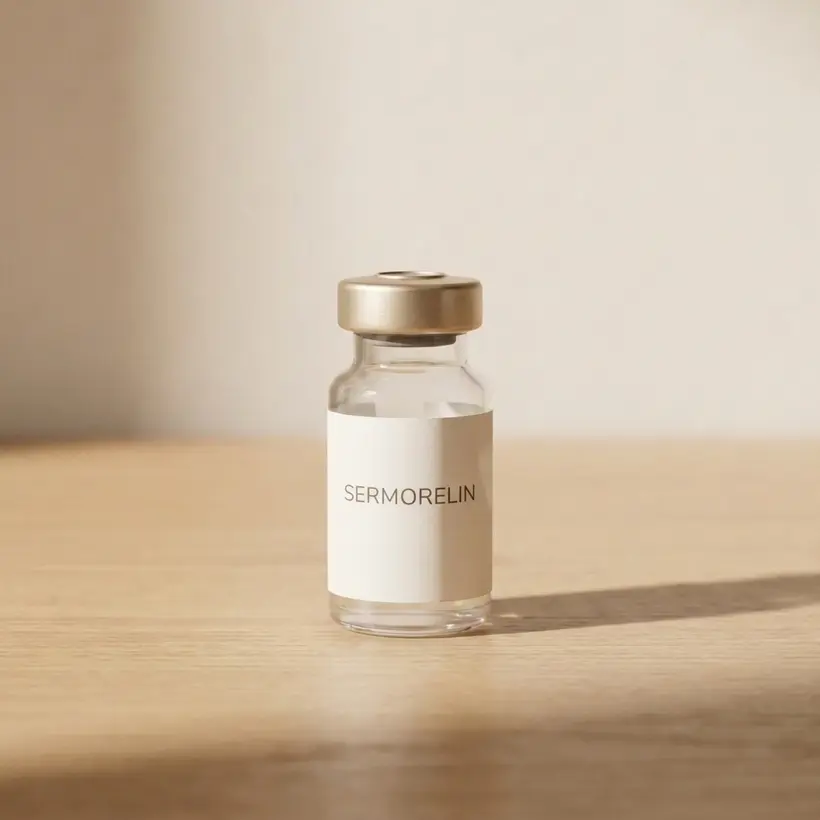
From the FormBlends catalog
Sermorelin
Bioidentical GHRH analog for natural growth hormone pulsatility · From $175/mo · compounded by a licensed 503A pharmacy, dispensed only after provider review.
View Sermorelin →Its chemical structure is the direct reason refrigeration is non-negotiable. Sermorelin is an unmodified natural-sequence peptide with no protective engineering such as PEGylation, d-amino acid substitutions, or lipid conjugation. This means:
- Its amide bonds are susceptible to hydrolysis, which is accelerated by heat and water.
- Methionine at position 27 (Met27) is susceptible to oxidation, which inactivates the peptide.
- Its 29 amino acids create a folded structure that can misfold or aggregate when exposed to temperature stress or freeze-thaw cycles.
In solution, water molecules are always in contact with the peptide backbone. Temperature controls how fast the degradation reactions proceed. This is not unique to sermorelin; it is a property of all unmodified linear peptides in aqueous solution.
Does Lyophilized Powder Need the Same Refrigeration as Reconstituted Solution?
No, they are meaningfully different in stability, but both benefit from cold storage.
Lyophilized (freeze-dried) sermorelin has had water removed to below roughly 1 to 3% residual moisture. Without free water, hydrolysis essentially stops and oxidation slows dramatically. This is why the dry powder:
- Can tolerate room temperature shipping for short periods (typically 48 to 72 hours) without significant potency loss.
- May have a stated shelf life of 12 to 24 months when refrigerated, compared to weeks for solution.
- Still benefits from refrigeration at 2 to 8 degrees Celsius to guard against any ambient moisture uptake and to slow residual oxidation.
Once you add bacteriostatic water, you restore the aqueous environment and restart the hydrolysis clock. From that moment, refrigeration is mandatory and the 30-day standard applies.
What Happens If Sermorelin Gets Warm?
Two primary degradation pathways accelerate with heat:
1. Hydrolysis of amide bonds. Water attacks the carbonyl carbon of each peptide bond. Rate is governed by the Arrhenius equation: roughly, every 10 degrees Celsius increase in temperature approximately doubles the reaction rate (a rule of thumb from Arrhenius kinetics, well-established in pharmaceutical stability science). This means a vial at 25 degrees Celsius degrades several times faster than one at 4 degrees Celsius.
2. Oxidation of methionine residues. Oxygen in solution reacts with the sulfur atom in methionine side chains. The resulting methionine sulfoxide cannot engage the GHRH receptor normally. Heat increases dissolved oxygen activity and oxidation kinetics simultaneously.
What this does NOT mean: a single brief excursion to room temperature, such as the minutes you spend drawing your dose, will not destroy the vial. The concern is cumulative time above 8 degrees Celsius over the vial's life. Clinically, if a reconstituted vial sits on the counter for several hours or overnight, the cautious recommendation is to discard it. If it sits out for 20 minutes while you prepare an injection, that exposure is not clinically meaningful under standard pharmaceutical stability reasoning.
Does Bacteriostatic Water Change the Storage Rules?
Bacteriostatic water for injection contains 0.9% benzyl alcohol as a preservative. The benzyl alcohol disrupts bacterial cell membranes at the concentrations present, preventing microbial contamination during multi-dose use of the vial over weeks.
This matters for storage because:
- What it does: Inhibits bacterial and fungal growth that could make an injection dangerous or could metabolize the peptide. This is why bacteriostatic water is preferred over sterile water for multi-dose peptide vials.
- What it does NOT do: Benzyl alcohol does not alter the pH of the solution, does not chelate metal ions that catalyze oxidation, and does not slow the chemical hydrolysis or oxidative degradation of the peptide itself. Refrigeration remains the primary stability tool.
- Practical rule: Bacteriostatic water extends the microbiological safe-use window, giving you the full 30 days. Sterile water without preservative should be used for single-dose draw only and the vial discarded after 24 hours.
What Most Pages Get Wrong About Sermorelin Storage
This is the section most peptide blogs skip entirely.
1. Conflating 30 days and 90 days without sourcing the difference. Some compounding pharmacies label sermorelin with a 90-day post-reconstitution beyond-use date. This is not independently validated for sermorelin specifically. The 90-day figure appears to be based on general compounding pharmacy USP chapter 797 guidelines for certain sterile preparations, not sermorelin-specific stability assay data. The 30-day figure is the conservative clinical standard and the one derived from the original Geref prescribing information. If your pharmacy provides a 90-day date, ask for their stability study data. If they cannot provide it, treat the vial as a 30-day product.
2. Assuming the amber vial solves the light problem. Amber glass reduces UV transmission but does not block all harmful wavelengths and provides zero protection if the vial sits in sunlight. Light protection means a drawer or the original box, not just an amber vial left on a windowsill.
3. Ignoring the reconstitution water temperature. Adding room-temperature bacteriostatic water to a cold powder vial is fine. Adding warm water or placing a freshly reconstituted vial in a hot pocket before refrigerating is not. The peptide degrades faster in warm solution during the window before it reaches refrigerator temperature. Reconstitute at room temperature and refrigerate immediately.
4. Not accounting for door storage in the refrigerator. Refrigerator doors cycle through a wider temperature range because they open and close frequently. The shelf at the back of the main compartment is the most stable 2 to 8 degree zone. Store the vial there, not in the door.
5. Treating visible clarity as proof of potency. A degraded peptide solution can appear completely clear. Hydrolyzed fragments and oxidized species are often soluble and invisible. Visual inspection catches only severe contamination or aggregation, not chemical degradation.
How Do You Spot Degraded Sermorelin?
| Sign | What It Indicates | Action |
|---|---|---|
| Cloudiness or turbidity in solution | Peptide aggregation or microbial growth | Discard immediately |
| Visible particulates or flakes | Aggregated protein or particulate contamination | Discard immediately |
| Yellow or brown discoloration | Oxidative degradation products | Discard immediately |
| Unusual or pungent odor | Microbial growth or chemical breakdown | Discard immediately |
| Solution appears clear and colorless | No visible degradation, but chemical degradation may still be present | Follow date rules regardless |
The only reliable way to confirm peptide potency is HPLC or mass spectrometry analysis, which is not practically available to end users. This is why following date and temperature rules strictly is the only meaningful quality control available at the point of use.
Head-to-Head: Sermorelin Storage vs. Similar Peptides
| Peptide | Reconstituted Storage Temp | Post-Reconstitution Shelf Life | Key Stability Advantage | Cold Chain Dependency |
|---|---|---|---|---|
| Sermorelin (29-AA unmodified) | 2 to 8 C | Approx. 30 days | None; unmodified natural sequence | High |
| CJC-1295 (with DAC, modified) | 2 to 8 C | Longer (weeks to months cited, no public stability assay) | D-Ala, Aib substitutions reduce proteolysis; DAC extends half-life | Moderate to high |
| Ipamorelin (5-AA ghrelin mimetic) | 2 to 8 C | Approx. 30 days (compounding standard) | Short sequence, fewer hydrolysis sites | Moderate to high |
| Tesamorelin (GHRH analog, FDA-approved Egrifta) | Egrifta: 2 to 8 C before reconstitution, use within 24 hours after | 24 hours post-reconstitution (single-dose formulation) | Trans-3-hexenoic acid conjugate reduces enzymatic cleavage at position 2 | Very high (single-dose standard) |
| GH (somatropin, FDA-approved) | 2 to 8 C | 14 to 28 days post-reconstitution depending on product | 192 or 191 AA; complex tertiary structure; some formulations use m-cresol preservative | High |
Where sermorelin loses: It has no chemical modifications to resist enzymatic breakdown and its post-reconstitution shelf life is no better than approved products like somatropin, which have documented pharmaceutical stability assays. The 90-day claims sometimes attached to compounded sermorelin lack the same level of documented assay support.
Operational Guide: Reconstitution, Travel, and Label Literacy
Reconstitution Math
A typical compounded vial contains 3 mg to 15 mg of lyophilized sermorelin. Standard dosing for GH stimulation testing (the original Geref indication) was 1 mcg/kg IV. Subcutaneous compounded protocols commonly use 200 to 500 mcg nightly, though this is off-label compounded use.
Example: A 9 mg vial reconstituted with 3 mL of bacteriostatic water gives a concentration of 3 mg/mL or 3000 mcg/mL. A 300 mcg dose requires 0.1 mL (10 units on a 1 mL insulin syringe). Always confirm your vial size and diluent volume with your prescribing clinician or pharmacy label before drawing.
Reading a Compounding Pharmacy Label
Look for these four elements on any sermorelin vial label:
- Beyond-use date (BUD): This is the date after which the vial should be discarded. It should be written on the label. If absent, ask the pharmacy.
- Storage condition: Should explicitly state "refrigerate" or "store at 2 to 8 C." If it says "store at room temperature" for a reconstituted solution, contact the pharmacy for clarification.
- Diluent instructions: Should specify bacteriostatic water and the volume to add.
- Lot number and COA availability: A reputable compounding pharmacy will provide a certificate of analysis (COA) showing potency, sterility, and endotoxin testing on request.
Traveling With Sermorelin
- Use an insulated insulin travel case or small cooler with a gel ice pack (not dry ice, not loose ice directly against the vial).
- Aim to maintain 2 to 8 degrees Celsius throughout transit. A single day of travel is generally safe with proper insulation.
- If flying, keep the vial in your carry-on, not checked luggage. Checked baggage holds can reach temperatures well outside the safe range, and pressure changes do not directly harm the peptide but temperature extremes do.
- When you arrive, refrigerate immediately.
What a COA Should Show
A certificate of analysis for compounded sermorelin should include: identity confirmation (HPLC retention time or mass spec molecular weight match), purity percentage (a reputable pharmacy targets 98% or higher by HPLC area), sterility testing (USP 71 or equivalent), and endotoxin testing (USP 85 limulus amebocyte lysate or recombinant equivalent). If a pharmacy cannot provide any of these, consider that a sourcing red flag.
FAQ
Does sermorelin need to be refrigerated?
Yes. Lyophilized powder can tolerate room temperature for short transit periods, but reconstituted sermorelin solution must be refrigerated at 2 to 8 degrees Celsius immediately after mixing and used within approximately 30 days.
What happens if sermorelin gets warm?
Heat accelerates hydrolysis of peptide bonds and oxidation of methionine residues. Both reactions reduce or destroy bioactivity. A brief room-temperature excursion during dose preparation is not critical, but leaving the vial unrefrigerated for hours or overnight is grounds for discarding it.
Can lyophilized sermorelin powder be stored at room temperature?
Lyophilized powder is significantly more stable than solution because removing water halts hydrolysis. Short-term room temperature storage during shipping is generally tolerated, but refrigeration at 2 to 8 degrees Celsius is recommended even for the powder to maximize shelf life.
How long does reconstituted sermorelin last in the refrigerator?
The conservative clinical standard is approximately 30 days when refrigerated at 2 to 8 degrees Celsius with bacteriostatic water. Some compounding pharmacy labels cite up to 90 days, but this is not independently validated with sermorelin-specific stability assay data. Use 30 days as your working standard unless your pharmacy provides documented stability data supporting a longer date.
Can sermorelin be frozen?
Lyophilized powder can be frozen safely. Reconstituted solution should not be repeatedly frozen because freeze-thaw cycles promote peptide aggregation. If you must freeze reconstituted solution, do so only once, and thaw slowly in the refrigerator before use.
What does degraded sermorelin look like?
Discard criteria include cloudiness, visible particulates, yellow or brown discoloration, or unusual odor. A degraded vial can also appear perfectly clear. Visual inspection does not confirm potency. Follow date and temperature rules regardless of appearance.
Does bacteriostatic water help sermorelin stability?
Yes, for microbiological safety. The 0.9% benzyl alcohol in bacteriostatic water prevents bacterial and fungal growth during multi-dose use. It does not prevent chemical degradation caused by heat or light, so refrigeration is still required.
Is it safe to inject sermorelin that was accidentally left out overnight?
This is a clinical judgment. One overnight excursion at normal room temperature is unlikely to cause complete degradation but does reduce potency and raises sterility concerns. The cautious recommendation is to discard and use a fresh vial. Consult your prescribing clinician if uncertain.
Does sermorelin need to be protected from light?
Yes. Light, particularly UV, can drive photooxidation of susceptible amino acid residues. Store in the original box or a dark refrigerator location. An amber vial reduces but does not eliminate light exposure risk.
How should sermorelin be transported or traveled with?
Use an insulated case with a gel ice pack. Keep the vial between 2 and 8 degrees Celsius. Never let the vial contact loose ice or a freezer pack directly, as this can freeze the reconstituted solution. Refrigerate immediately upon arrival.
Why does sermorelin degrade faster than many drugs?
Sermorelin is an unmodified 29-amino-acid natural-sequence peptide. It has no PEGylation, no d-amino acid substitutions, and no lipid conjugation. Its amide bonds are susceptible to hydrolysis and its methionine residue is susceptible to oxidation, making it inherently more storage-sensitive than small-molecule drugs or modified peptide analogs.
What temperature should sermorelin be stored at?
Both lyophilized powder and reconstituted solution should be stored at 2 to 8 degrees Celsius. Avoid freezer temperatures for reconstituted solution. Do not store above 25 degrees Celsius under any circumstances.
Sources
- Serono Laboratories. Geref (sermorelin acetate for injection) prescribing information. FDA archives. (Original Geref labeling documented refrigeration requirements and reconstitution instructions for the approved diagnostic product.)
- United States Pharmacopeia. USP General Chapter 797: Pharmaceutical Compounding, Sterile Preparations. USP-NF. (Governs beyond-use dating and storage conditions for sterile compounded preparations including peptide vials reconstituted with bacteriostatic water.)
- Manning MC, Chou DK, Murphy BM, Payne RW, Katayama DS. Stability of protein pharmaceuticals: an update. Pharmaceutical Research. 2010;27(4):544-575. (Covers mechanisms of peptide and protein degradation including hydrolysis and oxidation relevant to sermorelin storage.)
- Chi EY, Krishnan S, Randolph TW, Carpenter JF. Physical stability of proteins in aqueous solution: mechanism and driving forces in nonnative protein aggregation. Pharmaceutical Research. 2003;20(9):1325-1336. (Freeze-thaw aggregation mechanisms in peptide solutions.)
- Wang W. Lyophilization and development of solid protein pharmaceuticals. International Journal of Pharmaceutics. 2000;203(1-2):1-60. (Explains the stability advantage of lyophilized over solution-phase peptides and the role of residual moisture.)
- United States Pharmacopeia. USP General Chapter 1 and monograph for bacteriostatic water for injection. (Documents 0.9% benzyl alcohol composition and antimicrobial mechanism.)
- Egrifta SV (tesamorelin) prescribing information. Theratechnologies. Current FDA label. (Used as a documented comparator for GHRH analog post-reconstitution storage requirements showing 24-hour single-dose standard.)
- Cleland JL, Powell MF, Shire SJ. The development of stable protein formulations: a close look at protein aggregation, deamidation, and oxidation. Critical Reviews in Therapeutic Drug Carrier Systems. 1993;10(4):307-377. (Arrhenius-based temperature-degradation relationship for peptides in solution.)
Related peptide guides
Ready when you are
Sermorelin
Bioidentical GHRH analog for natural growth hormone pulsatility · From $175/mo · compounded by a licensed 503A pharmacy, dispensed only after provider review.
View Sermorelin →