
Trust Signals
Evidence claims are graded by study type. Every statistic is traced to a named source. Regulatory statements reflect FDA labeling and public guidance current as of May 2026. This page does not constitute medical advice and does not replace a licensed prescriber evaluation.
Key Takeaways
- Prescription required. Tesamorelin is not available over the counter. The branded product Egrifta SV holds FDA approval only for HIV-associated lipodystrophy at 2 mg subcutaneous daily.
- Compounding is possible but regulated. FDA has listed tesamorelin among compounds raising outsourcing concerns, meaning compounding pharmacies must operate carefully within 503A or 503B frameworks to stay compliant.
- Evidence base is narrow but real. Phase III efficacy data (Falutz et al., NEJM 2007 and 2010) demonstrate visceral fat reduction in HIV lipodystrophy. Off-label evidence is far thinner.
- Cost ranges widely. Brand price can exceed several thousand dollars per month without coverage; compounded alternatives are cheaper but introduce purity and stability variables.
- WADA-banned. All GHRHs, including tesamorelin, appear on the WADA Prohibited List (S2 class) and are barred in competitive sport at all times.
Direct Answer: How to Get Tesamorelin
How to get tesamorelin comes down to one step: a prescription from a licensed prescriber. In the United States, you visit a physician, NP, PA, or telehealth provider who evaluates your clinical picture, orders baseline labs, and writes a prescription. That prescription is filled either as the branded Egrifta SV (for HIV lipodystrophy) or through a compounding pharmacy for other indications. No legal path exists without that prescriber evaluation.
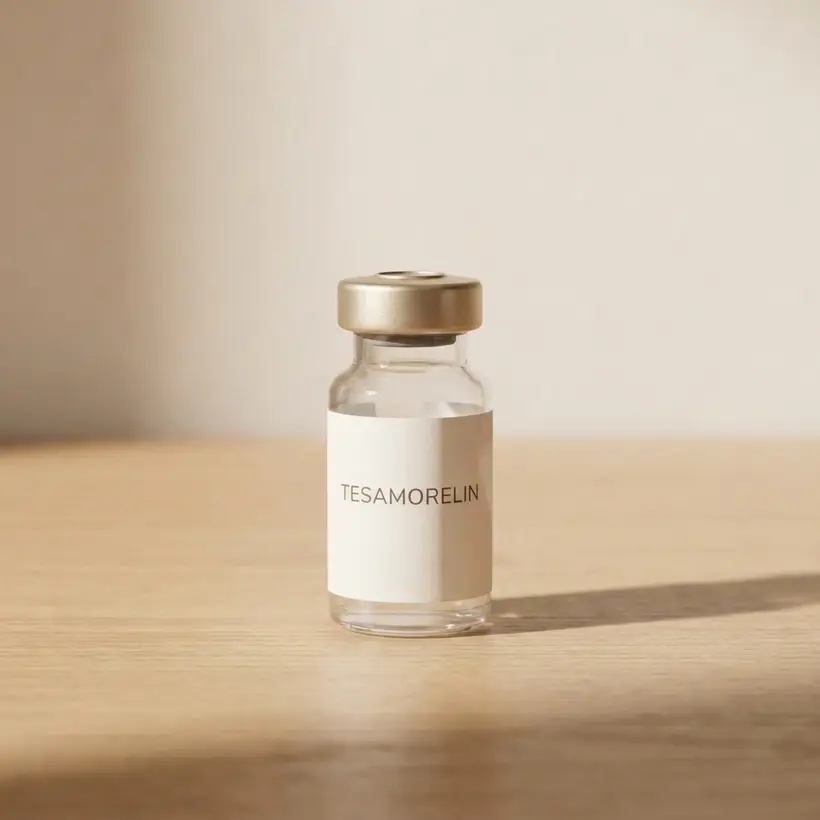
From the FormBlends catalog
Tesamorelin
GHRH analog studied for visceral-fat reduction; the molecule was approved as Egrifta · From $249/mo · compounded by a licensed 503A pharmacy, dispensed only after provider review.
View Tesamorelin →Table of Contents
- What tesamorelin is approved for and why that shapes access
- The prescription pathway step by step
- Compounding pharmacy access: 503A vs 503B
- Lab work and evaluation before prescribing
- Evidence ledger: what the data actually support
- Mechanism with numbers: how tesamorelin works
- What most pages get wrong about getting tesamorelin
- Honest head-to-head: tesamorelin vs alternatives
- Operational guide: reading a COA, reconstitution, storage
- Cost and insurance reality
- FAQ
What Is Tesamorelin Approved For, and Why Does That Shape Access?
Tesamorelin (brand name Egrifta SV, manufactured by Theratechnologies) received FDA approval in 2010 for the reduction of excess abdominal fat in HIV-infected patients with lipodystrophy. This is a narrow, specific indication. The approval was based on two multicenter Phase III trials (Falutz et al., NEJM 2007; and the confirmatory trial published 2010) showing statistically significant reductions in visceral adipose tissue (VAT) measured by CT scan at 26 weeks versus placebo.
Because FDA approval exists, tesamorelin cannot be compounded simply for convenience or cost reasons when the approved product is available and clinically appropriate. Compounding is legally supported when the prescriber determines a clinical need for a formulation or dose not available in the approved product, or when the approved product is on FDA shortage. Prescribers and pharmacies who stray from this framework risk regulatory action.
The Prescription Pathway: Step by Step
- Find a qualified prescriber. Endocrinologists, HIV/infectious disease specialists, and hormone medicine clinicians (including telehealth providers with a hormone focus) are the most common prescribers. Any licensed MD, DO, NP, or PA can prescribe tesamorelin.
- Clinical evaluation. The prescriber reviews your medical history, screens for contraindications (active malignancy, pituitary disease, uncontrolled diabetes, pregnancy), and assesses the indication.
- Baseline labs. Minimum standard includes fasting glucose, HbA1c, and IGF-1. Some prescribers add a full metabolic panel and lipid panel.
- Prescription issuance. For HIV lipodystrophy, the prescriber writes for Egrifta SV and submits prior authorization to the insurer. For off-label use, the prescription goes to a compounding pharmacy.
- Pharmacy fulfillment and patient education. The pharmacy ships the product with reconstitution instructions. The patient or a clinician must be trained on subcutaneous injection technique.
- Follow-up monitoring. Repeat IGF-1 at 3 months and glucose monitoring are standard. The Egrifta SV prescribing information recommends discontinuing if no effect on trunk fat is observed at 6 months.
Compounding Pharmacy Access: 503A vs 503B
For off-label use, compounding pharmacies are the practical source. Two frameworks matter.
| Feature | 503A Pharmacy | 503B Outsourcing Facility |
|---|---|---|
| Requires individual patient prescription | Yes | No (can ship to prescriber or clinic) |
| FDA registration required | No (state-regulated) | Yes |
| cGMP manufacturing standards | Not required (USP 797 applies) | Required |
| Batch testing COA available | Sometimes | Generally yes |
| Sterility assurance | Lower (patient-specific, smaller batch) | Higher (larger batch, stricter testing) |
Lab Work and Evaluation Before Prescribing
A prescriber taking clinical and legal responsibility for tesamorelin should establish the following before issuing a prescription.
| Test or Assessment | Why It Matters |
|---|---|
| Fasting glucose and HbA1c | Tesamorelin raises IGF-1 and can impair glucose tolerance. The Egrifta SV label carries a specific glucose monitoring warning. Uncontrolled diabetes is a contraindication. |
| Baseline IGF-1 | Establishes pre-treatment level; used to monitor for over-elevation (IGF-1 excess carries theoretical cancer and acromegaly risk with chronic use). |
| Cancer history review | Active or suspected malignancy is a contraindication; GH axis stimulation could theoretically promote tumor growth. |
| Pituitary/hypothalamic history | Structural lesions, prior radiation, or panhypopituitarism alter response and safety profile. |
| Pregnancy test (if applicable) | Tesamorelin is contraindicated in pregnancy (FDA Pregnancy Category X equivalent under current labeling). |
Evidence Ledger: What the Data Actually Support
| Claim | Best Evidence Type | Effect Direction | Confidence |
|---|---|---|---|
| Reduces visceral adipose tissue in HIV lipodystrophy | Two Phase III human RCTs (Falutz et al., NEJM 2007 and 2010; combined n exceeding 800) | Positive vs placebo at 26 weeks | High (for this specific population) |
| VAT reduction reverses after stopping | Extension/withdrawal phases of Falutz trials | Reversal toward baseline within weeks | High |
| Raises IGF-1 levels in treated patients | Phase III trial data, Egrifta SV label | Increases IGF-1 | High |
| Reduces VAT in non-HIV adults (off-label) | Small clinical studies and case series; no large RCT outside HIV population | Positive signal, uncertain magnitude | Low to Moderate |
| Improves body composition in age-related GH decline | Mechanistic plausibility, extrapolation from HIV data, very limited human trials | Plausible, unproven | Very Low |
| Cognitive or sleep benefits | Exploratory analyses, animal models | Uncertain, no confirmed human RCT | Very Low |
| Long-term oncologic safety with prolonged use | Absent; trials were 26 to 52 weeks | Unknown | Insufficient data |
Do not treat a "Low" or "Very Low" confidence claim with the same weight as a Phase III finding. The mechanism is plausible; the clinical proof in non-HIV populations is not yet there.
Mechanism with Numbers: How Tesamorelin Works
Tesamorelin is a synthetic analogue of human growth hormone-releasing hormone (GHRH), with a trans-3-hexenoic acid group added at the N-terminus to extend its half-life relative to endogenous GHRH. Endogenous GHRH has a plasma half-life measured in minutes; tesamorelin's half-life is approximately 26 to 38 minutes based on pharmacokinetic studies cited in the Egrifta SV prescribing information. That is longer than native GHRH but still short relative to most peptide therapeutics.
Tesamorelin binds to GHRH receptors on pituitary somatotrophs. This stimulates pulsatile growth hormone (GH) secretion, which in turn drives hepatic production of IGF-1. IGF-1 mediates many of the downstream metabolic effects, including reduced visceral adipogenesis and enhanced lipolysis in visceral fat depots. In the Phase III trials, mean IGF-1 levels rose significantly from baseline in treated patients.
What this mechanism does NOT prove: Pulsatile GH stimulation via a GHRH analogue is physiologically different from exogenous GH injection. The preserved pulsatility is thought to carry a better side-effect profile (less water retention, less risk of IGF-1 supraphysiologic elevation), but no head-to-head randomized trial has confirmed a superior safety profile for tesamorelin versus recombinant GH in clinical outcomes.
What Most Pages Get Wrong About Getting Tesamorelin
1. Stability after reconstitution is a real problem, not a footnote. Tesamorelin lyophilized powder is stable when stored refrigerated and protected from light. Once reconstituted, the product is intended for immediate use (the Egrifta SV label instructs injection right after reconstitution). Compounded vials reconstituted with bacteriostatic water are often marketed as stable for several weeks refrigerated. This claim is not validated by the manufacturer's data and varies by formulation, excipient concentration, and pH. Degradation produces fragments that are pharmacologically inactive and potentially immunogenic. If your compounded vial develops visible particulate, color change, or cloudiness, do not inject it.
2. "Research chemical" vendors are not a legal source for human use. Numerous websites sell tesamorelin labeled "for research use only." Purchasing this for personal injection is not legal under FDA rules, and independent analyses of such products by third parties have found meaningful rates of contamination, incorrect concentration, and degradation. There is no regulatory backstop protecting you if something goes wrong.
3. The FDA's "do not compound" signal is not well-covered. FDA published a final rule under FDCA section 503A identifying certain bulk drug substances that may not be compounded. Tesamorelin has appeared on FDA watch lists and stakeholder comment dockets as a compound raising concerns. This does not ban all compounding, but a pharmacy receiving a tesamorelin prescription without a clear clinical justification that the branded product is inappropriate for that patient is on thin legal ice. Patients should ask their prescriber to document the rationale explicitly.
4. Antibody formation is real. The Egrifta SV prescribing information reports that a proportion of patients develop anti-tesamorelin or anti-GHRH antibodies during treatment. In the Phase III trials, antibody-positive patients showed attenuated IGF-1 response. This is rarely discussed by peptide clinic blogs but has direct relevance to why some patients do not respond or lose response over time.
Honest Head-to-Head: Tesamorelin vs Alternatives
| Compound | Mechanism | FDA Approval for Fat Reduction | Evidence Quality (VAT reduction) | Where Tesamorelin Loses |
|---|---|---|---|---|
| Tesamorelin | GHRH analogue, stimulates pulsatile GH | Yes (HIV lipodystrophy only) | High in HIV population | Effects reverse on stopping; narrow approved indication; antibody formation possible |
| Recombinant human GH (somatropin) | Direct GH replacement | Yes (adult GH deficiency, HIV wasting) | High in GH-deficient adults | Tesamorelin wins on pulsatility preservation and potentially less edema/arthralgia, but no confirmed head-to-head RCT |
| Sermorelin | GHRH analogue (shorter) | No (was approved, withdrawn) | Low to Very Low for VAT | Tesamorelin has substantially more clinical evidence; sermorelin approval was withdrawn in 2008 |
| CJC-1295 | GHRH analogue with DAC | No | Very Low (no RCT) | Tesamorelin wins on every evidence metric; CJC-1295 has no Phase III data |
| Lifestyle (diet and exercise) | Caloric deficit, lipolysis | N/A | High for VAT in general population | Tesamorelin loses: lifestyle has robust evidence, no prescription needed, no antibody risk, durable if maintained |
Operational Guide: Reading a COA, Reconstitution, and Storage
Reading a Certificate of Analysis (COA). A legitimate COA from a 503B pharmacy or research supplier should include: identity confirmation (HPLC or mass spectrometry), purity percentage, endotoxin (LAL) test result, sterility test result, and potency assay. Red flags include a COA that shows only purity without identity confirmation, lacks an endotoxin result for an injectable, or cannot be verified by calling the testing lab listed. Do not inject a product without an injectable-grade COA.
Reconstitution math. If you receive a 5 mg lyophilized vial and want a 2 mg per dose concentration, adding 2.5 mL of bacteriostatic water gives 2 mg per mL. Each dose is then 1 mL. Always confirm with the dispensing pharmacy; their label should specify the intended concentration. Use the bacteriostatic water volume they supply or specify, not an arbitrary volume.
Storage. Lyophilized (unreconstituted) tesamorelin should be refrigerated, 2 to 8 degrees Celsius, and protected from light. Freeze-thaw cycling degrades peptide bonds over time; do not freeze and re-thaw repeatedly. After reconstitution, use immediately if following manufacturer guidance, or within the window specified by your compounding pharmacy if bacteriostatic water was used. Discard any vial with visible particulate matter, cloudiness, or discoloration.
Injection technique. Tesamorelin is subcutaneous. Rotate sites among abdomen, thigh, and upper arm. Inject at a 45 to 90-degree angle depending on tissue depth. Do not inject into scar tissue or areas of lipodystrophy. The Egrifta SV patient guide provides illustrated technique guidance that applies to compounded product as well.
Cost and Insurance Reality
Egrifta SV carries a wholesale acquisition cost that has historically placed it among the more expensive specialty biologics, with monthly costs well into four figures without coverage. Insurance coverage under Medicare Part D and commercial plans is generally limited to the approved indication (HIV lipodystrophy) with prior authorization documentation including HIV status and imaging or clinical evidence of lipodystrophy. Off-label use is almost never covered.
Compounded tesamorelin from a 503A or 503B pharmacy is priced substantially lower, with monthly costs that vary by dose and pharmacy but are commonly cited in the range of one to a few hundred dollars by hormone clinics. Telehealth platforms may bundle the consultation fee with pharmacy coordination. Always confirm whether the quoted price includes the sterile diluent and syringes, which are additional costs if not bundled.
FAQ
How do you get tesamorelin legally in the United States?
You need a valid prescription. The branded product Egrifta SV is FDA-approved only for HIV-associated lipodystrophy. Compounding pharmacies can fill tesamorelin prescriptions for off-label indications when a licensed prescriber orders it, but FDA has flagged tesamorelin as a compound raising outsourcing concerns, creating a regulatory gray area that every patient should understand before pursuing this route.
Can a primary care doctor prescribe tesamorelin?
Yes. Any licensed MD, DO, NP, or PA with prescribing authority can write a tesamorelin prescription. In practice, most prescriptions come from endocrinologists, HIV specialists, or anti-aging and hormone medicine clinics. The prescriber must document a clinical rationale; for the FDA-approved indication, that is HIV-associated lipodystrophy confirmed by imaging or clinical assessment.
Is tesamorelin available without a prescription?
No. Tesamorelin is a prescription-only compound in the United States. Websites selling it as a "research chemical" for human use operate in a legal gray area. The FDA has issued warning letters to vendors marketing injectable peptides for human use without prescriptions. Purchasing from such sources carries legal, safety, and purity risks.
What does tesamorelin cost with and without insurance?
Egrifta SV (brand) can exceed several thousand dollars per month without coverage. Insurance typically covers it only for the approved HIV lipodystrophy indication with prior authorization. Compounded tesamorelin from a 503A or 503B pharmacy is substantially less expensive, often in the range of a few hundred dollars per month, though price varies widely by pharmacy and dose.
What is the difference between 503A and 503B compounding pharmacies for tesamorelin?
503A pharmacies compound for individual patients based on a specific prescription. 503B outsourcing facilities can produce larger batches without individual prescriptions, are FDA-registered, and face stricter cGMP oversight. For injectable peptides like tesamorelin, 503B facilities generally offer stronger sterility assurance, though both must still operate within their state board requirements.
What lab work or evaluation is needed before getting tesamorelin?
A responsible prescriber will check fasting glucose and HbA1c (tesamorelin raises IGF-1 and can worsen glucose tolerance), a baseline IGF-1 level, and assess for contraindications including active malignancy, pituitary pathology, and pregnancy. The pivotal LIPO trials also excluded patients with uncontrolled diabetes.
How is tesamorelin administered and what does reconstitution involve?
Tesamorelin is given as a subcutaneous injection, typically once daily at 2 mg. The lyophilized powder must be reconstituted with the supplied sterile water for injection immediately before use. Egrifta SV uses a dual-chamber cartridge. Compounded versions arrive as a vial requiring reconstitution with bacteriostatic water according to pharmacy instructions.
How quickly does tesamorelin work and how long do results last?
In the Phase III LIPO trials by Falutz et al., statistically significant reductions in visceral adipose tissue versus placebo were observed at 26 weeks. VAT reduction reverses toward baseline within weeks of stopping treatment, as shown in the extension and withdrawal phases of those trials. Effects are not permanent.
Can tesamorelin be obtained through a telehealth provider?
Yes, several telehealth platforms that specialize in hormone and peptide therapy can evaluate patients and issue prescriptions that are then filled by a compounding pharmacy and shipped to the patient. The prescriber still needs to conduct an adequate evaluation; a quick online form without a clinical review does not meet standard of care.
What are the main contraindications a prescriber will screen for?
Active or suspected malignancy, hypersensitivity to tesamorelin or mannitol, active pituitary or hypothalamic disease, pregnancy, and significant hyperglycemia or uncontrolled diabetes are the major contraindications listed in the Egrifta SV prescribing information. Patients on glucocorticoids or insulin sensitizers need careful monitoring.
Is tesamorelin banned in sport?
Yes. WADA classifies growth hormone releasing hormones (GHRHs), the peptide class tesamorelin belongs to, as prohibited at all times under the S2 category. Competitive athletes subject to anti-doping rules should not use tesamorelin regardless of how it is obtained.
Sources
- Falutz J, Allas S, Blot K, et al. Metabolic effects of a growth hormone-releasing factor in patients with HIV. N Engl J Med. 2007;357(23):2359-2370.
- Falutz J, Mamputu JC, Potvin D, et al. Effects of tesamorelin (TH9507), a growth hormone-releasing factor analog, in HIV-infected patients with excess abdominal fat. J Acquir Immune Defic Syndr. 2010;53(3):311-322.
- Egrifta SV (tesamorelin for injection) Prescribing Information. Theratechnologies Inc. Current labeling available via FDA Drugs@FDA database.
- U.S. Food and Drug Administration. Bulk Drug Substances That May Be Used in Compounding Under Section 503A of the Federal Food, Drug, and Cosmetic Act. Federal Register notices and docket submissions.
- U.S. Food and Drug Administration. Human Drug Compounding: 503B Outsourcing Facilities. FDA.gov.
- World Anti-Doping Agency. Prohibited List 2024. S2: Peptide Hormones, Growth Factors, Related Substances and Mimetics. WADA.ama.org.
- U.S. Pharmacopeia. USP General Chapter 797: Pharmaceutical Compounding - Sterile Preparations.
- Theratechnologies Inc. Egrifta SV Patient Information and Injection Instructions. Current product labeling.
Related peptide guides
Ready when you are
Tesamorelin
GHRH analog studied for visceral-fat reduction; the molecule was approved as Egrifta · From $249/mo · compounded by a licensed 503A pharmacy, dispensed only after provider review.
View Tesamorelin →