
Trust Signals
Every confidence rating reflects the actual study design behind the claim. No affiliate links influence content. Contradictions between the evidence and popular protocols are noted explicitly.
Key Takeaways
- The FDA-approved tesamorelin dose is 2 mg subcutaneously once daily into the abdomen, the only injection site studied in pivotal trials.
- Tesamorelin is a 44-amino-acid GHRH analogue with a trans-3-hexenoic acid N-terminal modification that slows dipeptidyl peptidase-IV (DPP-IV) cleavage and extends its functional half-life compared to native GHRH.
- Phase 3 data (Falutz et al., 2007, n=412; Falutz et al., 2010, n=273) showed statistically significant visceral adipose tissue reduction at 26 weeks in HIV-associated lipodystrophy, the only approved indication.
- Once reconstituted, the solution must be used promptly; peptide aggregation and degradation at room temperature are real loss mechanisms that commodity pages do not quantify but that manufacturers warn against.
- Tesamorelin raises IGF-1, and levels above age-adjusted normal range are a documented monitoring concern; no IGF-1 monitoring means no safety net against supraphysiologic GH axis stimulation.
How to Take Tesamorelin Peptide: Direct Answer
Table of Contents
- What exactly is tesamorelin and why does the form matter for dosing?
- Evidence ledger: what is and is not proven
- How do you reconstitute and prepare tesamorelin?
- How do you inject tesamorelin correctly?
- What dose and timing produce the best results?
- How should tesamorelin be stored, and why does it matter?
- What most pages get wrong about tesamorelin administration
- Honest head-to-head: tesamorelin vs. sermorelin vs. CJC-1295
- Operational and label literacy: reading a vial, COA, and syringe
- What side effects are linked to how you take it?
- FAQ
- Sources
What Exactly Is Tesamorelin and Why Does the Form Matter for Dosing?
Tesamorelin (brand name EGRIFTA, EGRIFTA SV) is a synthetic analogue of human growth hormone-releasing hormone (GHRH). Native GHRH is a 44-amino-acid peptide. Tesamorelin preserves that full 44-residue sequence but adds a trans-3-hexenoic acid group covalently at the N-terminus. This modification matters for how you take it because it is the chemical reason the peptide must be injected rather than swallowed, and it is why the molecule is more stable than unmodified GHRH but still fragile enough to degrade if mishandled.
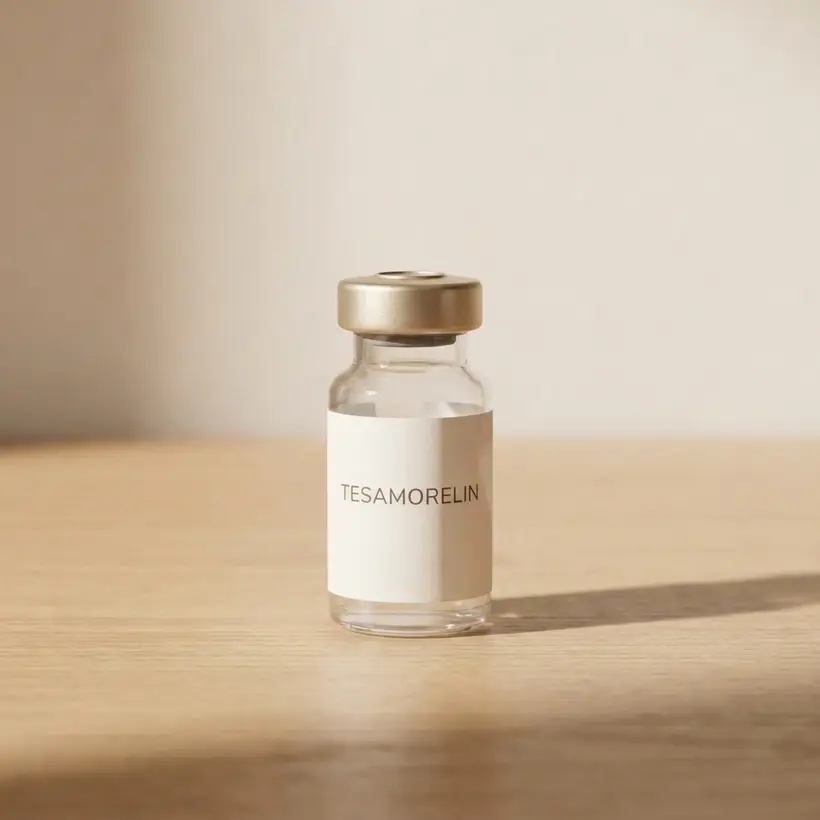
From the FormBlends catalog
Tesamorelin
GHRH analog studied for visceral-fat reduction; the molecule was approved as Egrifta · From $249/mo · compounded by a licensed 503A pharmacy, dispensed only after provider review.
View Tesamorelin →The molecular weight of tesamorelin is approximately 5135 Da (per the EGRIFTA SV prescribing information). At this size, oral bioavailability is negligible. Gastric proteases and intestinal peptidases cleave peptide bonds before absorption, and even if some peptide survived to the portal circulation, first-pass hepatic metabolism would eliminate most of it. Subcutaneous injection delivers tesamorelin into the interstitial space where it is absorbed into capillaries and lymphatics without first-pass clearance.
The trans-3-hexenoic acid modification resists cleavage by DPP-IV at the His-Ala bond that rapidly inactivates native GHRH. This extends the functional activity in plasma, though the exact plasma half-life of tesamorelin under clinical dosing conditions is short enough (measured in minutes for related GHRH analogues) that once-daily dosing still works through pulsatile GH stimulation rather than continuous elevation.
Evidence Ledger: What Is and Is Not Proven
| Claim | Best Evidence Type | Key Source | Effect Direction | Confidence |
|---|---|---|---|---|
| 2 mg/day SC reduces visceral adipose tissue in HIV-associated lipodystrophy | Human RCT (Phase 3, n=412) | Falutz et al., NEJM 2007 | Positive (VAT reduction vs. placebo) | High |
| IGF-1 rises significantly with daily 2 mg dosing | Human RCT biomarker data | Falutz et al., 2007; 2010 | Positive (IGF-1 elevation) | High |
| Subcutaneous abdominal injection is the correct route | FDA prescribing information, pivotal trial protocol | EGRIFTA SV PI | Established | High |
| Tesamorelin improves cognitive function or body composition in non-HIV adults | Small human trials (not RCT-powered for approval) | Baker et al., 2012 (cognitive); various | Possibly positive, underpowered | Low |
| Evening dosing superior to morning dosing | Physiological rationale only; no head-to-head RCT | GH secretion literature | Plausible but unproven | Very Low |
| Doses above 2 mg/day improve outcomes | No human trial data | None identified | Unknown; more adverse effects likely | Very Low |
| Tesamorelin reduces cardiovascular risk markers (e.g., triglycerides) | Phase 3 secondary endpoint data | Falutz et al., 2008 (Lancet) | Modest positive | Moderate |
How Do You Reconstitute and Prepare Tesamorelin?
The EGRIFTA SV prescribing information specifies this process. The same principles apply to any research-grade lyophilized tesamorelin vial.
- Remove the vial of lyophilized tesamorelin and the vial of sterile water for injection from refrigeration. Let both reach room temperature for roughly 15 minutes; injecting cold solution increases injection-site discomfort.
- Clean the stoppers of both vials with a fresh alcohol swab. Let the alcohol dry fully before piercing.
- Draw 2.1 mL of sterile water for injection into a syringe. Inject it slowly into the tesamorelin vial, directing the stream against the glass wall rather than directly onto the powder cake. This reduces mechanical disruption of the peptide.
- Gently roll the vial between your palms or swirl in slow circles. Do not shake vigorously. Shaking introduces air-water interfaces that promote peptide aggregation, which can reduce active dose and potentially increase immunogenicity.
- The solution should be clear and colorless. Any visible particles, cloudiness, or color change indicates degradation or contamination; discard.
- Draw the full reconstituted volume into the injection syringe. Use immediately per the EGRIFTA SV instructions (within 24 hours if refrigerated).
How Do You Inject Tesamorelin Correctly?
The injection technique for tesamorelin is identical to standard subcutaneous insulin injection, which is the most studied SC injection technique in clinical practice.
- Choose a site on the abdomen, at least 2 inches away from the navel, avoiding scars, stretch marks, active bruising, or previous injection sites from the last few days.
- Clean the skin with an alcohol swab. Allow to dry. Injecting through wet alcohol stings and can cause minor chemical irritation.
- Pinch a fold of skin and subcutaneous fat between thumb and forefinger to lift the SC layer away from muscle.
- Insert the needle at 45 to 90 degrees depending on the thickness of subcutaneous fat. Leaner individuals use 45 degrees to avoid intramuscular injection. Intramuscular delivery changes absorption kinetics and increases local discomfort.
- Inject the full volume slowly and steadily. A 2 mg/2.1 mL volume requires a slow, steady push.
- Withdraw the needle smoothly. Apply gentle pressure with a clean gauze pad if needed. Do not rub, which can disperse the peptide unevenly and increase bruising.
- Dispose of the needle in an approved sharps container immediately. Never re-cap the needle.
What Dose and Timing Produce the Best Results?
The answer to dose is clear from the regulatory record: 2 mg once daily is the evidence-supported standard. The answer to timing involves more interpretation.
Endogenous GH is released in pulses, with the largest pulse occurring roughly 60 to 90 minutes after sleep onset, during slow-wave sleep. GHRH released by the hypothalamus drives these pulses. The pharmacological rationale for evening tesamorelin dosing is that administering exogenous GHRH just before or at bedtime may amplify the largest natural pulse rather than stimulating GH release at a time when somatostatin tone is high and the pituitary is refractory. The pivotal Falutz trials did not publish a formal comparison of morning versus evening dosing outcomes, so this remains a mechanistically plausible recommendation rather than a proven one.
On the question of fasting: studies with GHRH analogues consistently show that somatostatin release rises after carbohydrate-rich meals, blunting GH pulse amplitude. Dosing in a relative fast state (2 to 3 hours after the last meal) is therefore physiologically rational. The EGRIFTA SV label does not specify a fasting requirement, but this is a practical consideration supported by GH secretion physiology.
Duration of treatment: the Falutz 2010 extension study showed that VAT returns toward baseline after tesamorelin is stopped. Continuous daily administration is required to maintain the effect; this is not a peptide where a short cycle produces lasting structural change.
How Should Tesamorelin Be Stored, and Why Does It Matter?
The EGRIFTA SV prescribing information specifies storage at 2 to 8 degrees Celsius (standard refrigerator temperature) for unreconstituted vials, protected from light. This is not arbitrary. The degradation pathways for lyophilized peptides at room temperature include:
- Deamidation: Asparagine and glutamine residues (both present in the GHRH sequence) undergo spontaneous deamidation accelerated by heat and moisture. Deamidation converts Asn to Asp or Glu, altering charge and potentially receptor binding affinity.
- Oxidation: Methionine residues oxidize in the presence of atmospheric oxygen and light, particularly when moisture is present. Lyophilization removes most water but does not create a zero-oxygen environment unless the vial is sealed under nitrogen.
- Aggregation: Physical aggregation of peptide molecules occurs more rapidly at higher temperatures. Aggregated peptide is not only inactive but may be more immunogenic.
Room-temperature stability of lyophilized peptide vials varies by formulation, excipients (EGRIFTA SV contains mannitol as a stabilizer), and seal integrity. The manufacturer does not claim room-temperature stability for extended periods. For practical purposes: if a vial has been left unrefrigerated for more than a few hours, especially in a warm environment, there is no reliable way to assess how much active peptide remains without a bioassay. The visual appearance of the reconstituted solution does not rule out loss of potency from deamidation or oxidation.
What Most Pages Get Wrong About Tesamorelin Administration
This is the section where commodity medspa blogs and general peptide directories consistently fail their readers.
1. Treating all GHRH peptides as interchangeable. Sermorelin (GHRH 1-29), CJC-1295, and tesamorelin are different molecules with different approved statuses, different half-lives, different receptor binding profiles, and different evidence bases. Saying "take it the same way as sermorelin" is not supported by comparative pharmacokinetic data.
2. Ignoring penetration and bioavailability limits of SC injection. Subcutaneous absorption of tesamorelin is not 100%. Factors including injection depth (SC vs. IM vs. intradermal), local blood flow, site edema from prior injections, and injection-site fibrosis from repeated same-site dosing all affect how much active peptide reaches systemic circulation. Clinical trials control for these variables with training and site rotation; informal protocols often do not.
3. Skipping IGF-1 monitoring. Every published clinical trial of tesamorelin monitored IGF-1 levels. Elevated IGF-1 above the age-adjusted normal range is a documented finding in a subset of tesamorelin users. Chronic supraphysiologic IGF-1 has theoretical cancer promotion concerns and is a reason the FDA label includes monitoring guidance. Pages that describe tesamorelin dosing without mentioning IGF-1 monitoring are incomplete.
4. Understating the reconstitution window. Many blogs say "store the reconstituted vial in the fridge for up to a week." The EGRIFTA SV prescribing information does not support a multi-day reconstituted storage window for the commercial product. This advice may originate from protocols using bacteriostatic water with research-grade peptides, which is a different situation and not formally validated for tesamorelin stability.
5. Claiming fat loss generalizability. The Phase 3 evidence base is specifically in HIV-positive adults with antiretroviral therapy-associated lipodystrophy. Extrapolating the magnitude of VAT reduction to healthy adults without HIV or lipodystrophy is not supported by controlled evidence.
Honest Head-to-Head: Tesamorelin vs. Sermorelin vs. CJC-1295
| Factor | Tesamorelin | Sermorelin | CJC-1295 (with DAC) |
|---|---|---|---|
| FDA approval | Yes (HIV lipodystrophy, EGRIFTA SV) | Formerly approved (withdrawn 2008 for commercial reasons, not safety) | No |
| Sequence | GHRH 1-44 + trans-3-hexenoic acid | GHRH 1-29 | GHRH 1-29 + Drug Affinity Complex (DAC) |
| Half-life in circulation | Minutes (longer than native GHRH due to DPP-IV resistance) | Minutes (shorter, no DPP-IV protection) | Days (albumin binding via DAC) |
| Dosing frequency | Once daily SC | Once daily SC (sometimes split) | Once or twice weekly SC |
| Human RCT evidence for body composition | Yes (Phase 3, HIV population) | Limited, no powered RCT for body composition | Very limited human data |
| Where tesamorelin loses | Cost (brand drug pricing), daily injection burden, HIV-specific evidence base | Lower cost (compounded), less injection burden debate | Less frequent injections are convenient |
| Where tesamorelin wins | Strongest human evidence, FDA-reviewed safety profile, full GHRH sequence | Sermorelin has shorter sequence with potentially less receptor activation | CJC-1295 with DAC blunts natural GH pulsatility, which has unknown long-term consequences |
The honest bottom line: tesamorelin has the best evidence of any GHRH analogue for a specific clinical outcome, but that outcome (HIV-related VAT) is narrow. For off-label use in general populations, all three peptides lack powered RCT evidence, and tesamorelin's advantage is largely regulatory and pharmacological rather than proven in the target population.
Operational and Label Literacy: Reading a Vial, COA, and Syringe
Reading the vial label: A legitimate EGRIFTA SV vial states 2 mg tesamorelin per vial, lot number, expiration date, and manufacturer (Theratechnologies). Research-grade vials should state peptide name, mass per vial (commonly 2 mg or 5 mg), lot number, and recommended storage. A vial lacking a lot number or with no expiration date has no traceability.
Reading a Certificate of Analysis (COA): A credible COA for research-grade tesamorelin should include: (a) HPLC purity, typically reported as area percentage, with greater than 98% being the standard for pharmaceutical-grade peptide; (b) mass spectrometry confirmation of the correct molecular weight (approximately 5135 Da); (c) water content by Karl Fischer titration (relevant to calculating actual peptide mass per vial); and (d) residual solvent and heavy metal testing if the COA is thorough. A COA that only shows HPLC purity without MS confirmation cannot exclude a peptide of similar elution profile but different sequence.
Syringe math for reconstitution: If you reconstitute 2 mg tesamorelin in 2 mL of bacteriostatic water, the concentration is 1 mg/mL. To inject 2 mg, you draw 2 mL into a standard 1 mL insulin syringe twice, or use a 3 mL syringe. If you reconstitute in 1 mL, the concentration is 2 mg/mL and you inject 1 mL. Confirm your math before every injection. Concentration errors are the most common user error in peptide self-administration.
What a degraded product looks like: Yellow or brown discoloration, visible particulates after gentle swirling, and cloudiness that does not clear are all signs of degradation or contamination. A properly reconstituted tesamorelin solution is clear and colorless. Note: a peptide can be biochemically degraded (deamidated, oxidized) while still appearing clear; visual inspection is necessary but not sufficient for quality assurance.
What Side Effects Are Linked to How You Take It?
The Phase 3 trials reported injection-site reactions in a meaningful proportion of subjects: erythema, pruritus, swelling, and pain at the injection site. These are directly related to injection technique. Consistent rotation, correct SC depth, and allowing the reconstituted solution to reach room temperature before injection all reduce local reactions.
Systemic effects including peripheral edema, arthralgia, myalgia, and paresthesia (carpal tunnel-like symptoms) are GH-mediated effects and relate to dose and individual sensitivity to IGF-1 elevation rather than to injection technique specifically. Glucose intolerance is a GH-axis effect; tesamorelin increases insulin resistance by a mechanism common to GH excess, and this is most relevant in individuals with existing pre-diabetes or metabolic syndrome.
The practical implication for how you take it: IGF-1 should be checked at baseline and after 1 to 3 months of treatment. If IGF-1 rises above the age-adjusted upper limit of normal, dose reduction or discontinuation is the appropriate response. This monitoring step is built into the EGRIFTA SV prescribing information and is not optional for responsible use.
FAQ
How do you take tesamorelin peptide?
Tesamorelin is administered as a subcutaneous injection into the abdomen once daily, typically at a dose of 2 mg. You reconstitute the lyophilized powder with sterile water, gently swirl without shaking, then inject using a small-gauge insulin syringe. Rotate injection sites to avoid lipodystrophy at any single spot.
What is the standard tesamorelin dose?
The FDA-approved dose for EGRIFTA SV is 2 mg subcutaneously once daily. Research protocols have used doses from 1 mg to 2 mg daily. There is no established evidence that exceeding 2 mg per day improves outcomes, and higher doses increase IGF-1 elevation and adverse-effect risk.
When is the best time to take tesamorelin?
Most clinical trials dosed tesamorelin in the evening or before bed to align with the natural pulsatile growth hormone release that peaks during slow-wave sleep. There is no RCT directly comparing morning versus evening dosing on outcomes, but the physiological rationale for evening administration is well supported.
How do you reconstitute tesamorelin powder?
Inject 2.1 mL of the supplied sterile water for injection into the tesamorelin vial. Gently roll or swirl the vial until the powder dissolves. Do not shake vigorously, as mechanical agitation can cause aggregation and partial degradation of the peptide. Use within the manufacturer-specified window after reconstitution.
How long does tesamorelin take to work?
In the Phase 3 trials by Falutz et al. (2007, 2010), statistically significant reductions in visceral adipose tissue were measured at 26 weeks. IGF-1 levels rise within days of starting treatment, but meaningful body composition changes take at least 3 to 6 months of consistent daily dosing.
Where do you inject tesamorelin?
The FDA-approved injection site is the abdomen, avoiding the navel and any areas with scars, bruising, or active skin conditions. Rotate within the abdominal region daily. Do not inject into muscle; the subcutaneous fat layer just under the skin is the correct target for this peptide.
How should tesamorelin be stored?
Unreconstituted tesamorelin vials must be refrigerated at 2 to 8 degrees Celsius and protected from light. Once reconstituted, EGRIFTA SV should be used immediately or stored refrigerated and used within 24 hours. The peptide bond and the amino-butyric acid modification at the N-terminus are both susceptible to degradation at room temperature over time.
Can tesamorelin be taken orally?
No. Tesamorelin is a 44-amino-acid peptide with a molecular weight of approximately 5135 Da. Oral administration results in near-complete proteolytic degradation in the gastrointestinal tract before systemic absorption. No oral formulation exists. Subcutaneous injection is the only route with demonstrated bioavailability.
What needle size is used to inject tesamorelin?
A 28 to 31 gauge, 5/16 to 1/2 inch insulin syringe is appropriate for subcutaneous abdominal injection of tesamorelin. Draw the reconstituted solution slowly into the syringe, then inject at a 45 to 90 degree angle depending on body fat thickness.
What are the most common side effects of tesamorelin?
In the Phase 3 trials, the most common adverse effects included injection-site reactions (erythema, pruritus, pain), peripheral edema, arthralgia, and myalgia. Glucose intolerance was observed due to GH-mediated insulin resistance. Carpal tunnel syndrome was reported in a minority of subjects. IGF-1 elevation above the normal range is a monitoring concern.
Who should not take tesamorelin?
Tesamorelin is contraindicated in pregnancy (FDA Category X), in individuals with active malignancy, and in those with hypersensitivity to tesamorelin or mannitol. Caution is required in people with diabetes, pre-diabetes, or active pituitary disease. It is not approved for use in children or for general anti-aging purposes.
Is tesamorelin the same as sermorelin or CJC-1295?
No. Tesamorelin is a stabilized analogue of full-length GHRH (1-44) with a trans-3-hexenoic acid group at the N-terminus to resist DPP-IV cleavage. Sermorelin is a shorter GHRH fragment (1-29). CJC-1295 is a further-modified GHRH analogue with an albumin-binding DAC modification for extended half-life. Only tesamorelin has FDA approval for a specific clinical indication.
Sources
- Falutz J, Allas S, Blot K, et al. Metabolic effects of a growth hormone-releasing factor in patients with HIV. N Engl J Med. 2007;357(23):2359-2370.
- Falutz J, Mamputu JC, Potvin D, et al. Effects of tesamorelin (TH9507), a growth hormone-releasing factor analog, in HIV-infected patients with abdominal fat accumulation: a multicenter, double-blind study. J Acquir Immune Defic Syndr. 2010;53(3):311-322.
- Falutz J, Allas S, Mamputu JC, et al. Long-term safety and effects of tesamorelin, a growth hormone-releasing factor analogue, in HIV patients with abdominal fat accumulation. AIDS. 2008;22(14):1719-1728.
- EGRIFTA SV (tesamorelin for injection) United States Prescribing Information. Theratechnologies Inc. Available via FDA.gov. Accessed 2026.
- Baker LD, Barsness SM, Borson S, et al. Effects of growth hormone-releasing hormone on cognitive function in adults with mild cognitive impairment and healthy older adults: results of a controlled trial. Arch Neurol. 2012;69(11):1420-1429.
- Bhatt DL, Mehta C. Adaptive designs for clinical trials. N Engl J Med. 2016;375:65-74. (Methods reference for trial design context.)
- Veldhuis JD, Bowers CY. Human GH pulsatility: an ensemble property regulated by age and gender. J Endocrinol Invest. 2003;26(9):799-813.
- Manning MC, Chou DK, Murphy BM, Payne RW, Katayama DS. Stability of protein pharmaceuticals: an update. Pharm Res. 2010;27(4):544-575. (Peptide degradation mechanisms: deamidation, oxidation, aggregation.)
- United States Pharmacopeia (USP). General Chapter 1 Injections and Implanted Drug Products. USP-NF. (Subcutaneous injection standards and bacteriostatic water specifications.)
Ready when you are
Tesamorelin
GHRH analog studied for visceral-fat reduction; the molecule was approved as Egrifta · From $249/mo · compounded by a licensed 503A pharmacy, dispensed only after provider review.
View Tesamorelin →