Key Takeaway
If you struggle with anxiety or brain fog, you have probably tried many approaches to feel sharper and calmer. Selank peptide is a synthetic peptide developed at the Institute of Molecular Genetics of the Russian Academy of Sciences.
If you struggle with anxiety or brain fog, you have probably tried many approaches to feel sharper and calmer. Selank peptide is a synthetic peptide developed at the Institute of Molecular Genetics of the Russian Academy of Sciences. It was designed as a stable analog of the naturally occurring immunomodulatory peptide tuftsin. Since the early 2000s, selank has been studied for its potential anxiolytic (anti-anxiety) and nootropic (cognitive-enhancing) effects.
Key Takeaways: - Learn how selank works in the brain - Understand what research says about selank's benefits - Learn how selank is administered - Safety Profile and Potential Side Effects
What makes selank interesting is that it works differently than traditional anxiety medications. It doesn't sedate you. It doesn't create dependency. And preliminary research suggests it may sharpen cognitive function at the same time it calms anxiety. Here is what the science says.
How Selank Works in the Brain
Selank is a heptapeptide, meaning it's made up of seven amino acids. It's based on the structure of tuftsin, a naturally occurring peptide fragment of immunoglobulin G (IgG). But selank has been modified to be more stable in the body and to cross into the central nervous system more effectively.
Research suggests selank affects several key neurotransmitter systems:
GABA system. Selank appears to modulate GABA (gamma-aminobutyric acid) activity, which is the brain's primary inhibitory neurotransmitter. GABA is the same system targeted by benzodiazepines, but selank doesn't bind to benzodiazepine receptors directly. Instead, it seems to influence the way GABA is processed, producing a calming effect without sedation.
Serotonin metabolism. Studies have shown that selank can affect serotonin metabolism in the brain. Research published in the Bulletin of Experimental Biology and Medicine found that selank influenced the metabolism of serotonin in several brain regions, which may contribute to its mood-regulating effects.
BDNF expression. Brain-derived neurotrophic factor (BDNF) is a protein that supports the growth and maintenance of neurons. Some research suggests selank can increase BDNF expression, which may explain its cognitive-enhancing effects. Higher BDNF levels are associated with better learning, memory, and neuroplasticity.
Immune modulation. As a tuftsin analog, selank has immunomodulatory properties. It may help regulate immune function without suppressing it. This is relevant because inflammation and immune dysfunction can contribute to both anxiety and cognitive impairment.
The combination of these mechanisms gives selank a unique profile: it may calm without sedating and sharpen cognition without stimulating. This dual action is what sets it apart from most conventional approaches to anxiety and cognitive support.
"The conversation about obesity needs to shift from willpower to biology. These medications work because obesity is a neuroendocrine disease, not a character flaw.") Dr. Fatima Cody Stanford, MD, MPH, Massachusetts General Hospital
What Research Says About Selank's Benefits
Selank has been studied in both animal models and human clinical trials, primarily in Russia where it was developed. Here is a summary of the key findings.

Anxiety reduction. Clinical studies in humans have compared selank to benzodiazepines for generalized anxiety. One study found that selank produced anxiolytic effects comparable to the benzodiazepine medazepam, but without the sedation, cognitive impairment, or dependency risk associated with benzodiazepines. Patients reported feeling calmer without feeling drowsy or mentally dull.
Free Download: Protocol Planner Track your selank protocol, mood, and cognitive performance with a structured weekly planner. Get yours free (we'll email it to you instantly. [Download Your Protocol Planner]
Cognitive enhancement. Animal studies have shown that selank can improve learning and memory formation, particularly under stressful conditions. Rats treated with selank performed better on memory tasks compared to controls. The enhancement was most pronounced when cognitive performance was impaired by stress, suggesting selank may help maintain mental clarity under pressure.
Mood stabilization. Some research indicates selank may have antidepressant-like properties in addition to its anti-anxiety effects. This may be related to its influence on serotonin metabolism and BDNF expression.
Neuroprotection. Preliminary studies suggest selank may have neuroprotective effects, potentially helping to protect brain cells from oxidative stress and inflammation-related damage.
It's critical to note that while these findings are promising, selank hasn't been approved by the FDA for any indication. Most human clinical data comes from Russian studies. More large-scale, placebo-controlled trials in Western research settings are needed to confirm these benefits. All use through FormBlends providers is prescribed off-label based on clinical judgment.
For a broader view of peptides that support recovery and repair, see our .
How Selank Is Administered
Selank is most commonly administered as a nasal spray, though subcutaneous injection is also used. The nasal route is preferred for neurological applications because it allows the peptide to reach the brain more directly via the olfactory nerve pathway.
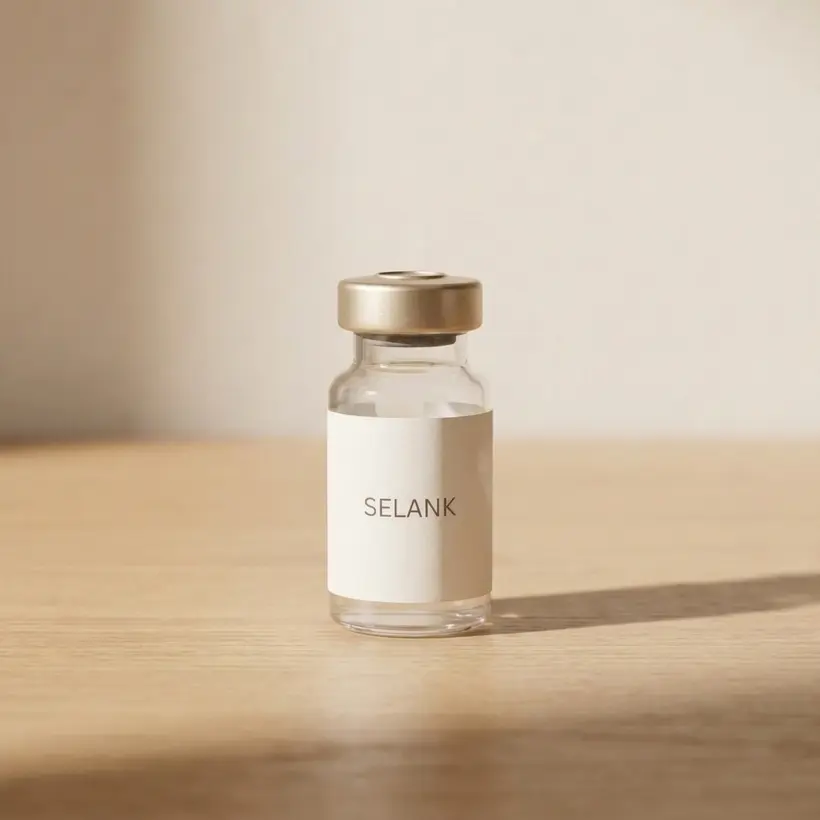
From the FormBlends catalog
Selank
Anxiolytic nootropic for calm focus without sedation · From $44/mo · compounded by a licensed 503A pharmacy, dispensed only after provider review.
Learn about Selank →Nasal spray protocol: - Typical dose: 200-400 mcg per administration - Frequency: 2-3 times daily - Cycle: Protocols typically run 2-4 weeks, followed by a break - Onset: Effects are often noticed within 15-30 minutes of nasal administration
Subcutaneous injection: - Typical dose: 250-500 mcg per injection - Frequency: Once daily - Cycle: Similar to nasal protocols, 2-4 weeks
The nasal spray format makes selank one of the more convenient peptides to use. There are no needles involved, and administration takes seconds. But the subcutaneous route may be preferred in some cases for more consistent dosing.
If your protocol includes injectable peptides, the can help you prepare your doses accurately.
Important timing notes: - Selank can be taken at any time of day - For anxiety support, morning and early afternoon dosing is common - For cognitive tasks, dosing 15-30 minutes before focused work may be helpful - Evening dosing is generally fine as selank doesn't typically cause insomnia
Your provider will customize your protocol based on your symptoms, goals, and response. If you're also taking a , selank works through entirely different pathways and is generally considered compatible, though your provider should be aware of your full medication list.
Safety Profile and Potential Side Effects
Selank has demonstrated a strong safety profile in the available research. Because it's based on a naturally occurring peptide fragment and doesn't bind directly to benzodiazepine receptors, it avoids many of the risks associated with traditional anti-anxiety medications.
What the safety data shows: - No evidence of dependency or withdrawal effects - No significant sedation at standard doses - No cognitive impairment (in fact, cognition may improve) - No known drug interactions have been widely reported, though this area needs more study
Possible side effects: - Mild nasal irritation (with nasal spray route) - Temporary fatigue in some users during the first few days - Rare reports of mild headache - Occasional mild dizziness
Serious adverse effects from selank haven't been documented in the published literature. But long-term safety data from large Western clinical trials is limited. This is why provider oversight is important.
Selank shouldn't be viewed as a replacement for psychiatric medication without a thorough clinical evaluation. If you're currently taking benzodiazepines, SSRIs, or other psychiatric medications, don't stop them in favor of selank without your prescribing provider's guidance.
Track your mood, anxiety levels, and cognitive performance in the to give your provider objective data for protocol adjustments.
Frequently Asked Questions
Does selank cause drowsiness like anti-anxiety medications?
No. One of selank's key advantages is that it doesn't cause the sedation associated with benzodiazepines and other traditional anti-anxiety medications. Research suggests it produces a calming effect while maintaining or even improving mental alertness. Most users report feeling calm but clear-headed.
How long does it take for selank to work?
Many users report feeling effects within 15 to 30 minutes of nasal administration, particularly a reduction in acute anxiety and improved focus. But the full benefits, especially cognitive enhancement and mood stabilization, may take one to two weeks of consistent use to become apparent.
Can I take selank with other peptides?
Selank can be part of a multi-peptide protocol. It's sometimes combined with semax (another nootropic peptide) for enhanced cognitive effects, or alongside GH peptides for a complete wellness protocol. Your provider will determine safe combinations based on your individual health profile.
Is selank legal in the United States?
Selank isn't FDA-approved and isn't a controlled substance. Licensed providers can prescribe it off-label, and licensed compounding pharmacies can prepare it. It isn't available as an over-the-counter supplement. FormBlends connects you with licensed providers and US-based 503A compounding pharmacies.
How is selank different from semax?
Both selank and semax are synthetic peptides developed in Russia for neurological applications. Selank is primarily anxiolytic (anti-anxiety) with cognitive benefits, while semax is primarily nootropic (cognitive enhancement) with some mood-supporting effects. They work through different mechanisms and are sometimes used together under medical supervision.
Start your plan Today
Every transformation starts with a single step. Talk to a licensed FormBlends provider about whether this approach is right for you) consultations are free and confidential.
Sources &. References
- Pickart L, Vasquez-Soltero JM, Margolina A. GHK Peptide as a Natural Modulator of Multiple Cellular Pathways in Skin Regeneration. BioMed Res Int. 2015;2015:648108. Doi:10.1155/2015/648108
- Pickart L, Vasquez-Soltero JM, Margolina A. GHK and DNA: Resetting the Human Genome to Health. BioMed Res Int. 2014;2014:151479. Doi:10.1155/2014/151479
- Sikiric P, Hahm KB, Blagaic AB, et al. Stable Gastric Pentadecapeptide BPC 157, Robert's Cytoprotection, Adaptive Cytoprotection, and Therapeutic Effects. Curr Pharm Des. 2018;24(18):1990-2001. Doi:10.2174/1381612824666180515125918
- Chang CH, Tsai WC, Lin MS, et al. The promoting effect of pentadecapeptide BPC 157 on tendon healing involves tendon outgrowth, cell survival, and cell migration. J Appl Physiol. 2011;110(3):774-780. Doi:10.1152/japplphysiol.00945.2010
- Seiwerth S, Brcic L, Vuletic LB, et al. BPC 157 and blood vessels. Curr Pharm Des. 2014;20(7):1121-1125. Doi:10.2174/13816128113199990421
- Bock-Marquette I, Saxena A, White MD, et al. Thymosin beta4 activates integrin-linked kinase and promotes cardiac cell migration, survival and cardiac repair. Nature. 2004;432(7016):466-472. Doi:10.1038/nature03000
- Malinda KM, Sidhu GS, Mani H, et al. Thymosin beta4 accelerates wound healing. J Invest Dermatol. 1999;113(3):364-368. Doi:10.1046/j.1523-1747.1999.00708.x
The information in this article is intended for educational use only and shouldn't be considered medical advice. Consult a qualified healthcare provider before making any changes to your medication or supplement regimen. FormBlends helps with connections with licensed providers for personalized medical guidance.
Last updated: 2026-03-24
Ready when you are
Selank
Anxiolytic nootropic for calm focus without sedation · From $44/mo · compounded by a licensed 503A pharmacy, dispensed only after provider review.
Learn about Selank →