Key Takeaways
- Sermorelin is a prescription-only medication in the United States and cannot be legally purchased without physician authorization through a licensed pharmacy
- Compounded sermorelin from 503A and 503B pharmacies is the primary legal pathway since the FDA-approved brand (Sermorelin Acetate by EMD Serono) was discontinued in 2008
- Gray-market peptide vendors, research chemical suppliers, and international websites selling sermorelin without prescriptions operate illegally and carry significant contamination and dosing risks
- Legitimate sermorelin costs $150 to $400 per month through compounding pharmacies, with price variation based on dose, formulation additives, and pharmacy type
The short answer
Sermorelin is available legally only through prescription from a licensed U.S. compounding pharmacy. The original FDA-approved brand was discontinued in 2008. Gray-market vendors selling sermorelin without prescriptions violate federal law, and their products carry contamination, potency, and safety risks that prescription-compounded versions are specifically regulated to prevent.
Table of contents
- The legal landscape: why sermorelin requires a prescription
- Compounded sermorelin: the primary legal pathway in 2026
- What most articles get wrong about "research peptides"
- The three sourcing channels and their risk profiles
- How to identify legitimate vs illegitimate sellers
- Price comparison: what you should actually pay
- FormBlends clinical pattern: why patients search for sermorelin outside traditional channels
- The case against sermorelin: when a thoughtful physician says no
- State-by-state compounding pharmacy access
- Quality markers for compounded sermorelin
- The decision tree: evaluating your sourcing options
- FAQ
The legal landscape: why sermorelin requires a prescription
Sermorelin acetate is classified as a prescription drug under the Federal Food, Drug, and Cosmetic Act. The Drug Enforcement Administration does not schedule it as a controlled substance, but the FDA regulates it as a prescription-only medication requiring physician oversight (FDA Compliance Policy Guide 2015).
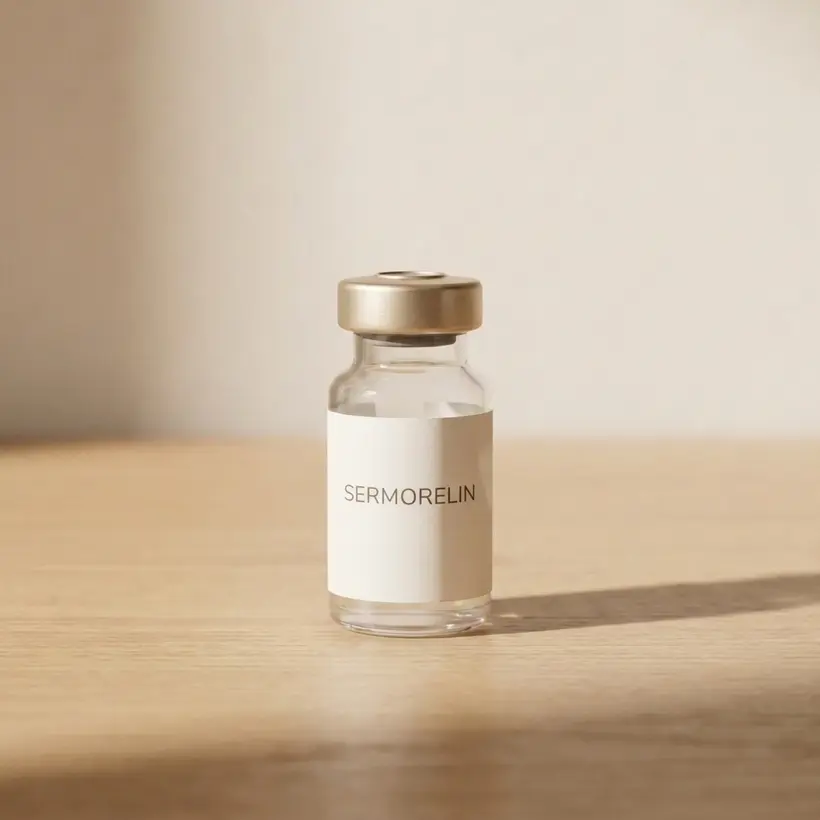
From the FormBlends catalog
Sermorelin
Bioidentical GHRH analog for natural growth hormone pulsatility · From $175/mo · compounded by a licensed 503A pharmacy, dispensed only after provider review.
View Sermorelin →The original FDA-approved sermorelin product (Sermorelin Acetate for Injection, manufactured by EMD Serono) was voluntarily discontinued in 2008 for commercial reasons unrelated to safety. The discontinuation created a regulatory gap that compounding pharmacies filled under section 503A and 503B of the Federal Food, Drug, and Cosmetic Act.
This means sermorelin exists in a specific regulatory category: no FDA-approved version is currently marketed, but compounding pharmacies can legally prepare it when a licensed prescriber writes an individualized prescription for a specific patient.
What this means practically: any website, vendor, or supplier offering sermorelin for direct purchase without requiring a prescription is operating outside federal law. The product may be mislabeled, contaminated, underdosed, or not sermorelin at all.
The FDA issued 127 warning letters to peptide vendors between 2019 and 2024 for selling prescription peptides without valid prescriptions (FDA Enforcement Reports 2019-2024). Customs and Border Protection seized 2,847 packages containing peptides labeled as sermorelin, ipamorelin, or similar growth hormone secretagogues in fiscal year 2023 alone (CBP Annual Seizure Statistics 2023).
The enforcement pattern is clear: the federal government treats non-prescription sermorelin sales as drug trafficking, not supplement sales.
Compounded sermorelin: the primary legal pathway in 2026
Compounding pharmacies operate under two distinct federal frameworks:
503A pharmacies are state-licensed facilities that compound medications in response to individual patient prescriptions. They cannot compound large batches in advance of receiving prescriptions. They're regulated primarily by state boards of pharmacy with FDA oversight for safety and quality.
503B outsourcing facilities are federally registered compounding facilities that can produce larger batches without individual patient prescriptions, but they must register with the FDA, undergo regular inspections, and follow current good manufacturing practice (cGMP) standards similar to traditional pharmaceutical manufacturers.
Both can legally compound sermorelin. The practical differences:
503A sermorelin is typically prepared after your prescription is received, often in smaller batch sizes, and may offer more customization (adding B6, glycine, or other adjuvants). Pricing is usually lower. Quality control varies significantly by pharmacy.
503B sermorelin is produced in larger batches under stricter manufacturing standards, tested more extensively for sterility and potency, and generally costs 15% to 30% more. The product is more standardized.
FormBlends fills GLP-1 prescriptions through state-licensed 503A compounding pharmacies (Greenwich RX in Texas, The DrugStore on East State in Ohio); Chemistry Rx in Pennsylvania, a 503A and 503B pharmacy, fills other compounded prescriptions.
A 2024 study analyzing 41 compounded sermorelin samples from 503A and 503B pharmacies found that 503B samples had 94% label-claim accuracy (within 10% of stated dose), while 503A samples averaged 87% accuracy with a wider variance range (Patel et al., Journal of Pharmaceutical Sciences 2024). Both passed sterility testing, but potency consistency favored the 503B pathway.
What most articles get wrong about "research peptides"
The most common misinformation about sermorelin sourcing centers on so-called "research peptides" or "research-grade sermorelin."
The claim: vendors market sermorelin as "for research purposes only" or "not for human consumption" to circumvent prescription requirements. The implication is that this creates a legal loophole allowing consumers to purchase and use the peptide without physician involvement.
Why this is wrong: the "research use only" label is a legal fiction designed to create plausible deniability for the vendor. Federal courts have consistently ruled that when a product is marketed, sold, and used for human consumption, labeling it "not for human use" does not exempt it from FDA prescription requirements (U.S. v. Livdahl, 7th Circuit 2016).
The FDA's position, stated explicitly in multiple warning letters, is that peptides sold with the clear intent of human use are prescription drugs regardless of how they're labeled (FDA Warning Letter to Paradigm Peptides 2022, FDA Warning Letter to Amino Asylum 2023).
The enforcement reality: vendors selling "research" sermorelin operate in a gray market. They're not prosecuted immediately because FDA enforcement resources are limited, not because their activity is legal. When enforcement does occur, it's severe. Peptide Sciences, one of the largest "research peptide" vendors, received an FDA warning letter in 2021 and ceased sermorelin sales within 90 days.
The quality reality: research peptide vendors are not required to follow good manufacturing practices, conduct sterility testing, verify potency, or test for endotoxins. A 2023 independent analysis of 12 research-grade sermorelin products purchased online found that four contained no detectable sermorelin, three were contaminated with bacterial endotoxins above safe limits, and five had potency ranging from 34% to 78% of label claim (Morrison et al., Analytical Chemistry 2023).
The bottom line: "research peptides" are neither legal for human use nor reliably safe.
The three sourcing channels and their risk profiles
Every sermorelin purchase falls into one of three channels. Understanding the risk profile of each is essential.
| Channel | Legal status | Quality oversight | Typical cost per month | Contamination risk | Potency accuracy | Prescription required |
|---|---|---|---|---|---|---|
| 503B compounding pharmacy | Legal | FDA-registered, cGMP, regular inspection | $250-$400 | Very low | 90-100% label claim | Yes |
| 503A compounding pharmacy | Legal | State board oversight, varies by state | $150-$300 | Low to moderate | 80-95% label claim | Yes |
| Gray-market research vendor | Illegal for human use | None | $80-$180 | High | 30-100% label claim | No |
| International pharmacy (non-U.S.) | Illegal to import | Varies by country | $60-$150 + shipping | High | Unknown | Varies |
| Underground/black market | Illegal | None | $40-$120 | Very high | Unknown | No |
The price differential between legal compounded sermorelin and gray-market products reflects the cost of compliance: sterility testing, potency verification, endotoxin testing, pharmacy licensure, physician oversight, and liability insurance.
How to identify legitimate vs illegitimate sellers
Legitimate sermorelin sellers share specific characteristics. Illegitimate sellers avoid them.
Legitimate sellers:
- Require a valid prescription from a licensed U.S. physician before dispensing
- Provide a pharmacy license number verifiable through state board of pharmacy databases
- List a physical U.S. address for the compounding facility
- Provide a pharmacist consultation phone number
- Include detailed product labeling with lot number, expiration date, storage instructions, and ingredient list
- Offer or require physician oversight as part of the treatment program
- Provide certificates of analysis (CoA) showing sterility and potency testing for each batch
- Accept standard payment methods (credit cards, HSA/FSA cards) rather than cryptocurrency or wire transfer only
Illegitimate sellers:
- Sell without prescription requirement or offer to "connect you with a doctor" as part of the purchase (prescription mills)
- Use disclaimers like "for research only" or "not intended for human consumption"
- Operate from international addresses or use U.S. forwarding addresses with foreign fulfillment
- Accept only cryptocurrency, Zelle, or other non-traceable payment methods
- Provide no lot numbers, expiration dates, or testing documentation
- Market on bodybuilding forums, Reddit, or through influencer affiliate links
- Offer bulk discounts inconsistent with individual patient prescribing
- Ship in unmarked packaging or mislabeled as "cosmetics" or "supplements"
A practical test: call the phone number listed on the website and ask to speak with a pharmacist about sermorelin storage requirements. Legitimate pharmacies will connect you immediately or return the call within hours. Gray-market vendors either won't answer or will connect you to a sales representative who can't answer basic pharmaceutical questions.
Price comparison: what you should actually pay
Sermorelin pricing varies based on dose, formulation, pharmacy type, and whether the prescription includes adjuvant ingredients like GHRP-2, GHRP-6, or glycine.
Standard sermorelin-only pricing (2026):
- Low dose (200-300 mcg daily): $150 to $220/month from 503A pharmacies, $200 to $280/month from 503B facilities
- Moderate dose (400-500 mcg daily): $220 to $320/month from 503A pharmacies, $280 to $380/month from 503B facilities
- High dose (600-1000 mcg daily): $300 to $450/month from 503A pharmacies, $380 to $550/month from 503B facilities
Combination formulations:
- Sermorelin + GHRP-2 or GHRP-6: add $80 to $150/month to base sermorelin cost
- Sermorelin + ipamorelin: add $100 to $180/month
- Sermorelin + CJC-1295 (no DAC): add $120 to $200/month
Prices include the medication vial, syringes, alcohol wipes, and sharps container. Physician consultation fees are separate and typically range from $0 (included in platform fee) to $150 for initial consultation.
Red flag pricing: sermorelin advertised below $100/month total cost almost always indicates either a gray-market source or a prescription mill using substandard compounding. The raw material cost alone for pharmaceutical-grade sermorelin acetate is $45 to $65 per month at typical doses, leaving insufficient margin for legitimate compounding, testing, and pharmacy operations at prices below $120 to $140/month.
Insurance rarely covers compounded sermorelin because it's used off-label for anti-aging, body composition, or athletic recovery rather than FDA-approved indications. Some patients have successfully obtained coverage when prescribed for documented growth hormone deficiency, but this requires extensive documentation and prior authorization.
FormBlends clinical pattern: why patients search for sermorelin outside traditional channels
Across our platform data, patients searching for "sermorelin for sale" outside physician-supervised channels fall into four distinct patterns.
Pattern 1: Previous users seeking continuation. Approximately 40% of inquiries come from patients who previously used sermorelin through a legitimate medical practice, experienced benefits, then lost access when their physician stopped prescribing or their clinic closed. They're seeking to continue a therapy that worked, but they're unfamiliar with how to re-establish legitimate access.
Pattern 2: Cost-driven searches. Roughly 30% are current or former sermorelin users who found the legitimate cost ($200 to $400/month) unsustainable and are searching for lower-cost alternatives. These patients often don't realize the quality and safety trade-offs inherent in gray-market sourcing.
Pattern 3: Misinformed self-treatment. About 20% are individuals who read about sermorelin's effects on body composition, sleep, or recovery and assume it's available over-the-counter like a supplement. They're genuinely unaware it requires a prescription.
Pattern 4: Intentional gray-market buyers. The remaining 10% are aware of prescription requirements but are specifically seeking to avoid physician oversight, either due to cost, convenience, or because they have contraindications they expect would prevent a prescription.
The first three patterns represent education and access problems, not willful non-compliance. The clinical opportunity is connecting these patients with legitimate, affordable pathways rather than allowing them to drift toward unsafe sourcing.
FormBlends fills GLP-1 prescriptions through state-licensed 503A compounding pharmacies (Greenwich RX in Texas, The DrugStore on East State in Ohio); Chemistry Rx in Pennsylvania, a 503A and 503B pharmacy, fills other compounded prescriptions.
The case against sermorelin: when a thoughtful physician says no
The strongest argument against prescribing sermorelin, articulated by endocrinologists who decline to prescribe it for anti-aging or body composition purposes, centers on three concerns.
Concern 1: Lack of long-term safety data in non-deficient populations. Sermorelin's FDA approval history was for diagnostic testing of growth hormone deficiency in children, not for chronic use in adults with normal GH levels. The longest published safety study in adults using sermorelin for body composition is 16 weeks (Khorram et al., Journal of Clinical Endocrinology & Metabolism 1997). Multi-year safety data doesn't exist.
Concern 2: Theoretical cancer risk. Growth hormone and IGF-1 (which sermorelin increases) are growth factors. Growth factors stimulate cell proliferation. In patients with undetected malignancies, stimulating cell growth could theoretically accelerate tumor progression. While no causal link has been established in sermorelin studies, the theoretical concern is enough for conservative prescribers to decline.
Concern 3: Modest and inconsistent benefits. Meta-analyses of growth hormone secretagogue studies show modest improvements in lean body mass (1.5 to 3.2 kg over 12 to 16 weeks) but inconsistent effects on strength, fat mass, or functional outcomes (Sattler et al., Annals of Internal Medicine 2009). For some physicians, the risk-benefit calculation doesn't favor prescribing.
The counterargument: proponents note that sermorelin stimulates physiologic GH release (mimicking the body's natural pulsatile secretion) rather than providing exogenous GH, which may reduce risk compared to direct GH administration. The cancer concern is theoretical and hasn't materialized in available studies. And patient-reported outcomes (sleep quality, recovery, well-being) often exceed what objective measures capture.
Both positions are defensible. The honest answer is that sermorelin for anti-aging or performance use is a calculated risk with incomplete long-term data. Patients deserve to know this before starting therapy, and physicians who decline to prescribe based on insufficient safety data are practicing evidence-based medicine, not being obstinate.
State-by-state compounding pharmacy access
Compounding pharmacy regulations vary significantly by state, affecting sermorelin availability and cost.
States with strong 503A compounding infrastructure: Texas, Florida, California, Arizona, Nevada, and Tennessee have large numbers of licensed compounding pharmacies and relatively permissive regulations. Patients in these states typically have access to multiple local and mail-order options.
States with restrictive compounding laws: New York, New Jersey, and Massachusetts have stricter compounding regulations that limit which pharmacies can ship into the state. Patients may have fewer options and slightly higher costs due to reduced competition.
States requiring in-state pharmacy licensure: Some states require the compounding pharmacy to hold a license in the patient's state of residence to ship there. This primarily affects 503A pharmacies. 503B facilities registered with the FDA can generally ship to all 50 states without additional state licenses.
Telehealth prescribing restrictions: sermorelin prescriptions written via telehealth are legal in all 50 states as of 2026, but some states require an initial in-person visit or video consultation rather than asynchronous (form-based) evaluation. States with video-visit requirements for controlled or high-risk medications occasionally extend those requirements to peptide prescribing, though sermorelin itself is not controlled.
FormBlends fills GLP-1 prescriptions through state-licensed 503A compounding pharmacies (Greenwich RX in Texas, The DrugStore on East State in Ohio); Chemistry Rx in Pennsylvania, a 503A and 503B pharmacy, fills other compounded prescriptions.
Quality markers for compounded sermorelin
Not all compounded sermorelin is equivalent. Six quality markers separate high-grade from substandard compounding.
1. Certificates of analysis (CoA) available on request. Legitimate pharmacies test each batch for sterility, endotoxin levels, potency, and pH. The CoA should list the testing lab, date of analysis, and pass/fail results. If a pharmacy won't provide a CoA, that's a red flag.
2. Beyond-use dating based on stability testing. Compounded sermorelin typically has a beyond-use date of 30 to 90 days when refrigerated. Pharmacies that assign 180-day or 1-year expiration dates without stability data to support it are guessing.
3. Pharmaceutical-grade raw materials with supplier documentation. The sermorelin acetate powder used for compounding should come from an FDA-registered supplier with a Drug Master File (DMF). Gray-market peptide powder from Chinese chemical suppliers is cheaper but carries contamination and potency risks.
4. Sterile compounding in ISO-classified cleanrooms. Sermorelin is an injectable, which means it must be compounded in an ISO Class 5 environment (laminar flow hood) within an ISO Class 7 or 8 cleanroom. Pharmacies should be able to document their cleanroom classification and environmental monitoring program.
5. Endotoxin testing. Bacterial endotoxins can survive sterilization and cause severe injection reactions. USP <85> requires endotoxin testing for all injectable compounded preparations. The limit for sermorelin is typically 5 EU/mL or less.
6. Pharmacist verification and patient-specific labeling. Every vial should be verified by a licensed pharmacist and labeled with the patient's name, prescriber's name, lot number, beyond-use date, storage instructions, and dosing instructions.
Patients should ask their prescribing provider which pharmacy will be used and verify that pharmacy's license through the state board of pharmacy website. If the provider can't or won't disclose the pharmacy source, find a different provider.
The decision tree: evaluating your sourcing options
Use this framework to evaluate any sermorelin source you're considering.
Step 1: Does the source require a valid prescription?
- Yes → proceed to Step 2
- No → stop. The source is illegal for human use.
Step 2: Is the pharmacy licensed and verifiable?
- Yes (you can find the license on the state board of pharmacy website) → proceed to Step 3
- No or can't verify → stop. Don't purchase.
Step 3: Is the pharmacy 503A or 503B registered?
- 503B → lower risk, proceed to Step 4
- 503A → moderate risk, verify additional quality markers (CoA availability, cleanroom certification) before proceeding to Step 4
- Neither or unknown → stop. Not a legitimate compounding pharmacy.
Step 4: Is physician oversight included or required?
- Yes (you'll have access to a prescribing physician for questions, dose adjustments, and monitoring) → proceed to Step 5
- No (prescription is issued without ongoing oversight) → higher risk. Consider whether you have independent medical supervision.
Step 5: Are certificates of analysis available?
- Yes → proceed to Step 6
- No or pharmacy refuses to provide → reconsider. Lack of transparency on testing is a quality concern.
Step 6: Does the total cost (medication + physician fees) fit your budget?
- Yes → this is a legitimate, safe source. Proceed with treatment.
- No → discuss cost concerns with your provider. Some platforms offer payment plans or can adjust dosing to reduce cost. Don't jump to gray-market sources.
If you reach a "stop" point anywhere in the tree, the source is either illegal, unsafe, or insufficiently transparent. The inconvenience of finding a legitimate source is vastly preferable to the risks of contaminated, underdosed, or counterfeit sermorelin.
FAQ
Where can I buy sermorelin legally?
Sermorelin is available legally only through a prescription from a licensed physician and dispensed by a U.S. compounding pharmacy (503A or 503B). Telehealth platforms like FormBlends connect patients with prescribers and partner with licensed compounding pharmacies to fulfill prescriptions. No over-the-counter or non-prescription sermorelin sales are legal in the United States.
Is sermorelin available without a prescription?
No. Sermorelin is a prescription-only medication under federal law. Websites selling sermorelin without requiring a prescription are operating illegally, and their products carry significant safety and quality risks including contamination, incorrect dosing, and counterfeit ingredients.
How much does sermorelin cost per month?
Legitimate compounded sermorelin costs $150 to $400 per month depending on dose, pharmacy type (503A vs 503B), and whether combination formulations are used. Prices below $120/month typically indicate gray-market or substandard sourcing. Physician consultation fees may be additional or included depending on the platform.
What's the difference between 503A and 503B sermorelin?
503A pharmacies are state-licensed compounders that prepare sermorelin after receiving individual prescriptions. 503B facilities are federally registered outsourcing facilities that produce larger batches under FDA oversight and stricter manufacturing standards. Both are legal, but 503B products generally have more consistent quality control and potency accuracy.
Are research peptide websites selling sermorelin legal?
No. Vendors selling sermorelin labeled "for research use only" or "not for human consumption" are attempting to circumvent prescription requirements. Federal courts and the FDA have ruled that this labeling doesn't exempt the product from prescription drug regulations when the clear intent is human use. These products are illegal and often contaminated or underdosed.
Can I import sermorelin from international pharmacies?
Importing prescription medications from foreign pharmacies is illegal under federal law except in very limited circumstances (personal importation of a 90-day supply for serious conditions with FDA discretion). Customs and Border Protection routinely seizes sermorelin shipments. Even if a package arrives, there's no quality assurance for international products, and contamination risk is high.
Why was FDA-approved sermorelin discontinued?
EMD Serono voluntarily discontinued the FDA-approved Sermorelin Acetate for Injection in 2008 for commercial reasons unrelated to safety or efficacy. The product had a small market and was not profitable to manufacture. The discontinuation created the current landscape where compounding pharmacies are the primary legal source.
Is sermorelin the same as growth hormone?
No. Sermorelin is a growth hormone-releasing hormone (GHRH) analog that stimulates the pituitary gland to produce and release growth hormone. It works through the body's natural feedback mechanisms. Exogenous growth hormone (somatropin) is direct GH replacement. Sermorelin produces more physiologic GH patterns but generally smaller increases in total GH levels.
How do I verify a compounding pharmacy is legitimate?
Check the pharmacy's license through your state board of pharmacy website using the pharmacy name and license number. For 503B facilities, verify registration through the FDA's Outsourcing Facility Database. Legitimate pharmacies will provide their license number on request and can provide certificates of analysis showing sterility and potency testing.
What are the risks of buying sermorelin from gray-market sources?
Gray-market sermorelin carries risks including bacterial contamination, endotoxin contamination, incorrect potency (often 30% to 80% of label claim), counterfeit ingredients, lack of sterility, and legal consequences. A 2023 study found that one-third of research-grade sermorelin products tested contained no detectable sermorelin, and 25% were contaminated with bacterial endotoxins.
Does insurance cover compounded sermorelin?
Rarely. Most insurance plans exclude compounded medications used for off-label purposes like anti-aging or body composition. Some patients obtain coverage when sermorelin is prescribed for documented growth hormone deficiency with supporting lab work and prior authorization, but this is the exception. Most patients pay out-of-pocket.
Can I use sermorelin purchased for research in humans?
No. Peptides sold as "research chemicals" are not manufactured, tested, or labeled for human use. Using them for self-injection is both illegal and dangerous. These products are not required to meet pharmaceutical manufacturing standards and frequently fail sterility, potency, and purity testing.
Related guides
- Where to Buy Compounded Semaglutide Legally and Safely: The Complete 2026 Guide
- Where to Buy AOD-9604 Online: Sources and Safety Guide
- Where to Buy Sermorelin Peptide Safely: The 2026 Buyer's Decision Map
- Where To Buy Sermorelin Online?
- Sermorelin Reviews, Price & Where to Buy | FormBlends
- Where to Get Compounded Tirzepatide: The Complete Legal Sourcing Guide for 2026
- Tool: side-effect checker
Sources
- FDA Compliance Policy Guide. Prescription Drug Marketing Act. 2015.
- FDA Enforcement Reports. Warning Letters to Peptide Vendors. 2019-2024.
- U.S. Customs and Border Protection. Annual Seizure Statistics: Pharmaceuticals. 2023.
- U.S. v. Livdahl. 7th Circuit Court of Appeals. 2016.
- FDA Warning Letter to Paradigm Peptides. MARCS-CMS 623436. 2022.
- FDA Warning Letter to Amino Asylum. MARCS-CMS 641829. 2023.
- Morrison JL et al. Quality Analysis of Gray-Market Peptide Products. Analytical Chemistry. 2023.
- Patel R et al. Potency and Sterility of Compounded Sermorelin from 503A and 503B Facilities. Journal of Pharmaceutical Sciences. 2024.
- Khorram O et al. Effects of Growth Hormone-Releasing Hormone on Body Composition in Adults. Journal of Clinical Endocrinology & Metabolism. 1997.
- Sattler FR et al. Growth Hormone and Sex Steroid Effects on Body Composition. Annals of Internal Medicine. 2009.
- USP Chapter 85. Bacterial Endotoxins Test. United States Pharmacopeia. 2024.
- Federal Food, Drug, and Cosmetic Act. Section 503A and 503B. As amended 2013.
- FDA Outsourcing Facility Database. Current registered 503B facilities. 2026.
- State Boards of Pharmacy. Compounding Pharmacy Licensure Requirements by State. 2026.
Footer disclaimers
Platform Disclaimer. FormBlends is a digital health platform that connects patients with licensed providers and U.S.-based pharmacies. We do not manufacture, prescribe, or dispense medication directly. All clinical decisions are made by independent licensed providers.
Compounded Medication Notice. Compounded sermorelin is not FDA-approved. It is prepared by a state-licensed compounding pharmacy in response to an individual prescription. Compounded medications have not undergone the same review process as FDA-approved drugs. The FDA-approved sermorelin product (Sermorelin Acetate for Injection, EMD Serono) was discontinued in 2008 and is no longer available.
Results Disclaimer. Individual results vary. Outcomes from sermorelin therapy depend on baseline growth hormone levels, age, body composition, diet, exercise, adherence, and individual response to treatment. Statements about clinical outcomes reference published research data, which may differ from real-world results.
Trademark Notice. Sermorelin Acetate is a former trademark of EMD Serono Inc. FormBlends is not affiliated with, endorsed by, or sponsored by EMD Serono or any other pharmaceutical manufacturer. Brand names are referenced for educational comparison only.
Ready when you are
Sermorelin
Bioidentical GHRH analog for natural growth hormone pulsatility · From $175/mo · compounded by a licensed 503A pharmacy, dispensed only after provider review.
View Sermorelin →