Key Takeaway
Complete guide to Sermorelin for tendon repair. Learn how growth hormone improvement supports tendon healing, collagen synthesis, and recovery from tendinopathy and tendon injuries.
Sermorelin for tendon repair works through growth hormone's critical role in connective tissue biology. We examine how GH improvement supports tendon healing, what distinguishes this approach from direct healing peptides, and how to build an effective tendon recovery protocol.
Why Tendons Need Growth Hormone
Tendons are composed primarily of Type I collagen fibers produced by specialized cells called tenocytes. These structures connect muscles to bones and must withstand enormous mechanical forces. When tendons are injured, the repair process is notoriously slow due to limited blood supply, low cellular density, and modest metabolic activity .
Growth hormone is directly involved in tendon health through several pathways:
- Collagen synthesis: GH and IGF-1 are among the strongest stimulators of collagen production in the body. Studies have shown that GH deficiency leads to reduced tendon collagen content and weakened mechanical properties .
- Tenocyte activity: IGF-1 receptors are present on tenocytes, and IGF-1 signaling stimulates tenocyte proliferation, matrix production, and migration to injury sites .
- Blood supply support: GH promotes angiogenesis, which can help address the limited blood supply that makes tendon healing so challenging.
- Proteoglycan production: Beyond collagen, tendons contain proteoglycans that provide hydration and compressive resistance. GH supports proteoglycan synthesis in connective tissues.
The Age Factor in Tendon Injuries
Tendon injuries become more common and heal more slowly with age. This timeline directly parallels the decline in growth hormone production:
- GH production peaks in the late teens and twenties
- By age 40, GH levels may be 50 percent or less of youthful peaks
- Achilles tendon ruptures peak in the 30 to 50 age range
- Rotator cuff tears become increasingly common after age 40
- Tendon collagen turnover slows progressively with each decade
Sermorelin aims to partially restore GH levels in this population, potentially bridging the gap between the healing demands of a tendon injury and the declining repair capacity that comes with age .
Research on GH and Tendon Healing
Collagen Synthesis Studies
A study published in the Journal of Applied Physiology measured the effect of GH on tendon collagen synthesis rates in humans. The researchers found that GH administration significantly increased the rate of tendon collagen synthesis compared to placebo . This is direct evidence that GH status affects the tendon's ability to build and repair its structural matrix.
From the FormBlends catalog
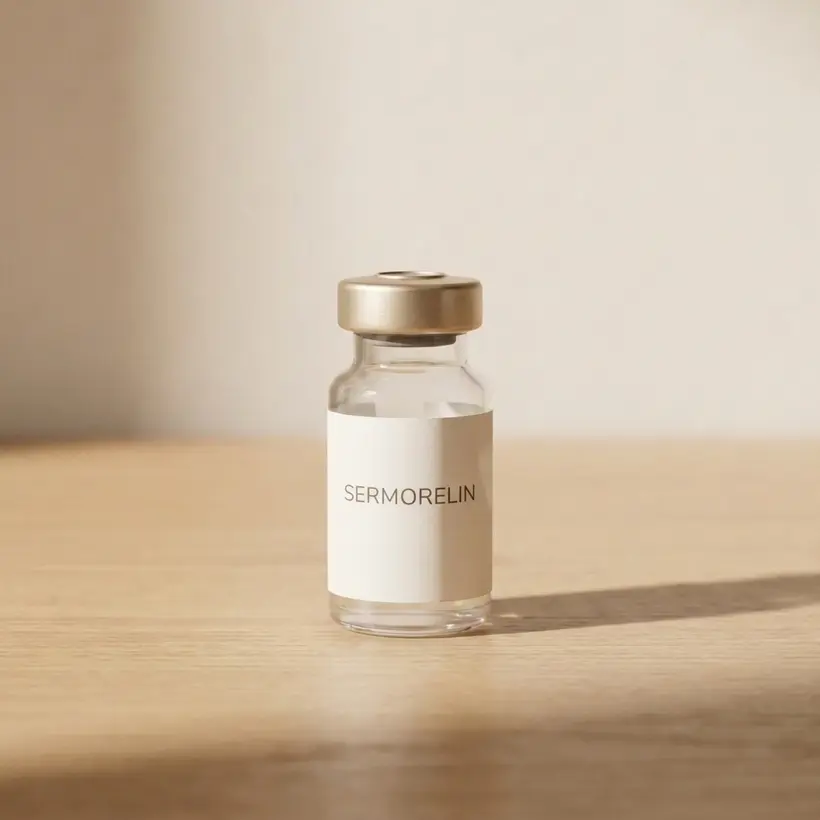
Sermorelin
Bioidentical GHRH analog for natural growth hormone pulsatility · From $175/mo · compounded by a licensed 503A pharmacy, dispensed only after provider review.
View Sermorelin →Achilles Tendon Research
Research examining Achilles tendon properties in adults with GH deficiency found that these individuals had reduced tendon stiffness and lower collagen content compared to healthy controls . After GH replacement therapy, tendon mechanical properties improved over several months.
Rotator Cuff Healing
Animal studies on rotator cuff repair have shown that local IGF-1 application improves tendon-to-bone healing at the repair site . While these studies used local rather than systemic IGF-1, they demonstrate the importance of IGF-1 signaling for tendon repair.
Sermorelin vs Direct Healing Peptides for Tendon Repair
| Peptide | Mechanism for Tendons | Evidence Level | Speed of Effect | Primary Role |
|---|---|---|---|---|
| Sermorelin | Systemic GH/IGF-1 improvement for collagen synthesis | GH/tendon studies (moderate) | Gradual (months) | Foundational support. long-term tendon health |
| TB-500 | Angiogenesis, cell migration, collagen organization | Preclinical (moderate) | Moderate (weeks) | Active injury repair |
| BPC-157 | Nitric oxide modulation, tendon-to-bone healing | Preclinical (moderate) | Moderate (weeks) | Active injury repair |
| GHK-Cu | Collagen remodeling, anti-inflammatory | Moderate (in vitro and animal) | Variable | Tissue remodeling support |
A Key Distinction
Sermorelin works differently from TB-500 and BPC-157 for tendon repair. Those peptides are direct-acting healing agents that target the injury site through specific biological mechanisms. Sermorelin operates upstream, improving the hormonal environment that influences the body's overall capacity to repair connective tissue.
Think of it this way: TB-500 and BPC-157 are like sending a specialized repair crew to the job site. Sermorelin is like ensuring the supply chain (GH, IGF-1, collagen precursors) is running at full capacity so the repair crew has everything it needs .
Building a Tendon Repair Protocol with Sermorelin
Sermorelin Dosing
- Dose: 200 to 300 mcg subcutaneous injection
- Timing: At bedtime
- Frequency: Nightly (5 to 7 days per week)
- Duration: 3 to 6 months minimum for tendon-related outcomes
Combined Protocol Example
For active tendon injuries, a thorough peptide approach might include:
- Sermorelin: 300 mcg at bedtime nightly (systemic GH/IGF-1 improvement)
- TB-500: 2.5 mg twice weekly during loading, once weekly maintenance (angiogenesis, cell migration)
- BPC-157: 250 to 500 mcg once or twice daily (local healing, nitric oxide modulation)
This multi-peptide approach addresses tendon repair at both the systemic (hormonal environment) and local (direct tissue repair) levels .
Common Tendon Conditions and Sermorelin Relevance
Different tendon conditions respond to GH improvement in different ways:
- Achilles tendinopathy: One of the most common tendon injuries in active adults. The Achilles tendon's limited blood supply makes it particularly dependent on systemic factors like GH for collagen turnover and repair. Sermorelin's angiogenic effects through GH/IGF-1 may help address this vascular limitation.
- Rotator cuff tears: Partial tears may benefit from GH improvement to support collagen synthesis at the repair site. For complete tears requiring surgical repair, Sermorelin may support the post-surgical healing of the reattached tendon to bone.
- Tennis elbow (lateral epicondylitis): This condition involves degeneration of the extensor tendon origin. GH/IGF-1 supports the tenocyte activity needed to replace degenerated tissue with healthy collagen matrix.
- Patellar tendinopathy: Common in athletes who jump or sprint. The patellar tendon's high mechanical demands require strong collagen quality that depends partly on adequate GH signaling.
- Plantar fasciitis: While technically a fascial condition rather than a tendon injury, the plantar fascia responds to similar collagen-synthesis pathways influenced by GH/IGF-1 .
important Complementary Strategies
Peptides alone aren't sufficient for tendon recovery. We recommend:
- Progressive loading: Tendons need mechanical stimulus to remodel properly. Work with a physical therapist to implement eccentric exercises and progressive loading appropriate for your injury.
- Collagen supplementation: Collagen peptides (15 to 20 g) with vitamin C (50 mg) taken 30 to 60 minutes before exercise may enhance tendon collagen synthesis .
- Adequate protein: Support overall collagen production with sufficient dietary protein (0.8 to 1.0 g per pound of body weight).
- Sleep: Sermorelin improves sleep quality, which is when the majority of tissue repair occurs. Prioritize 7 to 9 hours nightly.
- Manage training load: Avoid re-injuring the tendon by managing training intensity and volume during recovery.
Side Effects
- Injection site reactions (minor)
- Mild water retention
- Occasional headache
- Flushing
- Joint stiffness at higher doses (reduce dose if this occurs)
Joint stiffness from Sermorelin is typically dose-related and resolves with dose reduction. It shouldn't be confused with worsening of a tendon condition.
Frequently Asked Questions
How long does Sermorelin take to help a tendon injury?
Sermorelin supports tendon repair through gradual GH improvement, so effects on tendon tissue develop over months rather than weeks. Most users begin to notice tendon-related improvements after 2 to 4 months. For chronic tendinopathies, 4 to 6 months of consistent use is often needed. For faster direct healing support, consider combining with TB-500 or BPC-157.
Is Sermorelin better than TB-500 for tendon repair?
They serve different purposes and are complementary rather than competing options. TB-500 is a direct-acting healing peptide that produces faster local effects. Sermorelin is a systemic GH optimizer that creates a better overall environment for healing. For an active tendon injury, TB-500 would likely produce faster results. For long-term tendon health and prevention, Sermorelin has broader benefits. Using both together is the most thorough approach.
Can Sermorelin prevent tendon injuries?
By maintaining more youthful GH and IGF-1 levels, Sermorelin may support tendon collagen quality and mechanical properties, potentially reducing injury risk. This preventive application isn't proven by clinical trials but is consistent with the known effects of GH on connective tissue biology.
Should I stop Sermorelin after my tendon heals?
That depends on your overall health goals. Many users continue Sermorelin for broader GH improvement benefits (sleep, energy, body composition, immune function) beyond the tendon healing period. If your primary goal was tendon repair and you have achieved that, you can discontinue. Discuss ongoing use with your healthcare provider.
Can I exercise while using Sermorelin for a tendon injury?
Exercise should be guided by your injury severity and a qualified physical therapist's recommendations. Sermorelin doesn't make injured tendons instantly stronger. Progressive, controlled loading that gradually increases stress on the healing tendon is important for proper remodeling .
Our Assessment
Sermorelin for tendon repair works through a fundamentally sound mechanism: improving the GH/IGF-1 axis that directly governs collagen synthesis, tenocyte function, and connective tissue maintenance. It isn't a rapid-acting tendon repair peptide, but rather a systemic intervention that improves the body's overall capacity for tendon healing and maintenance.
We see Sermorelin as most valuable for tendon health when used as a foundational component alongside direct healing peptides (TB-500, BPC-157), progressive rehabilitation, and nutritional support. For adults over 40 dealing with tendon injuries or chronic tendinopathy, addressing the GH decline that contributes to their condition is a logical and evidence-supported step.
Want to build a complete tendon recovery plan? Explore our tendon repair peptide guides or contact our team for personalized protocol advice.
Ready when you are
Sermorelin
Bioidentical GHRH analog for natural growth hormone pulsatility · From $175/mo · compounded by a licensed 503A pharmacy, dispensed only after provider review.
View Sermorelin →