Key Takeaway
The connection between TB-500 and hair growth has generated significant interest. Research on Thymosin Beta-4 has shown it plays a role in hair follicle stem cell activation and migration.
The connection between TB-500 and hair growth has generated significant interest. Research on Thymosin Beta-4 has shown it plays a role in hair follicle stem cell activation and migration. Many users report improved hair thickness and growth as a secondary benefit of TB-500 treatment, even when they started it for other reasons.
Key Takeaways: - The Science Behind TB-500 and Hair Follicles - Understand what to realistically expect - TB-500 Hair Growth Protocol - Comparing TB-500 to Other Hair Treatments
This guide covers what the science says, what you can realistically expect, and how TB-500 fits into a hair restoration strategy.
The Science Behind TB-500 and Hair Follicles
Hair follicles cycle through phases: growth (anagen), regression (catagen), and rest (telogen). Hair loss occurs when follicles spend more time in the resting phase and less time actively growing.
Thymosin Beta-4 has been shown in research to interact with hair biology in several ways:
Stem cell activation. Hair follicles contain stem cells in a region called the bulge. These stem cells are responsible for regenerating the hair follicle with each growth cycle. Research has demonstrated that Thymosin Beta-4 promotes the migration and differentiation of these stem cells.
Angiogenesis around follicles. Blood supply to hair follicles directly affects their health and growth capacity. TB-500 promotes new blood vessel formation, which may improve nutrient and oxygen delivery to follicles.
Anti-inflammatory effects. Scalp inflammation is a contributor to many types of hair loss. TB-500's anti-inflammatory properties may help create a healthier scalp environment for hair growth.
Wound healing parallels. The biological processes that TB-500 activates for wound healing overlap significantly with the processes involved in hair follicle regeneration. Both involve cell migration, tissue remodeling, and stem cell activation.
A study published in research literature showed that Thymosin Beta-4 accelerated hair growth in a mouse model. The treated mice showed faster hair regrowth and denser hair coverage compared to controls.
"Compounding pharmacies serve a critical role in healthcare, but patients need to understand the difference between a properly regulated 503B facility and an unregulated operation. Ask about PCAB accreditation and third-party testing.") Dr. Scott Brunner, PharmD, Alliance for Pharmacy Compounding
Learn about for additional context.
What to Realistically Expect
TB-500 isn't primarily a hair growth treatment. Its potential hair benefits are a secondary effect of its systemic healing properties. Setting realistic expectations matters.
Free Download: Protocol Planner Track your TB-500 protocol progress including hair growth observations alongside primary healing goals. Get yours free, we'll email it to you instantly. [Download Your Free Protocol Planner]
What users commonly report: - Improved hair texture and thickness after 6-12 weeks of use - Reduced hair shedding, particularly during the maintenance phase - Faster nail growth (same keratin pathways) - Some report new hair growth in thinning areas - Results vary significantly between individuals
What TB-500 probably can't do: - Reverse advanced baldness where follicles have been dormant for years - Replace proven hair loss treatments like minoxidil or finasteride - Work as a standalone hair restoration solution for significant hair loss - Produce overnight results. hair growth is inherently slow
Best candidates for hair benefits from TB-500: - People with recent or early-stage hair thinning - Those experiencing hair shedding from stress, medication, or nutritional deficiencies - People already using TB-500 for injury repair who want to track hair as a secondary outcome - Those who want a complementary approach alongside proven hair treatments
Timeline for hair effects: - Weeks 1-4: unlikely to see visible hair changes - Weeks 4-8: some users notice reduced shedding - Weeks 8-12: possible improvement in hair texture and thickness - Weeks 12+: best chance of visible new growth in thinning areas - Hair growth is slow, so patience is important
Track changes with monthly scalp photos in consistent lighting. Use the to log observations alongside your protocol.
TB-500 Hair Growth Protocol
If your provider determines TB-500 is appropriate for you and you want to improve for hair benefits, here is the general approach:
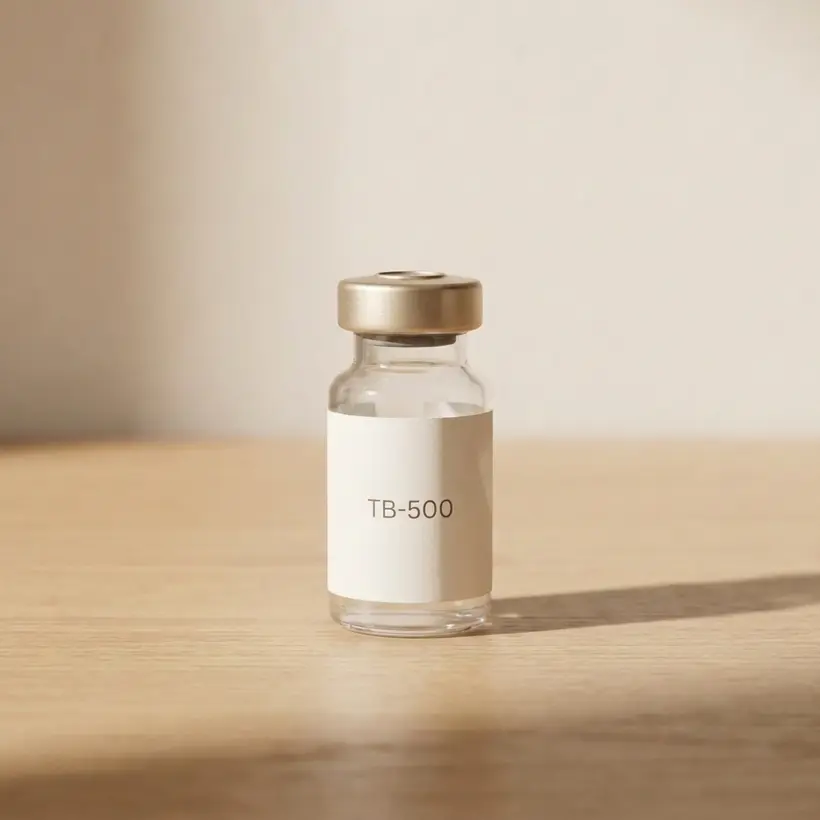
From the FormBlends catalog
TB-500 (Thymosin Beta-4)
Universal repair peptide for tissue regeneration · From $49/mo · compounded by a licensed 503A pharmacy, dispensed only after provider review.
Learn about TB-500 (Thymosin Beta-4) →Loading phase (weeks 1-6): - 2.0-2.5mg subcutaneously twice per week - Standard loading dose for systemic benefits - Hair effects begin building during this phase
Maintenance phase (weeks 7-16): - 2.0-2.5mg once per week - Extended maintenance may improve hair outcomes - Some providers recommend longer maintenance specifically for hair
Complementary strategies: - Ensure adequate protein intake (hair is made of keratin, a protein) - Check iron, ferritin, zinc, and vitamin D levels. deficiencies impair hair growth - Scalp massage for 5 minutes daily may improve blood flow to follicles - Reduce heat styling and chemical treatments during the protocol - Manage stress, which is a major contributor to hair loss
GLP-1 users take note: Hair thinning is a reported side effect of GLP-1 medications, likely from rapid weight loss and nutritional changes. TB-500 may help counteract this, but addressing the root cause (adequate nutrition, especially protein and micronutrients) is important.
Your can design a protocol that addresses both your primary treatment goals and hair health concerns.
Comparing TB-500 to Other Hair Treatments
How does TB-500 stack up against established hair loss treatments?
Minoxidil: FDA-approved topical treatment with strong evidence for hair regrowth. Works by improving blood flow to follicles. TB-500 may complement minoxidil through different mechanisms (stem cell activation versus vasodilation).
Finasteride: Oral medication that blocks DHT, the hormone most responsible for male pattern baldness. Addresses a different root cause than TB-500. May be used alongside peptide therapy.
PRP (platelet-rich plasma): Injected into the scalp to stimulate growth factors. Conceptually similar to TB-500 in promoting growth factor activity. TB-500 offers a systemic approach versus PRP's localized treatment.
GHK-Cu: Another peptide with hair growth potential that works through copper peptide pathways. Some providers combine GHK-Cu with TB-500 for combined hair benefits.
Low-level laser therapy: FDA-cleared devices that stimulate follicles with red light. Non-invasive and may complement TB-500 therapy.
TB-500's advantage is that it may offer hair benefits as part of a broader healing protocol. If you're using it for injury repair or general recovery, improved hair health is a potential bonus without additional cost.
Read about that may include hair-supportive compounds.
Frequently Asked Questions
Will TB-500 work for male pattern baldness?
TB-500 may help with early-stage thinning but is unlikely to reverse advanced male pattern baldness. Androgenetic alopecia involves hormonal factors (DHT) that TB-500 doesn't directly address. It may complement anti-androgen treatments but shouldn't be relied upon as a sole solution.
Can women use TB-500 for hair growth?
Yes. TB-500 is used by both men and women under medical supervision. Women experiencing hair thinning from stress, nutritional deficiencies, or hormonal changes may benefit from TB-500's hair follicle-supporting properties. Discuss this with your provider.
How long do hair results last after stopping TB-500?
This isn't well-established. Some users report maintained hair improvements for months after stopping. Others notice gradual regression. If the underlying cause of hair loss persists (hormonal, nutritional, stress), hair may thin again after discontinuing.
Can I apply TB-500 topically to my scalp instead of injecting it?
TB-500 is designed for subcutaneous injection, and its systemic distribution reaches the scalp through the bloodstream. There's limited research on topical application for hair specifically. Some compounding pharmacies offer topical formulations, but the evidence base is much stronger for injectable use.
Your Personalized Plan Is Waiting
No two patients are the same, and your protocol shouldn't be either. FormBlends providers create customized treatment plans based on your health profile, goals, and preferences.
Medical References
- Goldstein AL, Hannappel E, Sosne G, Kleinman HK. Thymosin beta4: a multi-functional regenerative peptide. Basic properties and clinical applications. Expert Opin Biol Ther. 2012;12(1):37-51. [PubMed | DOI]
Sources &. References
- Bock-Marquette I, Saxena A, White MD, et al. Thymosin beta4 activates integrin-linked kinase and promotes cardiac cell migration, survival and cardiac repair. Nature. 2004;432(7016):466-472. Doi:10.1038/nature03000
- Malinda KM, Sidhu GS, Mani H, et al. Thymosin beta4 accelerates wound healing. J Invest Dermatol. 1999;113(3):364-368. Doi:10.1046/j.1523-1747.1999.00708.x
This article is for educational purposes only and doesn't constitute medical advice. Always consult with a licensed healthcare provider before starting, changing, or stopping any medication or supplement. FormBlends connects you with licensed providers who can evaluate your individual health needs.
Last updated: 2026-03-24
Ready when you are
TB-500 (Thymosin Beta-4)
Universal repair peptide for tissue regeneration · From $49/mo · compounded by a licensed 503A pharmacy, dispensed only after provider review.
Learn about TB-500 (Thymosin Beta-4) →