Key Takeaway
Complete TB-4 storage instructions. Temperature requirements, shelf life for powder and reconstituted forms, travel tips, and signs of degradation.
Quick Answer: Thymosin Beta-4 storage instructions are straightforward. Unreconstituted (lyophilized powder) TB-4 should be stored in the refrigerator for long-term stability (12-24 months) or at room temperature for short-term storage (up to 3 months). Once reconstituted with bacteriostatic water, TB-4 must be refrigerated at 36-46 degrees F (2-8 degrees C) and used within 4 to 6 weeks. Never freeze reconstituted TB-4. Protect all forms from direct light and excessive heat .
Storage by Form
| Form | Temperature | Shelf Life | Key Rules |
|---|---|---|---|
| Lyophilized powder (refrigerated) | 36-46 F (2-8 C) | 12-24 months | Ideal long-term storage |
| Lyophilized powder (room temp) | 59-77 F (15-25 C) | 1-3 months | Acceptable for short-term |
| Lyophilized powder (frozen) | -4 F (-20 C) | 24+ months | Best for bulk storage |
| Reconstituted (refrigerated) | 36-46 F (2-8 C) | 4-6 weeks | Never freeze. minimize light |
| Reconstituted (room temp) | 59-77 F | 24-48 hours max | Return to fridge immediately |
Refrigerator Storage Tips
- Store on a middle shelf, away from the back wall (to avoid accidental freezing) and away from the door (temperature fluctuates)
- Keep vials upright with the rubber stopper facing up
- Use an opaque container or ziplock bag to protect from light exposure when the door opens
- Label each vial with the reconstitution date
- Don't store near produce drawers (higher humidity) or freezer vents
Signs of Degradation
Don't use TB-4 if you observe any of the following:
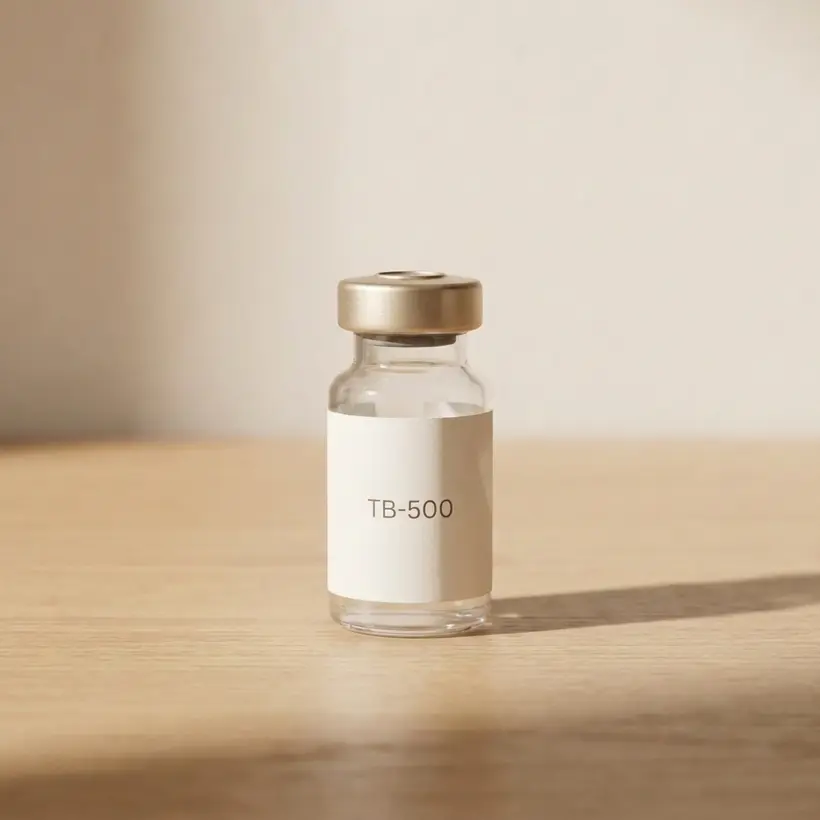
From the FormBlends catalog
TB-500 (Thymosin Beta-4)
Universal repair peptide for tissue regeneration · From $49/mo · compounded by a licensed 503A pharmacy, dispensed only after provider review.
Learn about TB-500 (Thymosin Beta-4) →
- Cloudiness: Clear solution turning hazy indicates aggregation or contamination
- Particles: Visible floaters, flakes, or sediment
- Color change: Any discoloration (yellow, brown, or other)
- Unusual odor: Beyond the faint benzyl alcohol scent of BAC water
- Rubber stopper coring: Pieces of rubber in the solution from repeated punctures
Travel with TB-4
- Short trips: Insulated lunch bag with a cold pack (keep vial separated from direct contact with ice)
- Air travel: Carry in carry-on with prescription label. TSA allows medically necessary liquids
- Extended travel: Bring unreconstituted vials (more stable) and BAC water, reconstitute at destination
- Never leave in a hot car: Interior temperatures can exceed 140 F, destroying the peptide
Frequently Asked Questions
I left my reconstituted vial out overnight. Is it still good?
If room temperature stayed below 77 F and it was a single overnight (8-12 hours), the TB-4 is likely still viable. Return to the refrigerator immediately. Discard if it was in a warm environment or left out for more than 24 hours.
Can I freeze reconstituted TB-4?
No. Freezing creates ice crystals that damage the peptide structure. Unreconstituted powder can be frozen safely for long-term storage.
How many punctures can the vial stopper handle?
Standard pharmaceutical vial stoppers tolerate 20 to 30 punctures with insulin-gauge needles. Insert the needle straight (not at an angle) to minimize coring.
Medical References
- Goldstein AL, Hannappel E, Sosne G, Kleinman HK. Thymosin beta4: a multi-functional regenerative peptide. Basic properties and clinical applications. Expert Opin Biol Ther. 2012;12(1):37-51. [PubMed | DOI]
Questions About Your Peptides?
At FormBlends, our team is available to answer your storage and handling questions throughout your treatment.
Disclaimer: This article is for informational purposes only and doesn't constitute medical advice. Thymosin Beta-4 isn't FDA-approved for any medical condition. Always consult with a licensed healthcare provider. Individual results may vary.
Ready when you are
TB-500 (Thymosin Beta-4)
Universal repair peptide for tissue regeneration · From $49/mo · compounded by a licensed 503A pharmacy, dispensed only after provider review.
Learn about TB-500 (Thymosin Beta-4) →