The short answer
Yes, lean pork chops are an excellent weight-loss food when chosen and cooked correctly. A 4 oz cooked pork loin chop has about 170 calories with 25 g of protein and almost no carbs. The protein-to-calorie ratio rivals chicken breast. The catch is cut selection and cooking method, which can double the calorie count.
Table of contents
- The 30-second answer
- The cuts that matter (and the ones to avoid)
- Reading the nutrition label like a clinician
- Why cooking method swings the calorie math
- Pork chops vs other lean proteins (table)
- How pork chops fit into a GLP-1 plan
- A simple weekly protein rotation
- Sample portion plate that works
- FAQ
- Footer disclaimers
The cuts that matter (and the ones to avoid)
"Pork chop" is not a single food. It's a category that ranges from 140 calories per 4 oz (lean tenderloin) to 320+ calories per 4 oz (untrimmed rib chop with fat cap intact). Picking the wrong cut is the single fastest way to take a weight-loss-friendly protein and turn it into something closer to a brisket.
Check your GLP-1 eligibility
Use our free BMI Calculator to see if you may qualify for provider-reviewed GLP-1 therapy.
Try the BMI Calculator →The cuts you want, ranked by lean-to-fat ratio per USDA FoodData Central data:
| Cut | 4 oz cooked | Calories | Protein | Total fat | Sat fat |
|---|---|---|---|---|---|
| Pork tenderloin (trimmed) | 4 oz | 140 | 26 g | 3.5 g | 1 g |
| Boneless center-cut loin chop (trimmed) | 4 oz | 170 | 25 g | 7 g | 2.5 g |
| Bone-in loin chop (trimmed) | 4 oz | 185 | 24 g | 9 g | 3 g |
| Sirloin chop (trimmed) | 4 oz | 175 | 23 g | 8 g | 2.5 g |
| Rib chop (trimmed) | 4 oz | 230 | 23 g | 15 g | 5 g |
| Blade/shoulder chop | 4 oz | 280 | 21 g | 21 g | 7 g |
| Untrimmed rib chop with fat cap | 4 oz | 320 | 22 g | 25 g | 9 g |
The two cuts that fit a weight-loss plan cleanly are pork tenderloin and the boneless center-cut loin chop, both trimmed. Both deliver 25+ g of protein per 4 oz at under 175 calories. That's a protein-to-calorie ratio in the same range as skinless chicken breast (about 1:6.5 to 1:7).
Cuts to avoid as a regular weight-loss staple: blade/shoulder chops, untrimmed rib chops, and any "country-style" pork rib labeled at the meat counter. Those run 280 to 320 calories per 4 oz and are closer in macros to chuck steak than to chicken breast.
The ribeye-equivalent cut in pork is the rib chop. It's delicious. It also comes with about double the saturated fat of a center-cut loin chop. Save it for once a month.
Reading the nutrition label like a clinician
Per 4 oz cooked boneless center-cut pork loin chop, trimmed, baked or grilled:
| Macro | Amount | % daily value |
|---|---|---|
| Calories | 170 | 8.5% |
| Total fat | 7 g | 9% |
| Saturated fat | 2.5 g | 13% |
| Cholesterol | 75 mg | 25% |
| Sodium | 60 mg | 3% |
| Total carbohydrate | 0 g | 0% |
| Dietary fiber | 0 g | 0% |
| Total sugars | 0 g | 0% |
| Protein | 25 g | 50% |
The protein-to-calorie ratio of 1:6.8 puts pork loin chop in the top tier of common proteins for weight loss, alongside chicken breast (1:6.5), white-fish fillet (1:5.5), and 99% lean ground turkey (1:6.0).
Micronutrients are a real plus. A 4 oz pork loin chop delivers:
- Thiamine (B1): about 60% of daily value, the highest of any common animal protein
- B6: about 35%
- B12: about 15%
- Niacin: about 25%
- Selenium: about 50%
- Zinc: about 18%
- Iron: about 6% (heme iron, well absorbed)
- Phosphorus: about 25%
Pork is the single best dietary source of thiamine in the standard American diet. That's not directly a weight-loss benefit, but it matters for energy metabolism and is one reason switching from chicken-only to chicken-and-pork rotation tends to make patients feel less depleted on a low-calorie plan.
The carbohydrate count is zero. The sodium count, in unprocessed pork, is low (60 mg per 4 oz). Both of those numbers swing wildly once you add seasoning, glazes, or cure (bacon, prosciutto, ham steak), so the data above only applies to plain pork chop.
Translation: lean pork chop is a high-protein, low-carb, micronutrient-dense protein that fits cleanly in a weight-loss plan, with the same caveat as any protein, the cooking method matters more than the meat itself.
Why cooking method swings the calorie math
A 6 oz boneless pork loin chop at the butcher counter weighs about 5 oz cooked (meat loses 15 to 20% during cooking). The same 5 oz cooked chop can land anywhere from 213 calories to 525 calories depending on how it's prepared.
| Preparation | 5 oz cooked, calories | Notes |
|---|---|---|
| Grilled, plain, salt only | 213 | The benchmark |
| Air-fried, no breading | 218 | Within 5 calories of grilled |
| Baked, plain | 213 | Identical to grilled |
| Pan-seared in 1 tsp olive oil | 253 | 40 cal added |
| Pan-fried in 1 tbsp butter | 313 | 100 cal added |
| Breaded and shallow-fried (panko) | 365 | 152 cal added |
| Breaded and deep-fried (schnitzel-style) | 425 | 212 cal added |
| Bacon-wrapped | 470 | 257 cal added |
| Honey-garlic glazed (1.5 tbsp glaze) | 285 | 72 cal from added sugar |
| Smothered with cream sauce (¼ cup) | 525 | 312 cal added |
The grill-bake-air-fry trio is what turns pork chop into a weight-loss food. The breading-frying-glazing trio is what turns it into a sit-down restaurant entree at twice the calorie cost.
The single biggest habit change for pork chops on a weight-loss plan is dropping the breaded-and-fried version (a "shake and bake" night) for an air-fryer chop with a dry rub. Same flavor profile, 150 to 200 fewer calories per chop.
For internal temperature, the USDA dropped the recommended pork doneness target to 145 °F with a 3-minute rest in 2011. A loin chop at 145 °F is faintly pink in the center and far juicier than the 160 °F end-point our parents used. If you're running pork chops dry on a baking sheet, undercooking is rarely the cause. Overcooking to 160 °F is.
Pork chops vs other lean proteins
| Protein | 4 oz cooked | Cal | Protein | Fat | Sat fat | Best for |
|---|---|---|---|---|---|---|
| Pork tenderloin (trimmed) | 4 oz | 140 | 26 g | 3.5 g | 1 g | Lowest cal density |
| Pork loin chop (trimmed) | 4 oz | 170 | 25 g | 7 g | 2.5 g | Flavor + macros balance |
| Chicken breast (skinless) | 4 oz | 165 | 31 g | 3.5 g | 1 g | Highest protein |
| Turkey breast (skinless) | 4 oz | 155 | 30 g | 3 g | 1 g | Lowest fat |
| 93% lean ground beef | 4 oz | 200 | 24 g | 11 g | 4.5 g | Ground meat use |
| 99% lean ground turkey | 4 oz | 130 | 27 g | 1.5 g | 0.5 g | Lowest cal |
| Salmon (Atlantic) | 4 oz | 235 | 25 g | 14 g | 3 g | Omega-3 |
| Cod fillet | 4 oz | 110 | 24 g | 1 g | 0 g | Lowest cal |
| Eggs (whole) | 2 large | 145 | 13 g | 10 g | 3 g | Cheapest |
| Greek yogurt (2%, plain) | 5.3 oz | 100 | 14 g | 2.5 g | 1.5 g | Dairy protein |
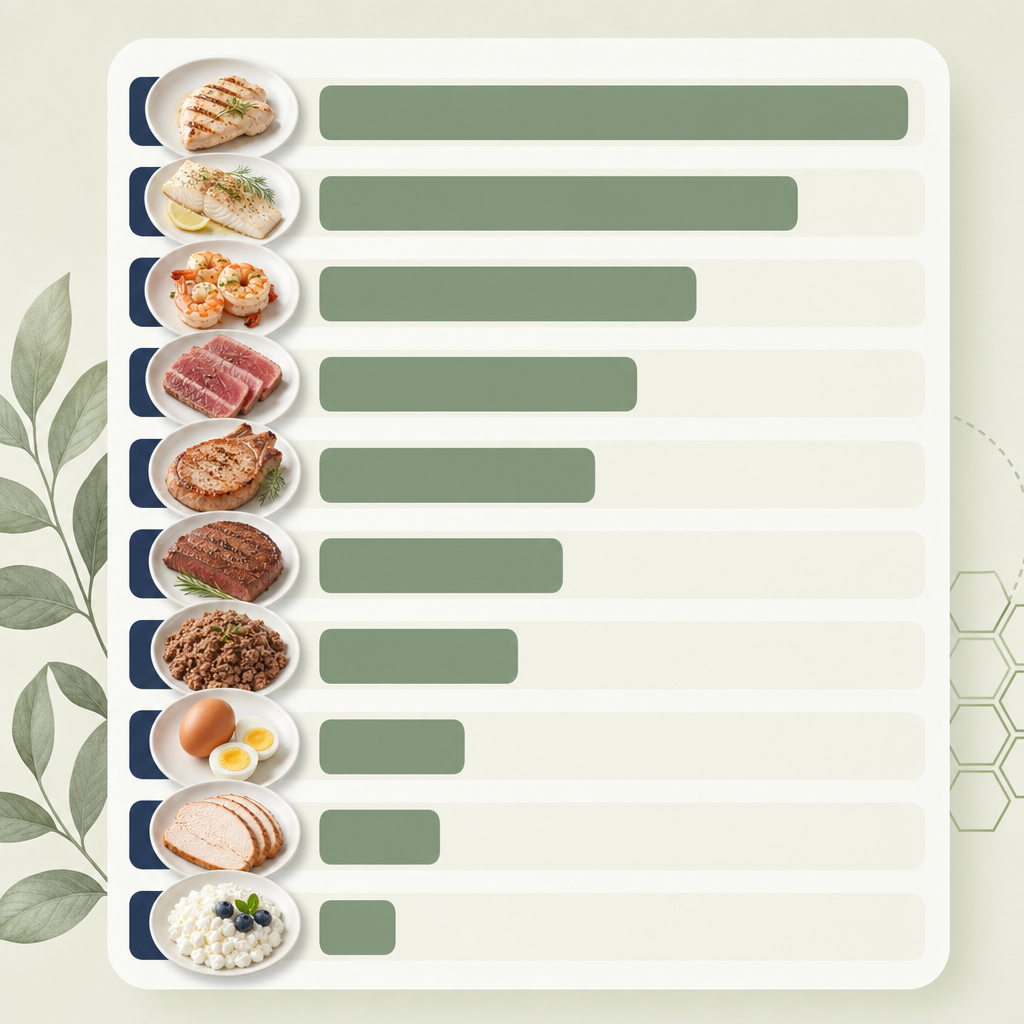
If your goal is the lowest-calorie way to get 25 g of protein, cod and 99% lean ground turkey win. If your goal is the same 25 g of protein with broader micronutrient coverage and a more satisfying meal feel, pork loin chop and chicken breast tie. Pork tenderloin is actually the leanest pork cut and beats chicken breast on calories per gram of meat.
How pork chops fit into a GLP-1 plan
Compounded semaglutide and tirzepatide push appetite down. Most patients on FormBlends programs end up eating 30 to 40% fewer total calories during titration. Within that smaller intake, protein adequacy becomes the single hardest macro to defend, and protein adequacy is what protects lean muscle mass during weight loss.
The SURMOUNT-1 trial body-composition substudy (Jastreboff et al. 2022, with follow-up DXA data published in 2024) found that about 25% of weight lost on tirzepatide came from lean tissue. That's not unusual for any rapid weight-loss protocol, but it's the part of the equation patients have most control over. Hitting 1.2 to 1.6 g of protein per kg of body weight per day, plus resistance training, brings that lean-tissue loss down meaningfully.
For a 180-lb (82 kg) person, that's about 100 to 130 g of protein per day. A 4 oz pork loin chop delivers 25% of the daily floor in one serving. That kind of protein density is exactly what you want when total intake is appetite-suppressed.
Practical notes for pork on GLP-1 therapy:
- Stick to lean cuts. Tenderloin and trimmed loin chop sit comfortably under the fat threshold most patients tolerate. Higher-fat cuts (rib chop with cap, blade) often trigger nausea or reflux during titration. (For reflux specifics see our piece on why GLP-1s can cause acid reflux.)
- Don't bread or fry. The same fat-tolerance issue applies to cooking method. Air-fried, grilled, or baked pork chops sit gentler on a GLP-1 stomach.
- Eat the protein first. Several patient-reported outcome studies show that "protein-first" eating order on GLP-1s reduces post-meal nausea by allowing the stomach to register fullness before carbohydrate volume arrives.
- Smaller, more frequent. A 4 oz portion is often easier to finish than 6 oz on a slower-emptying stomach. Two 4 oz servings spread across lunch and dinner usually works better than one 8 oz portion at dinner.
A simple weekly protein rotation
Most plateaus on weight-loss plans come from protein under-consumption, not from breaks in the diet. Building one pork chop night, two chicken nights, one fish night, one ground meat night, and two flexible/leftover nights into the rotation makes it harder to drift below your protein floor.
Sample week:
| Day | Protein | Method |
|---|---|---|
| Mon | Chicken breast | Air-fried, dry rub |
| Tue | Pork loin chop, 4 oz | Grilled, lemon and herb |
| Wed | Salmon, 4 oz | Baked with mustard glaze |
| Thu | 93% lean ground beef | Skillet, taco seasoning |
| Fri | Chicken thigh (skinless) | Sheet pan, vegetables |
| Sat | Pork tenderloin, 4 oz | Air-fried, garlic-rosemary |
| Sun | Cod, 4 oz | Pan-seared, butter and lemon |
Two pork nights a week is sustainable, varied, and keeps your protein floor easy to hit. If you'd rather consolidate into one batch-cooked pork night, slice a tenderloin into 1 lb and 1 lb halves, freeze one, cook one. Sliced cold pork loin on a salad through the week is one of the most underrated meal-prep moves.
Sample portion plate that works
A weight-loss-friendly pork chop dinner plate:
- 4 to 5 oz cooked boneless center-cut pork loin chop, trimmed (170 to 213 cal, 25 to 31 g protein)
- 1.5 cups roasted non-starchy vegetables (broccoli, brussels, cauliflower, asparagus) tossed in 1 tsp olive oil (about 130 cal)
- ½ cup cooked quinoa, brown rice, or roasted sweet potato (110 cal, 3 g fiber)
- 1 cup mixed greens with 2 tbsp vinegar-based dressing (40 cal)
Total: about 450 to 490 calories, 32 to 38 g protein, 6 to 8 g fiber.
Not surprising, but worth saying out loud: that plate is the single most photographed weight-loss dinner in the SURMOUNT and STEP trial diaries. It works because it lands above the protein floor, below 500 calories, and doesn't depend on willpower to stop.
FAQ
Are pork chops actually healthy for weight loss?
Yes, when you pick a lean cut (pork tenderloin, boneless center-cut loin chop) and cook it without breading, frying, or sugary glazes. A 4 oz cooked portion delivers 25 g of protein at 170 calories, which is roughly equivalent to chicken breast on macros.
How many calories are in a pork chop?
It depends on the cut. A 4 oz cooked boneless center-cut loin chop is about 170 calories. A 4 oz rib chop with fat trimmed is 230 calories. A 4 oz untrimmed bone-in chop with fat cap intact can hit 320 calories.
Are pork chops good for losing belly fat?
No food in isolation targets belly fat. What matters is total calorie intake and protein adequacy across the week. Lean pork chops support belly fat loss the way any high-protein, low-carb food does, by providing satiety and preserving lean tissue during a calorie deficit.
Are pork chops better than chicken breast for weight loss?
On macros, they're close. Skinless chicken breast has slightly more protein per ounce (about 31 g per 4 oz vs 25 g for pork loin chop) and slightly fewer calories. Pork wins on micronutrient density, especially thiamine (B1) and selenium.
Can you eat pork chops on a keto diet?
Yes. Pork has zero carbohydrates by default. Just avoid sugary glazes, breading, and BBQ sauces. Plain salt-and-pepper pork chops with vegetables fit into any keto meal plan.
How often can I eat pork chops on a weight-loss plan?
1 to 2 times a week is a sustainable cadence. Mixing pork with chicken, fish, and turkey gives you better variety in micronutrients and fatty acid profiles. Eating pork every night isn't dangerous, just nutritionally narrower than you'd want.
Is pork tenderloin or pork loin chop leaner?
Pork tenderloin is leaner by about 50 calories per 4 oz cooked. A 4 oz tenderloin runs 140 cal with 26 g protein and 3.5 g fat. A 4 oz loin chop runs 170 cal with 25 g protein and 7 g fat. Tenderloin is the leanest cut of pork commonly available.
What's the best way to cook pork chops for weight loss?
Air-fried, grilled, or baked, all without breading. A dry rub plus 145 °F internal temperature (with 3 min rest) gives you a juicy chop without the calorie load of pan-frying or smothering. Skip the cream sauce, BBQ glaze, or honey-garlic finish.
Do pork chops cause inflammation?
Lean unprocessed pork is not associated with inflammatory markers in published studies. Processed pork (bacon, ham, sausage, charcuterie) is in a different category and is associated with elevated CRP and other inflammation markers per WHO 2015 IARC data. Pork chops are unprocessed.
What's the safe internal temperature for pork chops?
145 °F with a 3-minute rest, per the USDA's 2011 update. The chop will be faintly pink in the center, which is the modern standard. Cooking pork to 160 °F dries the meat and isn't required for safety on commercially raised pork.
Are pork chops safe on a GLP-1 medication like compounded semaglutide or tirzepatide?
Yes, lean pork is one of the better protein choices during GLP-1 titration. Stick to trimmed loin chop or tenderloin, eat 4 oz portions rather than 6 to 8 oz, and avoid breading or fatty pan-fry methods, both of which can trigger nausea or reflux.
What sides go best with pork chops on a weight-loss plan?
Roasted non-starchy vegetables (broccoli, brussels, asparagus, cauliflower), a small portion of starch (½ cup quinoa, brown rice, or roasted sweet potato), and a green salad with vinegar-based dressing. Skip the mac and cheese, mashed potatoes with butter, and dinner rolls.
Author / review note
Reviewed by the FormBlends Medical Team. This article was last reviewed and updated on April 28, 2026. References cited above include USDA FoodData Central pork product entries (2024 update); the USDA Food Safety and Inspection Service guidance on pork doneness (2011); Jastreboff et al., New England Journal of Medicine, 2022 (SURMOUNT-1); 2024 SURMOUNT-1 body-composition substudy data; Phillips et al., Nutrition & Metabolism, 2016 (protein needs in weight loss); and the IARC 2015 monograph on processed meat classification.
Footer disclaimers
Platform Disclaimer. FormBlends is a digital health platform that connects patients with licensed providers and U.S.-based pharmacies. We do not manufacture, prescribe, or dispense medication directly. All clinical decisions are made by independent licensed providers.
Compounded Medication Notice. Compounded semaglutide and tirzepatide are not FDA-approved. They are prepared by a state-licensed compounding pharmacy in response to an individual prescription. Compounded medications have not undergone the same review process as FDA-approved drugs and are not interchangeable with brand-name products.
Results Disclaimer. Individual results vary. Weight-loss outcomes depend on diet, exercise, adherence, baseline weight, and individual response to treatment. Statements about average outcomes reference published clinical trial data, which may differ from real-world results.
Trademark Notice. Brand names referenced in this article are the property of their respective owners. FormBlends is not affiliated with, endorsed by, or sponsored by any brand-name pharmaceutical or food manufacturer.
Related guides
- Is Jasmine Rice Good for Weight Loss? The Honest Answer Backed by the Numbers
- Is Chai Latte Good for Weight Loss? An Honest Answer Backed by the Sugar Content
- Is Skinny Pop Healthy for Weight Loss? An Honest Answer Backed by the Nutrition Label
- Is Cream Cheese Healthy for Weight Loss? An Honest Answer Backed by the Nutrition Label
- Are Ritz Crackers Healthy for Weight Loss? An Honest Answer Backed by the Nutrition Label
- The Best Time to Eat Ice Cream for Weight Loss? An Honest Answer Backed by the Calorie Math
See your options in about 2 minutes
Take the free quiz and see what fits you. Quick, private, and no commitment to continue.
See my options →