The short answer
A 1 oz serving of Skinny Pop has 150 calories, 3 g of fiber, 2 g of protein, and 10 g of fat. It can fit a weight-loss plan, but only at the recommended portion. The full 4.4 oz "share" bag delivers around 660 calories, which is enough to erase a daily deficit by itself.
Table of contents
- The 30-second answer
- What's actually in the bag
- Reading the nutrition label like a clinician
- Why portion control is the real risk
- Skinny Pop vs other common snacks (table)
- How Skinny Pop fits into a GLP-1 plan
- A simple weekly snack swap framework
- Better alternatives if Skinny Pop isn't satisfying you
- FAQ
- Footer disclaimers
What's actually in the bag
Skinny Pop's original popcorn ingredient list is short: popcorn, sunflower oil, salt. That's it. The brand also lists what's absent (gluten, dairy, peanuts, GMOs, artificial preservatives), which is the part of the package most shoppers stop reading at. Short ingredient list is a real positive. It's also the reason the snack costs about double what a bag of generic popcorn costs.
Check your GLP-1 eligibility
Use our free BMI Calculator to see if you may qualify for provider-reviewed GLP-1 therapy.
Try the BMI Calculator →The popcorn itself is a whole grain, which delivers some real fiber. Sunflower oil is the calorie driver, and the salt content is moderate at around 75 to 95 mg per ounce, depending on the flavor. The sea-salt variant runs a little higher.
What the front of the bag doesn't tell you is that the oil accounts for 60% of the calories. A bag of microwave-style "lite" popcorn runs closer to 25 to 30% of calories from fat. That's a meaningful difference if you're trying to keep an eye on calorie density.
Reading the nutrition label like a clinician
Per 1 oz serving (around 3.75 cups):
| Macro | Amount | % daily value |
|---|---|---|
| Calories | 150 | 7.5% |
| Total fat | 10 g | 13% |
| Saturated fat | 1 g | 5% |
| Sodium | 75 mg (Original) | 3% |
| Total carbohydrate | 15 g | 5% |
| Dietary fiber | 3 g | 11% |
| Total sugars | 0 g | 0% |
| Protein | 2 g | 4% |
A clinician's read on this: it's a low-glycemic-impact snack with moderate fiber and almost no protein. Glycemic-impact-wise it's calmer than chips or pretzels because the fiber buffers the carbohydrate response. But because it has only 2 grams of protein, it doesn't hit satiety the way a 6 to 8 g protein snack would.
The 2024 update to the Journal of Nutrition satiety index work (Holt et al., original 1995, updated 2024) puts protein-light, fat-moderate snacks like Skinny Pop in the middle of the satiety pack: better than refined carbs, worse than Greek yogurt or hard-boiled eggs.
Translation: the snack will dent a craving. It probably won't keep you full for three hours.
Why portion control is the real risk
The 4.4 oz "share size" bag contains 4.5 servings. If you eat the whole bag in front of a movie (the way most people use Skinny Pop), you've consumed:
- 660 to 675 calories
- 45 g of fat
- 340 to 425 mg of sodium
- 13.5 g of fiber (which causes its own GI issues at that volume)
For a 5'4" woman on a 1,500 calorie target, that's 44% of her day. For a 5'10" man on a 2,200 calorie target, it's 30% of his day, gone, on a snack. Either way, it eats the entire deficit you'd typically build for weight loss.
This is the part of "is Skinny Pop healthy for weight loss" that gets lost. The food itself is fine. The packaging strategy is the problem. Sharing-size bags are designed to be finished. The pop-the-bag-and-graze pattern is what derails plans, not the popcorn.
The clinical fix is decanting. Buy the share size if you want the value, then portion it into 1 oz snack bags as soon as it gets home. The 100-calorie pre-portioned bags Skinny Pop sells solve the same problem at about 2x the cost per ounce.
Skinny Pop vs other common snacks (head-to-head)
| Snack | Serving | Cal | Protein | Fiber | Fat | Sat fat | Sodium | Best for |
|---|---|---|---|---|---|---|---|---|
| Skinny Pop Original | 1 oz / ~3.75 cups | 150 | 2 g | 3 g | 10 g | 1 g | 75 mg | Volume snacking |
| Air-popped popcorn (plain) | 3 cups | 95 | 3 g | 3.5 g | 1 g | 0 g | 1 mg | Lowest cal density |
| SmartPop 100-cal mini bag | 1 bag | 100 | 3 g | 4 g | 2 g | 0.5 g | 230 mg | Pre-portioned |
| Lay's Classic | 1 oz / 15 chips | 160 | 2 g | 1 g | 10 g | 1.5 g | 170 mg | Salt cravings |
| Pretzels (mini twists) | 1 oz | 110 | 3 g | 1 g | 0 g | 0 g | 360 mg | Low-fat option |
| Almonds (raw) | 1 oz / 23 nuts | 165 | 6 g | 3.5 g | 14 g | 1 g | 0 mg | Satiety |
| Greek yogurt (2%, plain) | 5.3 oz | 100 | 14 g | 0 g | 2.5 g | 1.5 g | 50 mg | Highest protein |
| Apple + 1 tbsp peanut butter | 1 medium + 1 tbsp | 190 | 4 g | 5 g | 8 g | 1.5 g | 75 mg | Most balanced |
| Edamame (in shell, salted) | 1 cup | 120 | 11 g | 5 g | 5 g | 0.5 g | 240 mg | Best protein:cal |
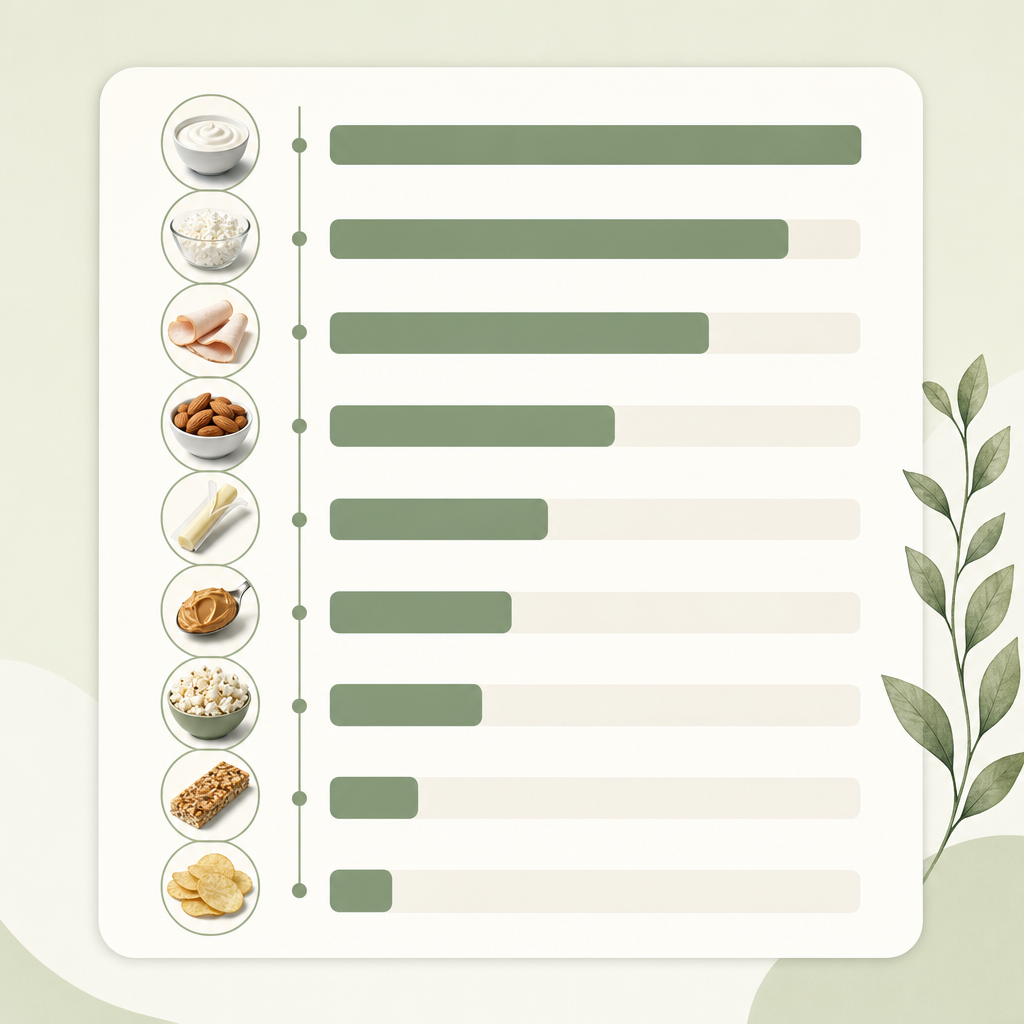
If your goal is staying full between meals, edamame, Greek yogurt, and apple-and-peanut-butter beat Skinny Pop on every metric except crunch. If your goal is filling a snack-shaped hole in your day for the lowest reasonable calorie cost without thinking too hard, Skinny Pop is a defensible pick.
How Skinny Pop fits into a GLP-1 plan
If you're on compounded semaglutide or tirzepatide, your relationship with snacks usually changes within 4 to 8 weeks. The constant low-grade hunger that drove mindless snacking quiets down. What people often report (this matches what the SURMOUNT-1 and STEP 1 trial diaries show) is that they want something to eat during habitual triggers (after dinner, on the couch, mid-afternoon) without feeling physically hungry.
Skinny Pop solves that habit-snack moment well, because:
- It's high volume per calorie, which scratches the "I want a snack" itch without overshooting your appetite-suppressed intake.
- It's low-fat enough at 10 g per ounce that it won't trigger the nausea or reflux that often accompanies higher-fat snacks on tirzepatide. (If you've had GLP-1-induced reflux, see our piece on why GLP-1s can cause acid reflux.)
- It's pre-shelf-stable and travel-friendly, which matters when most of your meals are smaller and snacks become higher-stakes.
The catch: GLP-1 patients on titration doses sometimes find that 3.75 cups is more than they can finish. That's a feature, not a bug. Listen to fullness cues. If you stop after 1.5 cups, that's 60 calories, not a failure.
A simple weekly snack swap framework
Most weight-loss plateaus come from the snacks, not the meals. The framework that has the most evidence behind it (see Drewnowski 2018 work on energy density and Volume Eating, and the more recent McGill et al. 2023 satiety data) is to allocate one snack slot per day to volume-driven snacks like Skinny Pop and the second snack slot to protein-driven snacks like Greek yogurt or edamame.
Sample one-week allocation:
| Day | Snack 1 (3 PM) | Snack 2 (8 PM) |
|---|---|---|
| Mon | Greek yogurt + berries | 1 oz Skinny Pop |
| Tue | 1 oz almonds | Apple + peanut butter |
| Wed | 1 oz Skinny Pop | Hard-boiled egg + cucumber |
| Thu | Cottage cheese + pineapple | 1 oz dark chocolate |
| Fri | 1 oz Skinny Pop | Edamame, 1 cup |
| Sat | Tuna pouch on cucumber rounds | 1 oz Skinny Pop |
| Sun | Greek yogurt + walnut | Air-popped popcorn, 3 cups |
That alternation gives you Skinny Pop three times a week without making it the cornerstone of your snacking. It also stops the pattern of "I had Skinny Pop yesterday, I'll have it again today, and the next day, and now I'm 200 calories over my goal every night."
Better alternatives if Skinny Pop isn't satisfying you
If you're eating Skinny Pop and still feeling hungry an hour later, the issue is the protein gap. Try one of these:
- Air-popped popcorn with nutritional yeast and a sprinkle of grated parmesan. 3 cups runs about 130 calories with 6 g of protein, double Skinny Pop's protein at the same volume.
- Quest Cheddar Protein Chips. 1 bag is 140 calories, 19 g protein, 3 g fat. Texture is closer to a baked chip than popcorn, but the satiety profile is in a different league.
- Crisp lupini beans, salted. 1 cup is around 200 calories with 25 g protein. Actually filling.
- Wasa crackers with cottage cheese. 2 crackers + 1/2 cup 2% cottage cheese = ~150 calories, 16 g protein.
None of these are crunchy in the same way as popcorn. But none of them require willpower to stop at one serving either, because the protein turns off the hunger signal.
FAQ
Is Skinny Pop actually healthy?
Skinny Pop is a relatively clean processed snack. The ingredient list is short, it's a whole grain, and it has 3 g of fiber per ounce. It's not a health food in any meaningful sense. It's a better-than-chips choice with low protein and high fat.
How many calories are in a whole bag of Skinny Pop?
A 4.4 oz "share" bag contains 4.5 servings, which works out to 660 to 675 calories, 45 g of fat, and 340 mg of sodium. The 1 oz mini bags are 150 calories. The 0.65 oz school-lunch bags are 100 calories.
Can you eat Skinny Pop every day on a diet?
You can, if you stick to a 1 oz portion, count the 150 calories, and pair it with a protein source. The risk isn't the popcorn. It's the daily 660-calorie bag-grazing pattern, which adds about 1.3 lbs per month of fat gain on top of an already-okay baseline.
Is Skinny Pop low-carb or keto-friendly?
No. A 1 oz serving has 12 g of net carbs. Standard ketogenic plans target under 25 g of net carbs per day total, so a single serving uses up close to half your daily allotment.
Why do I keep eating the whole bag?
Three reasons: the bag size is engineered to be finished in one sitting, popcorn has a low satiety-per-calorie score, and salt-fat combinations are specifically formulated to suppress the body's natural stop signal. Decanting into 1 oz portions is the only intervention that reliably works.
Is the sunflower oil in Skinny Pop bad for me?
Sunflower oil is high in linoleic acid, an omega-6 fatty acid. In moderate amounts it's fine. The concern is that most American diets already have a 15:1 omega-6 to omega-3 ratio, against the 4:1 ratio recommended in the 2020-2025 Dietary Guidelines. Skinny Pop pushes the ratio further in the wrong direction, but it's not the main driver.
Does Skinny Pop work as a snack on a GLP-1 medication like compounded semaglutide or tirzepatide?
Generally yes. The 1 oz serving is small enough to not overload appetite-suppressed intake, the low fat content reduces the risk of triggering nausea, and the volume satisfies the habit-snack reflex without adding meaningful calories. Most patients report tolerating 1.5 to 2 cups comfortably during titration.
Is Skinny Pop better than the 100-calorie microwave popcorn bags?
The 100-calorie microwave bags (SmartPop, Pop Secret 100 Calorie) are slightly higher in sodium (around 230 mg per bag) but lower in fat. From a weight-loss-only standpoint, they're roughly equivalent. The microwave bags are a better choice if portion control is your main struggle, because the bag is already pre-portioned.
Is Skinny Pop the healthiest popcorn?
No. Plain air-popped popcorn is the lowest in calories and fat. Skinny Pop is the lowest-effort version that still tastes good. If you have an air popper, the air-popped version is objectively better. If you don't, Skinny Pop is a reasonable trade for convenience.
How does Skinny Pop compare to Quest protein chips for weight loss?
Quest Cheddar Protein Chips are 140 calories with 19 g protein per bag. Skinny Pop Original 1 oz bag is 150 calories with 2 g protein. For satiety per calorie, Quest wins by roughly a 5x margin. For mouth-feel, taste, and "snack-feel," Skinny Pop usually wins.
Does Skinny Pop cause bloating?
Eating a full bag (13.5 g of fiber, around half the daily target in one sitting) routinely causes gas and bloating, especially in people not accustomed to high-fiber diets. The 1 oz serving rarely causes issues.
What's the best low-calorie snack besides Skinny Pop?
For raw calorie minimum, plain air-popped popcorn (95 cal for 3 cups) wins. For best satiety per calorie, plain Greek yogurt with a few berries (about 110 cal for 5 oz). For convenience, a small apple with 1 tbsp natural peanut butter (about 190 cal).
Author / review note
Reviewed by the FormBlends Medical Team. This article was last reviewed and updated on April 29, 2026. References cited above include Holt et al., European Journal of Clinical Nutrition, 1995 (satiety index, original); Drewnowski A., Annual Review of Nutrition, 2018 (energy density and weight management); McGill et al., Appetite, 2023; and the U.S. Dietary Guidelines for Americans, 2020-2025.
Footer disclaimers
Platform Disclaimer. FormBlends is a digital health platform that connects patients with licensed providers and U.S.-based pharmacies. We do not manufacture, prescribe, or dispense medication directly. All clinical decisions are made by independent licensed providers.
Compounded Medication Notice. Compounded semaglutide and tirzepatide are not FDA-approved. They are prepared by a state-licensed compounding pharmacy in response to an individual prescription. Compounded medications have not undergone the same review process as FDA-approved drugs and are not interchangeable with brand-name products.
Results Disclaimer. Individual results vary. Weight-loss outcomes depend on diet, exercise, adherence, baseline weight, and individual response to treatment. Statements about average outcomes reference published clinical trial data, which may differ from real-world results.
Trademark Notice. Brand names referenced in this article are the property of their respective owners. FormBlends is not affiliated with, endorsed by, or sponsored by any brand-name pharmaceutical manufacturer.
Related guides
- Is Cream Cheese Healthy for Weight Loss? An Honest Answer Backed by the Nutrition Label
- Are Ritz Crackers Healthy for Weight Loss? An Honest Answer Backed by the Nutrition Label
- Are Grits Healthy for Weight Loss? Here's What the Nutrition Label Actually Says
- Are Saltine Crackers Healthy for Weight Loss? An Honest Look at the Nutrition
- Can Boiled Pierogies Be Healthy for Weight Loss? An Honest Look at the Nutrition
- Is Jasmine Rice Good for Weight Loss? The Honest Answer Backed by the Numbers
See your options in about 2 minutes
Take the free quiz and see what fits you. Quick, private, and no commitment to continue.
See my options →