The short answer
Saltine crackers are low in calories (around 65 per 5 crackers) but offer almost no fiber, minimal protein, and a high glycemic index. They can fit a weight-loss plan in small portions paired with protein. As a standalone snack, they spike blood sugar and trigger rebound hunger within 60 to 90 minutes.
Table of contents
- The 30-second answer
- What's actually in a saltine
- Reading the nutrition label like a clinician
- The blood sugar problem nobody talks about
- Saltines vs other common crackers (table)
- How saltines fit (or don't) into a GLP-1 plan
- The one situation where saltines genuinely help
- A simple weekly cracker swap framework
- Better alternatives if you want a crunchy carb
- FAQ
- Footer disclaimers
What's actually in a saltine
The classic saltine ingredient list is short: enriched wheat flour (refined, not whole grain), vegetable oil, leavening, yeast, salt, and a sprinkle of coarse salt on top. The "enriched" tag means the wheat was stripped of its bran and germ during milling, then a few synthetic vitamins were added back. That's the central nutrition issue with saltines, and it's not a hidden one.
Check your GLP-1 eligibility
Use our free BMI Calculator to see if you may qualify for provider-reviewed GLP-1 therapy.
Try the BMI Calculator →Whole wheat keeps the bran (fiber) and germ (B vitamins, vitamin E, minerals). Refined wheat keeps almost none of that. The result is a cracker with the texture and shelf life people want, and the nutrient density of plain table sugar plus a few stray amino acids.
The salt on top is the part that makes them taste like a snack instead of cardboard. A typical saltine has 130 to 200 mg of sodium per 5-cracker serving depending on the brand. Reduced-sodium saltines drop that to around 50 to 75 mg.
Reading the nutrition label like a clinician
Per 5 saltine crackers (about 15 g, the standard serving size on most boxes):
| Macro | Amount | % daily value |
|---|---|---|
| Calories | 60 to 70 | 3.5% |
| Total fat | 1 to 1.5 g | 2% |
| Saturated fat | 0 g | 0% |
| Sodium | 130 to 200 mg | 8% |
| Total carbohydrate | 11 to 13 g | 4% |
| Dietary fiber | less than 1 g | 2% |
| Total sugars | 0 g | 0% |
| Protein | 1 g | 2% |
A clinician reads this label and sees three problems for satiety. First, the carbohydrate is almost entirely refined starch, which the body breaks down to glucose within 30 minutes of eating. Second, protein at 1 g per serving is essentially zero from a satiety perspective. Third, fiber under 1 g means there's nothing to slow gastric emptying or buffer the glucose response.
The 2024 update to the satiety index work originally published by Holt et al. in 1995 ranked plain crackers near the bottom of common foods for fullness per calorie. They beat candy. They lose to almost everything else.
The calorie count per cracker is genuinely low. That's the saltine's only real selling point for a weight-loss plan.
The blood sugar problem nobody talks about
Saltines have a glycemic index in the high 70s, similar to white bread. Glycemic index measures how quickly a food raises blood glucose compared to pure glucose at 100. For reference, oats sit around 55, lentils around 30.
What does that mean in practice? If you eat 5 saltines on an empty stomach, your blood glucose will climb sharply within 20 to 40 minutes, then drop below your starting level around 90 to 120 minutes later. That post-meal dip is the trigger for rebound hunger. The clinical name is reactive hypoglycemia, and people on calorie restriction feel it more strongly because their glycogen reserves are already lower.
Translation: 5 saltines makes you hungrier 90 minutes from now than you were when you ate them. That's not a useful trade for weight loss.
The fix is pairing. If you eat the same 5 saltines with a tablespoon of peanut butter, half a hard-boiled egg, or a slice of cheddar, the protein and fat slow gastric emptying. Glucose still rises, but the curve is flatter and the dip on the back end is gone. Now you're talking about a snack that holds you for 2 to 3 hours instead of 60 minutes.
Saltines vs other common crackers (head-to-head)
| Cracker | Serving | Cal | Protein | Fiber | Sodium | Glycemic index | Best for |
|---|---|---|---|---|---|---|---|
| Saltine (Original) | 5 crackers | 65 | 1 g | <1 g | 150 mg | 75 | Lowest cal per cracker |
| Whole wheat saltine | 5 crackers | 70 | 2 g | 2 g | 130 mg | 60 | Better fiber |
| Triscuit (Original) | 6 crackers | 120 | 3 g | 3 g | 135 mg | 50 | High fiber, whole grain |
| Wheat Thins (Original) | 16 crackers | 140 | 2 g | 2 g | 200 mg | 65 | Volume |
| Ritz (Original) | 5 crackers | 80 | 1 g | <1 g | 135 mg | 70 | Buttery flavor |
| Wasa Crispbread | 1 slice | 35 | 1 g | 2 g | 60 mg | 55 | Lowest sodium |
| Mary's Gone Crackers | 13 crackers | 140 | 3 g | 3 g | 160 mg | 45 | Seed-based, gluten-free |
| Flackers (flax crackers) | 8 crackers | 100 | 4 g | 6 g | 110 mg | 30 | Highest fiber |
| Almond flour crackers | 10 crackers | 150 | 5 g | 3 g | 110 mg | 35 | Lowest carb |
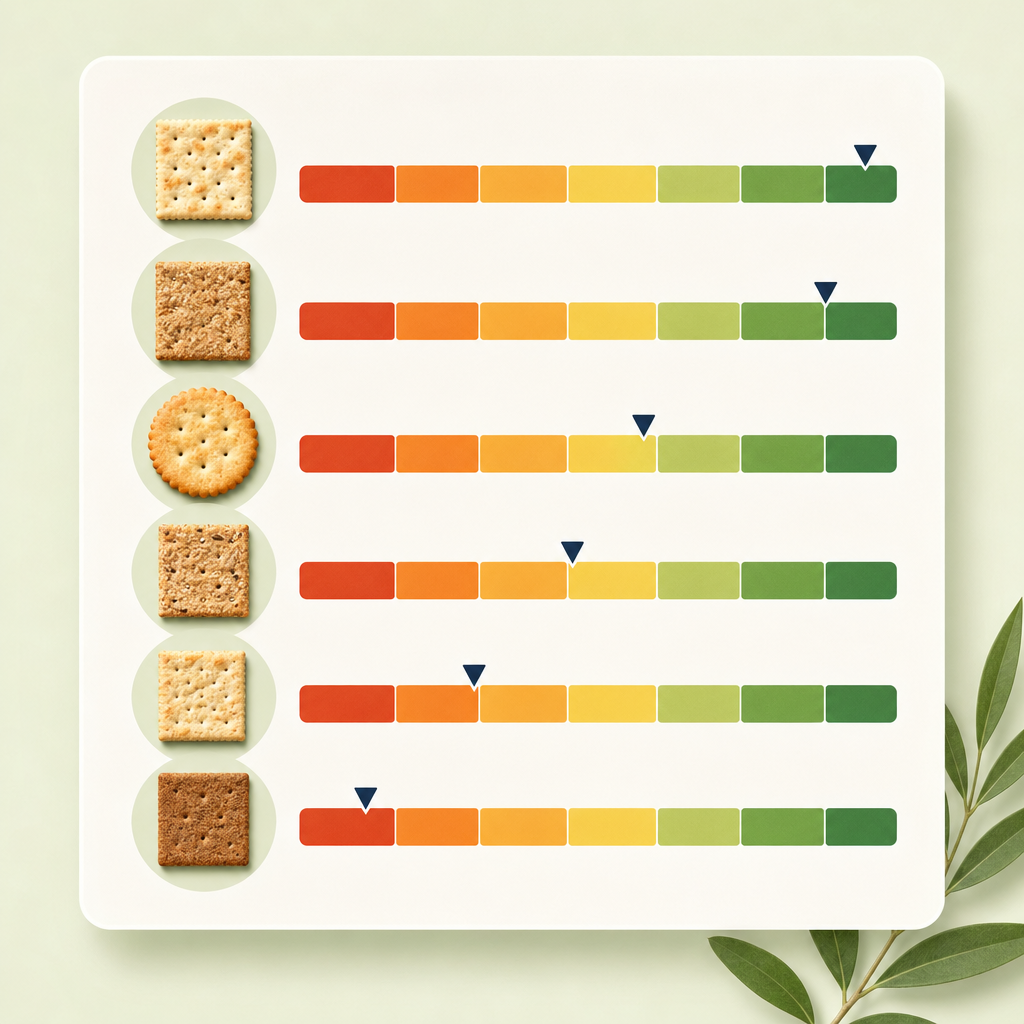
If you want a cracker for crunch with the lowest possible calories per piece, saltines win. If you want a cracker that actually holds you full, Flackers, Mary's Gone Crackers, and almond flour crackers do that job better at a small calorie premium.
How saltines fit (or don't) into a GLP-1 plan
If you're on compounded semaglutide or tirzepatide, your relationship with carbohydrate-heavy snacks tends to shift. Two patterns show up consistently in patient notes (and match what the SURMOUNT-1 and STEP 1 trial diaries documented).
First, refined carbs hit harder. With slowed gastric emptying, the same 5 saltines sit in your stomach longer. The glucose curve is actually flatter on a GLP-1 than off it, which is one of the medication's mechanisms. So the reactive hypoglycemia issue is less severe.
Second, the salty-bland appeal of saltines lines up with the food preference shifts most patients report. Tirzepatide and semaglutide reduce cravings for sweet, fatty, and intensely flavored foods more than they reduce cravings for plain starchy foods. Patients on titration doses who find dinner unappealing often default to saltines and broth because that's what stays down.
That second pattern is where saltines genuinely help. During the first 4 to 8 weeks of dose titration, mild nausea is common, and bland refined-starch foods (saltines, plain toast, plain rice) reduce that nausea reliably. The 2023 ADA standards of care guidance on GLP-1 nausea management lists "small portions of bland carbohydrates" as a first-line non-pharmacological intervention.
So during titration, eating a few saltines to settle nausea is fine. Outside of that window, they're a low-value snack.
The one situation where saltines genuinely help
Beyond GLP-1 nausea, saltines have one other legitimate role in weight management: morning sickness, post-viral nausea, and gastrointestinal recovery.
The 2022 American College of Obstetricians and Gynecologists guidance on first-trimester nausea names plain crackers as an evidence-supported first food. The mechanism is simple: a small amount of refined starch raises blood glucose enough to dampen nausea signaling, without the fat content that worsens reflux. The same mechanism applies post-stomach-bug or post-anesthesia.
This is a specific therapeutic use case, not a snacking strategy. Once nausea resolves, the saltines stop being useful.
A simple weekly cracker swap framework
If you currently eat saltines as a regular snack, the easiest upgrade isn't quitting crackers. It's substituting cracker types based on what role the snack is playing.
Sample one-week swap framework:
| Day | Snack moment | Old habit | Upgraded swap |
|---|---|---|---|
| Mon | 3 PM | 10 saltines | 6 Triscuits + 1 oz cheddar |
| Tue | 3 PM | Saltines + soup | Whole wheat saltines + soup |
| Wed | 3 PM | 10 saltines plain | 8 Flackers + 1 tbsp hummus |
| Thu | 3 PM | Saltines + cheese | Wasa + 2% cottage cheese |
| Fri | 3 PM | Crackers + pickle | Mary's Gone + 1 hard-boiled egg |
| Sat | 3 PM | Saltines + tuna | Whole wheat saltines + tuna |
| Sun | 3 PM | 10 saltines | 8 almond flour crackers + avocado |
The pattern: keep the 3 PM cracker habit if it's working for you, but pick a cracker that has fiber and pair it with a protein. The total calorie count goes up by 50 to 100 calories per snack, but the satiety improvement reliably saves 200 to 300 calories at dinner.
Better alternatives if you want a crunchy carb
If saltines were your snack of choice mainly for the crunch, several options deliver more nutrition at a similar calorie cost:
- Whole grain rice cakes with peanut butter. 1 cake plus 1 tbsp natural peanut butter is 130 calories with 4 g protein and 2 g fiber. The crunch is closer to saltines than most cracker substitutes.
- Roasted chickpeas. A 1 oz portion runs 120 calories with 6 g protein and 5 g fiber. Available in salted, ranch, and barbecue flavors that scratch the salty-snack itch.
- Cucumber rounds with everything bagel seasoning and a smear of cottage cheese. 100 calories, 12 g protein, basically zero refined starch.
- Quest tortilla-style protein chips. 1 bag is 140 calories, 18 g protein. Crunchy texture, salty flavor, drastically better satiety profile.
- Nut and seed crackers (Mary's Gone, Flackers, GG Bran Crispbread). 100 to 140 calories with 3 to 6 g of fiber per serving.
None of these are as cheap or shelf-stable as a sleeve of saltines. All of them keep you full longer.
FAQ
Are saltine crackers actually unhealthy?
Saltines aren't poison. They're refined-grain crackers with low fiber and minimal protein. Eating them occasionally as part of a balanced day won't sabotage anything. Eating them daily as a snack reliably worsens hunger swings and contributes to a refined-carb-heavy pattern that most weight-loss plans try to move away from.
How many calories are in a sleeve of saltines?
A standard sleeve holds about 40 crackers, which is 480 to 560 calories depending on the brand. That's roughly the same calorie count as a plate of pasta with a small portion of meat sauce, with much less satiety per calorie.
Can you eat saltines on a diet?
You can. The cleanest way to do it is treat saltines as a vehicle for a protein topping (cheese, peanut butter, tuna, hummus), keep the portion to 5 crackers, and count the full calories of the topping plus the crackers. Most people fail at the portion-control step.
Are saltines low-carb or keto-friendly?
No. A 5-cracker serving has 11 to 13 g of net carbs. Standard ketogenic plans target under 25 g of net carbs per day total, so a single small portion uses up half your daily allotment.
Why do saltines make me hungrier?
The combination of refined starch and almost no fiber drives a fast glucose spike followed by a fast drop. The drop triggers your body's hunger response. Adding protein or fat to the snack flattens the curve and removes the hunger rebound.
Do saltines spike blood sugar?
Yes. Saltines have a glycemic index in the mid-70s, similar to white bread. For people with type 2 diabetes or insulin resistance, that's a meaningful spike. For people without those conditions, the spike is real but the body's insulin response normalizes glucose within 90 to 120 minutes.
Do saltines work as a snack on a GLP-1 medication like compounded semaglutide or tirzepatide?
During the first 4 to 8 weeks of titration, saltines can settle medication-related nausea reliably. Outside the titration window, they're a low-satiety snack that doesn't fit well with the appetite-suppressed eating pattern most patients land in. Most people find higher-protein snacks more satisfying once nausea resolves.
Are saltines okay for an upset stomach?
Yes, this is the one case where saltines have real evidence behind them. The BRAT framework (bananas, rice, applesauce, toast) and its variants include plain saltine crackers as a first food after gastroenteritis or other GI upset. The refined starch is gentle on an irritated gut and provides a small amount of usable energy.
Are reduced-sodium saltines healthier?
Reduced-sodium saltines drop the sodium from 150 to 200 mg per serving down to 50 to 75 mg. If you're on a low-sodium plan for blood pressure or heart-failure management, that's a meaningful improvement. For a person with normal blood pressure pursuing weight loss, the sodium difference is minor and the rest of the nutritional profile is identical.
Are oyster crackers healthier than saltines?
Oyster crackers are nutritionally near-identical to saltines: same refined wheat base, similar calorie density, similar sodium per gram. The shape is different. The blood-sugar response is the same. There's no meaningful health advantage either way.
What's the healthiest cracker for weight loss?
For raw nutritional density, Flackers (flaxseed crackers) win on fiber and protein per calorie. For taste-versus-nutrition trade-off, Mary's Gone Crackers and Wasa Crispbread are usually the best balance. For lowest carbohydrate, almond flour crackers or seed-only crackers are the best fit.
How many saltines per day is okay on a weight loss plan?
There's no hard cutoff, but 5 to 10 crackers per day, eaten with a protein source, is a reasonable upper bound. Above that, the refined-carb load starts to push out other foods that would do more for satiety and nutrient density. Below that, occasional saltines aren't going to derail weight loss.
Author / review note
Reviewed by the FormBlends Medical Team. This article was last reviewed and updated on April 29, 2026. References cited include Holt et al., European Journal of Clinical Nutrition, 1995 (satiety index, original); the U.S. Dietary Guidelines for Americans, 2020-2025; the 2023 ADA Standards of Care guidance on GLP-1 nausea management; and the 2022 American College of Obstetricians and Gynecologists guidance on first-trimester nausea management.
Footer disclaimers
Platform Disclaimer. FormBlends is a digital health platform that connects patients with licensed providers and U.S.-based pharmacies. We do not manufacture, prescribe, or dispense medication directly. All clinical decisions are made by independent licensed providers.
Compounded Medication Notice. Compounded semaglutide and tirzepatide are not FDA-approved. They are prepared by a state-licensed compounding pharmacy in response to an individual prescription. Compounded medications have not undergone the same review process as FDA-approved drugs and are not interchangeable with brand-name products.
Results Disclaimer. Individual results vary. Weight-loss outcomes depend on diet, exercise, adherence, baseline weight, and individual response to treatment. Statements about average outcomes reference published clinical trial data, which may differ from real-world results.
Trademark Notice. All brand names referenced are the property of their respective owners. FormBlends is not affiliated with, endorsed by, or sponsored by any brand-name pharmaceutical manufacturer.
Related guides
- Are Ritz Crackers Healthy for Weight Loss? An Honest Answer Backed by the Nutrition Label
- Can Boiled Pierogies Be Healthy for Weight Loss? An Honest Look at the Nutrition
- Is Skinny Pop Healthy for Weight Loss? An Honest Answer Backed by the Nutrition Label
- Is Cream Cheese Healthy for Weight Loss? An Honest Answer Backed by the Nutrition Label
- Are Grits Healthy for Weight Loss? Here's What the Nutrition Label Actually Says
- Is Pita Bread Healthy for Weight Loss? A Label-First Look at the Numbers
See your options in about 2 minutes
Take the free quiz and see what fits you. Quick, private, and no commitment to continue.
See my options →