The short answer
Yes, boiled pierogies can fit a weight-loss plan at the right portion. Five medium boiled potato-and-cheese pierogies run about 280 to 350 calories. Pan-frying them in butter pushes that to 500-plus. Filling choice (sauerkraut, lean protein, vegetable) and topping (Greek yogurt instead of sour cream and butter) determine whether the meal works.
Table of contents
- The 30-second answer
- What's actually in a pierogi
- Reading the nutrition label like a clinician
- Boiled vs pan-fried, the calorie reality
- Pierogi fillings ranked (table)
- The topping problem
- How pierogies fit into a GLP-1 plan
- A simple weekly framework
- Better alternatives if pierogies aren't filling you up
- FAQ
- Footer disclaimers
What's actually in a pierogi
A pierogi (plural pierogies, or pierogi in proper Polish) is a half-moon dough pocket made from a flour-and-water dough, sometimes enriched with egg or sour cream, then filled, sealed, and either boiled, pan-fried, or both. Traditional Polish fillings include potato and farmer's cheese (the iconic "ruskie" filling), sauerkraut and mushroom, ground meat, sweet cheese, and seasonal fruit (blueberry, strawberry, plum) for dessert versions.
Check your GLP-1 eligibility
Use our free BMI Calculator to see if you may qualify for provider-reviewed GLP-1 therapy.
Try the BMI Calculator →The dough is the calorie baseline. A medium pierogi shell weighs roughly 25 to 30 g uncooked and contributes 60 to 80 calories on its own, mostly from refined flour. The filling adds another 10 to 60 calories depending on what's inside.
The grocery store frozen versions (Mrs. T's, Reames, Kasia's) are slightly larger than handmade and run a bit higher in sodium. A box of 12 Mrs. T's classic potato-and-cheddar pierogies, boiled, totals around 720 calories with 1,800 mg of sodium.
Reading the nutrition label like a clinician
Per 5 medium boiled potato-and-cheddar pierogies (Mrs. T's reference, ~140 g):
| Macro | Amount | % daily value |
|---|---|---|
| Calories | 300 | 15% |
| Total fat | 6 g | 8% |
| Saturated fat | 2 g | 10% |
| Sodium | 750 mg | 33% |
| Total carbohydrate | 51 g | 19% |
| Dietary fiber | 2 g | 7% |
| Total sugars | 3 g | n/a |
| Protein | 9 g | 18% |
A clinician's read: pierogies are starch-dominant. The 51 g of carbohydrate accounts for 68% of total calories, with most of that coming from the refined flour dough. Fiber at 2 g is low. Protein at 9 g is moderate. Sodium at 750 mg per 5 pieces is the most flagged number, particularly for patients managing blood pressure or fluid retention.
The protein number is higher than some readers expect, mostly thanks to the cheese in the filling. Cabbage-and-mushroom or potato-only fillings drop the protein to 4 to 6 g per 5 pieces. Meat-filled pierogies push it up to 14 to 16 g.
For weight-loss math, the key figure is the calorie-to-protein ratio. At 300 calories and 9 g of protein, you get about 30 calories per gram of protein. For comparison: chicken breast is 6 calories per gram of protein, Greek yogurt is 7, salmon is 11. Pierogies are mediocre on this metric.
Boiled vs pan-fried, the calorie reality
Boiling a pierogi adds essentially zero calories. The dough absorbs water and the salt content drops slightly as some sodium leaches into the boiling water.
Pan-frying changes the math significantly. A standard "sear after boil" finish in butter or oil adds 90 to 130 calories per 5 pieces depending on how heavy-handed the cook is. A fully pan-fried pierogi (no boil step, just oil-cooked) adds 140 to 200 calories per 5 pieces from the absorbed fat.
Per 5 pierogies, the calorie comparison:
| Cooking method | Calories | Fat | Best for |
|---|---|---|---|
| Boiled, plain | 300 | 6 g | Weight loss |
| Boiled, then 1 tbsp butter on top | 400 | 17 g | Compromise |
| Pan-seared in 1 tbsp oil | 410 | 16 g | Texture, occasional |
| Fully pan-fried in 2 tbsp oil | 480 | 26 g | Treat meal |
| Pan-fried with bacon and onions | 580 | 32 g | Special occasion |
That 280-calorie spread between the lightest and heaviest preparation is the difference between a meal that fits a weight-loss plan and one that doesn't. The boiling step on its own is the largest single optimization.
If you want some browning for texture without the full pan-fry, a 30-second sear in a teaspoon of butter or oil after boiling adds about 35 to 45 calories per 5 pieces. That's a workable middle ground.
Pierogi fillings ranked (head-to-head)
| Filling (per medium pierogi, boiled) | Cal | Protein | Fiber | Sodium | Best for |
|---|---|---|---|---|---|
| Sauerkraut and mushroom | 50 | 1.5 g | 1 g | 200 mg | Lowest cal |
| Cabbage (sweet or sour) | 55 | 1.5 g | 1 g | 180 mg | Low cal, high volume |
| Spinach and feta | 60 | 3 g | 0.5 g | 220 mg | Iron, calcium |
| Lentil and onion | 60 | 3 g | 1.5 g | 150 mg | Plant protein, fiber |
| Lean ground turkey | 65 | 5 g | 0 g | 180 mg | Highest protein |
| Farmer's cheese and dill | 65 | 4 g | 0 g | 230 mg | Calcium |
| Potato and cheddar | 70 | 2 g | 0.5 g | 240 mg | Classic |
| Ground beef | 75 | 5 g | 0 g | 220 mg | Iron, B12 |
| Sweet cheese (twaróg) | 90 | 3 g | 0 g | 100 mg | Dessert |
| Blueberry | 80 | 1 g | 0.5 g | 50 mg | Dessert, antioxidants |
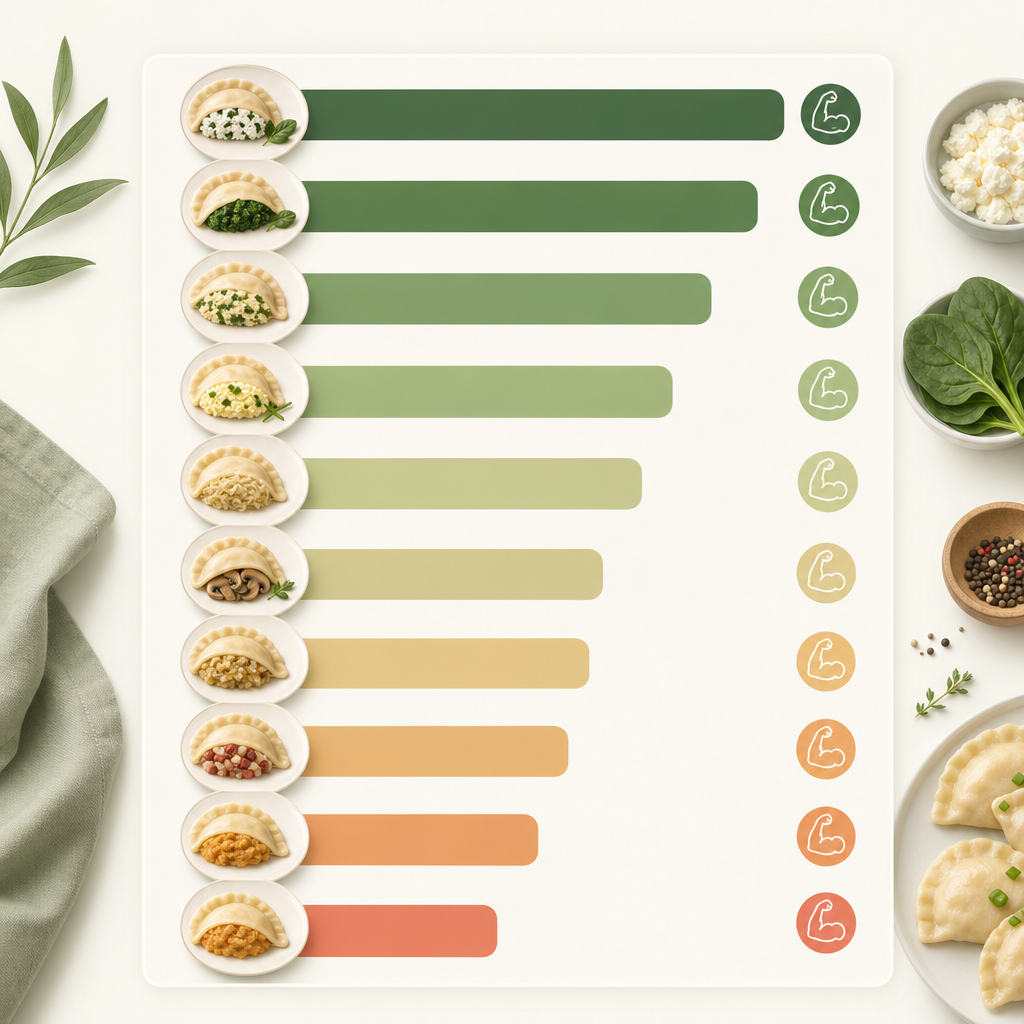
The fillings that best fit a weight-loss plan are sauerkraut-and-mushroom, lentil, and lean ground turkey. The classic potato-and-cheese is the most calorie-dense of the savory options. The dessert versions (sweet cheese, fruit) are the highest in calories per piece, though the sugar in the fruit fillings is mostly natural rather than added.
For homemade versions, you have full control over filling choice. For frozen, the grocery store standard is potato-and-cheddar, with sauerkraut and farmer's cheese available in larger or specialty stores. Mrs. T's Mini Sauerkraut pierogies run 35 calories per piece, the lowest commercially available.
The topping problem
The pierogi itself is rarely the calorie disaster. The classic Polish topping (browned onions, butter, sour cream) is. A traditional restaurant plate of 6 pierogies with butter-and-onion topping plus a dollop of sour cream runs 600 to 800 calories total.
Per tablespoon of common pierogi toppings:
| Topping | Calories | Protein | Fat |
|---|---|---|---|
| Butter | 100 | 0 g | 11 g |
| Sour cream (full-fat) | 30 | 0.5 g | 3 g |
| Sour cream (light) | 20 | 1 g | 1.5 g |
| Plain Greek yogurt (2%) | 14 | 2.5 g | 0.5 g |
| Plain Greek yogurt (0%) | 9 | 2 g | 0 g |
| Bacon bits (1 tbsp) | 30 | 2 g | 2 g |
| Caramelized onions (no butter) | 12 | 0.3 g | 0 g |
| Cottage cheese (2%, mashed) | 12 | 1.5 g | 0.5 g |
| Hot sauce | 1 | 0 g | 0 g |
| Apple sauce (unsweetened) | 5 | 0 g | 0 g |
Swapping the standard topping (1 tbsp butter, 2 tbsp sour cream) for plain Greek yogurt and caramelized onions cooked dry drops 130 calories per serving and gains 5 g of protein. That's enough to take a 500-calorie meal down to 370 without changing the pierogies themselves.
The most useful swap on the list: 0% Greek yogurt instead of sour cream. The texture is nearly identical, the tang is similar (some patients say it's stronger, which is solved by stirring in a teaspoon of lemon juice if needed), and the protein content is the highest of any tablespoon-sized topping.
How pierogies fit into a GLP-1 plan
If you're on compounded semaglutide or tirzepatide, your relationship with starch-heavy meals usually shifts in the first 4 to 8 weeks. Three patterns show up:
- Smaller portions feel filling. A typical patient who pre-treatment ate 8 to 10 pierogies for dinner finds 4 to 5 pierogies satisfying after 8 weeks of titration. The slowed gastric emptying and reduced appetite make starch-heavy meals genuinely filling at lower portions.
- High-fat preparations cause more nausea. Pan-fried pierogies with butter and bacon are among the foods patients most commonly report as nausea triggers during titration. The combination of fat density and starch sits in the stomach longer than either alone. Boiled pierogies with low-fat toppings are tolerated much better.
- The carbohydrate load is workable but not ideal. GLP-1s flatten the glucose curve significantly compared to off-medication baseline, so the refined-starch impact of pierogies is dampened. Still, pairing pierogies with vegetables and a protein source produces a more stable post-meal energy pattern than eating them alone.
The pattern that works for most GLP-1 patients: 4 to 5 boiled pierogies as a main course, paired with 1 to 2 cups of non-starchy vegetables (steamed cabbage, sautéed spinach, mushrooms, broccoli) and a 0% Greek yogurt topping. Total calories run 350 to 400 with 15 to 20 g of protein.
That portion fits comfortably in the appetite-suppressed eating pattern most patients land in, and the vegetable side closes the protein-and-fiber gaps that pierogies don't fill on their own.
A simple weekly framework
If pierogies are a comfort food you want to keep in rotation, a once-weekly "pierogi night" works well for most weight-loss plans. The framework that produces the best results pairs the pierogi meal with a higher-protein side that day, and balances the rest of the week with lower-starch dinners.
Sample weekly framework:
| Day | Dinner | Calories | Protein |
|---|---|---|---|
| Mon | Grilled chicken + roasted vegetables | 450 | 38 g |
| Tue | 5 boiled pierogies + sauteed cabbage + Greek yogurt topping | 380 | 18 g |
| Wed | Salmon + quinoa + green beans | 480 | 32 g |
| Thu | Turkey chili + small salad | 450 | 30 g |
| Fri | Stir-fry: chicken, mixed vegetables, brown rice | 470 | 35 g |
| Sat | Sheet-pan shrimp + roasted broccoli | 420 | 30 g |
| Sun | Lean ground beef pierogies (4) + steamed greens | 420 | 26 g |
That schedule includes pierogies twice (once with low-protein potato filling on Tuesday, once with meat filling on Sunday) without making them the cornerstone of dinner. The weekly average protein lands at 30 g per dinner, which supports muscle preservation during weight loss.
A simple homemade pierogi cooking method that minimizes calories: boil 5 to 6 pierogies for the standard 4 to 5 minutes, drain, then return them to a hot non-stick pan with a 1-second spray of olive oil for 30 seconds of light browning on each side. That gets you 90% of the texture of pan-fried pierogies for 5% of the added fat.
Better alternatives if pierogies aren't filling you up
If 5 pierogies leaves you hungry an hour later, the gap is protein, fiber, or both. Try one of these:
- Stuffed cabbage rolls (golabki). Polish cabbage rolls with a ground meat and rice filling, simmered in tomato sauce. About 240 calories per roll with 14 g protein, 4 g fiber. Better satiety per calorie than pierogies.
- Buckwheat (kasha) with mushrooms and onions. Whole-grain buckwheat groats are the most fiber-dense Polish staple. 1 cup cooked is 155 calories with 6 g protein and 5 g fiber. Pairs well with a piece of grilled chicken or kielbasa.
- Polish white borscht (zurek) with sausage. A fermented rye soup with white sausage, eggs, and potato. About 280 to 350 calories per bowl with 18 to 22 g protein. The fermented base (zakwas) provides probiotics.
- Pierogi-stuffed peppers. Bell peppers stuffed with the same potato-and-cheese filling, baked. Higher fiber, lower starch, similar comfort-food profile.
If your goal is to keep pierogies in your life but make them more satisfying, the simplest move is doubling the vegetable side. Six pierogies with 1 cup of cabbage feels like a meal. Six pierogies with 3 cups of cabbage feels like a feast, and the calorie cost of the extra vegetables is around 60 calories.
FAQ
Are boiled pierogies healthy?
Boiled pierogies are a starch-dominant comfort food with moderate calories (60 to 80 per medium piece) and decent protein when filled with cheese or meat. They can fit a weight-loss plan at the right portion (4 to 6 pieces) with low-fat toppings and a vegetable side. They're not a health food in any meaningful sense, but they're a reasonable comfort meal choice.
How many calories are in 5 boiled pierogies?
Five medium potato-and-cheddar pierogies run 280 to 350 calories depending on size and filling. Sauerkraut-and-mushroom versions are the lowest at around 250 calories per 5 pieces. Sweet dessert pierogies are the highest at around 450 calories per 5 pieces.
Are pierogies fattening?
Pierogies as commonly served (pan-fried with butter and sour cream) are calorie-dense at 500 to 700 per serving. Boiled with low-fat toppings, the same 5 pieces drop to 280 to 350 calories. Whether they're fattening depends entirely on the preparation and the rest of your day's intake.
Can you eat pierogies on a diet?
Yes. Boiled (not fried), 4 to 6 pieces per portion, paired with a vegetable side and a low-fat topping like Greek yogurt. That meal lands at 350 to 420 calories and fits most weight-loss plans.
What's the lowest-calorie pierogi filling?
Sauerkraut-and-mushroom and cabbage fillings are the lowest, at 50 to 55 calories per medium pierogi. Mrs. T's Mini Sauerkraut pierogies are 35 calories each, the lowest commercially available.
Are pierogies healthier boiled or fried?
Boiled by a wide margin. The boiling step adds zero calories. Pan-frying in oil or butter adds 90 to 200 calories per 5 pieces. The calorie difference is the single largest variable in pierogi nutrition.
Are pierogies good for weight loss compared to other carbs?
Pierogies are roughly equivalent to pasta in calorie density per gram and lower in fiber than most whole-grain options. They beat fried foods like french fries on calorie density. They lose to whole grains like quinoa, farro, and buckwheat on fiber and micronutrients.
Do pierogies work as a meal on a GLP-1 medication like compounded semaglutide or tirzepatide?
Yes, with modifications. Boil rather than fry, keep the portion to 4 to 5 pieces, use a low-fat topping like 0% Greek yogurt, and pair with a non-starchy vegetable side. Patients on titration often find this portion comfortably filling without triggering nausea.
What's a healthy pierogi topping?
Plain 0% or 2% Greek yogurt is the highest-protein, lowest-calorie topping. Caramelized onions cooked without butter add flavor at 12 calories per tablespoon. A dash of hot sauce, paprika, or fresh dill works for flavor without calories.
How many pierogies should I eat for weight loss?
For most adults, 4 to 6 medium boiled pierogies per meal is the right range. That's 240 to 420 calories before toppings and sides. Below 4, the meal often doesn't feel substantial enough. Above 6, the carbohydrate load starts to crowd out room for protein and vegetables.
Are frozen pierogies as good as homemade?
Frozen pierogies (Mrs. T's, Reames, Kasia's) are nutritionally similar to homemade with two differences: slightly higher sodium and slightly less filling per piece. The cooking time is the same. For weight-loss purposes, the difference is negligible. Homemade gives you control over filling and dough, which matters if you want to use whole-wheat flour or low-fat fillings.
Are pierogies a complete meal?
Not on their own. Pierogies are starch-heavy and moderate-protein. A complete meal needs added protein (a piece of meat, fish, or extra cheese) and a fiber source (vegetables). The pattern of "5 pierogies plus 1 to 2 cups of cabbage or sauteed greens plus a tablespoon of Greek yogurt" gets the meal to a balanced macro profile.
Author / review note
Reviewed by the FormBlends Medical Team. This article was last reviewed and updated on April 29, 2026. References cited include the USDA FoodData Central database; product nutrition labels from Mrs. T's, Reames, and Kasia's frozen pierogies; the U.S. Dietary Guidelines for Americans, 2020-2025; and clinical observations from GLP-1 titration patient cohorts in published trial data (STEP 1, SURMOUNT-1).
Footer disclaimers
Platform Disclaimer. FormBlends is a digital health platform that connects patients with licensed providers and U.S.-based pharmacies. We do not manufacture, prescribe, or dispense medication directly. All clinical decisions are made by independent licensed providers.
Compounded Medication Notice. Compounded semaglutide and tirzepatide are not FDA-approved. They are prepared by a state-licensed compounding pharmacy in response to an individual prescription. Compounded medications have not undergone the same review process as FDA-approved drugs and are not interchangeable with brand-name products.
Results Disclaimer. Individual results vary. Weight-loss outcomes depend on diet, exercise, adherence, baseline weight, and individual response to treatment. Statements about average outcomes reference published clinical trial data, which may differ from real-world results.
Trademark Notice. All brand names referenced are the property of their respective owners. FormBlends is not affiliated with, endorsed by, or sponsored by any brand-name pharmaceutical manufacturer.
Related guides
- Are Saltine Crackers Healthy for Weight Loss? An Honest Look at the Nutrition
- Is Skinny Pop Healthy for Weight Loss? An Honest Answer Backed by the Nutrition Label
- Is Cream Cheese Healthy for Weight Loss? An Honest Answer Backed by the Nutrition Label
- Are Ritz Crackers Healthy for Weight Loss? An Honest Answer Backed by the Nutrition Label
- Are Grits Healthy for Weight Loss? Here's What the Nutrition Label Actually Says
- Is Pita Bread Healthy for Weight Loss? A Label-First Look at the Numbers
See your options in about 2 minutes
Take the free quiz and see what fits you. Quick, private, and no commitment to continue.
See my options →