The short answer
Plain cooked grits run about 150 calories per cup with 4 g of protein and 2 g of fiber. They can fit a weight-loss plan if you choose stone-ground over instant, watch portion size, and skip the butter-and-cheese loadout. Oatmeal beats grits on fiber, but grits hold their own as a savory breakfast base.
Table of contents
- The 30-second answer
- What grits actually are
- Reading the nutrition label
- Stone-ground vs quick vs instant: the real difference
- Grits vs oatmeal vs cream of wheat (table)
- The Southern preparation problem
- How grits fit into a GLP-1 plan
- Building a weight-loss-friendly bowl
- FAQ
- Footer disclaimers
What grits actually are
Grits are coarsely ground corn, full stop. The corn is dried, hulled, and milled into a coarse meal. When the corn is treated with an alkaline solution (lime water, traditionally) the result is hominy grits, which is what most yellow-package grits in the South are made from. Stone-ground grits skip the alkaline treatment and keep more of the germ and bran.
Check your GLP-1 eligibility
Use our free BMI Calculator to see if you may qualify for provider-reviewed GLP-1 therapy.
Try the BMI Calculator →That last detail matters more than the package design. Stone-ground grits hold onto roughly 4 g of fiber per cooked cup. Instant grits, which have been parboiled, dried, and ground extra-fine to cook in 90 seconds, drop to about 1 g of fiber. Same starting ingredient, different finishing process, very different effect on blood sugar.
Quick grits sit in between, usually around 2 g of fiber per cup. The processing difference is the single biggest variable in whether grits help or hurt a weight-loss plan.
Reading the nutrition label
Per 1 cup cooked plain grits (made with water, no added fat):
| Macro | Stone-ground | Quick (regular) | Instant |
|---|---|---|---|
| Calories | 150 | 145 | 100 (per packet) |
| Total fat | 1 g | 0.5 g | 0.5 g |
| Sodium | 0 mg (unsalted) | 0 mg (unsalted) | 290 mg |
| Total carbs | 31 g | 31 g | 22 g |
| Dietary fiber | 4 g | 2 g | 1 g |
| Protein | 4 g | 3 g | 2 g |
| Glycemic index (est.) | 55 | 65 | 75+ |
Source: USDA FoodData Central; glycemic index estimates from the International Tables of Glycemic Index, Atkinson et al., Diabetes Care, 2021 update.
A clinician's take: stone-ground grits land in the moderate-glycemic range, which is acceptable for most weight-loss plans. Instant grits push into the high-GI category and behave more like white rice or a slice of white bread. The fiber gap is the reason. Fiber slows gastric emptying and blunts the post-meal glucose curve.
The protein content (4 g per cup) is low. That's the most important number on this label for satiety purposes. A bowl of plain grits will not keep you full. Pair it with something that brings the protein up to at least 20 g for the meal.
Stone-ground vs quick vs instant: the real difference
The package usually tells you which type you bought, but it isn't always obvious. Here's the shortcut:
- Stone-ground: Cooks in 30 to 45 minutes. Bag often says "stone-ground" or "old-fashioned." Texture is coarser and slightly speckled because the germ is still in there. Glycemic impact is the lowest of the three.
- Quick (regular): Cooks in 5 to 10 minutes. Most yellow-box and Quaker grits fall here. Smoother texture. Moderate glycemic impact.
- Instant: Single-serve packets, cooks in 90 seconds with hot water. Often pre-flavored (butter, cheese, country bacon). Highest glycemic impact and usually loaded with sodium (around 290 to 600 mg per packet).
If you're buying grits with weight loss in mind, stone-ground is the clear pick. If your grocery store doesn't carry it, the next best move is quick grits cooked plain, with the fat and protein added at the bowl.
The 2023 American Journal of Clinical Nutrition study by Reynolds et al. on whole-grain processing showed that minimally processed corn products produced a 25% smaller post-meal glucose peak compared to highly processed versions of the same grain. Same calories, very different metabolic effect.
Grits vs oatmeal vs cream of wheat (head-to-head)
For a 1-cup cooked, plain serving made with water:
| Breakfast cereal | Cal | Protein | Fiber | Carbs | Sugar | GI |
|---|---|---|---|---|---|---|
| Stone-ground grits | 150 | 4 g | 4 g | 31 g | 0 g | 55 |
| Quick grits | 145 | 3 g | 2 g | 31 g | 0 g | 65 |
| Instant grits (1 packet) | 100 | 2 g | 1 g | 22 g | 0 g | 75 |
| Old-fashioned oatmeal | 165 | 6 g | 4 g | 28 g | 1 g | 55 |
| Steel-cut oats | 170 | 6 g | 5 g | 29 g | 0 g | 52 |
| Instant oatmeal (plain) | 100 | 4 g | 3 g | 19 g | 0 g | 79 |
| Cream of wheat | 150 | 5 g | 1 g | 32 g | 0 g | 70 |
| Quinoa | 220 | 8 g | 5 g | 39 g | 1 g | 53 |
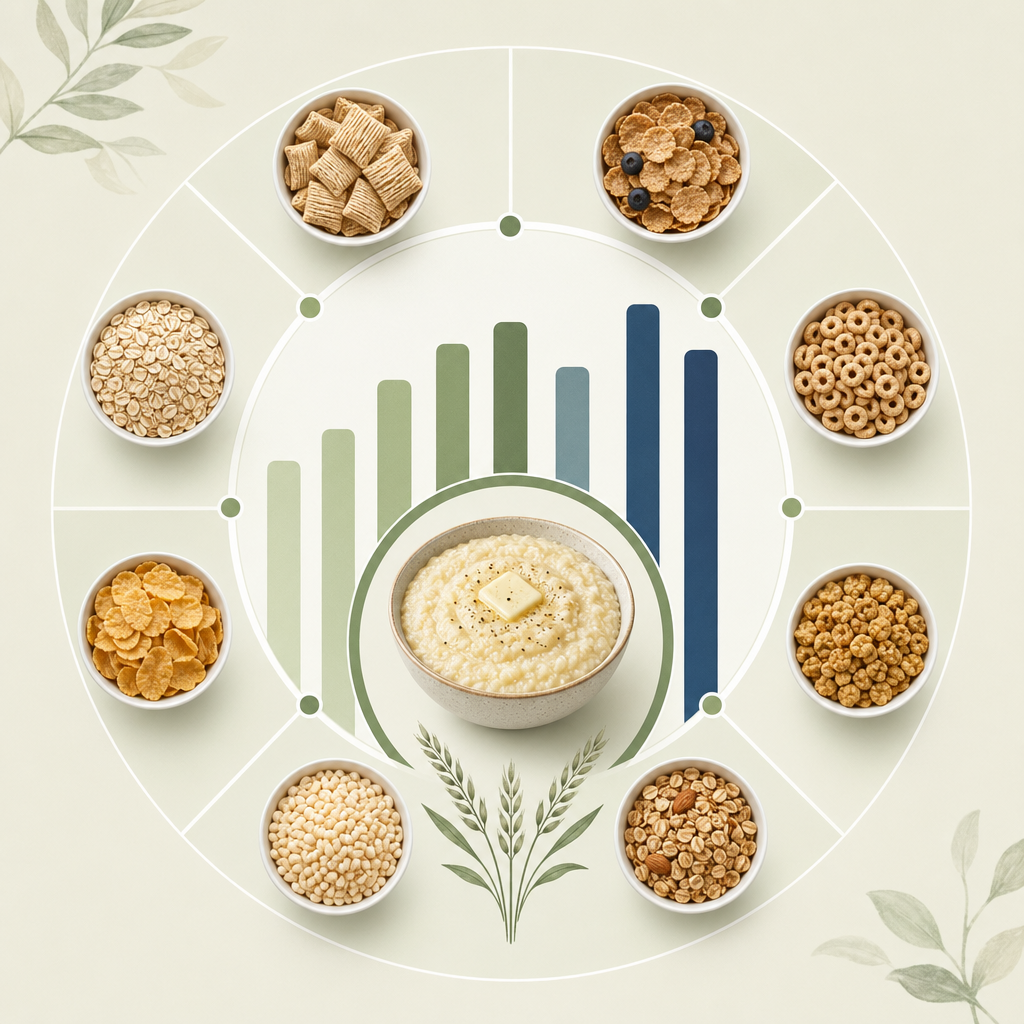
What this shows: oatmeal beats grits on fiber and protein at roughly the same calorie cost. Steel-cut oats are the strongest option for weight loss. Quinoa wins on protein but is more expensive and less culturally adjacent to a Southern breakfast. Cream of wheat looks similar to grits on calories but loses on fiber.
If your morning is a debate between stone-ground grits and old-fashioned oatmeal, oatmeal wins. If the choice is grits or a bagel, grits win. Context matters more than the food itself.
The Southern preparation problem
Plain cooked grits are 150 calories. A traditional Southern bowl of grits is rarely plain. Here's what a typical restaurant or home preparation actually looks like:
| Add-in | Amount | Calories added |
|---|---|---|
| Plain grits | 1 cup cooked | 150 |
| Butter | 2 tbsp | 200 |
| Sharp cheddar | 1/4 cup shredded | 110 |
| Heavy cream stir-in | 2 tbsp | 100 |
| Salt | to taste | 0 |
| Total | 560 |
A "small" bowl of cheese grits at a sit-down restaurant in the South averages 600 to 750 calories before you've added shrimp, sausage, or eggs. Add a side of bacon and a biscuit and the breakfast clears 1,200 calories.
This is the part of "are grits healthy for weight loss" that gets lost. The grain itself is fine. The construction of the bowl is what derails the plan. The same logic applies to a baked potato (130 cal) becoming a loaded baked potato (650 cal).
The fix is to pull the fat and dairy out of the cooking step and use them as a topping at the bowl, where you can see and control the portion.
How grits fit into a GLP-1 plan
If you're on compounded semaglutide or tirzepatide, breakfast tends to be the meal that changes the most. Many patients report that they wake up with no real appetite for the first 4 to 8 weeks, then settle into a pattern of wanting something small and warm in the morning. Grits fit that brief well, with caveats.
The case for grits on GLP-1:
- They're soft, warm, and gentle on a queasy stomach. Many patients tolerate plain grits during the first week of a dose increase when nausea is at its peak.
- They're easy to fortify with protein. A scrambled egg stirred in (or shrimp on top) takes the protein from 4 g to 20+ g without changing the texture much.
- Stone-ground grits have a moderate glycemic impact, which won't trigger the blood sugar swings that some patients notice after high-GI breakfasts.
The case against:
- Plain grits without protein leave most patients hungry within 90 minutes, even with appetite suppression. That can create a snack reflex that wasn't there before.
- The traditional cheese-and-butter preparation is high in saturated fat, which can worsen GLP-1-related nausea and reflux. (For more on reflux, see our piece on why GLP-1s can cause acid reflux.)
- The carb load can feel uncomfortable in an appetite-suppressed stomach. A 1/2 cup serving is often a better starting point than a full cup during titration.
Pragmatic approach: use stone-ground grits as a base, top with eggs and a small handful of greens, skip the butter and cheese for the first 90 days. If you tolerate that well, you can add a sprinkle of cheese later.
Building a weight-loss-friendly bowl
The framework is simple: keep the base modest, drive protein up, add a vegetable, control the added fat.
The 400-calorie weight-loss grits bowl:
| Ingredient | Amount | Calories | Protein |
|---|---|---|---|
| Stone-ground grits, cooked | 3/4 cup | 115 | 3 g |
| Two eggs, scrambled | 2 large | 140 | 12 g |
| Sautéed spinach | 1 cup | 40 | 1 g |
| Cherry tomatoes, halved | 1/2 cup | 15 | 1 g |
| Sharp cheddar, shredded | 1 tbsp | 30 | 2 g |
| Hot sauce | to taste | 0 | 0 |
| Total | 340 | 19 g |
That's 340 calories with 19 g of protein, which clears the satiety threshold most clinicians use as a minimum for breakfast. Compare that against the 560-calorie traditional preparation that delivers maybe 12 g of protein. Same general flavor profile, very different macros.
If you want shrimp and grits in a weight-loss-friendly form: 3/4 cup stone-ground grits, 4 oz peeled shrimp sautéed in 1 tsp olive oil with garlic and paprika, a squeeze of lemon, hot sauce. Around 380 calories with 28 g of protein.
A simple weekly breakfast rotation
Most weight-loss plateaus come from boredom-driven over-snacking, not from any single meal. Rotating breakfast types keeps the plan sustainable.
| Day | Breakfast | Cal | Protein |
|---|---|---|---|
| Mon | Stone-ground grits + 2 eggs + spinach | 340 | 19 g |
| Tue | Steel-cut oats + walnuts + berries | 380 | 12 g |
| Wed | Greek yogurt + chia + raspberries | 280 | 22 g |
| Thu | Shrimp and grits (light prep) | 380 | 28 g |
| Fri | Cottage cheese + pineapple + flaxseed | 290 | 24 g |
| Sat | Egg-white omelet + 1/2 cup grits side | 320 | 26 g |
| Sun | Smoked salmon + half bagel + cucumber | 350 | 22 g |
Grits show up twice. That's enough to satisfy the craving without crowding out higher-protein options.
When grits are a bad idea for weight loss
Three scenarios where grits are not the right call:
- You're insulin-resistant or pre-diabetic and the grits available to you are instant. The glycemic impact of an instant packet is high enough that it can spike fasting glucose for the next 12 hours. Stick with steel-cut oats or eggs.
- You can't stop at one cup. If your grits portion always becomes two or three cups, the calories scale fast. A 3-cup bowl with cheese and butter clears 1,000 calories. Switch to a portion-controlled option.
- Your protein intake for the day is already low. Grits add carbs without meaningfully moving your protein number. If you're consistently under 80 g of protein per day, swap grits for Greek yogurt or eggs.
FAQ
Are grits good for weight loss?
Plain stone-ground grits at a 1-cup portion, paired with at least 15 g of protein, can fit a weight-loss plan. The food itself is not the problem. The traditional Southern preparation (butter, cheese, cream) is what turns a 150-calorie base into a 600-calorie meal.
How many calories are in a cup of cooked grits?
Plain stone-ground or quick grits cooked with water deliver about 145 to 150 calories per cooked cup. An instant grits packet is about 100 calories. Restaurant cheese grits typically run 400 to 600 calories per side.
Are grits healthier than oatmeal?
No, on a fiber and protein basis, oatmeal wins. A cup of cooked old-fashioned oatmeal has 6 g of protein and 4 g of fiber against grits' 4 g and 4 g (stone-ground) or 3 g and 2 g (quick). Steel-cut oats are the strongest of the three.
What's the glycemic index of grits?
Stone-ground grits sit around 55, which is moderate. Quick grits run about 65. Instant grits push 75 or higher, which is comparable to white bread. Adding fat and protein to the bowl lowers the effective glycemic load regardless of the type.
Can diabetics eat grits?
Stone-ground grits in a 1/2 cup portion, paired with eggs or another protein, are generally okay for type 2 diabetics with reasonable glucose control. Instant grits are usually a poor choice. Anyone on insulin should test their post-breakfast glucose response before making grits a regular part of the rotation.
Do grits make you gain weight?
Grits don't cause weight gain on their own. The calorie load that comes from butter, cheese, and large portions is what drives gain. A plain 3/4 cup serving will not move the scale.
Are stone-ground grits worth the extra cooking time?
For weight loss, yes. The 4 g of fiber per cup (versus 1 to 2 g for quicker varieties) makes a measurable difference in satiety and post-meal blood sugar. The 30 to 45 minute cook time is also why batch-cooking on Sunday for the week makes sense.
Are grits gluten-free?
Plain grits are made from corn and are naturally gluten-free. Instant grits with added flavoring sometimes contain wheat-based ingredients, so people with celiac disease should check the label. Cross-contamination during processing is a concern with non-certified brands.
Can I eat grits while on compounded semaglutide or tirzepatide?
Most patients tolerate plain stone-ground grits well, especially during the first weeks of a dose increase when nausea is common. Avoid the heavy cream-and-cheese preparation, which can worsen GLP-1-related reflux. A 1/2 cup serving with eggs is a sensible starting point.
What's the best way to make grits weight-loss-friendly?
Three rules: use stone-ground grits, cook in water (not milk or cream), and add protein at the bowl. Eggs, shrimp, smoked salmon, or rotisserie chicken are all easy options. Top with a vegetable (spinach, tomatoes, scallions) and use cheese as a finishing touch, not as a base ingredient.
Are cheese grits ever okay on a diet?
Yes, in a controlled portion with the cheese measured. A 3/4 cup serving with 1 tablespoon of grated parmesan adds 30 calories and 2 g of protein, and the flavor punch of parmesan goes a long way. Avoid the 1/4 cup shredded cheddar default, which adds 110 calories on its own.
Do grits have any nutritional benefits?
Stone-ground grits are a whole grain with B vitamins (especially niacin and folate), iron, and the antioxidant lutein. They're low in fat and naturally sodium-free. They're not a superfood, but they're a defensible base for a savory breakfast when prepared sensibly.
Author / review note
Reviewed by the FormBlends Medical Team. This article was last reviewed and updated on April 29, 2026. References cited include U.S. Department of Agriculture, FoodData Central; Atkinson et al., Diabetes Care, 2021 (International Tables of Glycemic Index update); Reynolds et al., American Journal of Clinical Nutrition, 2023 (whole-grain processing and glucose response); and the U.S. Dietary Guidelines for Americans, 2020-2025.
Footer disclaimers
Platform Disclaimer. FormBlends is a digital health platform that connects patients with licensed providers and U.S.-based pharmacies. We do not manufacture, prescribe, or dispense medication directly. All clinical decisions are made by independent licensed providers.
Compounded Medication Notice. Compounded semaglutide and tirzepatide are not FDA-approved. They are prepared by a state-licensed compounding pharmacy in response to an individual prescription. Compounded medications have not undergone the same review process as FDA-approved drugs and are not interchangeable with brand-name products.
Results Disclaimer. Individual results vary. Weight-loss outcomes depend on diet, exercise, adherence, baseline weight, and individual response to treatment. Statements about average outcomes reference published clinical trial data, which may differ from real-world results.
Trademark Notice. All brand names referenced are the property of their respective owners. FormBlends is not affiliated with, endorsed by, or sponsored by any brand-name pharmaceutical manufacturer.
Related guides
- Is Skinny Pop Healthy for Weight Loss? An Honest Answer Backed by the Nutrition Label
- Is Cream Cheese Healthy for Weight Loss? An Honest Answer Backed by the Nutrition Label
- Are Ritz Crackers Healthy for Weight Loss? An Honest Answer Backed by the Nutrition Label
- Are Saltine Crackers Healthy for Weight Loss? An Honest Look at the Nutrition
- Can Boiled Pierogies Be Healthy for Weight Loss? An Honest Look at the Nutrition
- Is Pita Bread Healthy for Weight Loss? A Label-First Look at the Numbers
See your options in about 2 minutes
Take the free quiz and see what fits you. Quick, private, and no commitment to continue.
See my options →