Key Takeaway
Yes, Lemonaid Health appears to be a legitimate telehealth platform, not a scam. The more important question is whether its specific care pathway, clinician access, pharmacy routing, and recurring costs fit the service you want, especially if you are comparing it with a more specialized weight loss program.[1][2][3][4][5][6]
Lemonaid Health is a broad telehealth service, not a GLP-1-only clinic. Public summaries describe care for general health, mental health, and medication prescribing, with communication through online intake plus app, phone, or video follow-up depending on the condition.[1][2][3][7][8]
That distinction matters. A broad telemedicine platform can be perfectly legitimate and still be a weaker fit for someone who wants highly structured, long-term obesity medication management with very clear refill rules and pharmacy sourcing upfront.
The short verdict, legitimate platform, but the trust test is in the details
Lemonaid passes the basic legitimacy screen if it connects patients with licensed prescribers, requires a valid prescription before medication is dispensed, and routes medication through a pharmacy that can be independently verified under FDA, NABP, and LegitScript standards.[4][5][6]
The friction point is transparency, not existence. Publicly available materials summarized in reputable health coverage describe how Lemonaid works at a high level, but the source set available for this page does not provide a complete public breakdown of every recurring fee, refill policy, cancellation deadline, or pharmacy arrangement for every service line.[1][9][10]
What can be verified about Lemonaid Health
| Trust question | What is publicly supported | What still needs confirmation during signup |
|---|---|---|
| Is it a real telehealth business? | Yes. Public health coverage describes Lemonaid Health as a telemedicine platform for multiple conditions, not a fake storefront.[1][8] | The exact legal entity shown in consent, billing, and support documents. |
| Does it use licensed clinicians? | Public summaries say appointments are handled by doctors and nurse practitioners who may prescribe medication when appropriate.[2] | The assigned clinician’s name, credentials, and state license before treatment proceeds. |
| Does it use a real prescription model? | FDA BeSafeRx states that legitimate online pharmacy care should require a valid prescription from a licensed professional.[4] | Whether the chosen service line actually includes a clinical review before medication is charged or shipped. |
| Is mail-order pharmacy involved? | Public health coverage says Lemonaid offers a mail-order pharmacy option.[10] | The dispensing pharmacy name and whether prescriptions can also be sent elsewhere. |
| Is every medication automatically FDA approved? | No. FDA warns that compounded GLP-1 products are not FDA-approved and are not reviewed by FDA for safety, effectiveness, or quality before marketing.[11] | Whether the medication offered is a branded FDA-approved product, a compounded product, or either depending on supply. |
| Is the full long-term price easy to verify publicly? | Not from the verified source set used here. Public descriptions explain services, but not one stable all-in price sheet across every condition.[1][9] | Visit fees, recurring program fees, medication charges, refill fees, shipping, lab costs, and cancellation timing. |
Why Lemonaid feels different from a dedicated weight loss clinic
Lemonaid is described as treating more than 30 conditions across general and mental health categories, not just obesity medicine.[12][8] That usually means the platform is built for breadth and convenience first.
Not sure which GLP-1 is right for you?
Take a 2-minute assessment and get a personalized recommendation after licensed provider review.
Take the Assessment →For many people, that is a plus. For someone shopping specifically for GLP-1 treatment, the bigger issue becomes how much detail the platform gives before payment about medication type, refill cadence, follow-up visits, and pharmacy sourcing.
Pharmacy verification matters most, especially if GLP-1 treatment enters the picture
If Lemonaid routes a prescription to a standard licensed pharmacy for a branded medication, the trust check is relatively straightforward. The main things to verify are prescription legitimacy, pharmacy licensing, and whether the refill process is clearly explained.[4][5]
If the route involves compounded GLP-1 medication, the bar should be higher. FDA states that compounded semaglutide and tirzepatide products are not FDA-approved, and FDA does not review them for safety, effectiveness, or quality before marketing.[11]
FDA BeSafeRx says a legitimate online pharmacy setup should require a valid prescription, provide a physical U.S. address and phone number, make a licensed pharmacist available for questions, and hold active state licensure.[4] NABP Safe.Pharmacy and the LegitScript certification directory provide additional ways to check whether a linked online pharmacy or telemedicine operator is meeting recognized U.S. standards.[5][6]
If a compounded medication is offered, the FDA 503B registry is another useful check because it lists registered outsourcing facilities that are subject to CGMP requirements and FDA inspection schedules, which is different from a traditional 503A state-regulated compounding model.[13]
A practical legitimacy audit for Lemonaid before paying
| Question to answer in the checkout flow | Why it matters for Lemonaid specifically | Green flag | Red flag |
|---|---|---|---|
| Which type of visit is this, message-based, phone, or video? | Public summaries suggest Lemonaid uses different contact formats depending on the service line.[3][7] | The care format is disclosed before payment. | The visit type only becomes clear after purchase. |
| Who is the clinician assigned to the case? | Broad telehealth platforms may route patients through a larger clinician network rather than a single ongoing prescriber.[2] | Name, credentials, and state licensure are easy to find. | No clinician identity is shown before a prescription decision. |
| Which pharmacy will dispense the medication? | Lemonaid is described as offering mail-order pharmacy fulfillment, so pharmacy identity is a central trust check.[10] | The pharmacy can be looked up using NABP Safe.Pharmacy or state board records.[5] | Only vague wording such as “partner pharmacy” appears. |
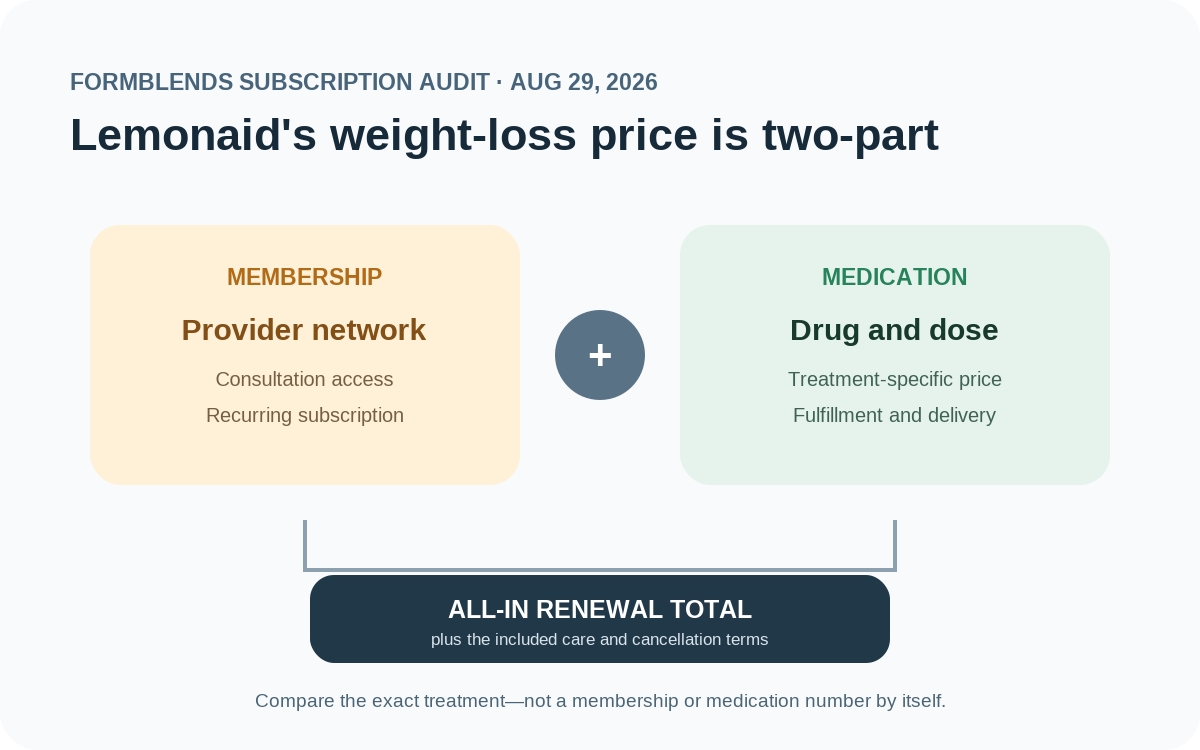
| What exactly is included in today’s charge? | Telehealth pricing is often split across consultation, medication, shipping, and ongoing management. | Separate line items appear before checkout. | Only a teaser price appears. |
| What happens after the first prescription? | Follow-up care is where recurring costs and refill delays often show up. | The platform shows refill timing, follow-up requirements, and messaging access clearly. | There is no clear explanation of refill cadence or review schedule. |
| How is cancellation handled? | Many telehealth complaints are really renewal or auto-billing disputes, not medical quality disputes. | Renewal timing and cancellation deadlines are shown before enrollment. | Cancellation rules are hard to locate until after signup. |
Pricing, what is knowable, and what is not
No verified source in this page set gives a complete, current, condition-by-condition Lemonaid fee schedule. That means any article claiming one precise all-in monthly price for Lemonaid across all services would be overstating what can be verified publicly from the approved sources.
Secondary review pages say Lemonaid generally operates as a cash-pay model, that therapy is not included, and that one mental health medication-management pathway carries a monthly fee.[14][15][16] Those details are useful clues about the business model, but not strong enough to treat as definitive current pricing facts.
Cost math that works for Lemonaid’s model
Instead of focusing on one advertised number, break the total into separate buckets during signup:
- Initial cost, visit or intake fee, plus medication, plus any shipping or lab charge
- Recurring cost, follow-up or program fee, plus refill medication cost, plus any delivery fee
- Change-over-time cost, whether price changes after dose escalation, refill stage changes, or a shift from starter to maintenance care
This is especially important for weight loss treatment. A low entry price is not very informative if the platform does not also show the refill cost, the maintenance-phase cost, and whether medication pricing changes as treatment progresses.
What the care experience is likely to feel like
Public coverage describes Lemonaid as a remote-first service where a patient submits information online and a clinician reviews it, with follow-up that may happen by app, phone, or video depending on the condition.[3][9][7] That usually produces a convenience-first experience.
That can work well for common, lower-complexity needs. It can feel less tailored for people who want high-touch longitudinal management, frequent medication adjustments, or very visible continuity with the same clinician over time.
That pattern fits the broader telehealth evidence base. Systematic reviews have found telehealth often performs well on access and patient satisfaction, but results vary by condition and by how the workflow handles follow-up and continuity.[17][18][19]
How Lemonaid compares with a specialized GLP-1 program on trust questions
| Question | Lemonaid’s likely model | Why readers should care |
|---|---|---|
| Is the platform built mainly for one condition? | No, public summaries describe a broad multi-condition service.[1][8] | Breadth can be convenient, but condition-specific logistics may be less obvious upfront. |
| Is the follow-up style likely to be standardized across all services? | Not necessarily, because contact format may vary by condition.[3][7] | Readers should confirm whether their service line is message-based, phone-based, or video-based. |
| Is pharmacy sourcing central to the trust decision? | Yes, especially if weight loss medication is involved.[11][4] | The exact dispensing route can affect medication type, verification steps, and refill reliability. |
| Is all-in price easy to audit from public sources? | No, not from the verified source set used here. | Readers should expect to calculate total cost from the actual enrollment flow, not from one headline number. |
Independent checks that matter more than marketing language
- Use NABP Safe.Pharmacy to verify the online pharmacy or linked dispensing pharmacy.[5]
- Use FDA BeSafeRx criteria to confirm that a valid prescription is required, a physical U.S. address and phone number are provided, pharmacist access exists, and state licensure is active.[4]
- If a compounded medication is involved, use the FDA 503B outsourcing facility registry to see whether the supplying facility is listed there.[13]
- Check the LegitScript certification directory for the telemedicine or pharmacy operation.[6]
- Look up the named prescriber in the relevant state professional license database once the clinician identity is disclosed.
Questions worth asking Lemonaid Health specifically
- Is the displayed price for the visit only, or for the visit plus medication?
- Will the prescription be sent to Lemonaid’s mail-order option, an outside pharmacy, or either?
- For weight loss treatment, is the product branded, compounded, or dependent on availability?
- What type of follow-up is required after the first prescription, messaging, phone, or video?
- Are follow-up visits included, required, or billed separately?
- Does the recurring monthly cost change after refill stage changes or dose changes?
- What is the cancellation deadline before the next charge or refill cycle?
- For mental health care, is the service medication management only, or are therapy services excluded?
Alternatives if you want a different kind of telehealth experience
If the goal is all-in-one remote care across several conditions, another general telemedicine platform may be the closest comparison. If the goal is structured obesity medication management, a more specialized weight loss provider may be easier to evaluate because refill cadence, pharmacy sourcing, and long-term pricing tend to be more central to the offer.
Readers comparing GLP-1 programs can review Found Weight Loss vs Lemonaid Health and MEDVi vs Lemonaid Health. Readers evaluating provider credibility can also compare Mochi Health: Is It Legit?.
Frequently Asked Questions
Is Lemonaid Health a scam?
No sign in the verified source set suggests Lemonaid Health is a scam. Public health coverage describes it as a real telemedicine platform, and the meaningful trust checks are the prescriber, the pharmacy, and the billing terms tied to the specific service selected.[1][2][4][5]
Is Lemonaid Health only for weight loss?
No. Public summaries describe a broader telemedicine service for general health and mental health, with treatment for many conditions beyond weight loss.[1][12][8]
Does Lemonaid Health use licensed clinicians?
Public summaries say Lemonaid appointments involve doctors and nurse practitioners who may prescribe medication if needed.[2] Independent legitimacy checks still matter, including verifying the named clinician through the relevant state licensing database once that identity is provided.
Are medications from Lemonaid Health FDA approved?
Not automatically. A telehealth platform is not itself FDA approved. If a prescription is for a branded medication, that product may be FDA approved. If it is compounded, FDA says compounded GLP-1s are not FDA-approved finished drugs.[11]
How can someone verify the pharmacy behind a Lemonaid prescription?
Use NABP Safe.Pharmacy, FDA BeSafeRx criteria, and the relevant state board of pharmacy records. If the medication is compounded, the FDA 503B registry is another useful check for listed outsourcing facilities.[5][4][13]
Is telehealth generally credible for ongoing care?
Often yes, especially for convenience and access. Systematic reviews show telehealth can support good patient satisfaction and effective care in many settings, but performance depends on the condition and the design of follow-up care.[17][18][19]
Bottom line: Lemonaid Health appears legitimate, but legitimacy is only the first filter. Before paying, confirm the clinician type, the visit format, the pharmacy path, the exact medication category, the recurring billing structure, and the cancellation rules for the specific service line you plan to use.
Verification and Clinical References for Lemonaid Health
- healthline.com: Lemonaid Health Reviews
- healthline.com: Lemonaid Health Reviews
- healthline.com: Lemonaid Health Reviews
- FDA BeSafeRx: Verify State-Licensed Online Pharmacies
- National Association of Boards of Pharmacy (NABP) Safe Pharmacy Checker
- LegitScript Healthcare and Telemedicine Certification Directory
- healthline.com: Lemonaid Health Reviews
- healthline.com: Lemonaid Health Reviews
- healthline.com: Lemonaid Health Reviews
- healthline.com: Lemonaid Health Reviews
- FDA Concerns with Unapproved GLP-1 Drugs Used for Weight Loss
- healthline.com: Lemonaid Health Reviews
- FDA Registered Outsourcing Facilities (Section 503B)
- choosingtherapy.com: Lemonaid Health Review
- choosingtherapy.com: Lemonaid Health Review
- choosingtherapy.com: Lemonaid Health Review
- Telehealth and patient satisfaction: a systematic review and narrative analysis.
- The effectiveness of teleconsultations in primary care: systematic review.
- Telemedicine interventions for older adults: A systematic review.
See your options in about 2 minutes
Take the free quiz and see what fits you. Quick, private, and no commitment to continue.
See my options →