Quick verdict
Yes, Mochi Health appears to be a legitimate U.S. telehealth platform, not a scam. The stronger question is whether its model is transparent enough for the medication and billing path a patient actually wants. Mochi offers licensed-clinician telehealth care and weight loss prescribing, but readers should verify the exact pharmacy used, whether the medication is brand or compounded, how membership renews, and what total monthly cost looks like after dose changes before paying.[1][2][3][4]
Mochi Health is primarily known for medical weight loss and GLP-1 prescribing, but its app store listings describe a broader telehealth marketplace with additional care categories such as nutrition, hair loss, skincare, mental health support, PCOS and hormonal care, and other longevity-related services.[5][6][7][8] That matters because readers searching “is Mochi legit?” are not just asking if the company exists. They are asking whether the clinical oversight, pharmacy pathway, and payment structure are trustworthy.
The short answer is yes, with caveats. The platform publicly states that medical services are provided by licensed clinicians affiliated with independent professional practices, that treatment decisions are made by licensed providers, and that the service is available nationwide through its app ecosystem.[9][10][11][12] Legitimacy still depends on the details behind the prescription, especially if a compounded GLP-1 is offered, because compounded semaglutide and tirzepatide are not FDA approved finished drugs.[4]
What makes Mochi look legitimate, and what still needs checking
| Checkpoint | What is publicly visible | What to confirm before paying |
|---|---|---|
| Licensed clinicians | Mochi states treatment decisions are made by licensed provider doctors and clinicians tied to independent practices.[9][10] | Ask for the clinician name and state license, then verify it on the relevant state medical board. |
| Nationwide availability | App listings say the service is available in all 50 states.[11][12] | Confirm that your exact medication option is available in your state, because eligibility and prescribing rules can vary. |
| Medication scope | Public descriptions mention GLP-1 treatment options for eligible patients and compounded semaglutide injection once weekly.[13][14] | Confirm whether the prescription would be brand name, compounded, oral, or injectable, because the safety and pricing implications are different.[4] |
| Pharmacy path | The app store language says patients can choose doctor, pharmacy, and treatment.[15][16] | Get the exact pharmacy name in writing, then verify licensing through the state board, NABP Safe.Pharmacy, and LegitScript if applicable.[2][3][1] |
| Compounded GLP-1 legitimacy | Mochi publicly markets compounded GLP-1 options in app listings and on its site ecosystem.[14][17] | If compounded medication is used, ask whether it comes from a state-licensed 503A pharmacy or a registered 503B outsourcing facility and confirm that independently.[18][4] |
| Ongoing support | Mochi says patients can message the care team anytime and that 24/7 support is included.[19][20] | Ask whether messages go to your prescribing clinician, a pooled support team, or both, and how refill issues are escalated. |
The green flags are straightforward. Mochi presents itself as a real telehealth company, offers clinician-based prescribing, and describes a recurring care model rather than anonymous medication sales.[15][10] Those are generally better signs than websites that skip medical evaluation or promise guaranteed prescriptions.
The unresolved pieces are the ones that matter most in practice. Readers still need exact membership terms, cancellation timing, the specific pharmacy that will dispense the medication, and whether the price shown during signup is only the visit fee or the full monthly spend once medication is added.
Mochi is not the medication, the legitimacy question changes by prescription type
Mochi itself is a telehealth platform. The prescription you receive may fall into one of two very different buckets.
1. Brand-name GLP-1 medications
If a patient receives an FDA-approved brand medication such as Wegovy or Zepbound through a standard licensed pharmacy, the legitimacy questions mostly center on the prescribing process, insurance handling, refill follow-through, and billing clarity. The drug itself is an FDA-approved product made under the manufacturer’s normal supply chain.
2. Compounded GLP-1 medications
If a patient receives a compounded semaglutide or tirzepatide product, the oversight picture is different. FDA states that compounded GLP-1 drugs are not FDA approved, and the agency does not review them for safety, effectiveness, or quality before marketing.[4] That does not automatically make them illegal or fake, but it does mean the patient should verify the dispensing pharmacy and understand that the product is not the same thing as an FDA-approved branded pen or vial.
This is the biggest place where “legit” can get blurry for consumers. A telehealth company can be legitimate while still offering a compounded medication path that requires more patient due diligence than a standard retail prescription.
How to verify a Mochi prescription pathway before checkout
FDA’s BeSafeRx framework gives the clearest consumer checklist for online pharmacy verification. A legitimate online pharmacy should require a valid prescription, list a physical U.S. address and phone number, provide access to a licensed pharmacist for questions, and hold an active state license.[1]
Not sure which GLP-1 is right for you?
Take a 2-minute assessment and get a personalized recommendation after licensed provider review.
Take the Assessment →NABP Safe.Pharmacy and LegitScript add another layer. NABP’s lookup tool can help verify whether a pharmacy is operating legally under U.S. pharmacy standards, and LegitScript certification can help confirm whether a telemedicine platform or linked pharmacy maintains appropriate licensing and prescribing compliance.[2][3]
If Mochi routes a prescription to a compounded product, ask one extra question. Is the source a state-regulated 503A compounding pharmacy or an FDA-registered 503B outsourcing facility? The FDA maintains a public registry for 503B facilities, which are distinct from 503A pharmacies and are subject to CGMP requirements and FDA inspection schedules.[18]
| Ask Mochi this exact question | Why it matters |
|---|---|
| What is the full name of the pharmacy that will fill my prescription? | You cannot verify licensing without the exact business name. |
| Is this medication brand name or compounded? | These are different regulatory categories with different risk and cost implications.[4] |
| If compounded, is the source 503A or 503B? | It tells you what type of facility is involved and how to verify it.[18] |
| Who handles refill delays, the clinician, care coordinator, or pharmacy? | This often determines whether problems get solved quickly or bounce between teams. |
| What fees continue if I pause or stop medication? | The monthly membership may continue even when medication does not ship, depending on terms. |
What Mochi seems to offer clinically
Public app listings describe Mochi as a telehealth marketplace where patients complete an intake, choose a board-certified provider, and receive a personalized care plan that may include GLP-1 treatment for eligible patients.[21][16][5][13] The platform also says patients can message the care team anytime, with 24/7 support included.[19][20]
That model can be convenient. Telehealth, when implemented well, is associated with good patient satisfaction and easier access for many patients, particularly when the platform has clear scheduling, licensing, follow-up, and communication processes.[22][23][24] But telehealth convenience does not replace the need for medication-specific monitoring, especially with drugs that commonly cause gastrointestinal side effects and require dose titration.
What is still too unclear publicly, and why that matters
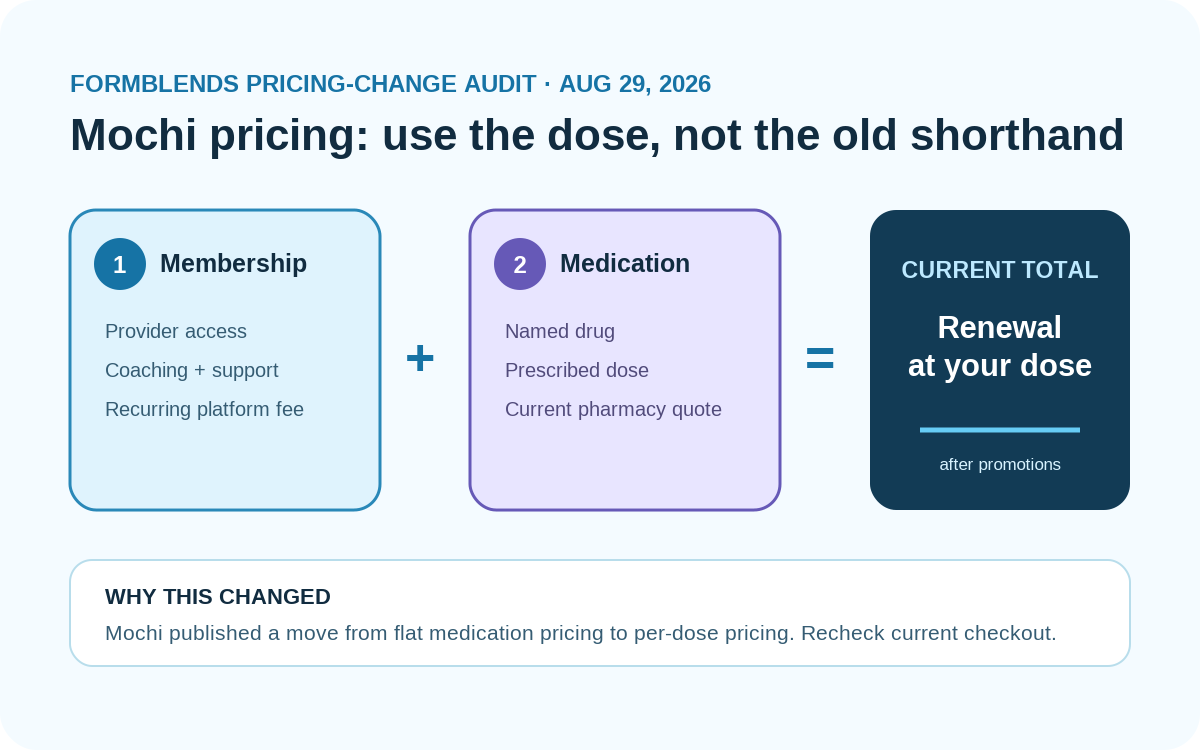
The biggest gap is true total cost transparency. Mochi’s own marketing ecosystem highlights membership pricing, medication pricing, insurance-related pricing, and dose-specific offers, but those figures can be conditional, state-specific, insurance-dependent, or promotional. Because those numbers can change, the safer way to judge legitimacy is to map the fee structure, not to repeat a price that may be outdated by the time someone reads this page.
Before enrolling, readers should identify every recurring or one-time charge in writing:
- membership fee
- medication fee
- brand versus compounded medication differences
- insurance visit copays, if any
- lab fees, if required
- prior authorization support fees, if any
- shipping or cold-pack charges, if any
- dose-escalation price changes
- late cancellation or renewal timing
A legitimate telehealth program can still frustrate patients if the membership renews separately from the medication or if the lowest advertised medication price applies only to a starter dose, a limited promotion, or an insurance scenario that many patients will not qualify for.
A simple Mochi total-cost worksheet
Use this before checkout so the advertised entry price does not become a surprise bill later.
| Cost category | What to enter | Question to ask |
|---|---|---|
| Monthly membership | $_____ | Does this renew automatically, and what notice is required to cancel? |
| Medication at starting dose | $_____ | Is this brand or compounded, and is this price only for the introductory dose? |
| Medication at higher maintenance dose | $_____ | What will month 3 or month 4 cost if the dose increases? |
| Labs | $_____ | Are labs required before prescribing or only in certain cases? |
| Insurance-related visit cost | $_____ | If insurance is used, what is the likely copay and what happens if coverage fails? |
| Shipping or cold packaging | $_____ | Is shipping included every month? |
| Total expected monthly spend | $_____ | What is my likely all-in monthly cost after the first dose increase? |
How Mochi’s weight loss claims compare with clinical trial benchmarks
Mochi’s app listings say that 50 percent of patients lose at least 10 percent of body weight within six months.[25][26] That is a company claim from app-store marketing, not a peer-reviewed published outcomes paper in the source set here. It should be treated as promotional color unless Mochi publishes methodology, patient selection criteria, dropout rates, and the specific medication mix behind that result.
When judging any telehealth weight loss platform, clinical trial benchmarks are a better anchor than testimonial-style claims. Brand-name GLP-1 and dual agonist medications such as semaglutide and tirzepatide have published trial data supporting meaningful average weight loss in appropriate patients, but real-world results depend heavily on dose reached, duration on therapy, tolerability, adherence, and whether the patient is on a brand product or a compounded alternative. If a telehealth platform advertises outcomes without clearly stating which medication version produced them, that is a reason to ask more questions, not fewer.
Common friction points with telehealth GLP-1 programs, including Mochi-style models
Most legitimacy concerns around telehealth weight loss programs are operational, not existential. In other words, the company may be real and the clinicians licensed, but patients can still run into friction around refill timing, prior authorization, shipment delays, dose-change communication, and subscription renewals.
Mochi’s model appears to rely on recurring membership plus ongoing remote support.[19][20] That structure can work well for people who want convenient messaging access. It can work poorly for people who expect retail-pharmacy simplicity, one-time visits, or instant response when insurance blocks a branded GLP-1.
One practical question is whether support messages go directly to the prescriber or through a layered support team first. Another is whether pharmacy issues are owned by Mochi, by the pharmacy, or by the patient. Those process details often matter more to day-to-day satisfaction than the marketing promise at signup.
Red flags and green flags specific to Mochi
| Green flags | Red flags to watch for during onboarding |
|---|---|
| Provider-led prescribing is stated publicly.[10] | You cannot identify the exact clinician or verify the license before the visit. |
| Mochi publicly describes messaging support and ongoing care, not just a one-click medication sale.[19][20] | The monthly membership terms are hard to find or the cancellation cutoff is not clearly disclosed. |
| The platform identifies GLP-1 care as part of a broader telehealth service with licensed clinicians.[5][9] | The medication source is described vaguely as “pharmacy partner” without naming the pharmacy. |
| If a named pharmacy can be verified through NABP, state boards, or LegitScript, that strengthens trust.[2][3][1] | A compounded GLP-1 is presented as if it were equivalent to an FDA-approved branded product without any regulatory explanation.[4] |
Is Mochi safer with brand-name GLP-1s than compounded versions?
From a regulatory standpoint, yes. FDA-approved brand products have gone through FDA review for safety, effectiveness, and manufacturing quality. Compounded GLP-1 products have not.[4] That does not mean every compounded prescription is illegitimate, but it does mean the consumer burden of verification is much higher.
If a patient wants the simplest legitimacy path, the cleanest version is usually licensed clinician, standard evaluation, FDA-approved medication, and a clearly identifiable licensed retail or specialty pharmacy. The farther a program moves from that model into compounded products and variable fulfillment arrangements, the more questions the patient should ask first.
Bottom line, is Mochi Health legit?
Yes, Mochi Health appears to be a legitimate telehealth company. Publicly available evidence supports that it uses licensed clinicians, offers structured telehealth care, and operates as a real nationwide platform rather than a fake storefront.[9][10][11][12]
The caution is not whether Mochi exists, but whether the exact offer shown to you is fully transparent. If the medication is compounded, verify the pharmacy and understand the FDA distinction. If the price looks unusually low, check whether it excludes membership, labs, insurance complications, or later dose increases. If cancellation terms are not obvious before payment, pause and get them in writing first.[4][1][2]
Frequently asked questions about Mochi legitimacy
Is Mochi Health FDA approved?
No telehealth platform itself is “FDA approved” in the way a drug is. The right question is whether the medication is an FDA-approved brand product or a compounded product. FDA-approved GLP-1 brands and compounded GLP-1 drugs are not the same regulatory category.[4]
Does Mochi use real doctors?
Public listings say treatment decisions are made by licensed provider doctors and that medical services are delivered by licensed clinicians affiliated with independent professional practices.[9][10] Patients can strengthen that by verifying the individual clinician’s state license.
How can someone verify the pharmacy used by Mochi?
Ask for the exact pharmacy name, then check the state board of pharmacy, FDA BeSafeRx criteria, NABP Safe.Pharmacy lookup, and LegitScript when applicable.[1][2][3] If the prescription is compounded and sourced from a 503B facility, use the FDA outsourcing facility registry too.[18]
Are compounded GLP-1 medications from telehealth platforms legit?
They can be legally compounded in some circumstances, but they are not FDA-approved finished drugs and are not reviewed by FDA for safety, effectiveness, or quality before marketing.[4] That is why pharmacy verification matters so much more with compounded options.
Is Mochi only a GLP-1 weight loss company?
No. Public app descriptions present Mochi as a broader telehealth marketplace that includes weight loss, nutrition, skincare, hair loss, PCOS and hormonal support, mental health support, and other care categories.[5][6][7][8]
What should a patient confirm before subscribing?
Confirm the exact membership fee, whether it auto-renews, the medication type, the dispensing pharmacy, expected refill timing, dose-escalation pricing, lab requirements, and the cancellation cutoff date. Those details usually determine whether the experience feels smooth or frustrating.
Verification and Clinical References for Mochi Health
- FDA BeSafeRx: Verify State-Licensed Online Pharmacies
- National Association of Boards of Pharmacy (NABP) Safe Pharmacy Checker
- LegitScript Healthcare and Telemedicine Certification Directory
- FDA Concerns with Unapproved GLP-1 Drugs Used for Weight Loss
- Mochi Health iOS App Store Listing
- Mochi Health iOS App Store Listing
- Mochi Health iOS App Store Listing
- Mochi Health iOS App Store Listing
- Mochi Health iOS App Store Listing
- play.google.com: Details
- Mochi Health iOS App Store Listing
- play.google.com: Details
- play.google.com: Details
- play.google.com: Details
- Mochi Health iOS App Store Listing
- Mochi Health iOS App Store Listing
- Mochi Health iOS App Store Listing
- FDA Registered Outsourcing Facilities (Section 503B)
- Mochi Health iOS App Store Listing
- Mochi Health iOS App Store Listing
- Mochi Health iOS App Store Listing
- Telehealth and patient satisfaction: a systematic review and narrative analysis.
- Telemedicine: a Primer.
- Administering a Telemedicine Program.
- Mochi Health iOS App Store Listing
- play.google.com: Details
See your options in about 2 minutes
Take the free quiz and see what fits you. Quick, private, and no commitment to continue.
See my options →