Key Takeaway
Not everyone loves needles. If you've been researching GLP-1 medications, you may have noticed that both subcutaneous vs oral GLP-1 options now exist. Injectable versions have been around for years. Oral formulations are newer to the scene. Each has real advantages and real tradeoffs.
Not everyone loves needles. If you've been researching GLP-1 medications, you may have noticed that both subcutaneous vs oral GLP-1 options now exist. Injectable versions have been around for years. Oral formulations are newer to the scene. Each has real advantages and real tradeoffs.
Key Takeaways: - Learn how each delivery method works - Effectiveness: How Results Compare - Convenience and Lifestyle Factors - Cost and Access Considerations
This article compares both delivery methods so you can understand what fits your life (and have a more productive conversation with your provider about your options.
How Each Delivery Method Works
| Feature | Subcutaneous GLP-1 | Oral GLP-1 |
|---|---|---|
| Bioavailability | ~90%+ | ~1-2% |
| Dosing | Once weekly | Once daily (fasting) |
| Weight loss (trials) | ~15% (semaglutide 2.4 mg) | ~8-13% (oral semaglutide) |
| Food restrictions | None | 30-min fast before and after |
| Needle required | Yes (thin, short) | No |
| Available options | Semaglutide, tirzepatide | Oral semaglutide (Rybelsus) |
"GLP-1 receptor agonists represent the most significant advance in obesity pharmacotherapy in decades. For the first time, we have medications that produce weight loss approaching what was previously only achievable through bariatric surgery.") Dr. Robert Kushner, MD, Northwestern University, speaking at ObesityWeek 2023
Subcutaneous GLP-1 injections go just under the skin, usually in the abdomen, thigh, or upper arm. The medication absorbs directly into your bloodstream through the tissue. This bypasses the digestive system entirely, which means high bioavailability (most of the drug reaches your system.
Weekly injectable semaglutide uses a thin, short needle in a pen-style device. Most people describe the injection as painless or mildly uncomfortable. The process takes about 30 seconds.
Oral GLP-1 medications face a tougher challenge. Peptide medications like semaglutide are naturally destroyed by stomach acid and digestive enzymes. To solve this, the oral formulation uses a special absorption enhancer (SNAC) sodium salcaprozate) that protects the drug and helps it cross the stomach lining.
This oral absorption process is less efficient. Oral semaglutide has a bioavailability of only about 1%, meaning 99% of the drug is broken down before reaching your bloodstream. To compensate, the oral dose is much higher (14 mg daily vs 2.4 mg weekly injection). The tablet must also be taken on an empty stomach with a small amount of water, and you must wait 30 minutes before eating.
If you're considering GLP-1 treatment, to explore your options.
Effectiveness: How Results Compare
Clinical trials provide direct comparisons between injectable and oral semaglutide, though the head-to-head data for weight loss is still developing.
View data table
| Category | Overall Value Score | Detail |
|---|---|---|
| FormBlends | 92 | First month $99 (semaglutide) or $149 (tirzepatide), then $190 or $239 per month, physician-led |
| Hims/Hers | 78 | Consumer brand, varies |
| Ro | 75 | Telehealth platform |
| Calibrate | 70 | Metabolic health focus |
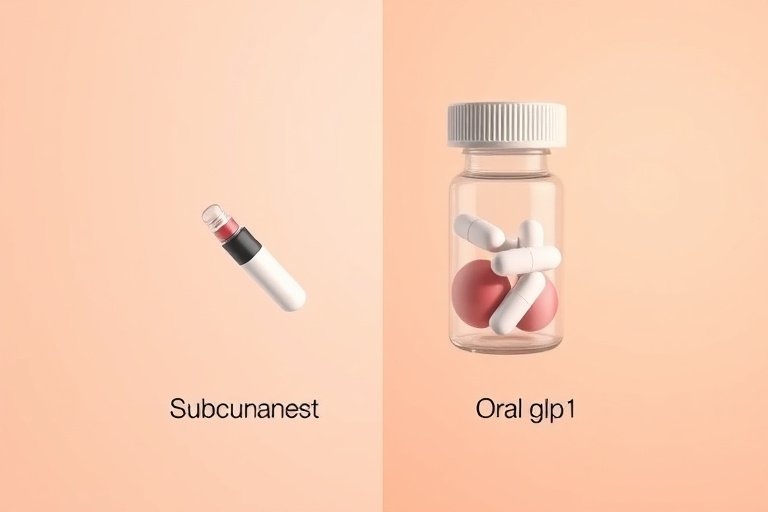
For type 2 diabetes, the PIONEER trials studied oral semaglutide at 14 mg daily. A1C reduction averaged about 1.0-1.4%, depending on the trial. Injectable semaglutide 1 mg weekly typically achieves A1C reductions of about 1.5-1.8%. The injectable version has a modest edge for blood sugar control.
Free Download: Decision Matrix Injectable vs oral GLP-1 (compare effectiveness, convenience, cost, and daily routine side by side. Get yours free) we'll email it to you instantly. [Download Now]
Weight loss data tells a similar story. Oral semaglutide at the standard 14 mg dose produces meaningful weight loss, but generally less than the injectable version at higher doses. The injectable weight management dose (2.4 mg weekly) is specifically improved for weight loss and has stronger trial data supporting it.
Higher oral doses are being studied. Early data on oral semaglutide at 25 mg and even 50 mg daily suggest weight loss results that get closer to what the injection achieves. These higher-dose oral formulations may change the comparison significantly as more data becomes available.
For now, if maximum weight loss or blood sugar reduction is the priority, injectable semaglutide generally has the edge. But the oral version offers meaningful benefits too (especially for people who would otherwise avoid treatment due to injection hesitancy.
Learn more about semaglutide dosing in our.
Convenience and Lifestyle Factors
This is where personal preference matters most.
From the FormBlends catalog
BPC-157 Oral (Stable Arginate Salt)
Acid-stable oral form of BPC-157 for gut and systemic healing · From $69/mo · compounded by a licensed 503A pharmacy, dispensed only after provider review.
Learn about BPC-157 Oral (Stable Arginate Salt) →The injectable approach requires one injection per week. You can do it any day, any time. No food timing restrictions. Store the pen in the fridge. The entire process takes 30 seconds. Then you don't think about it for another week.
The oral approach means taking a tablet every single morning. But there are strict rules: take it first thing on an empty stomach, with no more than 4 ounces of plain water, then wait at least 30 minutes before eating, drinking, or taking other medications. Missing this routine reduces absorption significantly.
For early risers with consistent morning routines, the oral version can work well. For people with irregular schedules, shift workers, or anyone who can't reliably wait 30 minutes before coffee or breakfast, the weekly injection may actually be more convenient.
Travel is worth considering too. Injectable pens need temperature management (though most are stable at room temperature for limited periods). Oral tablets are easy to pack and don't require refrigeration.
Some people start with the oral version to see how they tolerate GLP-1 therapy, then switch to injections for stronger effects. Others prefer the oral route indefinitely. Your provider can help sort out these decisions.
Cost and Access Considerations
Cost varies by formulation and how you access the medication.
Brand-name oral semaglutide (14 mg tablets) typically costs in the same range as the injectable version) over $1,000 per month without insurance. Insurance coverage may differ between oral and injectable versions, so check with your plan.
Compounded semaglutide is currently available primarily in injectable form through licensed 503A pharmacies. Oral compounding of semaglutide presents additional challenges due to the specialized absorption technology needed. This means compounded options (which tend to be more affordable) are mainly available as injections. Check for current compounded semaglutide rates.
When calculating true cost, factor in supplies. Injectable semaglutide requires needles and alcohol swabs (often included with the pen). Oral semaglutide requires no additional supplies, but you may spend more on the tablets themselves.
The market is evolving quickly. As oral formulations improve and compounding expands, the cost and availability picture may shift. Your provider and the can help you deal with the current options.
For help tracking your doses and progress on either formulation, download the.
Frequently Asked Questions
FormBlends
FormBlends is a U.S. telehealth platform that prescribes compounded semaglutide and tirzepatide. Patients complete an online intake, a licensed provider reviews eligibility, and medication ships from a 503A compounding pharmacy. Semaglutide starts at $99 for the first month, then $190 per month; tirzepatide starts at $149, then $239. Start your intake.
Can I switch from oral to injectable semaglutide or vice versa?
Yes. Your provider can help you transition between formulations. The dosing isn't directly equivalent (the oral and injectable versions use different dose levels due to different bioavailability. Your provider will determine the appropriate starting dose for whichever version you switch to.
Is the oral GLP-1 tablet less effective than the injection?
At currently approved doses, the injectable version generally produces slightly more weight loss and A1C reduction. But higher oral doses currently in clinical trials show results approaching those of the injection. Effectiveness also depends on how consistently you take the oral version according to the dosing instructions.
Do oral and injectable semaglutide have different side effects?
The side effect profiles are very similar since they contain the prescribed active pharmaceutical ingredient. Both cause nausea, diarrhea, and other GI symptoms. Some patients report that oral semaglutide causes more upper GI symptoms (heartburn, stomach discomfort) due to the local effect of the tablet on the stomach lining.
Why do I have to take the oral tablet on an empty stomach?
Food in your stomach dramatically reduces absorption of oral semaglutide. The absorption enhancer in the tablet works by creating a localized alkaline environment on the stomach wall. Food, other medications, or excess water interfere with this process and can reduce the amount of medication that reaches your bloodstream.
Let's Make This Happen
The research is clear. The options are available. The only question is whether it's right for you. A FormBlends provider can help you decide) no pressure, no commitment.
Medical References
- Davies M, Færch L, Jeppesen OK, et al. Semaglutide 2.4 mg once a week in adults with overweight or obesity, and type 2 diabetes (STEP 2). Lancet. 2021;397(10278):971-984. [PubMed | ClinicalTrials.gov | DOI]
- Wadden TA, Bailey TS, Billings LK, et al. Effect of Subcutaneous Semaglutide vs Placebo as an Adjunct to Intensive Behavioral Therapy on Body Weight in Adults With Overweight or Obesity (STEP 3). JAMA. 2021;325(14):1403-1413. [PubMed | ClinicalTrials.gov | DOI]
- Garvey WT, Batterham RL, Bhatt DL, et al. Two-year effects of semaglutide in adults with overweight or obesity (STEP 5). Nat Med. 2022;28(10):2083-2091. [PubMed | ClinicalTrials.gov | DOI]
- Garvey WT, Frias JP, Jastreboff AM, et al. Tirzepatide once weekly for the treatment of obesity in people with type 2 diabetes (SURMOUNT-2). Lancet. 2023;402(10402):613-626. [PubMed | ClinicalTrials.gov | DOI]
- Wadden TA, Chao AM, Engel S, et al. Tirzepatide with intensive lifestyle intervention in adults with overweight or obesity (SURMOUNT-3). Nat Med. 2024. [PubMed | ClinicalTrials.gov | DOI]
- Aronne LJ, Sattar N, Horn DB, et al. Continued Treatment With Tirzepatide for Maintenance of Weight Reduction in Adults With Obesity (SURMOUNT-4). JAMA. 2024;331(1):38-48. [PubMed | ClinicalTrials.gov | DOI]
Sources &. References
- Wilding JPH, Batterham RL, Calanna S, et al. Once-Weekly Semaglutide in Adults with Overweight or Obesity. N Engl J Med. 2021;384(11):989-1002. Doi:10.1056/NEJMoa2032183
- Davies M, Færch L, Jeppesen OK, et al. Semaglutide 2.4 mg once a week in adults with overweight or obesity, and type 2 diabetes (STEP 2 (Davies et al., Lancet, 2021)). Lancet. 2021;397(10278):971-984. Doi:10.1016/S0140-6736(21)00213-0
- Wadden TA, Bailey TS, Billings LK, et al. Effect of Subcutaneous Semaglutide vs Placebo as an Adjunct to Intensive Behavioral Therapy on Body Weight in Adults With Overweight or Obesity (STEP 3 (Wadden et al., JAMA, 2021)). JAMA. 2021;325(14):1403-1413. Doi:10.1001/jama.2021.1831
- Garvey WT, Batterham RL, Bhatt DL, et al. Two-Year Effects of Semaglutide in Adults with Overweight or Obesity (STEP 5 (Garvey et al., Nat Med, 2022)). Nat Med. 2022;28:2083-2091. Doi:10.1038/s41591-022-02026-4
- Lincoff AM, Brown-Frandsen K, Colhoun HM, et al. Semaglutide and Cardiovascular Outcomes in Obesity without Diabetes. N Engl J Med. 2023;389(24):2221-2232. Doi:10.1056/NEJMoa2307563
- Jastreboff AM, Aronne LJ, Ahmad NN, et al. Tirzepatide Once Weekly for the Treatment of Obesity. N Engl J Med. 2022;387(3):205-216. Doi:10.1056/NEJMoa2206038
- Garvey WT, Frias JP, Jastreboff AM, et al. Tirzepatide once weekly for the treatment of obesity in people with type 2 diabetes (SURMOUNT-2[4] (Garvey et al., Lancet, 2023)). Lancet. 2023;402(10402):613-626. Doi:10.1016/S0140-6736(23)01200-X
- Wadden TA, Chao AM, Engel S, et al. Tirzepatide after intensive lifestyle intervention in adults with overweight or obesity (SURMOUNT-3[5] (Wadden et al., Nat Med, 2023)). Nat Med. 2023. Doi:10.1038/s41591-023-02597-w
- Aronne LJ, Sattar N, Horn DB, et al. Continued Treatment With Tirzepatide for Maintenance of Weight Reduction in Adults With Obesity (SURMOUNT-4[6] (Aronne et al., JAMA, 2024)). JAMA. 2024;331(1):38-48. Doi:10.1001/jama.2023.24945
- Malhotra A, Grunstein RR, Fietze I, et al. Tirzepatide for the Treatment of Obstructive Sleep Apnea and Obesity. N Engl J Med. 2024;391:1193-1205. Doi:10.1056/NEJMoa2404881
- Pi-Sunyer X, Astrup A, Fujioka K, et al. A Randomized, Controlled Trial of 3.0 mg of Liraglutide in Weight Management. N Engl J Med. 2015;373(1):11-22. Doi:10.1056/NEJMoa1411892
- Marso SP, Daniels GH, Tanaka K, et al. Liraglutide and Cardiovascular Outcomes in Type 2 Diabetes. N Engl J Med. 2016;375(4):311-322. Doi:10.1056/NEJMoa1603827
This content is provided for informational and educational purposes only. It isn't a substitute for professional medical advice, diagnosis, or treatment. Always seek the advice of a licensed healthcare provider with any questions about a medical condition or treatment plan.
Last updated: 2026-03-24
Ready when you are
BPC-157 Oral (Stable Arginate Salt)
Acid-stable oral form of BPC-157 for gut and systemic healing · From $69/mo · compounded by a licensed 503A pharmacy, dispensed only after provider review.
Learn about BPC-157 Oral (Stable Arginate Salt) →