Last November, a 42-year-old portfolio manager named Kevin in Scottsdale told his prescriber he'd been pinning 600 mcg of AOD 9604 every morning for five weeks and hadn't lost a single pound. "I figured more was better," he said. His provider dropped him to 300 mcg, restructured his meal timing, and added a 30-minute fasted walk. Eight weeks later, Kevin was down nine pounds of fat mass on a DEXA scan. The dose wasn't the problem. Everything around the dose was the problem.
That story captures the boring truth about AOD 9604 dosing: the numbers matter less than the context you put them in. This article walks through the commonly referenced ranges, timing strategies, cycle lengths, and practical injection details drawn from the 2007 Phase 2b clinical trial by Metabolic Pharmaceuticals, animal research, and current compounding pharmacy practice. None of this replaces a prescriber. All of it should make your conversation with one more productive.
The Numbers Most Prescribers Work With
Current compounding practice lands on 250 to 500 mcg subcutaneous daily, with roughly 300 mcg as the most common starting reference point. That's the sweet spot where clinical anecdote and available data seem to overlap.
For context, the 2007 Metabolic Pharmaceuticals Phase 2b trial used oral AOD 9604 at 1 mg daily over 12 weeks. Oral delivery is mostly irrelevant to how the peptide is used now (subcutaneous injection, because oral bioavailability of the intact peptide is terrible). But the trial's 12-week continuous dosing pattern and daily cadence still inform current protocols. The trial enrolled 300 obese adults across multiple sites in Australia, and the 1 mg oral group showed a statistically significant reduction in body weight compared to placebo at the 12-week mark. Keep in mind: oral doses need to be substantially higher to compensate for gut degradation and poor absorption. That 1 mg oral figure does not translate directly to a 1 mg subcutaneous target.
Earlier animal work adds another layer of reference. Heffernan et al. (2001) demonstrated that AOD 9604 reduced adiposity in ob/ob mice at doses ranging from 50 to 500 mcg/kg, with the lipolytic effect appearing dose-responsive up to a ceiling. Beyond a certain threshold, additional peptide didn't push the needle further. That ceiling effect in rodents is worth holding in mind when someone tells you they're running 1000 mcg or more daily. The biology seems to plateau.
Some research peptide community protocols do push up to 1000 mcg daily. Here's the thing: there's no available data showing that doubling or tripling the dose produces proportionally greater effects. You're burning through vials faster without a clear payoff. And because AOD 9604 is a fragment of human growth hormone (amino acids 177-191), there's an implicit assumption floating around that it should behave like GH itself, where higher doses yield more dramatic body composition changes. It doesn't. The fragment lacks the IGF-1-stimulating, insulin-modulating, and anabolic properties of full-length GH. It's a narrower tool, and dosing it like a broader one misses the point.
On the lower end, some prescribers start patients at 150 to 200 mcg daily for the first week as a tolerance check before titrating up. A reasonable approach, especially for patients new to subcutaneous peptides. The initial low dose lets you confirm no injection site reactions, no headaches (rarely reported but worth screening for), and no GI discomfort before committing to a full 8-to-12-week protocol at a higher dose.
When You Pin It Matters More Than You Think
Think of AOD 9604's proposed mechanism like trying to catch a wave. You need to be in the water when the wave comes. In this case, the "wave" is the fasted-state lipolytic window, and the peptide's action on adipocytes and beta-3 adrenergic signaling has the clearest mechanistic context in that window.
Morning, fasted. That's the standard approach and the one most protocols default to. When you wake after an overnight fast, insulin is low, glucagon is relatively elevated, and your body is already primed for lipolysis. Introducing a peptide that signals fat cells to release stored fatty acids at this exact moment makes physiological sense. Most prescribers recommend injecting within 15 to 30 minutes of waking, before coffee with cream, before a protein shake, before anything caloric.
Pre-exercise split. Some protocols break the dose into morning and pre-workout administrations, reasoning that exercise drives its own lipolytic signaling and the peptide may compound that effect. For example, a patient might take 150 mcg upon waking and another 150 mcg 30 minutes before a late-morning training session. Not unreasonable, though the evidence base here is thin. The practical upside is maintaining fasted-state signaling across a wider window. The practical downside is two injections per day, which some patients find annoying enough to hurt adherence. And adherence always beats optimization.
Evening dosing. A few protocols mention bedtime dosing to coincide with the natural nocturnal growth hormone pulse. The idea is that AOD 9604 might synergize with endogenous GH secretion during deep sleep. The problem: there's no published data supporting this timing, and it introduces a variable (nighttime food intake, late dinners) that muddies the fasted-state rationale. Most prescribers avoid it.
Meal spacing. Most protocols specify waiting at least 2 to 3 hours between the injection and your first meal. The idea is simple: don't eat yourself out of the fasted physiological state you just injected into. Insulin is a potent anti-lipolytic signal. If you inject AOD 9604 and then eat a bowl of oatmeal 20 minutes later, you've just put the brakes on the very process you were trying to accelerate. Kevin, the Scottsdale portfolio manager, was eating breakfast within 45 minutes of his injection. That was one of the structural problems his prescriber fixed.
How Long to Run It (and Whether to Take Breaks)
The Phase 2b trial ran 12 continuous weeks with no cycling. Some current protocols mirror that with 8 to 12 weeks of uninterrupted daily use.
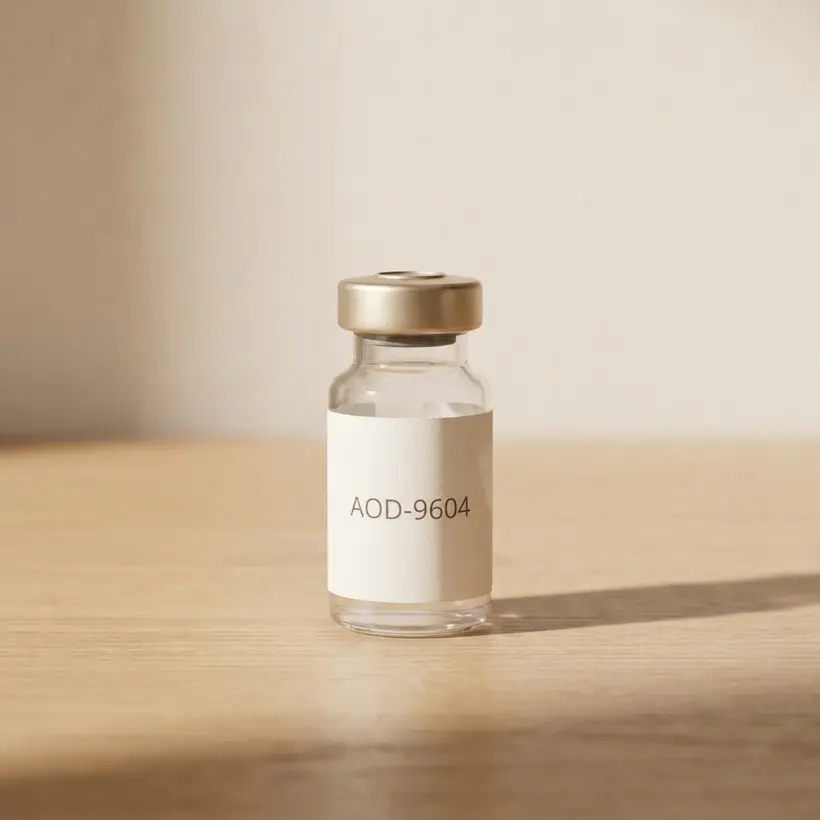
From the FormBlends catalog
AOD-9604
Fat-targeting fragment without growth hormone side effects · From $199/mo · compounded by a licensed 503A pharmacy, dispensed only after provider review.
View AOD-9604 →The more common approach in the peptide community is 6 to 12 weeks on, followed by 2 to 4 weeks off. People cite "preserving response sensitivity" as the reason for off-periods, which sounds logical but lacks documented support. AOD 9604 doesn't have a well-characterized tolerance curve in the available literature. The off-period rationale is more precautionary habit than evidence-driven protocol. It borrows from the cycling logic of GH secretagogues like GHRP-6, where receptor desensitization is a documented concern. Whether the same desensitization applies to AOD 9604's mechanism of action at the adipocyte level hasn't been specifically studied.
A practical middle ground: if you're seeing measurable progress at week 10 or 12, there's no strong reason to stop arbitrarily. If results plateau before that, a break followed by reassessment makes more sense than blindly increasing the dose.
Patients focused on body composition often run multiple cycles separated by breaks over several months. Reasonable. Just know that each cycle should be paired with the same dietary discipline as the first one. The peptide isn't doing the work for you. A common pattern looks like 10 weeks on, 4 weeks off, 10 weeks on, with DEXA or skinfold measurements at each transition point.
Practical Injection Details
Sites. Abdominal subcutaneous tissue is the go-to for body composition use cases. Specifically, the periumbilical area (about two inches to either side of the navel) offers reliable absorption and easy self-injection access. Thigh and upper outer arm are alternatives. Rotate sites. This is standard for any subQ peptide and helps prevent localized lipoatrophy or irritation.
Needle gauge and depth. A 29- to 31-gauge insulin syringe with a half-inch needle is standard. You're targeting the subcutaneous fat layer, not muscle. Pinch the skin, insert at roughly 45 degrees (or 90 if there's ample subcutaneous tissue), inject slowly, hold for a few seconds, and release. This isn't complicated, but doing it carelessly can lead to bruising or inconsistent delivery.
Reconstitution. Lyophilized AOD 9604 gets reconstituted with bacteriostatic water, either by you or the pharmacy. Your dispensing pharmacy should provide specific reconstitution instructions and concentration guidance. Follow them, not a Reddit thread. Standard reconstitution volumes typically yield a concentration that makes 300 mcg easy to draw on an insulin syringe (for example, adding 2 mL of bacteriostatic water to a 5 mg vial gives you 2,500 mcg per mL, meaning 300 mcg equals roughly 12 units on a U-100 syringe). Always confirm your math with the pharmacy.
Storage. Once reconstituted, refrigerate at 36 to 46 degrees Fahrenheit. Lyophilized powder is hardier and can handle room temperature for short stretches during shipping or transport. The pharmacy sets the beyond-use date. Respect it. Most reconstituted peptides in bacteriostatic water carry a 28-day beyond-use window, though some pharmacies assign shorter periods depending on stability testing.
Dose Adjustments: When to Move and When to Stop
If 300 mcg daily hasn't produced any observable effect after a full 8 to 12 week cycle, some prescribers titrate to 500 mcg. Fine. But pushing past 500 mcg when nothing is happening at 500 is generally not productive. At that point, the honest conversation is whether AOD 9604 is the right molecule for this patient, or whether adjacent options (like Tesamorelin) make more sense. Tesamorelin, notably, has FDA approval for the reduction of excess abdominal fat in HIV-associated lipodystrophy, giving it a regulatory and evidence-base foothold that AOD 9604 doesn't share.
Some prescribers also evaluate the basics before any dosage change: is the patient actually in a caloric deficit? Are they sleeping seven-plus hours? Is their stress managed to a degree that cortisol isn't sabotaging lipolysis? These factors are free, they don't require a dose change, and they account for more failed peptide cycles than the peptide itself does.
Injection site irritation is usually managed by rotating sites more frequently or switching reconstitution diluent. Not a dosing problem. If a patient reports redness, itching, or small welts consistently at the injection site, switching from one brand of bacteriostatic water to another (different preservative concentrations) sometimes resolves it.
One more thing worth flagging: AOD 9604 doesn't have widely distributed structural variants the way Semax and Selank do. The molecule is the stabilized HGH fragment (amino acids 177-191) with the added N-terminal tyrosine. There's no long-acting modified form floating around, no acetylated version, no prodrug. What you see is what you get.
Use Case Shapes the Dose
Body composition. 250 to 500 mcg daily, 8 to 12 week cycles. Effects develop gradually. If you're checking the mirror every three days, you'll drive yourself crazy. DEXA or calipers at the start and end of a cycle tell the real story. Progress photos taken under consistent lighting and at the same time of day offer a secondary data point, but objective measurement is always better than subjective visual assessment.
Joint and cartilage research. Some protocols use 150 to 300 mcg daily with comparable cycle lengths. This application is less established than the fat loss use case, and the dosing reflects that uncertainty (lower and more exploratory). Preliminary in vitro research, including work by Metabolic Pharmaceuticals, suggested that AOD 9604 may stimulate proteoglycan and collagen synthesis in chondrocytes. Translation to clinical outcomes in living humans is speculative at this point. Patients pursuing this use case should have especially candid conversations with their prescribers about expectation management.
Combination protocols. Some prescribers stack AOD 9604 with GH-releasing peptides like Sermorelin or Tesamorelin. The logic: AOD 9604 targets adipocytes directly, while the GH secretagogues stimulate endogenous growth hormone release for broader effects including lean mass support, improved sleep quality, and skin health. Whether this combination produces additive benefit is a prescriber judgment call, not something the current evidence base resolves cleanly. Timing matters in these stacks. Most protocols separate the AOD 9604 injection (morning, fasted) from the secretagogue injection (typically at night before bed to coincide with natural GH pulsatility), avoiding potential receptor competition or signal interference.
Setting Honest Expectations
The Phase 2b trial showed statistically significant but modest weight loss over placebo. Modest. Not dramatic. The 1 mg oral group lost approximately 2.8 kg over 12 weeks compared to about 1.5 kg in the placebo group. That delta, while real, is not the kind of result that makes someone look in the mirror and see a different person. It's the kind of result that shows up on a scale and a DEXA scan when everything else is dialed in.
My honest take: AOD 9604 is best understood as a fat-releasing signal layered on top of a caloric deficit and consistent exercise. It's the assist, not the goal.
Patients who expect the peptide to do the heavy lifting on its own are going to be disappointed, and they're going to blame the molecule for what was really a programming problem. The most consistent finding across the literature is targeted lipolytic signaling without the broader endocrine disruption of exogenous HGH. That's genuinely useful. It's just not magic. You don't get the water retention, the joint pain, the insulin resistance, or the potential tumor-promoting IGF-1 elevation that come with supraphysiological GH dosing. What you give up is the dramatic anabolic punch. That tradeoff is worthwhile for the right patient, but only when expectations match the pharmacology.
Frequently Asked Questions
What is a typical starting dose of AOD 9604?
Most protocols begin at 150 to 250 mcg subcutaneous daily for the first week, then titrate to 300 to 500 mcg based on tolerance and prescriber guidance. The first week at a lower dose serves as a screening period for adverse reactions, which are uncommon but worth watching for.
Should I inject AOD 9604 in the morning or evening?
Morning fasted administration is the most common approach. Some protocols split dosing between morning and pre-exercise. Evening dosing is uncommon and lacks a clear mechanistic rationale, since the primary proposed action (adipocyte lipolysis) is best supported when insulin is low and the body is already in a fasted or post-absorptive state.
How long until I see results from AOD 9604?
The Phase 2b trial measured outcomes at 12 weeks. Effects are gradual over a multi-week cycle, not dramatic week to week. Expect to evaluate results at the end of a full cycle, not halfway through. Patients who track waist circumference weekly sometimes notice subtle changes by weeks 4 to 6, but definitive assessment requires a complete cycle plus objective measurement.
Do I need to cycle off AOD 9604?
Cycle structure is a prescriber decision. Common approaches include continuous 8 to 12 week courses or shorter cycles with 2 to 4 week breaks. Available data doesn't clearly favor one approach over the other. The off-period convention is borrowed from GH secretagogue cycling and hasn't been validated specifically for AOD 9604.
Can AOD 9604 be taken orally?
The Phase 2b trial used oral dosing, but current compounding practice overwhelmingly favors subcutaneous injection due to low oral bioavailability. Compounded oral preparations exist but are uncommon. The oral route requires substantially higher doses to achieve comparable systemic exposure, and the cost-per-effective-microgram math tilts heavily toward injection.
Is a higher dose always better?
No. Available data does not support the idea that doses above 500 mcg produce proportionally greater effects. More isn't better here. The animal literature suggests a ceiling effect, and clinical practice mirrors that observation. Patients who escalate beyond 500 mcg without prescriber guidance are spending more money without a reasonable expectation of better results.
Can AOD 9604 be combined with other peptides?
Some prescribers combine it with GH-releasing peptides like Sermorelin or Tesamorelin. This is a clinical decision, not a self-directed one. Timing, dose separation, and patient-specific factors (age, metabolic status, concurrent medications) all influence whether a combination protocol makes sense. Your prescriber should be able to articulate a specific rationale for any stack they recommend, not just a generic "they work well together."
Related Reading
- AOD 9604 Hub
- AOD 9604 Benefits and Research
- AOD 9604 versus HGH
- AOD 9604 for Weight Loss
- AOD 9604 versus Tesamorelin for Fat Loss
Compliance Footer
AOD 9604 is not approved by the FDA for the prevention, mitigation, treatment, or cure of any disease. Compounded AOD 9604 is prepared by licensed compounding pharmacies for individual patients under a valid prescription from a licensed prescriber. Information on this page is educational and is not medical advice. Individual results vary.
Ready when you are
AOD-9604
Fat-targeting fragment without growth hormone side effects · From $199/mo · compounded by a licensed 503A pharmacy, dispensed only after provider review.
View AOD-9604 →