Last February, a 38-year-old software engineer named Derek in Portland told his prescriber he'd been "spraying Semax like Afrin" for three weeks, using about 1,200 mcg a day from a 1% solution, then couldn't figure out why he was wired at midnight and getting tension headaches. His pharmacist walked him back to 300 mcg split across two morning doses. Within four days, the headaches stopped and his focus, the whole reason he'd started, actually improved. Derek's experience is almost boringly common: more Semax does not mean better Semax.
This article lays out the dosing reference ranges pulled from Russian clinical literature, compounding pharmacy dispensing norms, and what the research peptide community has settled on through trial and error. None of it replaces a prescriber's judgment. But if you want to understand the numbers before your next appointment, here's the map.
How Much and for What: The Common Ranges
The doses that show up repeatedly across published research and compounding scripts cluster into a few buckets.
Cognitive and attentional use sits between 250 and 600 mcg per day, split into two or three intranasal administrations. Most patients land on either two doses of 200 to 300 mcg or three doses of 100 to 200 mcg. Starting at 250 mcg (often a single morning dose) is standard practice to see how someone responds before moving the number up.
Russian stroke recovery protocols are a different animal entirely. Those use 1,000 to 1,500 mcg per day across multiple administrations for 10 to 14 days during acute and subacute ischemic stroke management. This is hospital-level dosing for a specific neurological emergency. It is not a cognitive enhancement protocol and shouldn't be borrowed as one.
ADHD adjunct research (also Russian, mostly open-label, small samples) has explored the 250 to 500 mcg per day range in pediatric and adolescent populations over multi-week courses. Interesting data, but not the foundation for a DIY protocol.
Here's the thing most people get wrong: the 600 mcg ceiling for cognitive use isn't arbitrary. It represents the upper edge where subjective reports of benefit flatten out and side effects (restlessness, headache, sleep disruption) start climbing. Going past it for focus is like turning up the volume past the point where the speakers distort.
What's Actually in the Bottle
Compounded Semax comes as either a 0.1% solution (1 mg/mL) or a 1% solution (10 mg/mL). The concentration matters more than people realize because it determines how many sprays equal a target dose.
A 0.1% solution delivers roughly 50 to 100 mcg per spray pump actuation. A 1% solution delivers roughly 500 to 1,000 mcg per actuation. If you're aiming for 200 mcg and you've got the 1% concentration, a single full spray overshoots your dose by two to five times.
Compounding pharmacies label the per-actuation amount on the dispensed bottle. Follow that number. Don't back-calculate from the solution percentage using internet math.
When to Spray and When to Stop Spraying
Timing is the easiest part of Semax dosing to get right, and also the part most commonly botched.
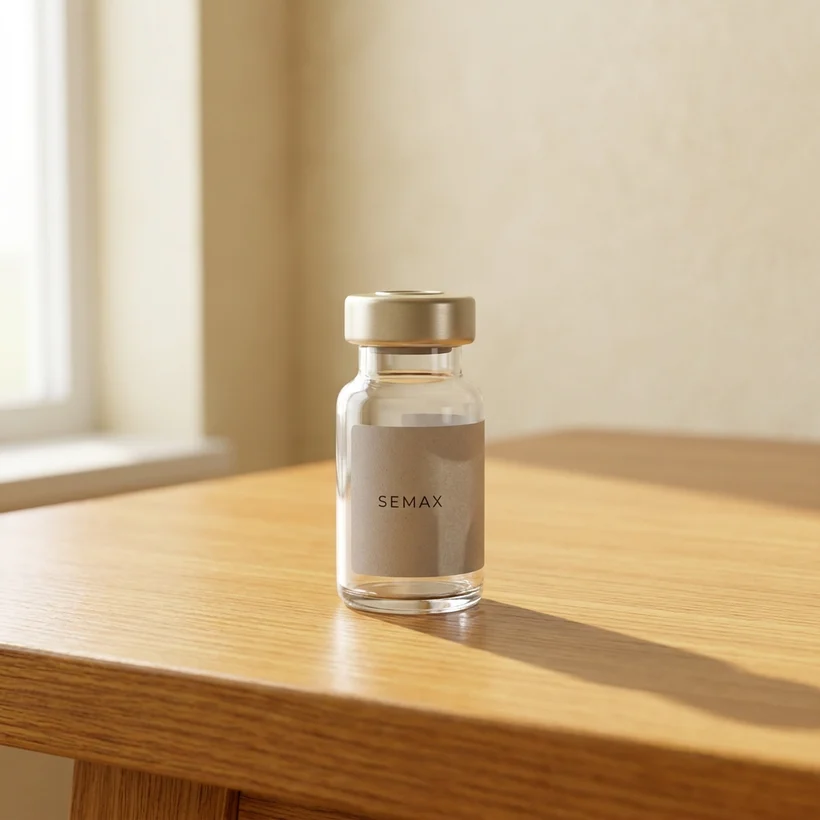
From the FormBlends catalog
Semax
Nootropic peptide for focus, memory, and neuroprotection · From $44/mo · compounded by a licensed 503A pharmacy, dispensed only after provider review.
Learn about Semax →First dose: morning. Within an hour of waking. The alerting and pro-attentional effects align naturally with the first half of the day.
Second dose: midday-ish. Somewhere between mid-morning and early afternoon extends the active window through the workday.
After 2 or 3 PM: probably not. Semax is not a sedating peptide. Dosing late will keep some people awake. If you've had trouble falling asleep since starting, the fix is almost always pulling the last dose earlier rather than adding melatonin on top.
Space doses about 4 to 6 hours apart. Tighter spacing doesn't compound the benefit in any available reports, and in sensitive users it can produce a jittery overstimulation that defeats the purpose.
Cycling: How Long On, How Long Off
This is where Russian clinical practice and the Western peptide community diverge.
Russian clinical protocols describe 10 to 14 day treatment courses, reflecting Semax's original role as an acute intervention for stroke and related indications. Short, defined bursts.
The peptide community has mostly settled on longer cycles of 4 to 8 weeks, followed by 2 to 4 weeks off. The rationale for the off-period is partly theoretical (receptor sensitivity preservation, potential adaptation reset) and partly anecdotal (people report the "crispness" of the effect returns after a break).
Continuous daily use? It hasn't been formally studied in Western research. Some long-term users report no apparent tolerance over months. But long-term safety data doesn't exist, so anyone running Semax indefinitely is their own experiment. A prescriber who is honest with you will say exactly that.
The Variants Change Duration, Not Dose
There are three forms you'll encounter: base Semax, N-Acetyl Semax, and N-Acetyl Semax Amidate. The microgram dose ranges are comparable across all three. What changes is how long each dose lasts.
N-Acetyl Semax has an extended half-life from N-terminal acetylation. Same microgram amounts, but the longer duration means two daily doses often replace three.
N-Acetyl Semax Amidate is the fully blocked variant with the longest half-life. Most users dose it once daily, in the morning. Same microgram ballpark.
Think of it like the difference between regular and extended-release formulations of the same medication. The drug is doing the same thing; it's just doing it over a different timeline.
Storage, Handling, and Not Ruining an Expensive Bottle
Compounded Semax intranasal solution goes in the fridge. The beyond-use date on the label reflects the stability of that specific formulation and preservative system. Follow it.
Brief room temperature exposure (a few hours while you're using it during the day, travel situations) is generally fine. Leaving it on your bathroom counter for a week is not. Heat and light degrade peptides, and degraded peptide solution is just expensive saline.
For administration: tilt the head slightly forward, place the nozzle in one nostril, spray during a gentle inhale. The mistake is sniffing hard, which drives the solution past the nasal mucosa straight down your throat. You want the mist to land on the mucosal tissue, not get swallowed. Alternate nostrils between doses to spread the mucosal exposure and reduce irritation.
When the Dose Isn't Working (or Is Working Too Well)
Dose adjustment is a conversation with your prescriber, not a solo project. That said, the common patterns are predictable.
Overstimulation (racing thoughts, tension headache, irritability) in the first few days usually responds to reducing the per-dose amount and cutting back to fewer daily administrations. Some early headaches resolve spontaneously after one to two weeks at the same dose, but a modest reduction speeds the process.
Underwhelming response after a consistent multi-week course is more often addressed by switching variants (base Semax to N-Acetyl Semax Amidate, for instance) than by pushing the dose higher. Escalating milligrams when the pharmacokinetic profile is the real bottleneck rarely helps and often introduces side effects.
The boring truth about Semax dosing is that most people do well in the 300 to 500 mcg per day range, dosed twice in the morning and around midday, cycled in 4 to 8 week blocks. The protocol is not complicated. The discipline of sticking to it is.
Frequently Asked Questions
What is a typical starting dose of Semax?
Most prescribers start at 250 mcg per day total, usually as a single morning dose, with the plan to titrate upward after assessing response over the first week.
Can Semax be injected?
Compounded Semax is almost universally supplied as an intranasal spray. Injectable forms exist in some research settings, but that is not the standard compounded preparation you'll receive from a pharmacy.
How long until I feel anything?
Acute effects (improved clarity, alertness) are typically noticed within 15 to 40 minutes of an intranasal dose. Broader, sustained improvements in focus across a full workday usually become apparent after several days of consistent dosing.
Should I take Semax every day?
Cycle structure depends on your prescriber's plan. Some protocols use daily dosing for 10 to 14 days, others run 4 to 8 week cycles, and continuous indefinite use has not been formally studied for safety or efficacy.
Does Semax interact with stimulant medications?
There is no formal interaction data from Western clinical trials. The alerting properties of Semax are additive in a subjective sense with stimulants, so prescribers typically monitor for overstimulation when both are used together.
Is the 1% solution better than the 0.1% solution?
Neither is inherently better. The 1% solution is more concentrated, meaning fewer actuations per dose, which some patients prefer for convenience. The 0.1% solution allows finer dose titration. Your prescriber and pharmacy will choose the concentration that matches your target dose.
Related Reading
- Semax Hub
- Semax versus Selank
- N Acetyl Semax Amidate versus Semax
- Semax for ADHD and Focus
Compliance Footer
Semax is not approved by the FDA for the prevention, mitigation, treatment, or cure of any disease. Compounded Semax is prepared by licensed compounding pharmacies for individual patients under a valid prescription from a licensed prescriber. Information on this page is educational and is not medical advice. Individual results vary.
Ready when you are
Semax
Nootropic peptide for focus, memory, and neuroprotection · From $44/mo · compounded by a licensed 503A pharmacy, dispensed only after provider review.
Learn about Semax →