Last February, a nurse practitioner in Austin named Rachel told me something that stuck. She'd had a patient, a 52-year-old software architect named Greg, who came in after six months of fragmented sleep, averaging maybe four and a half hours a night. He'd tried melatonin (10 mg, way too high), trazodone (morning grogginess he couldn't tolerate), and a white noise machine his wife hated. Rachel prescribed compounded DSIP at 50 mcg subcutaneous, 45 minutes before bed. "By night three," she said, "he texted me at 7 a.m. saying he'd slept six hours straight for the first time since July. Not a miracle. Just... functional sleep again."
That's what this peptide does when it works. Not a knockout, not sedation. A nudge toward deeper, more consolidated sleep architecture.
Here's what the research literature and current compounding practice tell us about DSIP dosage, and what falls outside the evidence.
The Numbers: Reference Dose Ranges
DSIP is supplied as a lyophilized powder for reconstitution and subcutaneous injection. The amounts involved are small, measured in micrograms rather than milligrams. If you're coming from a background with BPC-157 or other peptides dosed in the hundreds of micrograms to milligrams range, DSIP sits at the lower end of the spectrum. That low dosing threshold is part of what makes titration delicate and precision during reconstitution genuinely important.
For sleep: 50 to 100 mcg subcutaneous before bedtime. Most protocols start at 50 mcg for the first week before anyone considers moving up. The boring truth is that many people stay at 50 mcg because it's enough. A 2017 review of neuropeptide sleep modulators noted that DSIP produces measurable EEG changes at doses in this range, specifically increased delta wave power during NREM stages, which aligns with the subjective reports of deeper, less interrupted sleep (Graf & Kastin, 1986).
For stress modulation (less common): 100 to 200 mcg, sometimes administered earlier in the day or timed before anticipated stressful events. This is a smaller, less well-documented use case. The proposed mechanism involves DSIP's observed effect on cortisol and ACTH levels in animal studies, where it appeared to dampen the hormonal stress response without outright suppression. In practical terms, a prescriber might consider this application for a patient dealing with a discrete, time-limited stressor, say a surgeon preparing for a high-stakes operating schedule or a patient navigating an acute grief period. But the evidence base is thin, and sleep remains the primary clinical application by a wide margin.
In research protocols: Some studies have pushed up to 250 mcg. The data doesn't convincingly show that higher doses produce proportionally better sleep outcomes. Think of it like volume on a stereo: past a certain point, you're just adding distortion. One study involving intravenous DSIP administration in chronic insomnia patients found that improvements in sleep quality plateaued and did not continue to scale with dose increases beyond a moderate threshold (Schneider-Helmert & Schoenenberger, 1983).
Chronic pain research: Russian research lines exploring DSIP as an adjunct in chronic pain settings used variable ranges, typically 100 to 250 mcg. Particular interest centered on opioid withdrawal and chronic headache populations, where DSIP showed some promise in reducing subjective pain scores alongside improvements in sleep quality (Kovalzon, 1990). These are research contexts, not standard practice patterns.
When to Inject (and When Not To)
For sleep applications, standard timing is 30 to 60 minutes before you intend to fall asleep. The window allows the peptide to distribute into circulation before sleep onset. Some patients report that injecting precisely 45 minutes before lights-out feels like the sweet spot, but there is individual variability here, as there is with most biological timing questions.
One thing worth being specific about: "before bedtime" means before the time you actually close your eyes, not before you start your evening routine. If you inject at 9:30 p.m. but then scroll your phone for another 90 minutes, you've shifted the effective window. DSIP isn't strong enough to override bad sleep hygiene, and expecting it to is a recipe for frustration.
Daytime dosing for sleep purposes? Not typical, and not how this peptide is designed to work. DSIP is positioned to influence sleep architecture during the sleep period itself, not to make you drowsy at your desk at 2 p.m. The peptide doesn't produce acute sedation in the way benzodiazepines or antihistamines do. People who report feeling "sleepy" within minutes of injection are likely experiencing either placebo effects or a conditioned relaxation response associated with their bedtime routine.
For the stress modulation use case, the described pattern is administration before anticipated stress exposure. But again, sleep is the primary application.
The Practical Stuff: Injection, Reconstitution, Storage
Injection sites: Abdominal subcutaneous tissue, thigh, or upper outer arm. Rotate sites. Because the injection volume is so small, injection site reactions are rare, but rotation prevents localized tissue irritation over time. A simple rotation pattern (left abdomen, right abdomen, left thigh, right thigh) works fine for most patients and doesn't require a tracking spreadsheet.
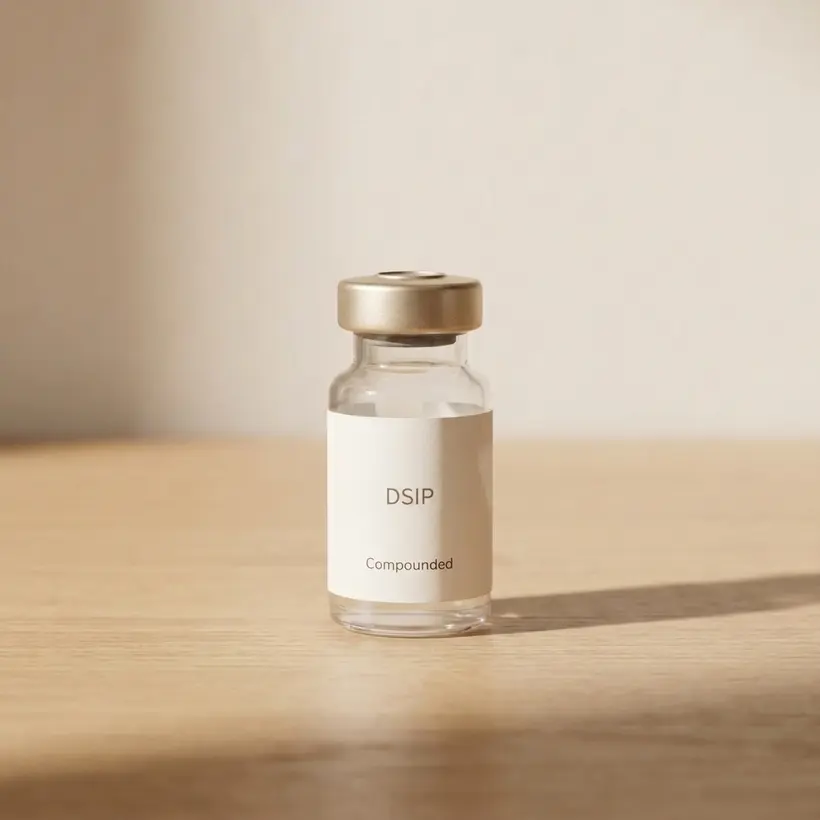
From the FormBlends catalog
DSIP (Delta Sleep-Inducing Peptide)
Restore deep, restorative delta wave sleep · From $179/mo · compounded by a licensed 503A pharmacy, dispensed only after provider review.
View DSIP (Delta Sleep-Inducing Peptide) →Reconstitution: Bacteriostatic water, per your dispensing pharmacy's specific guidance. Don't freelance this part. The concentration you end up with depends on the amount of bacteriostatic water added to a given vial size, and getting this wrong means your per-injection dose will be off. If your pharmacy supplies a 1 mg vial and you reconstitute with 2 mL of bacteriostatic water, you get 500 mcg/mL. At a 50 mcg dose, that's 0.1 mL per injection, or 10 units on an insulin syringe. Write the concentration on the vial with a fine-tip marker after reconstitution. You will forget otherwise.
Volume: You're looking at small subcutaneous injections, typically 0.1 to 0.3 mL at the microgram doses described above. Insulin syringes with fine-gauge needles (29 to 31 gauge) are standard. The injection itself is about as eventful as a mosquito bite.
Storage: Lyophilized (unreconstituted) powder is stable at room temperature for short periods, but refrigerate it for anything longer. Once reconstituted, keep it refrigerated. The peptide degrades in solution, and your dispensing pharmacy will set a beyond-use date, typically 28 to 30 days for reconstituted peptides in bacteriostatic water, though this can vary. Brief room-temperature exposure during travel or daily prep is generally fine. Leaving a reconstituted vial on your bathroom counter overnight? Less fine. Treat it the way you'd treat insulin: not with paranoia, but with basic cold-chain respect.
How Long to Use It: Cycle Structures
This is where it gets interesting, and where honest practitioners admit the evidence thins out.
Short-term runs (1 to 3 weeks): Use during a period of disrupted sleep, then stop and reassess. This is probably the most common pattern. A patient dealing with jet lag after international travel, a shift worker rotating to nights, or someone navigating the acute phase of a medication change might use DSIP for two weeks and then stop. Many prescribers report that the improved sleep architecture "holds" for some period after discontinuation, though the duration of this residual effect varies and hasn't been formally quantified.
Intermittent, as-needed use: Only on nights when you anticipate difficulty (jet lag, high-stress work weeks, acute life disruptions). No continuous administration required. I'd argue this is the most sensible approach for most people, though prescribers may see it differently for individual patients. The analogy here is closer to how some people use melatonin, not nightly for years, but strategically when the situation calls for it.
Continuous nightly use: It's been described. But here's the thing: long-term safety data doesn't exist. That's not a hedge or a disclaimer. It's a gap in the literature that should factor into any dosing conversation with your prescriber. No tachyphylaxis (tolerance requiring higher doses) has been formally documented with DSIP, but absence of evidence isn't evidence of absence.
When Adjusting the Dose Makes Sense
Dose adjustment is a prescriber decision, full stop. But the patterns reported in clinical and research peptide communities follow predictable logic:
If 50 mcg produces minimal subjective effect after a reasonable trial (usually defined as 5 to 7 consecutive nights), titrating up to 100 mcg is common. Going above 100 mcg hasn't consistently produced proportionally greater effects in available reports.
If you're getting mild dizziness or a transient headache (both uncommon but documented), reducing the per-dose amount usually resolves it. These effects tend to appear in the first few nights and fade, suggesting they may relate more to initial physiological adjustment than to a persistent problem with the peptide itself.
And if 100 mcg over multiple weeks does nothing? Further dose escalation is generally not the answer. At that point, the conversation shifts to whether DSIP is the right molecule for your particular sleep problem. Sometimes the answer is simply no. Sleep is a complex system, and a single peptide targeting one node of sleep regulation won't fix every category of insomnia. Patients with sleep-disordered breathing, restless leg syndrome, or untreated anxiety driving their insomnia need those root causes addressed, not a higher peptide dose.
Stacking: What Gets Combined With DSIP
DSIP plus melatonin: The rationale is complementary mechanisms. DSIP for sleep depth and architecture, melatonin for circadian timing. There's no formal validation of the combination, but the logic tracks and it shows up in protocols regularly. Typical melatonin doses used alongside DSIP are low, in the 0.3 to 1 mg range, rather than the 5 to 10 mg doses often found on drugstore shelves. Higher melatonin doses don't improve sleep and can cause next-day grogginess and paradoxical wakefulness in some people (Auld et al., 2017).
DSIP plus magnesium: Magnesium (glycinate or threonate, typically) is baseline sleep support. It's commonly used alongside any sleep-oriented peptide. Nothing specific to DSIP here. The general recommendation for magnesium glycinate in sleep contexts is 200 to 400 mg elemental magnesium, taken in the evening. Threonate has a more specific claim to neurological uptake, though the clinical evidence for its superiority over glycinate for sleep specifically remains limited.
DSIP plus evening GH-releasing peptides: CJC-1295 and Ipamorelin dosed in the evening for growth hormone release have indirect effects on slow-wave sleep. Some protocols layer DSIP on top, reasoning that the mechanisms complement each other. Reasonable theory, limited formal evidence. If you're already on an evening GH protocol, adding DSIP at 50 mcg is a straightforward addition from a logistics standpoint, though the two injections should ideally be drawn into separate syringes unless your pharmacy has specifically compounded them together.
DSIP plus behavioral interventions: This deserves mention because it's frequently overlooked. Cognitive behavioral therapy for insomnia (CBT-I) has the strongest long-term evidence base of any insomnia intervention, stronger than any medication or peptide. DSIP is best understood as an adjunct that might help a patient get enough sleep to actually engage with the behavioral work, stimulus control, sleep restriction, cognitive restructuring, rather than as a standalone solution.
A Note on Variants
DSIP doesn't have the constellation of structural variants you see with some other peptide families. The molecule as supplied is the original nonapeptide identified by Monnier and Schoenenberger in 1977 from the dialysate of sleeping rabbits. Some researchers have explored modified versions with extended half-lives or enhanced blood-brain barrier permeability, but these aren't commonly available through current compounding pharmacies. If a source is offering you "enhanced DSIP" or a named analog you can't find in published literature, treat that as a red flag.
Who Dispenses It: Sourcing Matters
DSIP should be obtained through a licensed compounding pharmacy operating under a valid prescription from your provider. The peptide marketplace includes vendors of varying quality, and with a molecule dosed in micrograms, purity and accurate quantification aren't optional. A vial that's 85% pure instead of 99% pure means your effective dose is meaningfully different from what you think you're taking.
For patients sourcing through telehealth or direct-to-consumer peptide prescribing platforms, look for pharmacies that provide Certificates of Analysis, operate under state board of pharmacy oversight, disclose their pharmacy relationship clearly, and require a real prescription rather than a checkout-style purchase flow.
Cost
Worth mentioning: DSIP is one of the less expensive compounded peptides per dose. At microgram-level dosing, a typical compounded supply lasts considerably longer than peptides dosed at higher daily amounts. A single 1 mg vial at 50 mcg per night provides 20 doses, potentially a full three-week cycle from one vial. For many patients, that changes the cost-benefit calculation meaningfully, especially compared to ongoing costs of prescription sleep medications.
Frequently Asked Questions
What is a typical starting DSIP dose?
50 mcg subcutaneous, administered 30 to 60 minutes before bedtime. Response is assessed over the first week before considering any titration upward. Most prescribers want to see at least five to seven consecutive nights at the starting dose before making changes.
When should I inject DSIP?
30 to 60 minutes before intended sleep for sleep applications. Earlier timing may apply for the less common stress modulation use case. The key detail is that "before bed" means before you plan to actually be in bed with the lights off, not before you begin your evening wind-down.
How long until I notice effects?
Some subjective effects develop within 30 to 60 minutes of dosing. But improvements in overall sleep quality across multiple nights are typically more noticeable than any dramatic first-night experience. Give it at least several days. Greg's experience, noticing a meaningful shift by night three, is fairly representative of what prescribers report, though some patients take a full week or longer before the pattern becomes clear.
Do I need to cycle off DSIP?
Cycle structure is a prescriber decision. Both short-term use patterns (1 to 3 weeks) and intermittent, as-needed patterns are common. Continuous long-term use has not been formally validated for safety. A reasonable default is to use it for a defined period, stop, and see whether your sleep improvements persist before deciding on another cycle.
Can I take DSIP every night?
Short-term nightly use is described in both research and clinical contexts. Long-term continuous nightly use lacks formal validation. Most patterns favor intermittent or short-duration use, which seems prudent given the evidence gaps. If you find yourself needing it nightly for months on end, that's a signal to revisit the underlying cause of your sleep disruption with your prescriber rather than to simply continue indefinitely.
Does higher dose mean better sleep?
Not reliably. Available data doesn't support the assumption that escalating beyond 100 mcg produces proportionally greater sleep benefits. More is not necessarily more with this peptide. The Schneider-Helmert research from 1983 observed a plateau effect, and clinical reports since then have generally been consistent with that finding.
Can DSIP be combined with melatonin?
Yes, this combination appears in some protocols. The rationale is that they target different aspects of sleep (architecture versus circadian timing). No formal validation exists for the combination, but no contraindication has been identified either. If combining, keep melatonin at physiologic doses (0.3 to 1 mg) rather than the supraphysiologic amounts commonly sold over the counter.
Related Reading
- DSIP Hub
- DSIP Sleep Protocols
- Best Peptides for Sleep
- Selank Hub
- Epithalon Hub
Compliance Footer
DSIP is not approved by the FDA for the prevention, mitigation, treatment, or cure of any disease. Compounded DSIP is prepared by licensed compounding pharmacies for individual patients under a valid prescription from a licensed prescriber. Information on this page is educational and is not medical advice. Individual results vary.
Ready when you are
DSIP (Delta Sleep-Inducing Peptide)
Restore deep, restorative delta wave sleep · From $179/mo · compounded by a licensed 503A pharmacy, dispensed only after provider review.
View DSIP (Delta Sleep-Inducing Peptide) →