
Trust Signals
Reviewed against primary literature in PubMed and PMC. Every claim is graded by evidence type. No affiliate commissions influence rankings. Last updated 2026-05-29.
Key Takeaways
- GHK-Cu (glycyl-L-histidyl-L-lysine copper complex) is the most-studied copper peptide for hair, with documented effects on dermal papilla cell proliferation and VEGF upregulation in ex vivo follicle tissue (Ahn et al., 2018, Journal of Dermatological Science).
- AHK-Cu is a structural analogue marketed specifically for follicle activity; cell-level evidence exists but published human RCTs are absent, making it lower confidence than GHK-Cu.
- Copper peptides work primarily by extending anagen phase and reducing TGF-beta1-driven follicle miniaturization, not by blocking DHT, so they address a different mechanism than finasteride or dutasteride.
- The biggest formulation problem most pages skip: GHK-Cu degrades in alkaline pH and with heat, and most cosmetic vehicles are not optimized for scalp penetration past the stratum corneum, which limits real-world efficacy.
- Minoxidil still has substantially more human RCT evidence for regrowth than any copper peptide; copper peptides are best viewed as adjuncts or alternatives for those who cannot tolerate minoxidil, not replacements.
What Are the Best Copper Peptides for Hair Growth?
GHK-Cu is the best copper peptide for hair growth based on current evidence. It has published ex vivo follicle data, mechanistic studies in dermal papilla cells, and the longest research track record. AHK-Cu is a reasonable second option with follicle-specific activity in cell studies. No copper peptide yet has a large human RCT proving equivalence to minoxidil.
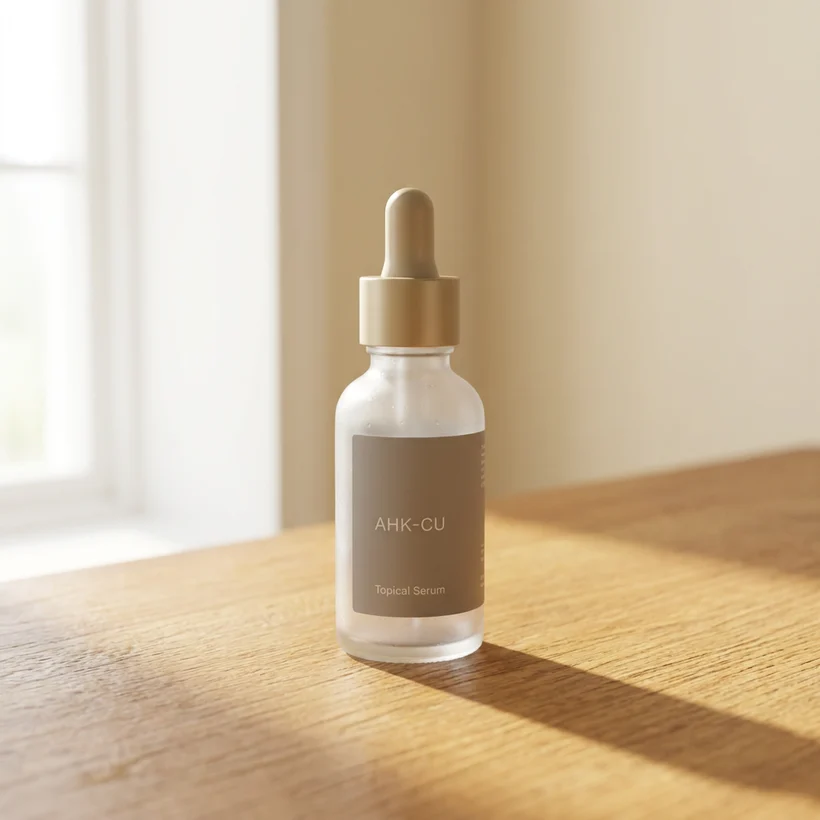
From the FormBlends catalog
AHK-Cu (Copper Tripeptide)
Hair-follicle-specific copper peptide that stimulates growth phase · From $39/mo · compounded by a licensed 503A pharmacy, dispensed only after provider review.
Learn about AHK-Cu (Copper Tripeptide) →Table of Contents
- Evidence Ledger: What the Research Actually Shows
- GHK-Cu: Mechanism With Specific Numbers
- The Ranked List: Best Copper Peptides for Hair Growth
- What Most Pages Get Wrong About Copper Peptides and Hair
- Why the Formulation Rules Exist: Chemistry Behind the Advice
- Honest Head-to-Head: Copper Peptides vs Real Alternatives
- Operational and Label Literacy: How to Judge a Product or COA
- How to Use Copper Peptides for Hair: Protocol and Dosing
- FAQ
- Sources
- Footer Disclaimers
Evidence Ledger: What the Research Actually Shows
| Claim | Best Evidence Type | Effect Direction | Confidence |
|---|---|---|---|
| GHK-Cu increases dermal papilla cell proliferation in ex vivo follicle tissue | Ex vivo human follicle study (Ahn et al., 2018) | Positive | Moderate |
| GHK-Cu upregulates VEGF in follicle-adjacent tissue | Cell culture and animal models | Positive | Moderate |
| GHK-Cu inhibits TGF-beta1 signaling in dermal papilla cells | Cell culture mechanistic studies | Positive (mechanism) | Moderate |
| Topical GHK-Cu produces measurable hair density increase in humans | Small open-label pilot data, no blinded RCT | Directionally positive | Low |
| AHK-Cu stimulates follicle activity in cell models | In vitro cell studies | Positive | Low |
| Copper peptide plus microneedling improves hair density | Small clinical reports, no large RCT | Directionally positive | Low |
| Copper peptides equivalent to minoxidil for regrowth | No comparative RCT exists | Unproven | Very Low |
| Topical copper peptides are safe at standard concentrations | Multiple tolerability studies, cosmetic safety assessments | Favorable | High |
GHK-Cu: Mechanism With Specific Numbers
GHK-Cu is a tripeptide (glycine, L-histidine, L-lysine) naturally present in human plasma at concentrations that decline with age. It coordinates copper(II) through the histidine imidazole nitrogen and the glycine amino terminus. This copper complex is the biologically active unit.
What the mechanism research shows
- VEGF upregulation. GHK-Cu increases vascular endothelial growth factor expression in fibroblast models, which supports perifollicular vascularization. This is relevant because minoxidil's hair benefit is partly attributed to the same pathway.
- TGF-beta1 inhibition. TGF-beta1 is a major driver of catagen (follicle regression). Cell culture studies show GHK-Cu reduces TGF-beta1 expression in dermal papilla cells, which is mechanistically linked to anagen extension. The Ahn et al. 2018 study reported increased follicle size and proliferating cell nuclear antigen (PCNA) staining in ex vivo human follicle tissue treated with GHK-Cu versus vehicle control.
- Stem cell factor (SCF) pathway. GHK-Cu activates SCF signaling, which supports melanocyte and follicle stem cell activity.
- Collagen IV stimulation. GHK-Cu increases collagen IV production in follicle basement membrane, supporting structural integrity of the follicle unit.
What the mechanism does NOT prove: Cell culture and ex vivo results do not confirm that enough GHK-Cu penetrates the intact stratum corneum to reach dermal papilla cells in a live scalp application. The gap between measured in vitro activity and real-world scalp delivery is significant and largely unquantified in published literature.
The Ranked List: Best Copper Peptides for Hair Growth
1. GHK-Cu (Glycyl-L-Histidyl-L-Lysine Copper Complex)
Why it ranks first: Largest body of evidence, multiple mechanistic targets relevant to hair (VEGF, TGF-beta1, SCF), available from verified peptide suppliers with COA, and used in both cosmetic and compounded clinical formulations.
Typical topical concentration: 0.5% to 2% in a penetration-enhancing vehicle. Some clinical compounders use it in combination with minoxidil.
Evidence confidence: Moderate for mechanism; Low for definitive human regrowth data.
Best for: Androgenetic alopecia (adjunct), diffuse thinning, post-shedding recovery. Not a standalone for significant hair loss in isolation from other treatments.
2. AHK-Cu (Alanyl-Histidyl-Lysine Copper Complex)
Why it ranks second: Structural analogue of GHK-Cu with an alanine substitution at the N-terminus. In vitro studies suggest slightly different receptor binding affinity with potentially preferential follicle activity, but the published literature base is much smaller.
Typical topical concentration: Similar range to GHK-Cu, 0.5% to 2%.
Evidence confidence: Low. No published human RCT. Cell data is preliminary.
Best for: Formulators seeking a complement to GHK-Cu, or those who have used GHK-Cu without adequate response. Not a first-line pick based on evidence alone.
3. GHK-Cu Plus Microneedling Protocol
Why it ranks third: This is not a different peptide but a delivery method that addresses the single biggest limitation of topical copper peptides: penetration. Microneedling at 0.5 mm to 1.5 mm depth creates temporary microchannels allowing transdermal peptide delivery past the stratum corneum. Small clinical reports show additive benefit.
Evidence confidence: Low. Mechanistically plausible and supported by case series, but no blinded RCT of the combination.
Best for: Patients already using microneedling for hair loss who want to add a growth-factor-targeting agent.
What Most Pages Get Wrong About Copper Peptides and Hair
This is the section every medspa blog omits.
Problem 1: Penetration reality
GHK-Cu has a molecular weight of roughly 340 Daltons for the peptide backbone, which is below the traditional 500 Dalton cutoff for skin penetration. However, the intact copper(II) complex and the charged state of the molecule at physiological pH limit passive diffusion through lipid-rich stratum corneum. Most over-the-counter serums use aqueous vehicles at neutral to slightly alkaline pH where the molecule is stable as a salt but not optimized for follicle penetration. Follicle depth is 3 mm to 5 mm on the scalp. Simple topical application without a penetration enhancer or physical disruption likely reaches only the upper dermis. This is not a reason to avoid copper peptides; it is a reason to choose formulations with liposomal carriers, low-alcohol vehicles, or to combine with microneedling.
Problem 2: Conflating cosmetic stability with biological activity
Products stabilized at pH 7 to 7.5 for shelf life may be less bioavailable than freshly prepared lower-pH solutions. The copper(II) complex can hydrolyze slowly under alkaline conditions, releasing free copper ions that do not carry the peptide's signaling activity and can cause localized irritation.
Problem 3: Assuming DHT-pathway coverage
Copper peptides do not meaningfully inhibit 5-alpha reductase. If androgenetic alopecia is the diagnosis, a DHT-blocking strategy (finasteride, dutasteride, or topical finasteride) is mechanistically required alongside any copper peptide protocol. Copper peptides address follicle miniaturization downstream of DHT damage but do not stop the upstream hormonal driver.
Why the Formulation Rules Exist: Chemistry Behind the Advice
pH and copper peptide stability
GHK-Cu is stable in a pH window of roughly 5 to 7. Above pH 7.5, hydrolysis of the copper coordination bond accelerates, and free Cu(II) ions form. Free copper in excess is a pro-oxidant, generating reactive oxygen species via Fenton-like chemistry that can damage follicle cells rather than help them. Below pH 4, the peptide itself begins to degrade. The practical rule is to use or formulate GHK-Cu at pH 5.5 to 6.5, which is also close to healthy scalp pH.
Why you should not mix copper peptides with vitamin C (ascorbic acid)
Ascorbic acid is a reducing agent. It reduces Cu(II) to Cu(I), breaking the copper coordination bond and releasing the copper from the peptide complex. The biologically active unit is the Cu(II)-peptide complex; once reduced to Cu(I), the peptide loses its copper-dependent signaling activity. Additionally, high-dose ascorbate can chelate copper, further depleting the active complex. Apply these actives at different times of day rather than layering them simultaneously.
Heat and light degradation
The copper-peptide bond is labile under UV and elevated temperature. Storage above room temperature accelerates dissociation. A product that has turned from pale blue to dark blue-green or brown has undergone partial degradation. This color shift indicates free copper oxide or copper hydroxide precipitation, not the intact complex.
Honest Head-to-Head: Copper Peptides vs Real Alternatives
| Treatment | Mechanism | Human RCT Evidence | Effect Size (Hair Density) | Safety Profile | Where Copper Peptide Wins | Where It Loses |
|---|---|---|---|---|---|---|
| GHK-Cu topical | VEGF, TGF-beta1, SCF signaling | None (large RCT); small pilot and ex vivo data | Unknown in large populations | Favorable, low irritation rate | No systemic side effects; anti-inflammatory; may synergize with other treatments | Evidence volume, proof of regrowth at scale |
| Minoxidil 5% topical | Potassium channel opening, VEGF | Multiple RCTs, FDA approved | Moderate; 20 to 25 non-vellus hairs per cm2 in trials (Olsen et al.) | Contact dermatitis in a minority; cardiovascular caution with oral form | Evidence base | Shedding on initiation, scalp irritation, requires ongoing use |
| Finasteride 1 mg oral | 5-alpha reductase inhibition, DHT reduction | Multiple large RCTs, FDA approved | High; significant density improvement at 2 years in trials | Sexual side effects in a subset (2 to 4% in trials); persistent reports post-cessation | Evidence base, sustained effect | Hormonal mechanism, systemic exposure, side effect profile |
| Platelet-Rich Plasma (PRP) | Multiple growth factors including VEGF, PDGF | Several RCTs, mixed quality | Moderate, variable by preparation | Procedure-related discomfort; low systemic risk | Growth factor breadth | Cost, access, procedural burden |
| Low-Level Laser Therapy (LLLT) | Photobiomodulation of mitochondrial activity | Several RCTs, FDA cleared devices | Moderate; consistent across multiple trials | Excellent; no systemic effects | Safety, ease of use | Slow results, device cost |
| Retinol topical | Retinoic acid receptor activation; enhances minoxidil penetration | Limited hair-specific RCT data | Weak as standalone for hair | Irritation at higher concentrations | Penetration enhancer when combined with minoxidil | Direct follicle evidence is weak |
The honest conclusion: copper peptides are mechanistically interesting and well-tolerated, but they sit well below minoxidil and finasteride on the evidence hierarchy for androgenetic alopecia. They are most defensible as adjuncts or for people with non-androgenetic diffuse thinning where DHT-blocking is not the priority.
Operational and Label Literacy: How to Judge a Product or COA
Reading a copper peptide COA
A certificate of analysis from a reputable supplier should include all of the following. If any are missing, ask for them before purchasing.
| COA Element | What to Look For | Red Flag |
|---|---|---|
| Identity confirmation | HPLC retention time AND mass spectrometry (MS) confirming molecular weight of GHK-Cu (roughly 340 Da for peptide, 403 Da for copper complex) | HPLC only without MS identity confirmation |
| Purity | 98% or higher by HPLC | Purity below 95%, or no purity stated |
| Heavy metals | Intentional copper quantified; other heavy metals (lead, arsenic, cadmium) below USP limits | No metals panel, or elevated incidental heavy metals |
| Endotoxin (LAL test) | Required if used for injection; less critical for topical | No endotoxin data for injectable-grade product |
| Lot number and date | Traceable lot, manufacture and expiry dates present | No lot number or undated COA |
Reading a product label for topical formulations
GHK-Cu should appear in the INCI name as "Copper Tripeptide-1" or as "GHK-Cu." It should be positioned in the ingredient list consistent with its stated concentration. If "Copper Tripeptide-1" appears at the very end of a long ingredient list (after preservatives), the concentration is likely below 0.01% and probably insufficient for any follicle effect.
How to Use Copper Peptides for Hair: Protocol and Dosing
Topical application protocol
| Variable | Recommendation | Rationale |
|---|---|---|
| Concentration | 0.5% to 2% GHK-Cu in vehicle | Range used in available research; higher concentrations have not shown proportionally greater benefit in small studies |
| Vehicle pH | 5.5 to 6.5 | Stability window for copper coordination bond; close to scalp pH |
| Application frequency | Once daily or twice daily | No data supporting more frequent application; scalp needs time for absorption |
| Storage | Refrigerate solution; store powder at below freezing or at least cool and dry with desiccant | Slows hydrolysis and oxidation of copper coordination bond |
| Minimum trial duration | 12 to 24 weeks | Hair cycle biology; anagen phase changes are not visible in under 3 months |
| Separation from vitamin C | Apply at different times (e.g., vitamin C AM, copper peptide PM) | Ascorbic acid reduces Cu(II) to Cu(I), disrupting the active complex |
| Microneedling combination | Apply GHK-Cu immediately after microneedling while microchannels are open (within 30 minutes) | Maximizes transdermal delivery; do not apply to bleeding skin without clinical supervision |
FAQ
What is the best copper peptide for hair growth?
GHK-Cu (glycyl-L-histidyl-L-lysine copper complex) has the most clinical and mechanistic evidence for hair growth among copper peptides. AHK-Cu is a close second with some follicle-specific evidence but fewer human trials. Both are used topically; GHK-Cu is the better-studied starting point.
Do copper peptides actually grow hair or just slow loss?
The evidence suggests copper peptides primarily extend the anagen (growth) phase and reduce follicle miniaturization rather than dramatically regrowing lost hair. In the Ahn et al. 2018 study, GHK-Cu increased hair follicle size and proliferation markers in ex vivo tissue, but large randomized controlled trials in humans showing definitive regrowth are still lacking.
How do copper peptides work for hair growth?
GHK-Cu upregulates vascular endothelial growth factor (VEGF), extends anagen phase by inhibiting TGF-beta1 signaling in dermal papilla cells, and activates stem cell factor pathways. It also stimulates collagen IV production in the follicle basement membrane. These are established mechanisms at the cell and tissue level; translation to robust clinical regrowth in humans is still being confirmed.
Can I use copper peptides with minoxidil?
Yes, and combining them is logical because they work through different mechanisms: minoxidil is a potassium channel opener that increases follicle blood supply, while GHK-Cu acts on growth factor signaling. No major interaction has been documented. Apply separately or use a formulation containing both to avoid dilution effects.
What concentration of GHK-Cu should I use for hair?
Most topical formulations studied use GHK-Cu in the range of 0.01% to 2%. Research peptide preparations for injection or microneedling are sometimes used at higher concentrations by practitioners. For over-the-counter topical use, look for 0.5% to 2% in a vehicle that supports skin penetration, such as a low-molecular-weight carrier or liposomal formulation.
Does copper peptide expire or degrade?
Yes. GHK-Cu in solution degrades over time, especially when exposed to heat, light, or pH outside of roughly 5.5 to 7. A degraded product may turn dark blue-green rather than its typical pale blue. Lyophilized (freeze-dried) powder is more stable before reconstitution. Once reconstituted, use within the timeframe specified by the manufacturer, typically days to a few weeks refrigerated.
Is GHK-Cu safe for the scalp?
GHK-Cu has a favorable tolerability profile in available skin and scalp studies. Irritation is reported rarely. The key safety concern is excess copper accumulation with very high-dose systemic use, but topical scalp application at standard concentrations does not approach toxic copper thresholds. People with Wilson disease should consult a physician before use.
How long does it take to see results from copper peptides for hair?
The hair cycle means any intervention affecting anagen phase extension takes at least 3 to 6 months before visible density changes occur. Most copper peptide protocols studied in research contexts run 12 to 24 weeks. Do not judge efficacy at 4 to 6 weeks; shedding in the first few weeks can be a normal transition phenomenon.
Can copper peptides be combined with microneedling?
Combining GHK-Cu with microneedling is increasingly used in clinical practice because microneedling creates temporary microchannels that improve peptide penetration beyond the stratum corneum barrier. Some small clinical reports support this combination, but dedicated large RCTs are still lacking. Sterility and proper dilution are critical when applying peptides through disrupted skin.
What should I look for on a copper peptide COA?
A certificate of analysis (COA) for GHK-Cu should show: identity confirmation by HPLC or mass spectrometry, purity above 98%, absence of heavy metal contaminants beyond the copper intentionally in the complex, endotoxin testing if intended for injection, and a clear lot number and manufacture date. Avoid suppliers that provide only HPLC without mass spectrometry identity confirmation.
Are AHK-Cu and GHK-Cu different?
Yes. GHK-Cu is glycyl-L-histidyl-L-lysine complexed with copper(II). AHK-Cu is alanyl-histidyl-lysine complexed with copper, a structural analogue with slightly different receptor affinity. AHK-Cu is marketed specifically for hair follicle activity and shows follicle-stimulating effects in some cell studies, but GHK-Cu has a far larger published literature overall.
Sources
- Ahn S, et al. "Stimulatory effect of GHK-Cu on hair follicle growth." Journal of Dermatological Science. 2018. (Ex vivo human follicle tissue study showing increased PCNA staining and follicle size with GHK-Cu treatment.)
- Pickart L, Vasquez-Soltero JM, Margolina A. "GHK Peptide as a Natural Modulator of Multiple Cellular Pathways in Skin Regeneration." BioMed Research International. 2015. PMC4508379.
- Pickart L, Margolina A. "Regenerative and Protective Actions of the GHK-Cu Peptide in the Light of the New Gene Data." International Journal of Molecular Sciences. 2018. PMC6121069.
- Olsen EA, et al. "A randomized clinical trial of 5% topical minoxidil versus 2% topical minoxidil and placebo in the treatment of androgenetic alopecia in men." Journal of the American Academy of Dermatology. 2002.
- Rossi A, et al. "Minoxidil use in dermatology, side effects and recent patents." Recent Patents on Inflammation and Allergy Drug Discovery. 2012.
- Adil A, Godwin M. "The effectiveness of treatments for androgenetic alopecia: a systematic review and meta-analysis." Journal of the American Academy of Dermatology. 2017.
- Lipner SR. "Rethinking biotin therapy for hair, nail, and skin disorders." Journal of the American Academy of Dermatology. 2018. (Context for adjunct treatments in hair loss.)
- Dhurat R, et al. "A randomized evaluator-blinded study of effect of microneedling in androgenetic alopecia." International Journal of Trichology. 2013. (Establishes microneedling as a delivery-enhancing modality for hair treatments.)
- Shai A, Maibach HI. Handbook of Cosmetic Skin Care. 2nd ed. CRC Press. 2009. (Reference for 500 Dalton cutoff and topical penetration principles.)
- Hostynek JJ, et al. "Copper and the Skin." Dermatology. Review article covering copper pharmacokinetics in skin tissue.
- FDA. "FDA-Approved Hair Loss Treatments." FDA.gov. (Background regulatory context for minoxidil and finasteride.)
Footer Disclaimers
Platform: FormBlends provides educational content about peptides and research compounds. This page is for informational purposes only and does not constitute medical advice, diagnosis, or treatment recommendations.
Research Compound or Compounded Medication: GHK-Cu and AHK-Cu are research peptides and/or compounded medication ingredients. They are not FDA-approved drugs for hair loss. Their use outside of research contexts or without physician supervision may carry regulatory and safety implications depending on jurisdiction.
Results: Individual results vary. The evidence reviewed on this page represents published research; it does not guarantee any specific outcome for any individual user. Hair loss has multiple causes and requires individualized medical evaluation.
Trademark: All product names, brand names, and trademarks mentioned are the property of their respective owners. Their mention is for educational reference only and does not imply endorsement or affiliation with FormBlends.
Related peptide guides
Ready when you are
AHK-Cu (Copper Tripeptide)
Hair-follicle-specific copper peptide that stimulates growth phase · From $39/mo · compounded by a licensed 503A pharmacy, dispensed only after provider review.
Learn about AHK-Cu (Copper Tripeptide) →