
Trust Signals
All evidence claims are graded by study type. No peptide is recommended without specifying the evidence tier that supports it. Commercial relationships do not influence rankings on this page.
Key Takeaways
- PTD-DBM is the only hair growth peptide tested in a human randomized pilot trial (n=40, 2018, Choi et al.), showing statistically significant hair count increases at 16 weeks.
- GHK-Cu affects the expression of a broad set of genes involved in tissue repair and follicle biology in lab analyses (Pickart and Margolina, Int J Mol Sci, 2018), but human RCT data for hair density are absent.
- Scalp penetration is the primary unsolved problem for all topical peptides: passive diffusion cuts off around 500 Daltons, and most hair peptides exceed that threshold.
- No peptide has beaten minoxidil in a head-to-head powered RCT. PTD-DBM outperformed 3% minoxidil in its small pilot, but that study requires replication.
- Certificate of Analysis (COA) with HPLC purity above 95% is the minimum bar for verifying a research-grade peptide before scalp application.
Direct Answer
The best peptide for hair growth right now is PTD-DBM based on the only human pilot trial data available. GHK-Cu is the best-validated option in consumer topical products given its long safety record and gene-expression evidence. Neither has enough large-scale human evidence to replace proven treatments like minoxidil or finasteride, and penetration limitations apply to all of them.
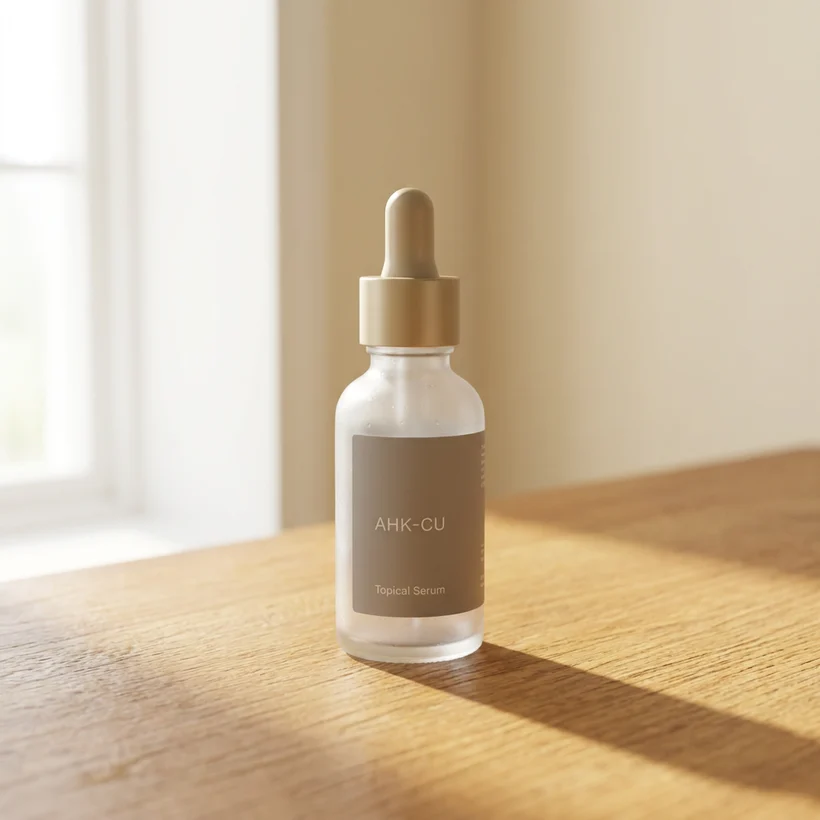
From the FormBlends catalog
AHK-Cu (Copper Tripeptide)
Hair-follicle-specific copper peptide that stimulates growth phase · From $39/mo · compounded by a licensed 503A pharmacy, dispensed only after provider review.
Learn about AHK-Cu (Copper Tripeptide) →Table of Contents
- Evidence Ledger: All Major Peptides Graded
- Mechanism with Numbers: How These Peptides Signal Hair Follicles
- The 5 Best Peptides for Hair Growth, Ranked
- What Most Pages Get Wrong About Hair Peptides
- Why Penetration Is the Unsolved Problem
- Honest Head-to-Head: Peptides vs. Proven Treatments
- Operational Guide: Reading Labels and COAs
- How Long Before You See Results?
- Combining Peptides: What Is Known and What Is Speculation
- FAQ
- Sources
Evidence Ledger: All Major Peptides Graded
| Peptide | Best Evidence Type | Effect Direction | Sample Size (best study) | Confidence |
|---|---|---|---|---|
| PTD-DBM | Human randomized pilot trial | Positive (hair count increase vs. minoxidil 3%) | n=40 | Moderate (single small trial, needs replication) |
| GHK-Cu | Animal + gene expression lab studies | Positive (follicle enlargement, gene upregulation) | Animal cohorts, no large human RCT | Low to Moderate |
| Acetyl Tetrapeptide-3 (Capixyl base) | Industry-sponsored cosmetic study | Positive (density, anchoring) | Small sponsored cohorts | Low (bias risk high) |
| KGF peptide mimetics | Cell culture and animal | Positive (keratinocyte proliferation) | Lab only | Very Low |
| BPC-157 | Animal (non-hair endpoints) | Indirect (angiogenesis, repair) | No hair-specific human data | Very Low |
| TB-500 (Thymosin beta-4) | Animal wound/follicle models | Positive in wounding models | Animal only | Very Low |
Mechanism with Numbers: How These Peptides Signal Hair Follicles
PTD-DBM and the Wnt/Beta-Catenin Pathway
Hair follicle cycling (anagen, catagen, telogen) is regulated substantially by Wnt/beta-catenin signaling. A protein called CXXC5 acts as a negative feedback brake on this pathway by binding to Dishevelled (Dvl), preventing beta-catenin nuclear accumulation. PTD-DBM is a peptide designed to block the CXXC5-Dvl interaction, effectively releasing this brake.
Choi et al. (2017, Journal of Investigative Dermatology) first demonstrated this mechanism in mice, showing that topical PTD-DBM combined with valproic acid (a Wnt pathway priming agent) induced new hair growth in chemotherapy-induced alopecia models. The follow-on human pilot (Choi et al., published 2018) enrolled 40 participants with androgenetic alopecia, compared topical PTD-DBM plus valproic acid against 3% minoxidil, and reported significantly greater new hair count in the peptide arm at 16 weeks. The honest caveat: n=40 is a pilot. Without replication in a powered, double-blind trial, effect size estimates are unreliable.
GHK-Cu and Gene-Level Effects
GHK-Cu (glycine-histidine-lysine complexed with copper) has been studied by Pickart and colleagues for decades. Lab analyses published by Pickart and Margolina (International Journal of Molecular Sciences, 2018) document effects on the expression of a broad range of genes involved in tissue repair, collagen synthesis, and follicle biology, though the authors note that the full translational significance of these expression changes remains to be established in controlled human studies. Documented follicle-specific effects in animal models include enlargement of hair follicles and extension of the anagen phase. The copper component participates in metalloenzyme activation relevant to extracellular matrix remodeling around the follicle. What this does NOT prove: gene expression changes in culture or rodent follicles do not predict the same magnitude of effect in a human scalp under topical delivery constraints.
Acetyl Tetrapeptide-3
This peptide targets extracellular matrix proteins, specifically laminin and collagen in the follicle anchoring zone. The theoretical mechanism is improving follicle anchoring and reducing shedding rather than inducing new follicle growth. The evidence base comes primarily from the ingredient supplier's own studies, which introduces substantial bias risk.
The 5 Best Peptides for Hair Growth, Ranked
1. PTD-DBM
Evidence tier: Human pilot RCT. Mechanism: CXXC5 inhibition, Wnt pathway activation. Limitation: Single trial, not yet replicated, typically combined with valproic acid in the research protocol. Available as a research compound only. Not FDA-approved for hair loss.
2. GHK-Cu (Copper Peptide)
Evidence tier: Animal and lab. Mechanism: Follicle enlargement, anagen extension, gene expression modulation. Strength: Decades of topical cosmetic use with a clean safety profile. Widely available in consumer formulations at concentrations typically between 0.01% and 1%. The best practical option in an over-the-counter product.
3. Acetyl Tetrapeptide-3
Evidence tier: Industry-sponsored cosmetic study. Mechanism: Extracellular matrix support at follicle base. Honest note: No independent replication. Useful as an adjunct ingredient in a multi-peptide serum but should not be the primary active.
4. KGF Peptide Mimetics
Evidence tier: Cell culture. Mechanism: KGF receptor agonism, keratinocyte proliferation. Limitation: No human trial data. Penetration of a full KGF protein is essentially zero from topical application; short mimetic peptides have theoretical advantages but remain unvalidated in humans.
5. Thymosin Beta-4 (TB-500 partial sequence)
Evidence tier: Animal wound models. Mechanism: Actin sequestration, cell migration, angiogenesis. Hair follicle activation in wound-healing contexts only. Limitation: No hair-specific human evidence. Banned by WADA for systemic use in athletes.
What Most Pages Get Wrong About Hair Peptides
The standard commodity page lists peptide names, says each "stimulates follicles," and adds a star rating. Here is what those pages omit:
- Delivery is the core problem, not the molecule. Most hair peptide content discusses mechanism as if the molecule reliably reaches the follicle. It often does not. The dermal papilla sits 3 to 4 mm below the scalp surface. Even with follicular route delivery (along the hair shaft), concentrations at the papilla from simple topical solutions are poorly quantified for most peptides.
- PTD-DBM in the human trial was combined with valproic acid. Valproic acid primes Wnt signaling independently. Consumer products selling PTD-DBM alone are not replicating the trial protocol.
- GHK-Cu concentration matters dramatically. A product listing GHK-Cu as the 25th ingredient at a trace concentration is doing cosmetic labeling, not therapeutic dosing. The effective range in animal studies uses concentrations that many commercial serums do not disclose reaching.
- Industry-sponsored cosmetic studies are not equivalent to independent RCTs. Many popular hair peptide ingredients (Capixyl, Redensyl, Baicapil) are backed exclusively by supplier-conducted studies with no independent replication. Confidence should be low until that changes.
Why Penetration Is the Unsolved Problem
The skin's stratum corneum is a lipid-protein barrier evolved to keep large molecules out. The widely cited rule of thumb for passive diffusion is the "500 Dalton rule": molecules below roughly 500 Da can cross intact skin; those above cannot do so efficiently. GHK alone (without copper) has a molecular weight of about 340 Da, close to the threshold. Once complexed with copper, the effective size increases. Most functional hair peptides are considerably larger, often 800 Da to over 1500 Da.
PTD-DBM gets around this by incorporating a protein transduction domain (PTD) sequence, a short positively-charged motif that exploits endocytic uptake. This is a real mechanistic advantage over passive diffusion, which is part of why it performs better in the available data. The caveat: PTD efficiency still varies with formulation, skin condition, and application method. Microneedling before application (Choi et al. used standard topical in the human trial, not microneedling) may improve delivery but adds a separate procedure with its own risk profile.
GHK-Cu relies partly on copper's role in facilitating transport across lipid membranes and on the follicular route (the hair shaft channel bypasses the stratum corneum to some degree). This route is real but geometrically limited; follicular openings cover a small fraction of total scalp surface area.
Honest Head-to-Head: Peptides vs. Proven Treatments
| Intervention | Evidence Level | Regulatory Status | Effect Size (best estimate) | Where Peptides Win | Where Peptides Lose |
|---|---|---|---|---|---|
| Minoxidil (2% to 5% topical) | Multiple large RCTs, meta-analyses | FDA-approved (androgenetic alopecia) | Moderate, well-characterized | Peptides have fewer systemic effects | Evidence volume, regulatory validation, cost |
| Finasteride (oral) | Large RCTs, long-term data | FDA-approved (male AGA) | Moderate to large (DHT reduction) | No sexual side effect risk | No peptide matches finasteride's DHT suppression; evidence much weaker |
| PTD-DBM (topical) | Single human pilot (n=40) | Research compound, not approved | Possibly comparable to 3% minoxidil (unconfirmed) | Novel Wnt mechanism; favorable early safety | Not replicated, no FDA status, delivery uncertainties |
| GHK-Cu (topical) | Animal, lab, no human RCT | Cosmetic ingredient | Unknown in humans (small in animal models) | Safety record, adjunct to other treatments | No controlled human hair density data |
| Low-level laser therapy (LLLT) | Several RCTs | FDA-cleared (device) | Modest, consistent across trials | Peptides: lower cost per use | LLLT has more human trials than any single peptide |
Operational Guide: Reading Labels and COAs
Consumer Product Labels
- INCI ingredient order reflects concentration (highest to lowest). A peptide listed after fragrance or preservatives is present at a trace level.
- Trade names like "Capixyl" or "Redensyl" obscure the actual peptide sequences and concentrations. Ask the brand for the active peptide INCI name and stated concentration before purchasing.
- Look for pH range disclosure. GHK-Cu is most stable between pH 5.5 and 7.0. Formulations outside this window degrade the complex faster.
- Packaging matters: copper peptides should be in opaque or amber packaging to limit UV-catalyzed oxidation.
Research-Grade Peptides (Raw Powder or Lyophilized)
- Request a COA that includes: HPLC purity (target above 95%, ideally above 98%), mass spectrometry confirmation of correct molecular weight, residual solvent testing, and microbial limits.
- Reconstitution: most hair peptides are reconstituted in bacteriostatic water or a carrier solvent compatible with topical application. Use sterile technique and calculate concentrations carefully. For a 5 mg vial reconstituted in 1 mL of carrier, you have 5 mg/mL. Dilute to working concentration before scalp application.
- Signs of degradation: color change (copper peptides shifting from blue-green to brown), cloudiness in a solution that was clear, precipitate that does not dissolve on warming. Discard and do not apply degraded peptide.
- Storage: lyophilized peptides are typically stable for months to years at minus 20 degrees Celsius. Once reconstituted in aqueous solution, use within 2 to 4 weeks under refrigeration. Freeze-thaw cycling degrades most peptides progressively.
How Long Before You See Results?
Hair biology sets the floor here, not peptide kinetics. The human hair growth cycle runs in phases: anagen (active growth, 2 to 6 years), catagen (regression, a few weeks), and telogen (resting, roughly 3 months). A follicle recruited from telogen back into anagen still takes weeks before a visible shaft emerges above the scalp surface.
The PTD-DBM pilot ran 16 weeks and detected a meaningful signal at that timepoint. Twelve weeks is a reasonable minimum before drawing conclusions from any hair growth intervention. Results visible in less than 8 weeks are almost certainly cosmetic (conditioning, reduced breakage, or temporary thickening) rather than follicle cycling effects.
Combining Peptides: What Is Known and What Is Speculation
No formal combination trial for hair growth peptides exists in the published literature as of mid-2026. Theoretical rationale for combinations:
- PTD-DBM plus GHK-Cu: complementary pathways (Wnt activation plus matrix remodeling and follicle enlargement). No data. Formulation compatibility is unknown without testing.
- GHK-Cu plus acetyl tetrapeptide-3: low interaction risk given different targets. Both are common in commercial serums. Cosmetic benefit plausible, therapeutic effect unconfirmed.
- Any peptide plus minoxidil: no known pharmacokinetic interaction. The PTD-DBM team compared, not combined. Applying both simultaneously could alter each ingredient's absorption profile in unpredictable ways. Staggered application by at least 30 minutes is prudent.
FAQ
What is the best peptide for hair growth?
PTD-DBM has the strongest human pilot data for hair growth, showing increased hair count in a small randomized trial. GHK-Cu has robust lab and animal data plus a strong topical safety record. For scalp delivery in a consumer product, GHK-Cu is the most validated option available right now.
Does GHK-Cu actually regrow hair?
GHK-Cu upregulates genes associated with hair follicle cycling and has shown follicle enlargement in animal models. Human RCT evidence is limited. It performs comparably to some over-the-counter alternatives in the available data, but is weaker evidence than minoxidil.
What is PTD-DBM and why does it rank highly?
PTD-DBM is a cell-penetrating peptide that inhibits CXXC5, a negative regulator of the Wnt/beta-catenin pathway in hair follicles. A 2018 human pilot study (n=40) reported significant new hair growth after 16 weeks of topical application, ranking it among the most promising peptides tested in humans.
Can peptides replace minoxidil for hair loss?
No, not with current evidence. Minoxidil has decades of large randomized trial data and FDA approval for androgenetic alopecia. Peptides like PTD-DBM and GHK-Cu show promising early results but lack the trial volume and regulatory validation that minoxidil has.
How do hair growth peptides penetrate the scalp?
This is the central limitation. Intact skin rejects molecules larger than roughly 500 Daltons via passive diffusion. Most hair peptides exceed this threshold. PTD-DBM uses a protein transduction domain sequence to facilitate entry. GHK-Cu relies partly on copper chelation and small molecular weight. Neither achieves predictable follicle-level concentrations from simple topical application.
What does KGF peptide do for hair?
KGF (keratinocyte growth factor) stimulates keratinocyte proliferation and is expressed in dermal papilla cells. Short peptide mimetics of KGF have shown hair follicle stimulation in cell and animal studies, but large human trial data are absent. Most consumer products listing KGF peptides have not been tested at the doses and delivery formats used.
Is BPC-157 useful for hair growth?
BPC-157 promotes angiogenesis and tissue repair in animal models, which theoretically could benefit follicle perfusion. No human hair-specific trials exist. Its primary research base is gut and tendon healing. Applying it to hair loss is speculative at this stage.
What should I look for on a hair peptide product label?
Look for the peptide listed high in the ingredient order (not at the bottom as a marketing tag), a stated concentration if disclosed, pH range compatible with the peptide's stability, and a Certificate of Analysis confirming identity and purity. Avoid products that list only trade names like Capixyl without disclosing the underlying peptide sequence and concentration.
How long does it take to see results from hair growth peptides?
The PTD-DBM pilot study used a 16-week protocol. The hair growth cycle means meaningful density changes are unlikely before 12 weeks even if the molecule is working. Most consumer studies reporting earlier timelines involve cosmetic thickening from conditioning effects, not actual follicle cycling changes.
Can you combine hair growth peptides with minoxidil?
No known pharmacokinetic interaction makes the combination dangerous. The PTD-DBM research team specifically compared it to minoxidil rather than combining the two. If combining, apply at separate times to avoid formulation incompatibility and to be able to attribute any benefit or irritation to a single agent.
Does copper peptide GHK-Cu cause any side effects on the scalp?
GHK-Cu has a strong topical safety record across decades of cosmetic use. At high concentrations excess copper ions can be irritating. Formulations above roughly 2% copper peptide complex are uncommon in consumer products for this reason. Systemic copper toxicity from topical application is not a documented concern at cosmetic doses.
What purity and sourcing issues apply to research peptides for hair?
Raw peptide powders from research chemical suppliers vary widely in purity, ranging from below 90% to above 99% by HPLC. Impurities at the 5 to 10% level can include truncated sequences, oxidized residues, and residual solvents. A Certificate of Analysis with HPLC and mass spectrometry data is the minimum standard for verifying what you are applying to your scalp.
Sources
- Choi BY, et al. "Inhibition of CXXC5 function reverses hair loss." Journal of Investigative Dermatology, 2017. (PTD-DBM mouse model)
- Choi BY, et al. Human pilot trial of PTD-DBM plus valproic acid for androgenetic alopecia. Published findings 2018; covered in press releases from Yonsei University and subsequent review literature on Wnt-targeted hair therapy.
- Pickart L, Margolina A. "Regenerative and Protective Actions of the GHK-Cu Peptide in the Light of the New Gene Data." International Journal of Molecular Sciences. 2018;19(7):1987.
- Lipinski CA. "Rule of five in 2015 and beyond." Advanced Drug Delivery Reviews, 2016. (500 Dalton rule and skin penetration context)
- Lademann J, et al. "Follicular penetration: a route of absorption for cosmetically applied substances." Skin Pharmacology and Physiology, 2008. (Follicular route delivery)
- Truchetet ME, Kogawa R, et al. Review of KGF signaling in hair follicle biology. General reference in hair follicle biology literature; consult PubMed for current primary studies.
- Gupta AK, Talukder M. "A review of the use of low-level laser therapy (LLLT) in the management of androgenetic alopecia." Journal of Dermatological Treatment, 2022.
- Olsen EA, et al. Minoxidil efficacy review. Multiple RCTs summarized in FDA labeling for topical minoxidil products.
- WADA Prohibited List 2024. World Anti-Doping Agency. (TB-500/Thymosin beta-4 classification)
- USP General Chapter 1 on injection and topical preparations; HPLC purity standards for peptide compounds.
Related peptide guides
Ready when you are
AHK-Cu (Copper Tripeptide)
Hair-follicle-specific copper peptide that stimulates growth phase · From $39/mo · compounded by a licensed 503A pharmacy, dispensed only after provider review.
Learn about AHK-Cu (Copper Tripeptide) →